JD.com: Retail Stops the Bleeding While Overseas Burns Cash — When Will the "Thrashing" End?
 11/18 2026
 485
On the 17th, ahead of the U.S. market open, JD.com released its Q3 2026 earnings report. Overall, the results were fairly unremarkable — neither major flaws nor major surprises: revenue was broadly in line with Bloomberg consensus, and GAAP operating profit came in only slightly ahead of expectations.
In terms of trends, the highlight is that growth in the retail business has indeed bottomed out and rebounded, with daily necessities and advertising also accelerating from the prior quarter. However, retail profit margin declined year-over-year, the expense ratio rose noticeably, and new business barely narrowed its losses quarter-over-quarter. The details:
1. Overall: revenue in line with expectations, no big surprise on profit either
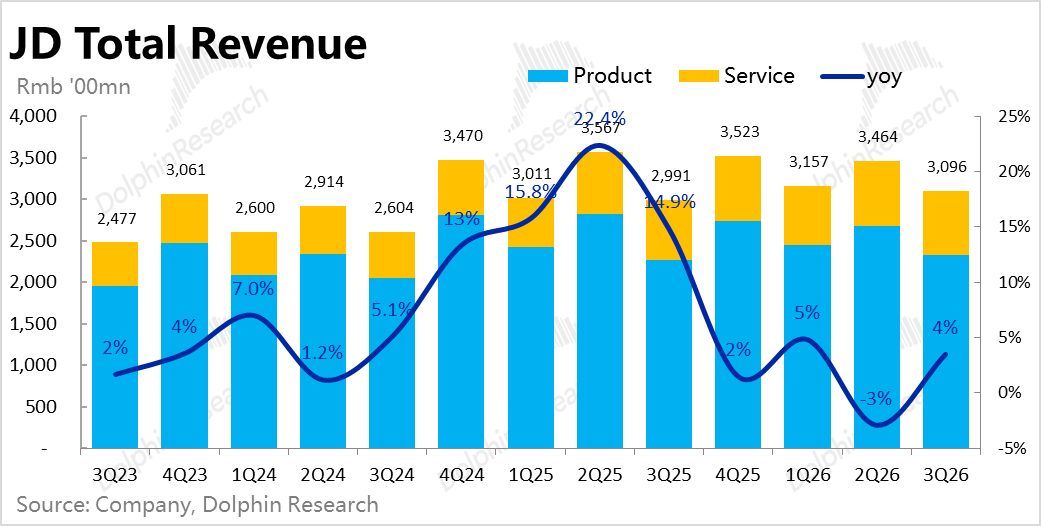
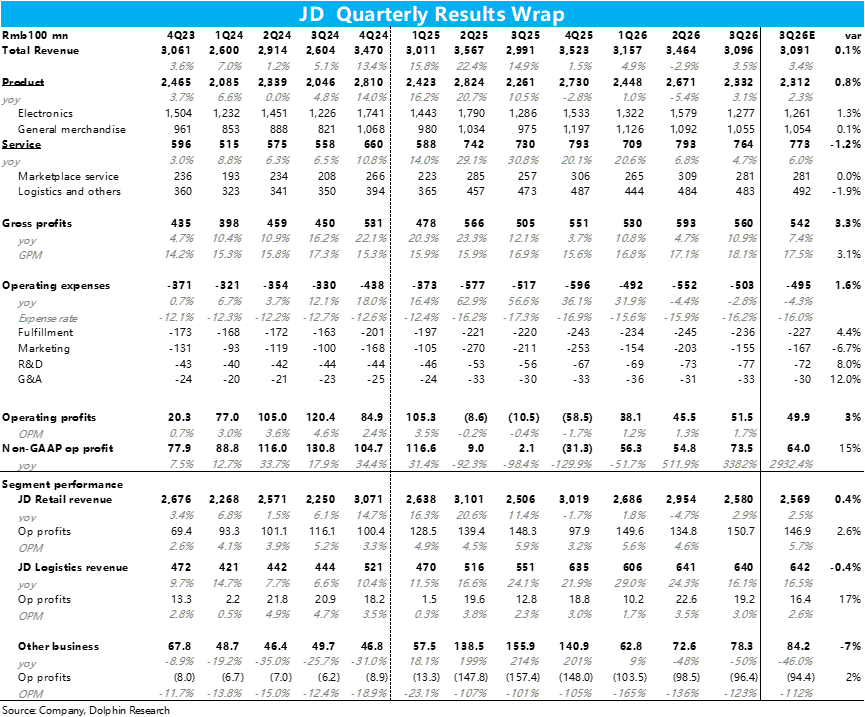
Total revenue this quarter was 309.6 billion yuan, up 3.5% year-over-year, returning to positive growth after a decline last quarter and broadly in line with consensus.
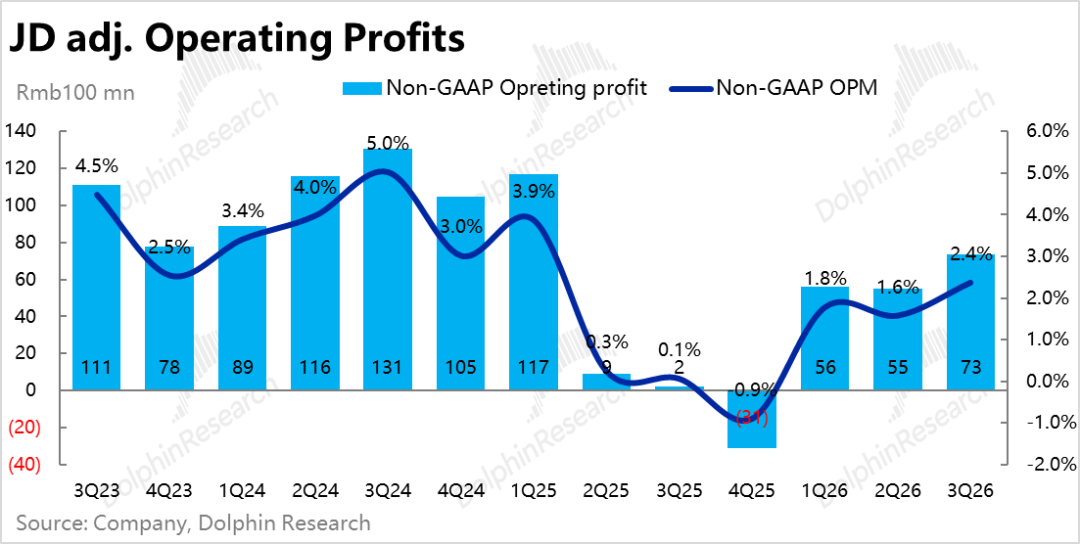
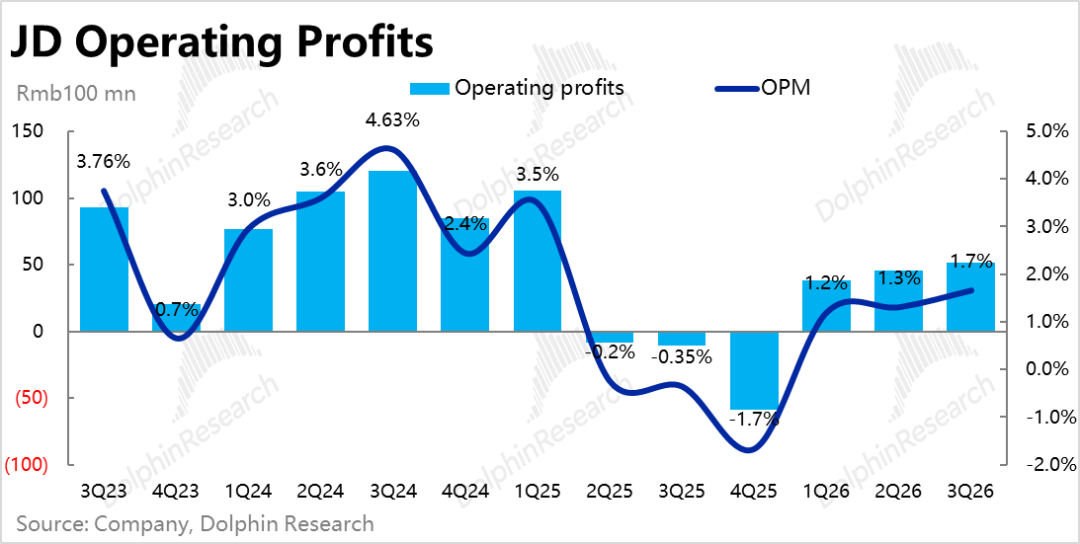
On profit, GAAP operating profit was 5.15 billion yuan, about 3% above consensus; non-GAAP operating profit — after adding back adjustments such as goodwill impairment and share-based compensation — was 7.35 billion yuan. Although considerably above Bloomberg expectations, the gap versus more precise major-bank estimates was not large.
By segment, retail and logistics profits were slightly better than expected, while new business losses were slightly larger — the two essentially offset each other.
2. Retail growth: indeed bottomed out, daily necessities and advertising re-accelerated
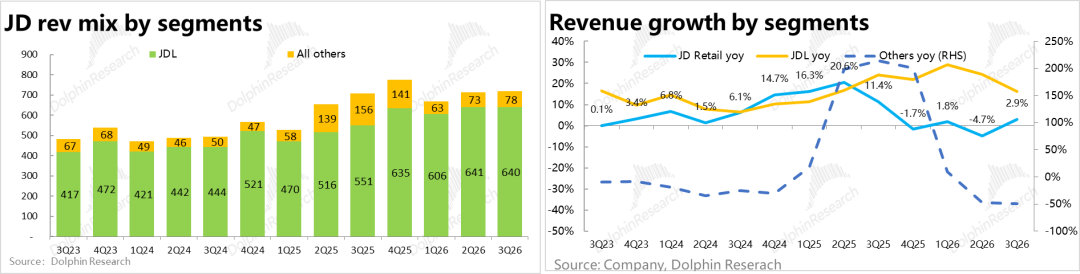
JD Retail revenue grew 2.9% year-over-year, versus -4.7% last quarter, slightly better than consensus.
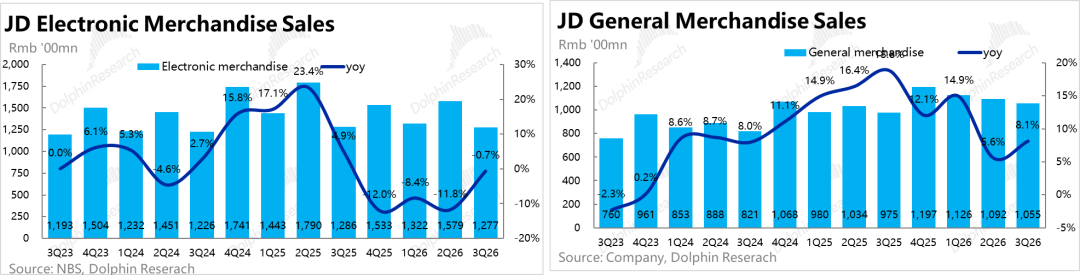
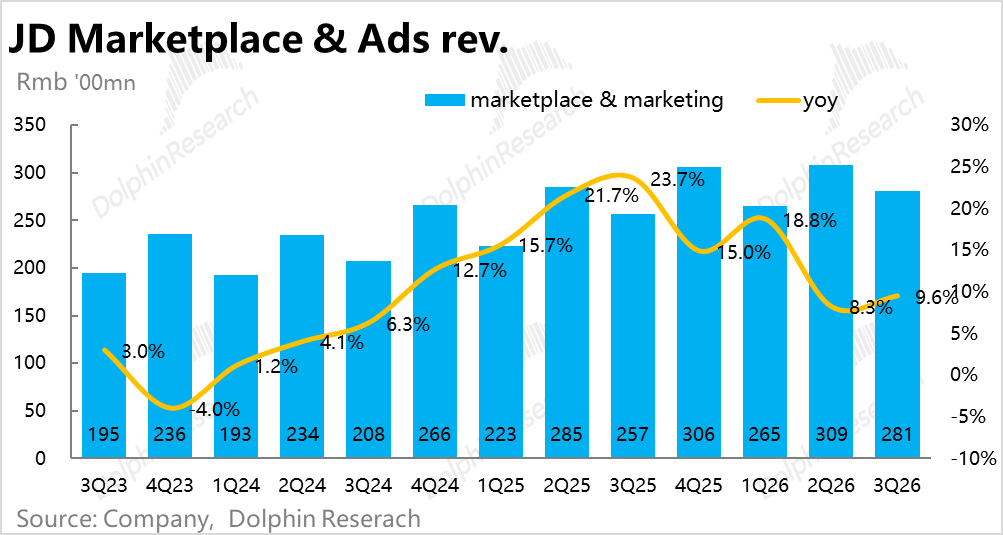
By category, electronics and home appliances fell 0.7% year-over-year, with the decline greatly narrowed, as the impact of the high base from national subsidies has largely passed. Daily necessities and advertising grew 8.1% and 9.6% year-over-year respectively, both noticeably faster than last quarter and broadly in line with expectations.
The acceleration in daily necessities and advertising was not solely due to the base effect; on a two-year stacked basis, growth was also accelerating. This suggests that once the drag from fading national subsidies passed, JD.com's traffic indeed showed signs of recovery.
Management said quarterly active users and PLUS members both maintained double-digit year-over-year growth, the number of newly onboarded merchants grew more than 30% year-over-year, and daily necessities grew faster than the industry.
3. Logistics growth slowed noticeably; new business revenue rebounded quarter-over-quarter
Among other segments, JD Logistics revenue grew 16.1% year-over-year this quarter — slower than last quarter but broadly in line with expectations. This should mainly reflect the impact of shrinking instant delivery revenue tied to food delivery.
According to JD Logistics' own results announcement, revenue from external integrated supply chain customers grew 17% year-over-year, with both customer count and revenue per customer increasing, and performance was relatively stable.
Also due to the high base from food delivery last year, revenue in the new business segment still fell by nearly half year-over-year this quarter. On a quarter-over-quarter basis, however, while food delivery scale contracted, new business revenue grew for two consecutive quarters — indicating that new overseas businesses took over growth and the associated investment.
Management also said revenue in the new business segment has become more diversified; since Joybuy officially launched, both transaction value and user scale have achieved strong growth.
4. Retail profit margin: declined year-over-year, expense ratio rose noticeably
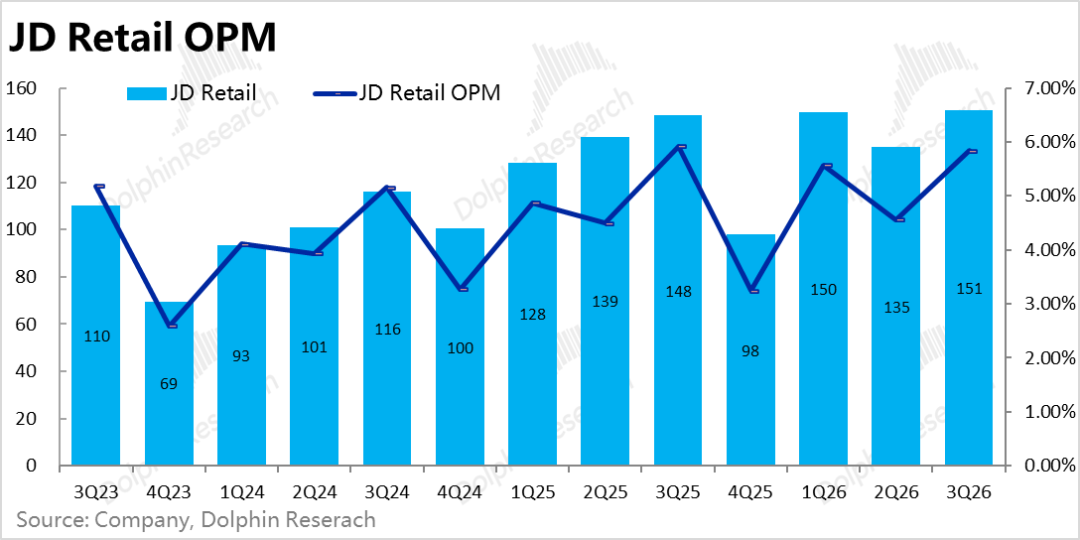
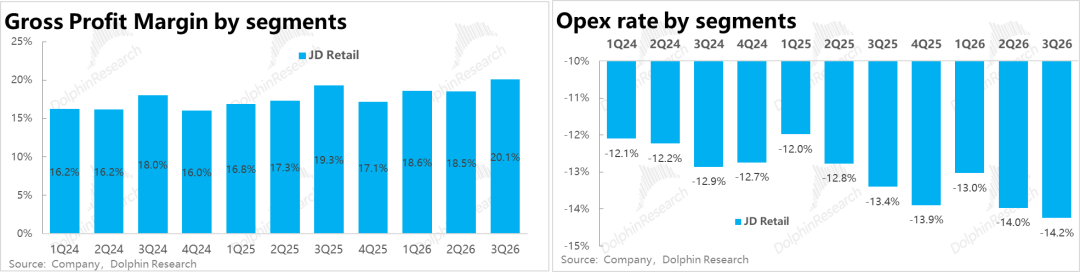
JD Retail operating profit was 15.1 billion yuan, with a profit margin of 5.8%, down about 0.1pt year-over-year — slightly better than expected.
However, the year-over-year improvement trend in retail profit margin has been narrowing quarter by quarter: in Q1 it rose about 0.7pt year-over-year, in Q2 it was roughly flat, and this quarter it turned negative. Broken down, retail gross margin continued to rise noticeably (about 0.8pt). Management attributed this first to improving product gross margin (major daily necessities categories were all improving), and second to a higher share of high-margin advertising revenue. But the retail segment's expense ratio also rose by about 0.8pt, completely offsetting the gross margin improvement.
On the conference call, management explained that of the 84bps increase in the retail expense ratio, R&D accounted for 61bps — mainly due to the impact of developing AI applications — but did not rule out somewhat higher subsidies on the main site.
5. New business: loss reduction unsatisfactory, offset by logistics
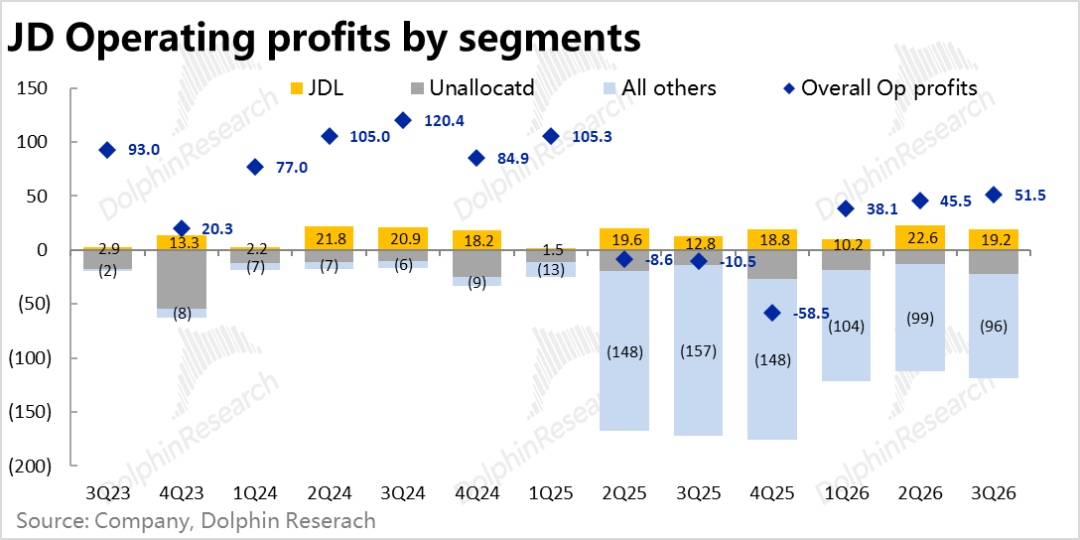
New business losses were 9.6 billion yuan. Although losses were substantially reduced by about 6 billion yuan year-over-year — reflecting the benefit of reduced food delivery losses — on a quarter-over-quarter basis they narrowed by only about 200 million yuan, below expectations.
On the conference call, management said food delivery itself narrowed by another roughly 7% quarter-over-quarter, Joybuy investment increased only slightly quarter-over-quarter, and the loss ratio continued to improve. Not investing in food delivery but investing overseas — "thrashing around" is worse than returning funds to shareholders.
JD Logistics operating profit was 1.92 billion yuan, up about 50% year-over-year — better than expected, exactly offsetting the drag from new business. Its profit margin rose about 0.7pt year-over-year, mainly because revenue grew 16% while employee compensation was basically flat and fixed costs such as rent, vehicles, and depreciation barely rose, resulting in noticeable dilution.
6. Costs and expenses: gross margin continued to rise; saved marketing expenses all went into R&D and fulfillment
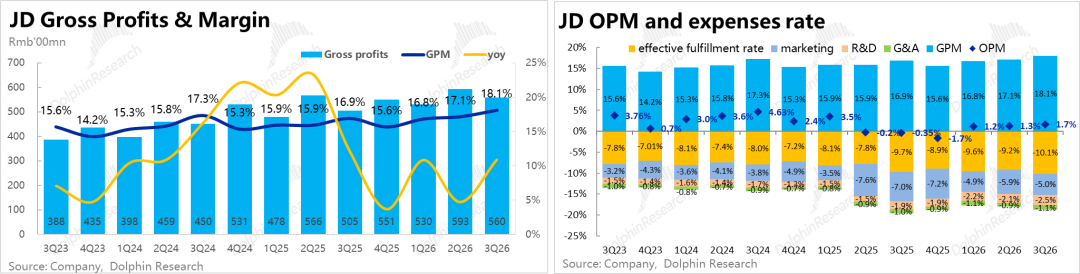
The group's gross margin was 18.1%, up about 1.2pt year-over-year and continuing to rise quarter-over-quarter.
On the expense side, marketing expenses fell 26% year-over-year, with the expense ratio dropping from 7.0% to 5.0%; but R&D expenses grew 37% year-over-year, with the expense ratio rising from 1.9% to 2.5%; the fulfillment expense ratio also rose from 7.4% to 7.6%; management expenses grew 12% year-over-year, mainly due to an increase in share-based compensation.
In other words, a considerable portion of the marketing expenses saved from food delivery contraction was offset by investment in R&D and fulfillment — which is also why the core retail profit margin failed to continue rising.
7. Cash flow and shareholder returns
Cash flow performance this quarter was weak: in Q3, net cash flow from operating activities was an outflow of 18.7 billion yuan, and free cash flow was an outflow of 23.9 billion yuan. Although Q3 has always been a seasonal low point for cash flow, the outflow was larger this year. First, inventory reached 116.2 billion yuan, up 15% year-over-year — far faster than the 3% growth in merchandise revenue; it is speculated that in addition to stocking up for Double 11, there may also have been advance stockpiling ahead of electronics price increases.
Second, capital expenditure was 5.5 billion yuan, more than double the same period last year, corresponding to increased investment in new overseas businesses.
Buybacks shrank quarter by quarter: 630 million USD in Q1, 370 million in Q2, and nearly zero in Q3. Annualizing the 1 billion USD of buybacks in the first three quarters, plus the approximately 1.4 billion USD annual dividend paid in April this year, this corresponds to a return yield of about 8% on the current market value — noticeably lower than the roughly 10% level in 2025.
8. Below is an overview of the core earnings information
Dolphin Research view:
1. Core information for this quarter
JD.com's performance this quarter was unremarkable in terms of expectation gaps — neither major flaws nor major surprises. As the drag from fading national subsidies gradually diminished, the performance of JD.com's main body — the retail segment — rapidly repaired and returned to normal. But after "thrashing around" with food delivery, the company has not converged and refocused on its core main business. New business losses remain high, and buyback intensity has declined noticeably. Dolphin believes the most noteworthy points include:
1) Retail: has repaired and returned to normal, but medium-to-long term can only stabilize
The retail segment this quarter indeed bottomed out and rebounded as expected. First, the impact of the high base from national subsidies has passed, and the decline in electronics and home appliances narrowed sharply; second, growth in daily necessities and advertising was indeed good — not only because of the base effect — as growth in active users and merchant count shows that traffic is recovering.
Looking ahead, in Q4 electronics and home appliances will face a low base from a 12% decline in the same period last year; the drags are the higher base for daily necessities and sharp price increases in electronics, which will suppress demand. In addition, industry-wide growth during Double 11 may be only in the single digits, and recent retail sales data have also been quite weak.
We expect Q4 retail revenue growth may be somewhat faster than this quarter, but most likely still in the low-to-mid single digits, and a clear upward pull is unlikely.
Medium-to-long term, against the backdrop of a weak overall domestic consumption environment and still intense competition, the retail segment's performance can only be described as stabilizing, without major highlights.
2) Retail profit margin: has room for improvement peaked in the short term?
In recent quarters, retail profit margin continued to exceed expectations, relying on gross margin improvement (higher share of high-margin advertising and daily necessities, and extracting gross profit from the supply chain). But the benefit from revenue mix improvement is diminishing at the margin, while investment in R&D and fulfillment is increasing — and this quarter the trend of retail segment profit margin improvement reversed.
Looking ahead, management said last quarter that R&D (especially AI applications) will continue to grow in the near term, while new overseas businesses are strengthening infrastructure such as fulfillment, and related expenses are still in an investment period, so the expense ratio is likely difficult to bring back down in the short term. We expect the retail segment's profit margin may be flat or slightly decline year-over-year in the short term, and may not improve noticeably again within the next few quarters.
3) New business: after thrashing around with food delivery, expanding everywhere — better to return to shareholders
This is the point Dolphin dislikes most: after "thrashing around" with the food delivery business, the company has not converged and refocused on its core main business, but is still expanding in overseas directions (Joybuy, acquisition of Ceconomy) and elsewhere, causing new business losses to remain high, with almost no quarter-over-quarter loss reduction this quarter (see above).
Dolphin understands management's urgency to explore a second growth curve, but rather than thrashing around everywhere in new businesses with uncertain prospects, it would be better to return funds to shareholders. And the company's buyback intensity has declined noticeably recently (see above); JD.com is no longer one of the companies among China concept stocks with the strongest shareholder returns — which is precisely a reflection of this trade-off.
2. Forecast adjustments and value analysis
Because retail profit margin no longer improved this quarter and new business loss reduction slowed, we mainly lowered the mall profit margin and the pace of new business loss reduction. After adjustment, 2027 mall segment operating profit is about 57 billion yuan — about 7% lower than before adjustment and about 2% above consensus.
On core assumptions, for 2027 we expect mall segment revenue growth to recover to about 6%, with the operating profit margin rising slightly from about 4.7% to about 4.75%; JD Logistics segment revenue growth to fall back from about 20% (as the base period after incorporating the instant delivery business passes) to about 7%, with the operating profit margin rising slightly to about 3.2%.
New businesses (including food delivery, Jingxi, and overseas businesses) are expected to narrow total losses to about 27 billion yuan in 2027. The impact of consolidating Ceconomy will be added after the conference call clarifies the basis.
In the near to medium term, JD.com's performance is stabilizing and does not involve a significant amount of AI business or investment. As a result, it is less affected by the current market-wide pullback in AI trading and the negative impact of the new BIS rules. To some extent, it can also be considered one of the options for safe-haven funds. However, from a medium-to-long-term perspective, retail can only stabilize, new businesses are still burning cash, and shareholder returns are also contracting, so Dolphin still sees no obvious bright spots.
- END -
// Reprint permission
This article is an original article by Dolphin Research. If you need to reprint it, please obtain authorization.
// Disclaimer and general disclosure notice
This report is intended for general comprehensive data purposes only, for general reading and data reference by users of Dolphin Research and its affiliates. It does not take into account the specific investment objectives, investment product preferences, risk tolerance, financial condition, and special needs of any person who receives this report. Investors must consult independent professional advisers before making investments based on this report. Anyone who makes investment decisions due to the use of or reference to the content or information mentioned in this report shall bear the risk themselves. Dolphin Research shall not be liable for any liability or loss that may be directly or indirectly caused by the use of the data contained in this report. The information and data contained in this report are based on publicly available materials and are for reference only. Dolphin Research strives for but does not guarantee the reliability, accuracy, and completeness of the relevant information and data.
The information mentioned or views expressed in this report shall not, in any jurisdiction, be treated as or regarded as an offer to sell securities or an invitation to buy or sell securities, nor do they constitute advice, inquiry, or recommendation regarding the relevant securities or related financial instruments. The information, tools, and materials contained in this report are not intended or proposed to be distributed to citizens or residents of any jurisdiction where the distribution, publication, provision, or use of the relevant information, tools, and materials would conflict with applicable laws or regulations, or would cause Dolphin Research and/or its subsidiaries or affiliates to be required to comply with any registration or licensing requirements in that jurisdiction.
This report reflects only the personal views, opinions, and analytical methods of the relevant creators and does not represent the position of Dolphin Research and/or its affiliated institutions.
This report is produced by Dolphin Research, and the copyright is solely owned by Dolphin Research. Without the prior written consent of Dolphin Research, no institution or individual may (i) produce, copy, reproduce, duplicate, forward, or otherwise distribute any form of copies or reproductions in any manner, and/or (ii) directly or indirectly redistribute or transfer to other unauthorized persons. Dolphin Research reserves all related rights.
-
![]()
OpenAI Unveils GPT-6.2 Astra and Sol, Outperforming Claude Fable 5.2 at Just 5% of the Cost
-
![]()
Baidu's Q3 Report: Advertising Stalls as AI Takes the Wheel
-
![]()
JD.com: Retail Stops the Bleeding While Overseas Burns Cash — When Will the "Thrashing" End?
-
![]()
Great report! But without Jensen Huang, Nvidia just doesn't feel the same!
-
![]()
LCoS and the Screen Door Effect: Why Do Our Eyes "Catch" the Pixel Gaps?
-
![]()
Cybertruck Failed to Keep Musk, the Car Builder
-
![]()
Chips Are Scarce, Yet TSMC Has Started "Vetting Customers' Finances"?
-
After "Taking Down" Jensen Huang, the United States Officially Shows Its Hand: A Comprehensive Blockade on China's AI Computing Power