Ascend Rising: The Acceleration Moment for China's Domestic AI Computing Power Industry Chain
 11/26 2026
 554
Domestic computing power plays such as Huawei Ascend and Huawei Kunpeng have recently gathered momentum in quick succession. The backdrop to this rally is that the market is dialing down the valuation premium it assigns to the continued rapid expansion of overseas computing power, while marking up its pricing of domestic supply capabilities and the potential to monetize applications. In other words, after more than half a year of valuation digestion, the Huawei Ascend chain now stands at a golden crossover window: "fundamentals accelerating upward, valuation center falling back."
01 Demand side: dramatic changes in the landscape, with share restructuring faster than expected
To judge an industrial mainline, the first thing to look at is whether the industry landscape has undergone an irreversible change. Data from China's AI chip market in the first half of 2026 gives a clear answer.
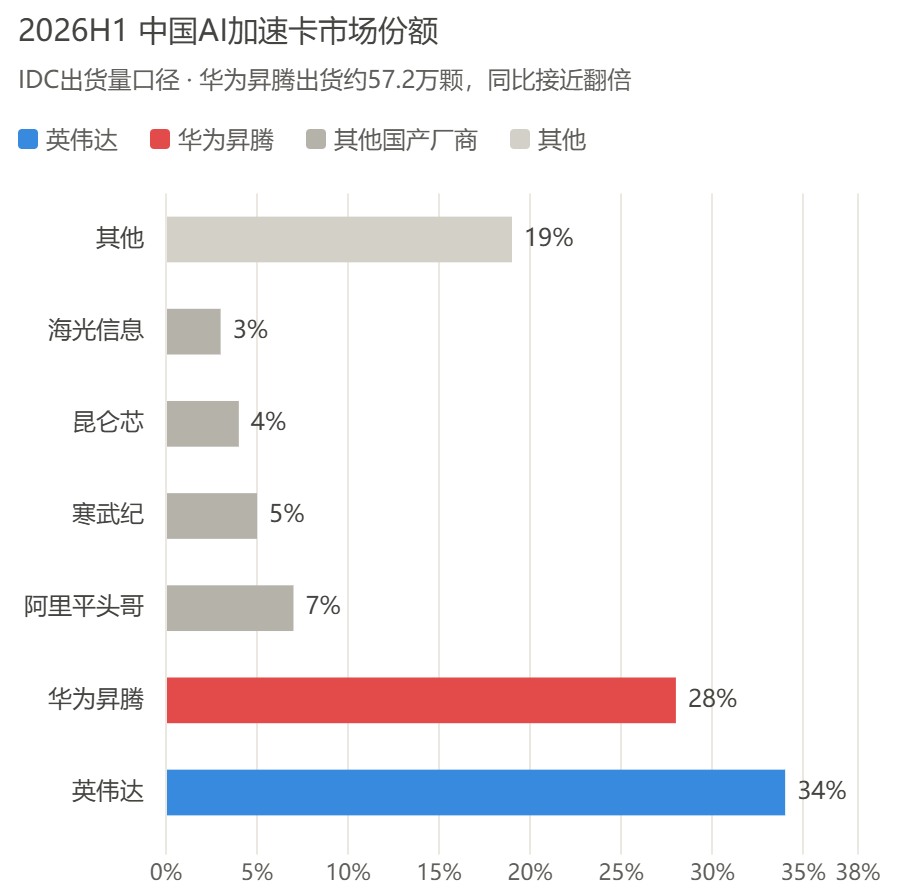
The first set of data is market share. According to IDC statistics, in the first half of 2026 Huawei Ascend AI accelerator card shipments were about 572,000 units, nearly doubling year-on-year, with a market share of 28%; the gap with the No. 1 player Nvidia (34%) narrowed from 31 percentage points a year earlier to only 6 percentage points—Nvidia's lead shrank by 80% within a year. By the measure of all accelerator cards, Huawei rotating chairman Xu Zhijun revealed in September this year that Ascend's shipments in the Chinese market have already surpassed Nvidia's. Even the statistical scope is shifting rapidly, which itself is a typical feature of a market restructuring period.
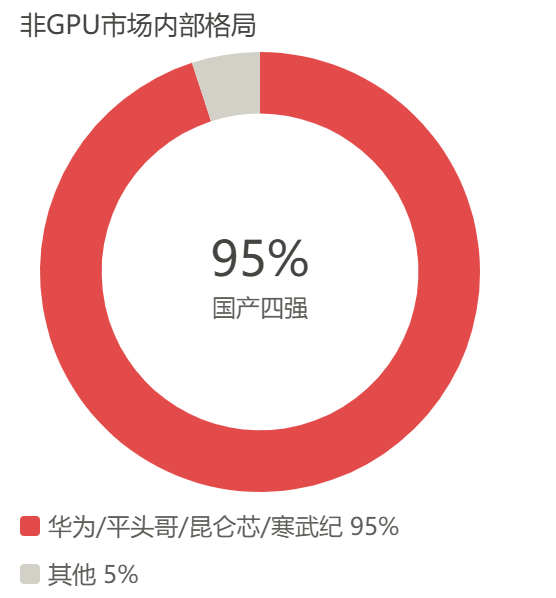
The second set of data is structure. In the first half of 2026, shipments of non-GPU accelerators (NPU, ASIC, etc.) reached 1.016 million units, up nearly 80% year-on-year, surpassing GPUs' 991,000 units for the first time. Huawei, T-Head, Kunlunxin, and Cambricon together accounted for 95% of the non-GPU market. This marks that the center of gravity of China's AI computing power demand is shifting from "buying general-purpose GPUs for training" to "using specialized accelerators for inference"—and inference is precisely the battlefield where domestic chips are most competitive.
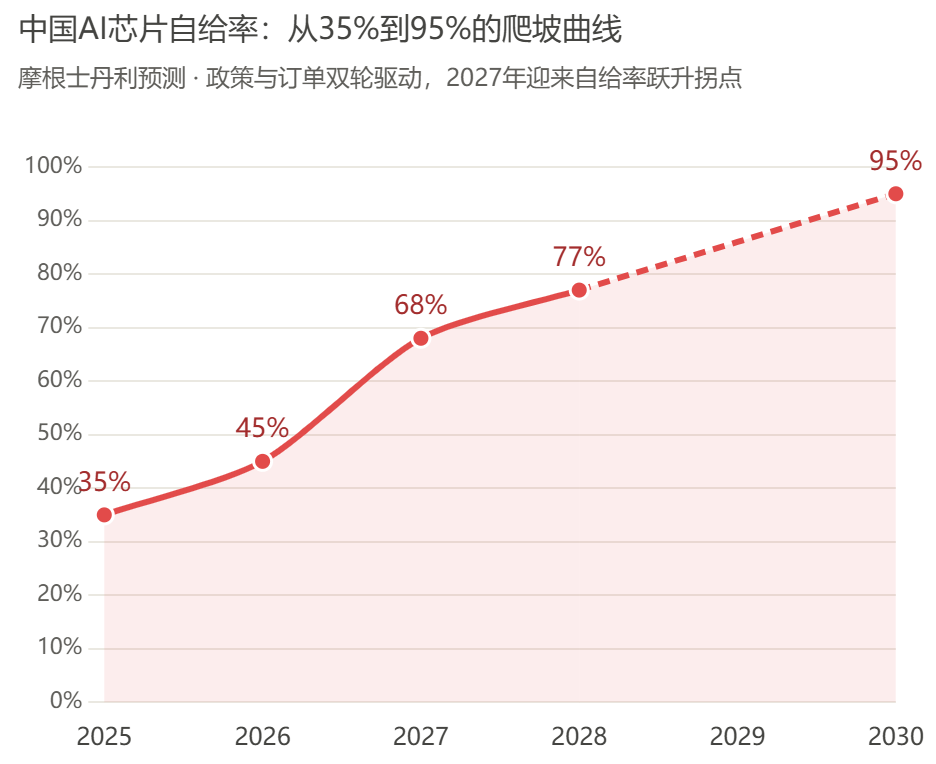
The third set of data is policy and orders. Under export controls, after Nvidia's H200 was permitted for export, actual deliveries remained at zero for a long time, and Jensen Huang publicly admitted that the roughly $50 billion Chinese AI chip market is "being given to Huawei." The flood of demand is turning to domestic products: ByteDance placed purchase orders for Ascend chips on the scale of $5.6 billion; China Mobile's 2026-2027 AI supernode centralized procurement (6,208 cards) explicitly locked in Huawei's CANN ecosystem; in carrier centralized procurement, Huawei ecosystem vendors won bids totaling 13.864 billion yuan and captured a 72.5% share. Morgan Stanley expects China's AI chip self-sufficiency rate to rise from 35% in 2025 to 45% in 2026, jump to 68% in 2027, and reach 95% in 2030.
Xu Zhijun's summary is blunt and powerful: "What constrains Ascend's volume growth today is no longer demand, but supply capability." When a company's bottleneck changes from "can it be sold" to "can it be produced," the investment attribute of its industry chain shifts from beta speculation to capacity delivery.
02 Supply side: dual-wheel drive of generational product leaps and doubled production capacity
The logic of the supply side can be unfolded at three levels: "chip—system—ecosystem."
At the chip level, according to Bloomberg, Huawei plans to raise Ascend 910C output to about 600,000 units, nearly double that of 2025; the total wafer output target for the Ascend series is to be raised to 1.6 million wafers. More critical is generational iteration: the inference-optimized Ascend 950 series (950PR/950DT) has entered large-scale commercial use, and the Atlas 950 supernode equipped with Ascend 950 has achieved real-machine deployment of a 1024-card cluster; the Ascend 960 supernode released at the September 2026 Huawei Connect conference reaches 4,096 cards per supernode, 8E FP8 computing power, and 1PB HBM capacity, becoming the industry's first NPO-form supernode. The country's first Ascend 950DT token export computing cluster has been lit up in Shantou—domestic computing power is beginning to go global.
Frankly speaking, at the single-card level, Ascend 910C is about 60% to 70% of H100 performance and is still constrained by SMIC's N+2 equivalent 7nm process. But Ascend's competitive strategy has never been "single card versus single card": through self-developed HCCS high-speed interconnect, the 384 supernode connects hundreds of cards into a unified computing pool, and has now deployed more than 1,000 sets with cumulative online card time exceeding 650 million hours, making it the only computing foundation in China that has completed native pre-training of more than 40 large models. The focus of competition has shifted from "single-chip benchmark scores" to "system-level computing power," and system-level innovation is precisely Huawei's forte built over three decades.
Breakthroughs at the ecosystem level are even more strategically significant. In July 2026, Ascend became an officially supported technical route of PyTorch, the only Chinese hardware vendor to receive this status; DeepSeek-V4 released in April listed Ascend alongside Nvidia GPUs as a verified hardware platform, achieving "Day 0" full-stack adaptation; on September 30, DeepSeek further open-sourced the TileLang compilation tool, DeepGEMM operator library, and DeepEP communication library for Ascend—with the same code, changing one environment variable allows switching between Ascend 950 and Nvidia. The CANN community now has more than 30 SIG groups and over 5,000 monthly active developers, making it China's most active AI open-source community, with 61% of developers coming from outside Huawei.
The software ecosystem's shift from "unusable" to "measurable, comparable, and deployable" means the biggest psychological threshold for domestic substitution has been crossed.
03 Earnings delivery: from thematic speculation to financial report verification
Themes can tell stories, but the financial reports of industry chain companies do not lie. Data from the 2026 third-quarter reports show that the earnings elasticity of core companies in the Huawei Ascend chain is being released:
- SMIC (chip manufacturing): revenue in the first three quarters was 60.62 billion yuan, up 22.4% year-on-year; net profit attributable to parent was 7.31 billion yuan, up 91.6% year-on-year;
- Cambricon (AI chips): revenue in the first three quarters was 9.53 billion yuan, up 106.8% year-on-year; net profit attributable to parent was 3.72 billion yuan, up 131.5% year-on-year;
- Hygon Information (domestic CPU/DCU): revenue in the first three quarters was 14.95 billion yuan, up 57.6% year-on-year;
- Wus Printed Circuit (high-layer PCBs): revenue in the first three quarters was 23.23 billion yuan, up 71.9% year-on-year; net profit attributable to parent was 5.62 billion yuan, up 106.9% year-on-year;
- JCET (advanced packaging): first-half revenue was 19.53 billion yuan, net profit attributable to parent up 79.4% year-on-year, and in September it launched a 6.5 billion yuan private placement, of which 1.5 billion yuan was added to advanced packaging for high-performance computing;
- HGTECH (optical interconnect): in the first three quarters, optical interconnect business revenue was 6.54 billion yuan, up 26% year-on-year, with Q3 net profit surging 201% quarter-on-quarter, and 800G/1.6T optical modules delivered in batches.
It is worth noting that this report card was achieved against the backdrop of significant share price corrections for many companies during the year. Take SMIC as an example: its PE (TTM) has fallen from about 270 times in mid-year to around 120 times in late November; Hygon Information fell from 236 times to 107 times; HGTECH even digested from over 100 times to 31 times. The combination of "falling stock prices + rising earnings" is rapidly repairing the risk-return ratio of the entire sector.
04 Facing shortcomings squarely: domestic substitution is not without hidden reefs
Being optimistic is not the same as following blindly; the risks in this chain must be put on the table.
First, HBM remains the capacity ceiling. In global HBM revenue in the second quarter of 2026, SK Hynix, Samsung, and Micron accounted for 50%, 33%, and 18% respectively, while Chinese manufacturers are still in the sample delivery stage. ChangXin Memory currently has HBM capacity of about 5,000 wafers per month, and its HBM3 production line is expected to start production only by the end of 2026. According to SemiAnalysis estimates, domestic HBM supply can support only 250,000 to 300,000 Ascend-class chips in the short term. Whether the production target of 600,000 units can be fulfilled depends to a large extent on ChangXin's ramp-up speed. But from another perspective, Goldman Sachs expects ChangXin's HBM revenue to grow at a compound annual growth rate of 166% from 2026 to 2030, and the shortcoming itself is the source of excess returns in the next stage.
Second, the yield gap remains significant. The yield rate of SMIC's N+2 production line is about 65%-70% (different institutions have different measures), lower than TSMC's roughly 90% for the same process.
Third, the training side has not yet fully closed the loop. High-end training computing power still needs to rely on a limited import window, and "reverse chokepoint" currently holds only on the inference side. Supernodes trade about four times the power consumption for cluster computing power, and the energy efficiency account is not easy in power-constrained regions.
These shortcomings determine that this is an industry where "the slope of capacity ramp-up determines the slope of stock prices," and the investment rhythm must closely track SMIC's expansion progress, ChangXin's HBM mass production milestones, and quarterly shipment data.
05 Layout mainline: look for opportunities along the "bottlenecks"
The distribution of opportunities in the industry chain can be summarized as "chips as the outline, supporting segments as the details":
1. Advanced manufacturing and packaging: SMIC, ChangXin Memory—manufacturing and storage are the tightest constraints of the entire chain and the segments where policy resources are most intensively poured;
2. AI server complete machines: Huawei ecosystem vendors collectively hold a 72.5% share in carrier centralized procurement, and 2026 is the "first year of volume release for domestic supernodes"; CICC expects the supernode-related market space to reach 341.4 billion yuan by 2028;
3. Optical interconnect and high-speed interconnection: under the supernode architecture, interconnect bandwidth demand explodes, and HGTECH, Wus Printed Circuit, Shennan Circuits, and others have already verified their elasticity with third-quarter reports; the optical communications sector is expected to continue high growth in 2027;
4. Cooling and power supply: under high-power system architectures, the value of liquid cooling and high-power power supplies is being systematically re-rated.
As for catalysts, in the short term watch capital expenditure guidance from leading cloud vendors, domestic intelligent computing project tenders, and ChangXin's HBM mass production milestones; in the medium and long term, watch "15th Five-Year Plan" computing infrastructure investment and the Ascend ecosystem.
06 Conclusion: from "spare tire" to "main force"
The Huawei Ascend chain is completing two fundamental transformations: in industrial status, from "domestic substitution spare tire" to "system-level computing main force"—the share gap with Nvidia has narrowed to 6 percentage points, non-GPU accelerators have surpassed GPUs for the first time, and more than a thousand supernodes have been deployed; in investment attribute, from "thematic speculation" to "earnings delivery."
Historical experience has repeatedly proved that the most rewarding stage of industrial trend investing often comes not before the logic reaches consensus, but during the misalignment period between valuation digestion and fundamental acceleration. When four things happen at the same time—demand is irreversible, supply is ramping up, earnings are being delivered, and valuations have fallen back—any underestimation of the domestic substitution Huawei chain may become the biggest regret in the next two years of investing. Of course, this is a marathon measured in years—keep an eye on capacity, keep an eye on yield rates, keep an eye on HBM, and dance with the industry rhythm; that is the best policy.
- END -
-
Apple Is Very Proud: I Sold 710,000 Fewer Phones, Yet Revenue Increased by 55 Billion!
-
Does Xiaomi Need to Go All In?
-
![]()
Xiaomi, Seeking a "New Rhythm"
-
![]()
Only 3 Years Left Before China's Auto Export Boom Ends?
-
![]()
Two Central SOEs Swap Equity Stakes
-
![]()
Aston Martin Appoints New Asia-Pacific Head as Volume Cuts Aim to Protect Pricing
-
![]()
BYD Set to Acquire French Factory, Macron Announces Publicly
-
![]()
Those Who Need a Personal Agent Most Are Middle-Aged People Starting to Become Forgetful