Xiaomi, Seeking a "New Rhythm"
 11/26 2026
 526
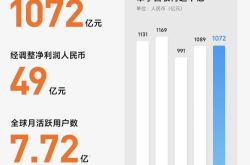
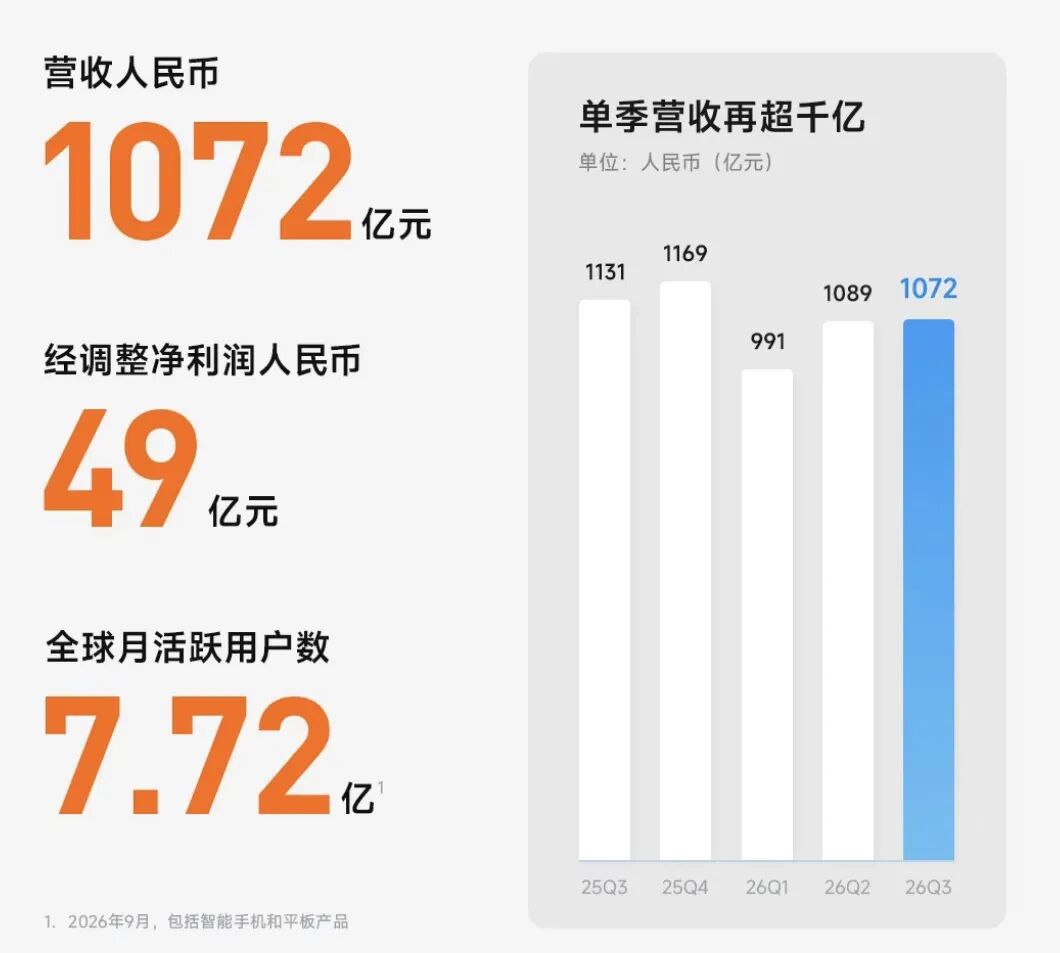
On November 24, Xiaomi Group released its third-quarter 2026 results. The company reported quarterly revenue of 107.239 billion yuan, holding above the 100-billion-yuan mark for another quarter, while adjusted net profit came in at 4.884 billion yuan, down 56.8% year-on-year. Judged on the numbers alone, it would be easy to read the report as a quarter under pressure. Lu Weibing, partner and president of Xiaomi Group, put it bluntly on the earnings call, calling it "the hardest quarter since I started working."
Yet a closer look at the income statement—and then beyond the financial report—suggests that what Xiaomi did this quarter points not to contraction for its own sake, but to a deliberate "deep squat" with a clear sense of direction. Smartphones completed a proactive shift in product mix amid a revaluation of costs; the automobile business rolled out a second product line with the launch of extended-range models; and R&D spending continued to flow into chips, large models, and production lines at a rate of 9.2 billion yuan in a single quarter.
Smartphones Shift Gears to Protect Gross Margin
Memory chips were a cost problem for the global smartphone industry this quarter. The combined share of DRAM and NAND in the smartphone bill of materials rose from 13% in the first quarter of 2025 to 49% in the second quarter of 2026, and on flagship models the cost of DRAM alone exceeded that of the SoC for the first time.
Faced with an impact of this magnitude, Xiaomi chose a tougher path: cutting low-end shipments, shifting the product focus toward higher price bands, and using changes in product mix to offset rising material costs. Quarter-on-quarter data from the smartphone business offered direct evidence of the shift. In the third quarter, Xiaomi's smartphone revenue was 45.6 billion yuan, up 8.2% quarter-on-quarter; gross margin was 9.2%, up 0.6 percentage points from the second quarter and ahead of market expectations. Even more telling is the average selling price: the global smartphone ASP reached 1,486 yuan, up 39.8% year-on-year and a record high.
Lu Weibing laid out the logic behind the change clearly on the earnings call: keep optimizing the product mix in global markets, proactively reduce low-end handset shipments to keep channels healthy, and adjust pricing in line with market dynamics amid sharply rising costs—striking a balance between cost pressure and user acceptance. The approach is to counter cost increases with product innovation and stabilize gross margin through structural upgrading, rather than simply passing the pressure on through price hikes.
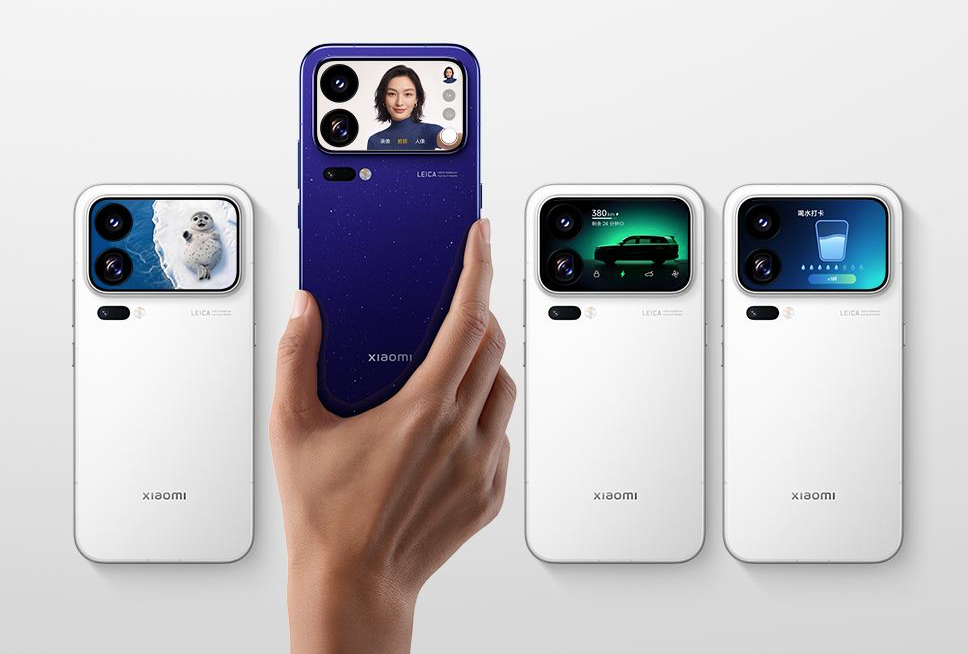
In fact, Xiaomi's progress in premiumization shows up beyond the average selling price. In the Chinese mainland price band of 6,000 yuan and above, Xiaomi's sales share reached 4.4%, up 1.2 percentage points year-on-year. The Xiaomi 18 Fold, released in September, entered the foldable flagship segment with a starting price of 10,999 yuan, while the Xiaomi 18 Pro series anchored the starting price of straight-screen flagships at 5,999 yuan; together, the foldable and straight-screen lines gave Xiaomi density in the high-end price band.
In global markets, Xiaomi's smartphone shipments ranked in the top three for the 25th consecutive quarter, with a 12.1% share in the quarter—up quarter-on-quarter for the third quarter in a row. With industry-wide shipments contracting, the steady quarter-on-quarter gain in share says more than the absolute volume of any single quarter: the foundation of Xiaomi's smartphone business has not loosened. What has changed is the arrangement of the product mix, with the space vacated by low-margin models taken up by higher price band products.
The overall gross margin of Xiaomi's smartphone × AIoT segment also improved. The financial report showed segment revenue of 83.4 billion yuan for the quarter, with a gross margin of 20.4%, slightly up quarter-on-quarter; smartphone gross margin recovered from 8.5% to 9.2%.
Lu Weibing's outlook also rests on structure: memory costs will remain relatively high in 2027, a further increase in smartphone ASP versus 2026 is a near-certainty, and he is confident in maintaining a good gross margin performance. The direction of the shift has been set; what to watch next is whether the product rhythm can stay on this track.
Automobile Business Remains "Healthy"
The financial report showed that Xiaomi's segment of new energy vehicles and AI and other innovative businesses generated revenue of 23.9 billion yuan in the quarter, of which automobile sales revenue was 22.7 billion yuan, with 100,975 new vehicles delivered, a segment gross margin of 19.2%, and an operating loss of 3.4 billion yuan. But the highlight of the automobile business this quarter is not the absolute size of the loss, but the changes in product structure behind it.
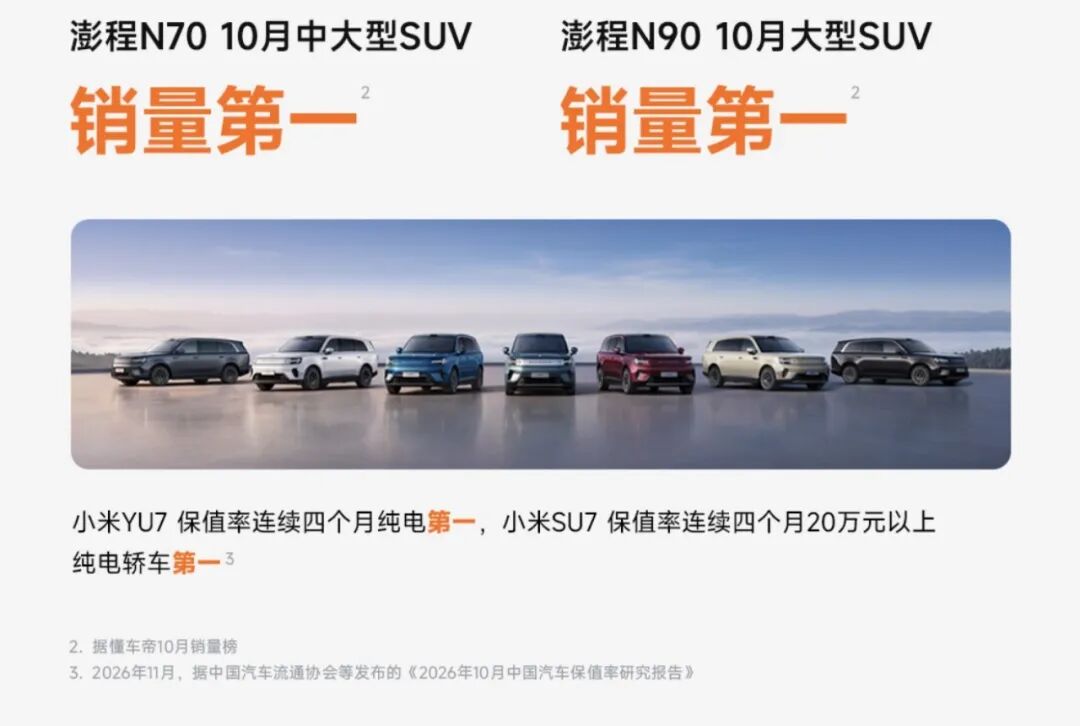
In September this year, four extended-range SUVs from Xiaomi's Pengcheng series officially began delivery, with starting prices ranging from 209,900 yuan to 299,900 yuan; locked orders exceeded 10,000 units within 4 minutes of sale, and locked orders in the first sales month exceeded 70,000 units. October data further confirmed the carrying capacity of this product line: Xiaomi Automobile's monthly deliveries exceeded 50,000 vehicles, setting a new monthly high for the year; the Pengcheng N90 ranked first on the large SUV sales list, and the N70 ranked first on the extended-range vehicle and mid-to-large SUV sales lists.
In the brand sales ranking for starting prices of 200,000 yuan and above, Xiaomi Automobile ranked first; among the top ten in the retail sales list of new energy vehicles priced above 200,000 yuan, all four Xiaomi models on sale were listed, with each model selling more than 10,000 units.
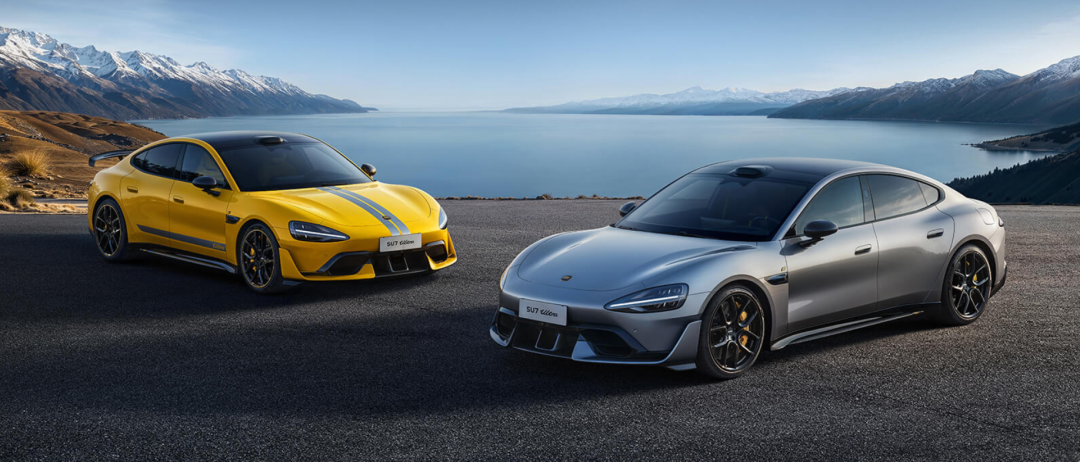
Lu Weibing offered a noteworthy judgment at the earnings call: after the launch of the extended-range models, sales of the SU7 and YU7 were not affected but instead grew; the user groups for extended-range and pure electric vehicles are sufficiently different, and there was no internal cannibalization. This means the automobile business has moved from a stage driven by a single hit product to one where pure electric and extended-range run in parallel and the user base has significantly broadened.
Xiaomi's deliveries in the quarter stabilized at the 100,000-vehicle level, the segment gross margin was flat quarter-on-quarter at 19.2%, and the effect of scale in diluting expenses is becoming visible. The Pengcheng series' locked orders exceeding 70,000 units in the first sales month correspond to simultaneous expansion of production capacity ramp-up, channel deployment, and delivery system carrying capacity. Xiaomi management's statement on the follow-up gross margin is "relatively high and healthy," and it is confident in maintaining automobile gross margin.
In addition, the timetable for Xiaomi Automobile's overseas expansion has also landed on specific actions. In September, Xiaomi officially announced that its automobiles would enter the European market in 2027 and signed memoranda of cooperation with eight leading German automobile dealers at the Berlin International Consumer Electronics Show. From the expansion of the product matrix to the rollout of regional markets, what the automobile business did this quarter was a set of forward-looking actions with a clear direction: Pengcheng expanded the base from one car to four cars, October deliveries stood at 50,000 vehicles, and the skeleton of European channels began to be built.
R&D Flows to Chips and Models
This quarter, Xiaomi's R&D did not slow down. In the third quarter, Xiaomi's single-quarter R&D investment was 9.243 billion yuan; in the first three quarters, the cumulative amount was 27.428 billion yuan, up 16.5% year-on-year, and in the first nine months, AI-related R&D expenses accounted for more than 30% of total R&D.
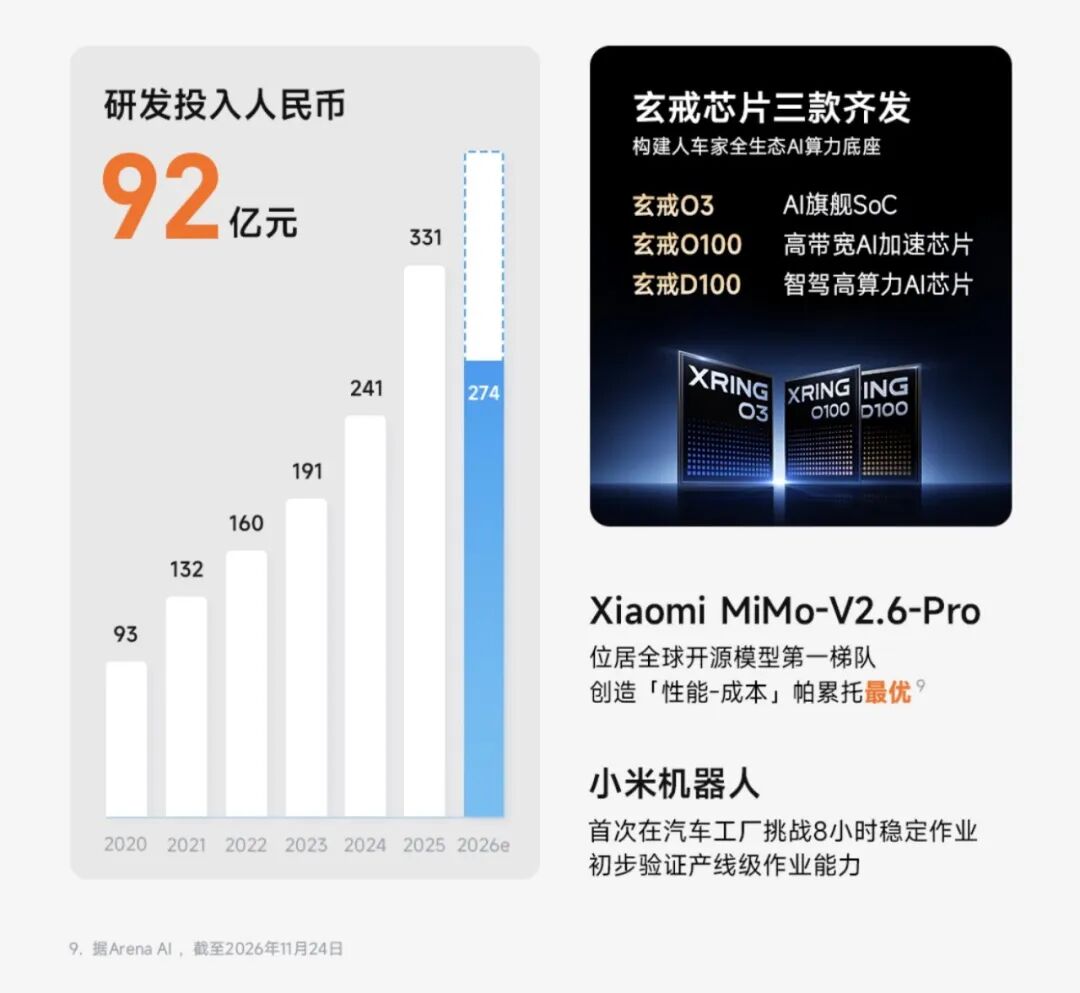
From the chip level, the three self-developed chips Xiaomi released in August — Xuanjie O3, O100, and D100 — have all completed tape-out verification. As an AI flagship SoC, Xuanjie O3 has already been adopted in the Xiaomi 18 Fold and Xiaomi Pad 9 Pro Max and entered mass production and commercial use; O100 targets high-bandwidth AI computing, with bandwidth reaching 1.22TB/s; D100 points to high-computing-power intelligent driving scenarios.
The three chips cover flagship terminals, high-bandwidth computing, and intelligent driving respectively. Completion of tape-out verification means the chain from design to tape-out has been connected, and the mass production and commercial use of Xuanjie O3 means self-developed chips have entered the shipment sequence of real products. Xiaomi also demonstrated an AI Cube prototype integrating the three chips, which can run dual models of 120 billion parameters and 3 billion parameters locally.
At the large model level, the MiMo-V2.6 series released and open-sourced by Xiaomi in September, while achieving a similar level of intelligence, cost about 1/20 to 1/60 per task compared with similar overseas models, becoming the highest-scoring open-source model in the world at that time; the core architecture of the next-generation MiMo-V3 has also been disclosed, optimized for long-context processing and multi-turn Agent task execution efficiency.
Xiaomi's robots have also moved from the laboratory to the production line: a bionic hand designed based on data from 1,827 automobile factory operation processes completed 8 consecutive hours of stable operation at a sorting station in an automobile factory and achieved two autonomous recharges. Eight consecutive hours of stable operation and autonomous recharging mean the robot has the ability to work continuously within real production rhythms.
Lei Jun, founder, chairman, and CEO of Xiaomi Group, has previously made clear that Xiaomi plans to invest at least another 200 billion yuan over the next five years, using the three core technologies of chips, OS, and AI as the foundation to drive the upgrading of the entire ecosystem.
What provides room for maneuver for R&D and automobile expansion are two stable gross margin foundations in Xiaomi's traditional businesses. Among them, IoT and lifestyle products revenue in the quarter was 27.2 billion yuan, with a gross margin of 21.7%, up 1.6 percentage points quarter-on-quarter; revenue from key categories such as large home appliances, tablets, notebooks, and TVs all achieved year-on-year growth. Internet services revenue was 9.5 billion yuan, with a gross margin of 73.8%; global monthly active users reached 771.9 million, a record high, and domestic monthly active users reached 199 million. The number of connected devices on the AIoT platform reached 1.2035 billion, up 16.2% year-on-year.
It can be seen that the structural actions completed by each of Xiaomi's three business cross-sections have already provided clues more worth tracking: smartphones are moving upward, automobiles are expanding the product line, and technology investment is laying a solid foundation for Xiaomi.
END
-
Apple Is Very Proud: I Sold 710,000 Fewer Phones, Yet Revenue Increased by 55 Billion!
-
Does Xiaomi Need to Go All In?
-
![]()
Xiaomi, Seeking a "New Rhythm"
-
![]()
Only 3 Years Left Before China's Auto Export Boom Ends?
-
![]()
Two Central SOEs Swap Equity Stakes
-
![]()
Aston Martin Appoints New Asia-Pacific Head as Volume Cuts Aim to Protect Pricing
-
![]()
BYD Set to Acquire French Factory, Macron Announces Publicly
-
![]()
Those Who Need a Personal Agent Most Are Middle-Aged People Starting to Become Forgetful