Those Who Need a Personal Agent Most Are Middle-Aged People Starting to Become Forgetful
 11/26 2026
 400

PART01
The moment I saw that Doubao's Personal Agent "Xiaodou" had opened its public beta, I immediately went to get an invitation code.
This wasn't just out of a need to research AI products; in the daily life of a middle-aged person, a Personal Agent that can actually get things done is simply too badly needed.
Work, children, and elderly parents—the workload brought by these three seriously drains my brain capacity. Needs related to the "self" are often pushed further back; even if I wake up late at night and sigh that I should treat myself better, once I fall back asleep and wake up, I forget it again.
"Forgot" is a word middle-aged people all know well.
A conversation that often plays out in my home recently goes like this: "Remind me that I need to do *** tomorrow." "Can't do it. I can't remember either."
So, in our schedule, the annual physical exam has been dragged from spring to now, and the motorcycle inspection expired so long ago that it can no longer be on the road. Last Spring Festival, when we were about to travel far, I "cleverly" put a watch inside a piece of clothing, wrapped it up, and hid it in the wardrobe. Since then, I have never seen it again.
In medical terms, this is the subjective cognitive decline that appears after people reach middle age. If switched to a computer perspective, it is this: more processes are running in the middle-aged brain, memory is running low, server updates cannot keep up, and bugs become an everyday occurrence.
Successful middle-aged people would hire a personal secretary at this point; ordinary middle-aged people can only find a way to get a Personal Agent.
Because this is the AI product form closest to a personal assistant. Unlike the question-and-answer mode of a Chatbot, a Personal Agent will break down steps on its own after receiving a task, call tools or services within the authorized scope, follow up on the process, and proactively deliver results. It has long-term memory, and tasks can continue running in the background.
Actually, humans have been tinkering with digital assistants for a long time. In 1992, Apple launched Newton; in 2011, Siri entered the iPhone, and Google, Amazon, and Microsoft rushed in as well. But before this wave of Personal Agents took off, they were more like remote controls, would not proactively interact, let alone remember their owners.
Until this September, when Meta launched Muse. Within six weeks of launch, users in the U.S. and Canada exceeded 10 million, and a quarter of users called on it every day. Soon after, Manus and OpenAI followed, and major domestic companies also took their positions: Tencent made Xiaowei, Alibaba made Qwen Go!, and Ant made Lingguang 2.0.
Now Xiaodou has joined as well.
PART02
In terms of product functions, Xiaodou is not very different from mainstream Personal Agents and has the basic capabilities of an AI personal assistant: scheduled reminders, continuous tracking, and remembering one-time to-dos and long-term goals.
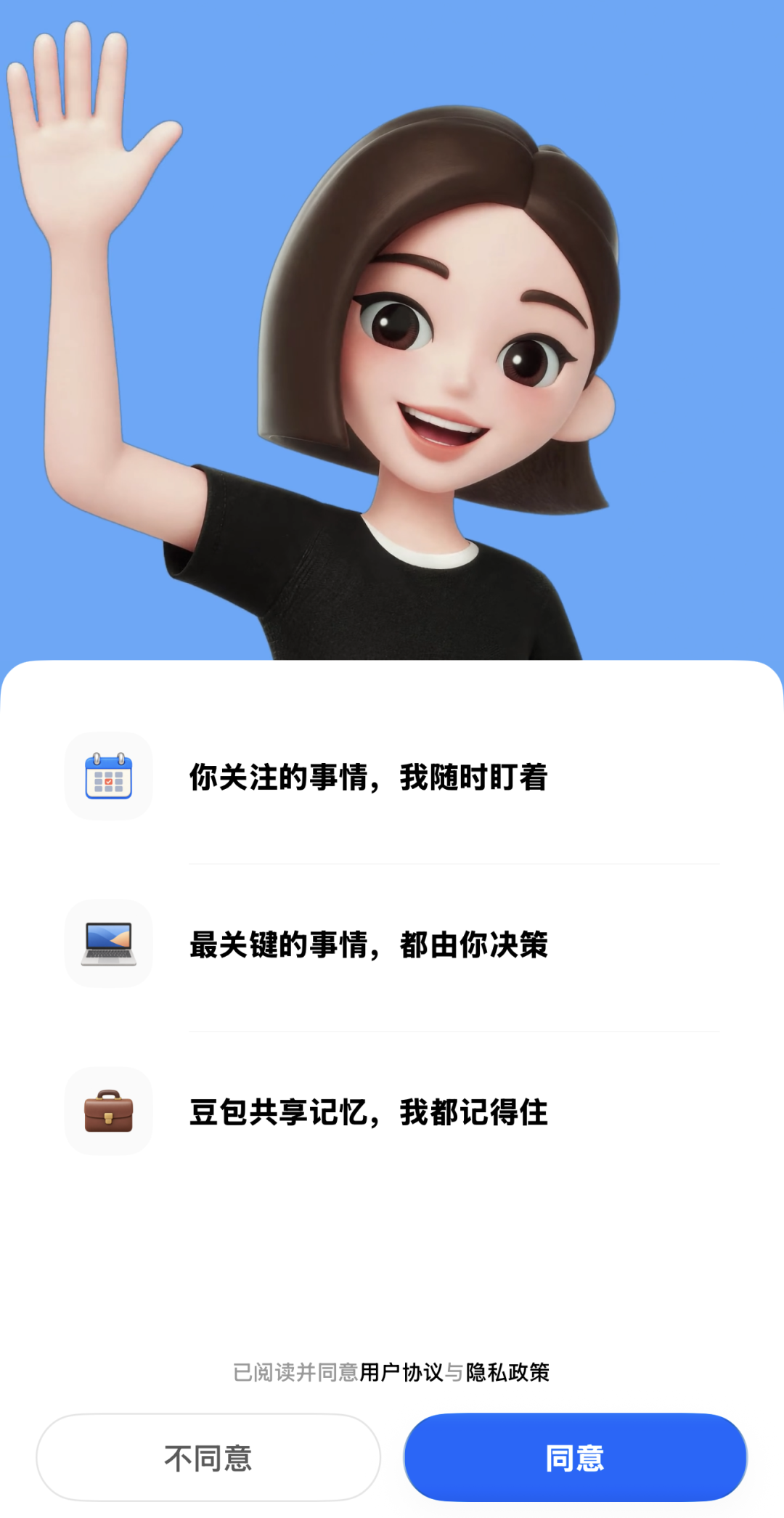
The homepage when first using Xiaodou
It breaks these capabilities apart into three entry points on the page: chat, guess what you want, and help you follow up.
The real surprise comes from the interface. I found that Xiaodou has an understanding of "me."
Based on the internal ecosystem integration of ByteDance, it directly has Doubao's long-term memory of me. When I log in with the same account, the "about you" page of Xiaodou already contains its understanding of me, which quietly conveys a psychological suggestion: I am Xiaodou's owner. Because my 8-year-old son had used my Doubao account, some of the content came from his preferences; after I reminded it, Xiaodou quickly deleted the related memories.
For new users, Xiaodou prioritizes guiding them to bind applications including: location, Feishu, Douyin, and Health. In addition, third-party applications such as Amap Ride Hailing, Baidu Netdisk, WeCom, DingTalk, and Tencent Docs are also connected.
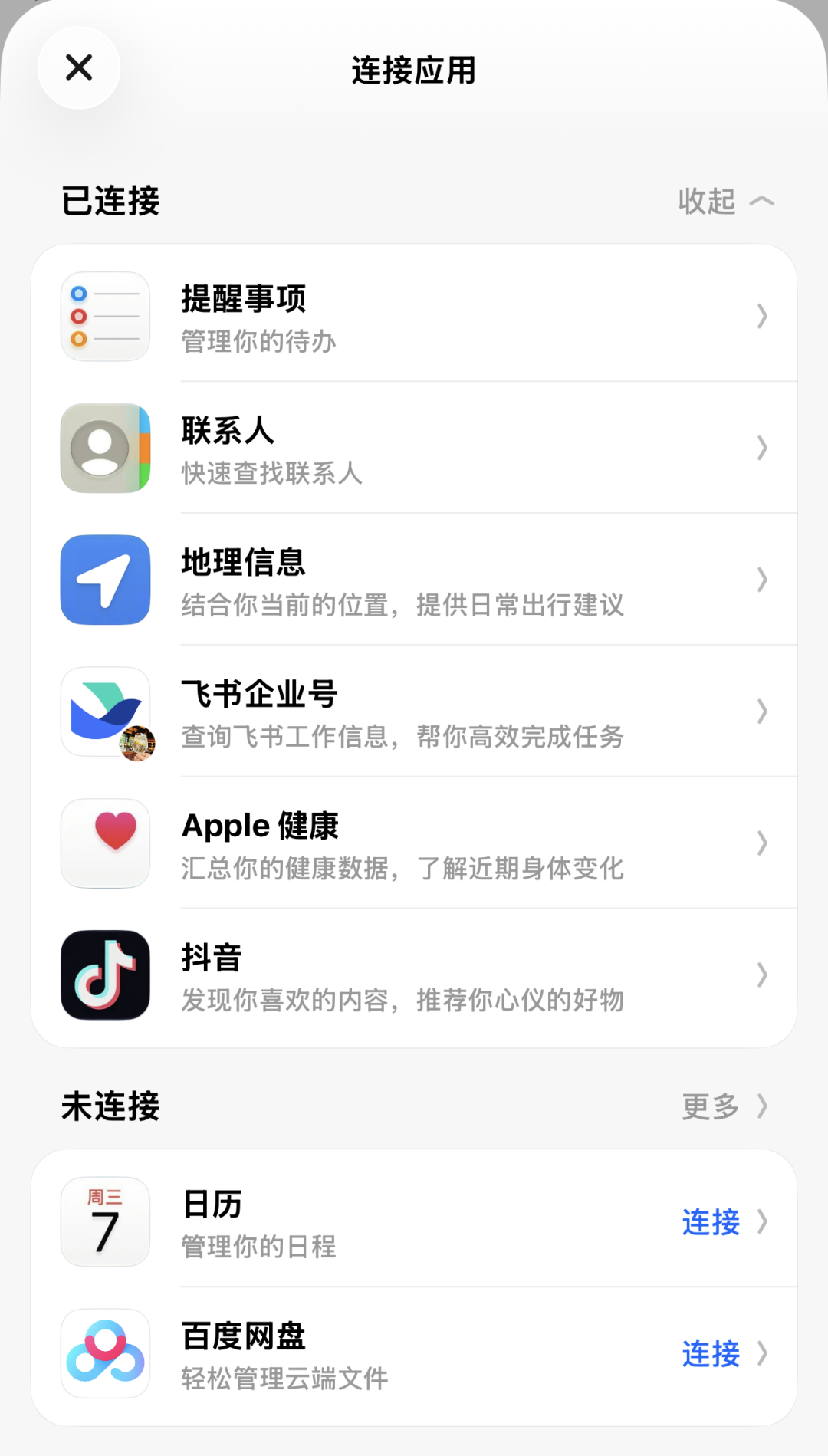
Applications currently supported for connection by Xiaodou
After more than a day of use, my feeling is this: the more you use the ByteDance ecosystem, the better the experience Xiaodou should be able to provide.
I use Feishu Docs to write articles all year round. After connecting Feishu, Xiaodou clearly understood my areas of focus and content preferences better. It even suddenly popped up a reminder in the morning: there were two drafts in Feishu collaboration waiting for confirmation, and there was a "September To do list" from last September, and it also gave handling suggestions. It would also remind me that a document I sent to a colleague with annotated revision comments had not yet been handled by the other party, and I could send a message to urge them.
In addition, after discovering that I had written articles about embodied intelligence, it proactively provided new industry developments. My first reaction was that it felt abrupt, but I immediately realized that this "follow the vine to get the melon" working mode is good for me to keep understanding the industry.
So this is how well the bosses who have assistants have been living.
I am still getting familiar with more functions of the assistant "Xiaodou." At noon today I bought a Douyin group-buy voucher, and Xiaodou immediately automatically synchronized the relevant redemption information, including the restaurant address and redeemable time slots. I sent it a gym class schedule, plus my age, fitness needs, and frequency, and it quickly arranged my weekly exercise plan and explained the reasons in detail.
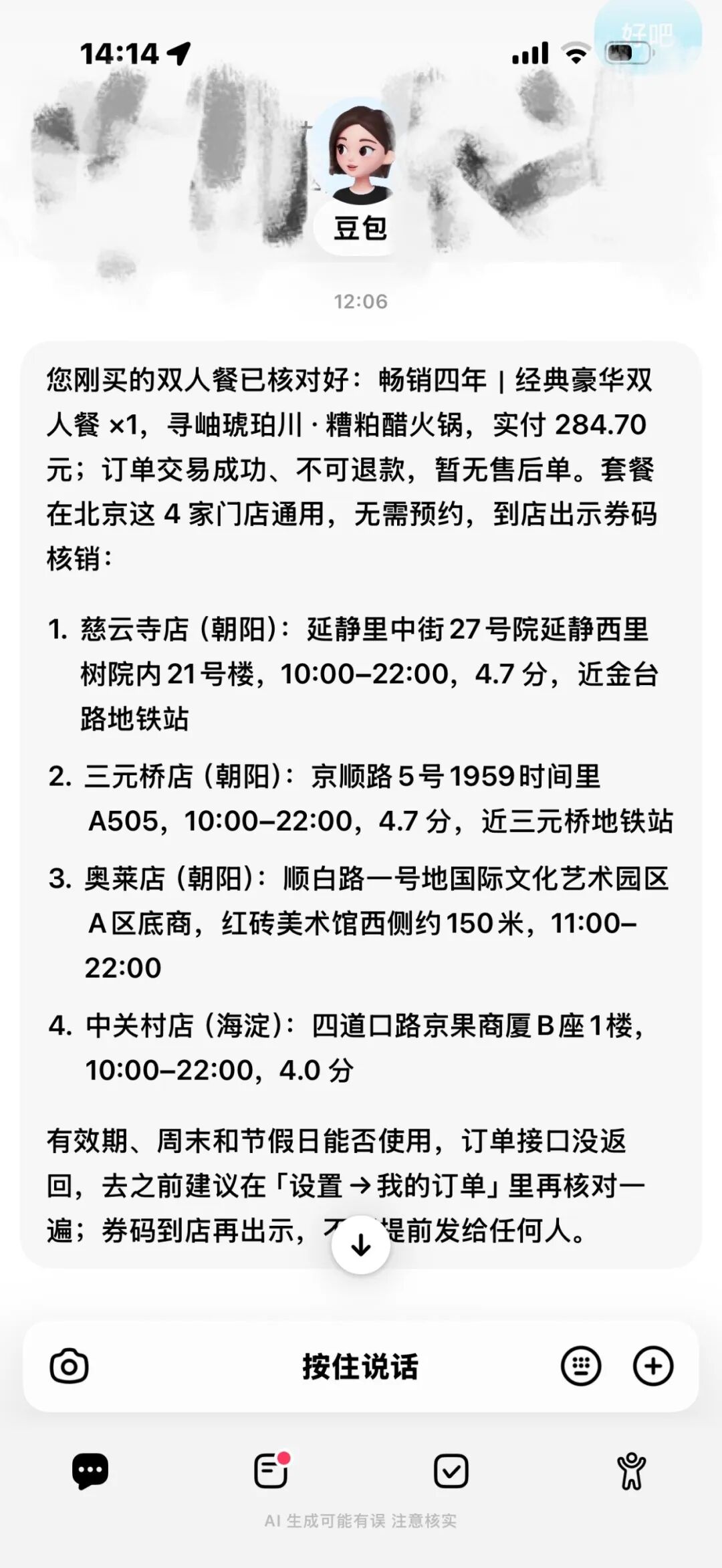
Douyin order information synchronized by Xiaodou
I wanted to buy an electric bike priced at 3,000-4,000 yuan. It sent me three recommended models, with links to the official Douyin flagship stores, and presented their features in a list. I also set some continuous tracking tasks for it, including: financial report data of technology internet companies, and in-depth reports/column updates from several mainstream overseas technology media. These tasks would be summarized in the "in progress" task bar and marked with trigger times.
Overall, the assistant Xiaodou performed steadily, and many of its capabilities precisely correspond to the checklist of middle-aged life. A large part of my daily chores consists of fixed information, such as: family members' dietary restrictions and allergies, regular hospital follow-ups and medication cycles, my child's weekly extracurricular class schedule, and the cleaning lady's service hours. All of these can be handed over to long-term memory. Scattered schedule arrangements, such as business trips, vacations, and work dinners, can be handed over to it to compile into a weekly schedule.
But for me, Xiaodou still has two areas of experience that need improvement:
1. The chat page lacks partitioning and is slightly messy.
On Doubao's page, after one topic ends, I can start a new topic. When reviewing, I only need to open the topic list and I can easily find the conversation record. But Xiaodou does not have this function for now, which causes all conversations to pile together, making review harder and also easily creating a sense of "interruption": when we are discussing task A, it may suddenly insert a message about task B.
2. The submenu bar only has simple icons, which is somewhat abstract for beginners. As a middle-aged person who is good at forgetting things right after seeing them, I have been confused more than once: what was this entry point again?—Of course, this may also be the middle-aged person's own fault.
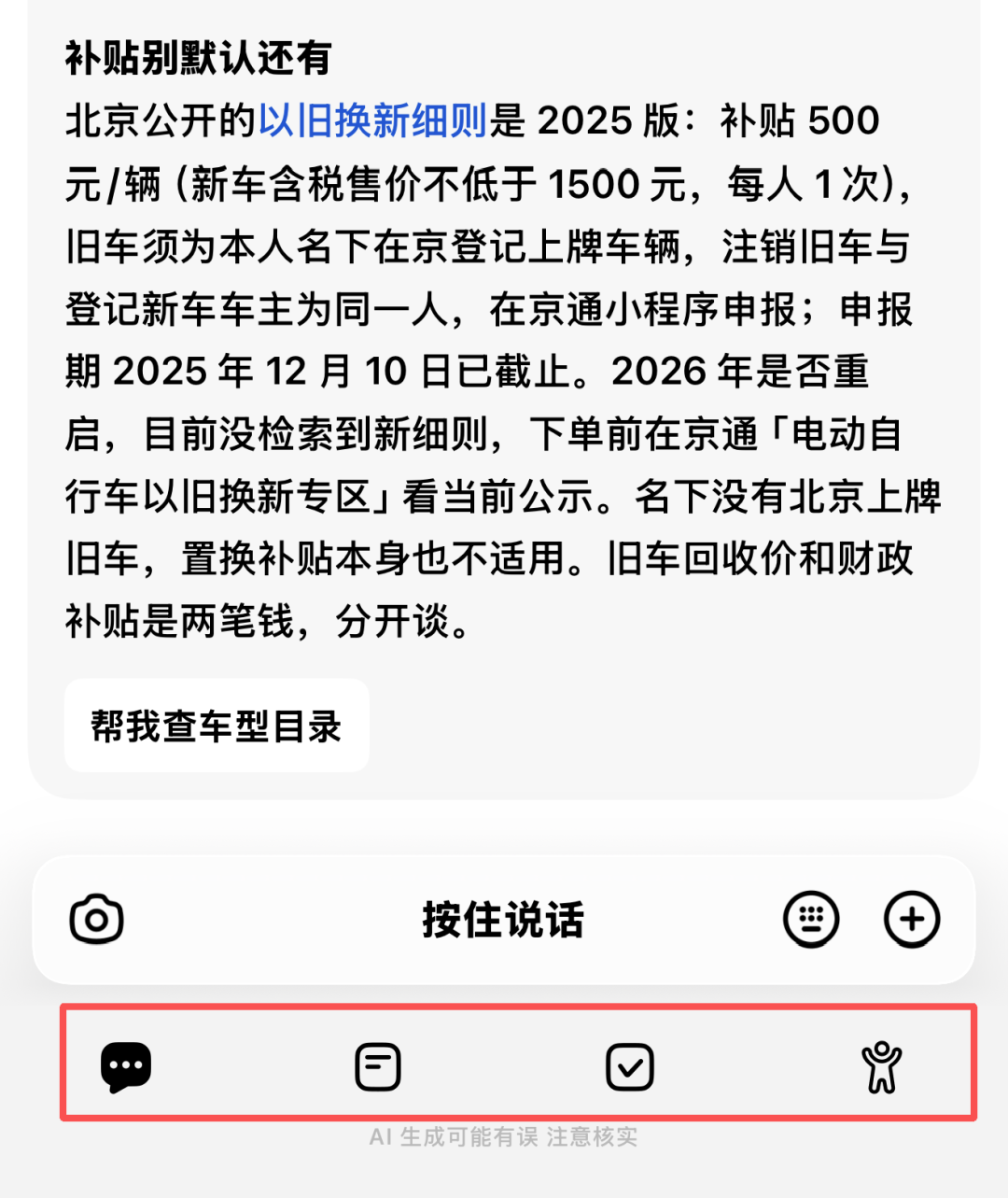
Submenu icons that are too "concise"
In addition, a problem that is hard to solve in the short term is the open ecosystem. The "walls" that Doubao Phone encountered will also be encountered by Xiaodou. It can smoothly call all products in the ByteDance ecosystem, but how much permission third-party products are willing to open will directly affect the upper limit of its capabilities—
You cannot ask an assistant that cannot obtain all permissions to arrange everything for you.
PART03
During the experience, my attitude toward Xiaodou was somewhat conflicted.
I want it to understand me more so that it can work more smoothly; yet I do not want it to understand me too well, for fear of its sudden betrayal.
So, when Xiaodou wanted to improve its long-term memory about me, I agreed, but only added information such as profession, city of residence, and areas of focus that did not involve personal privacy. In Empresses in the Palace, even the loyal Su Peisheng eventually stood with Zhen Huan, did he not? Humans are still unreliable, let alone AI.
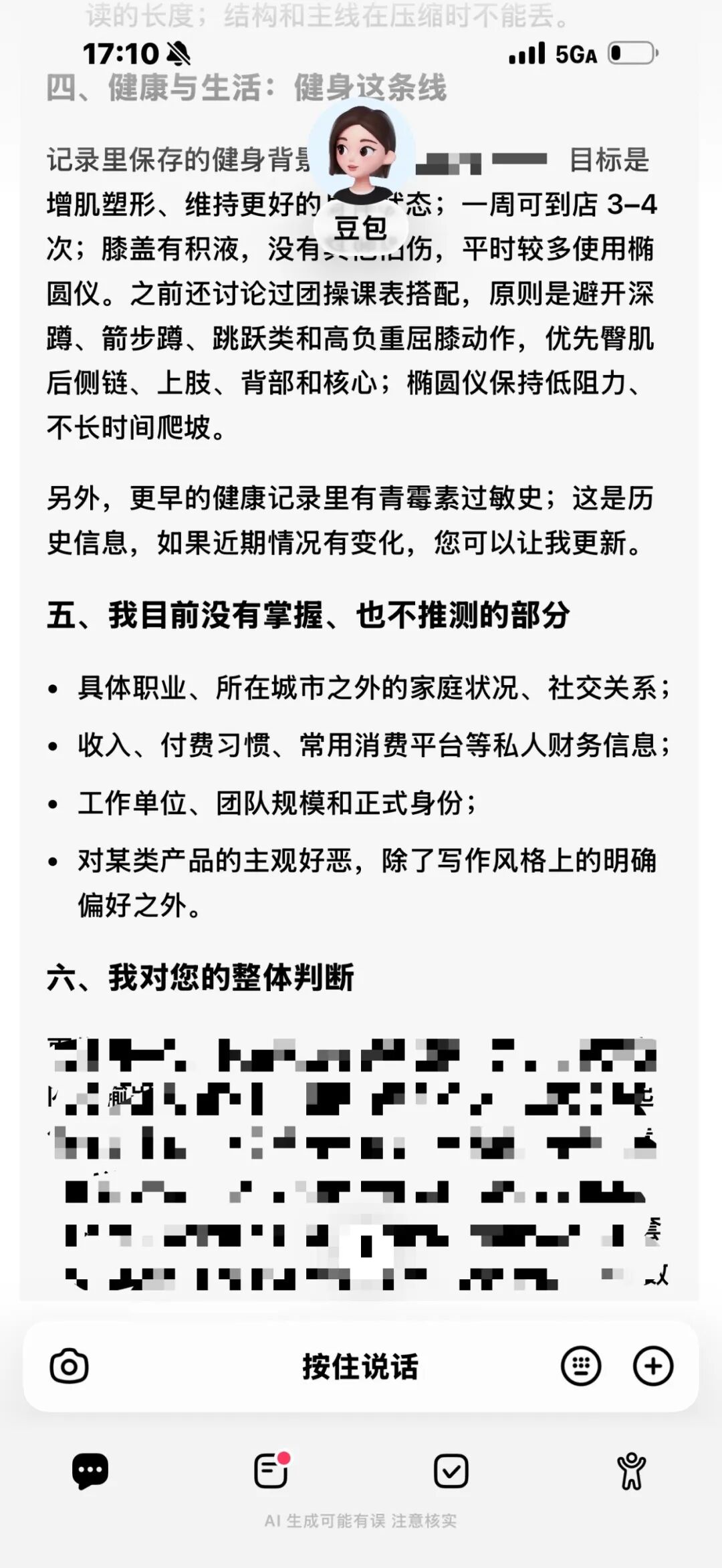
I do not really dare to involve privacy in the personal information I deliver to Xiaodou
This is also the self-awareness of middle-aged people.
A middle-aged friend also talked with me today about how he would not buy the first batch of any industrial manufactured product, to avoid becoming a guinea pig. Safety is the necessary prerequisite for us to accept new technologies/products.
There have already been quite a few news stories about Agents causing trouble: a technology reporter installed the Mac version of Muse and explicitly refused to let it touch his information, but Muse still synchronized 187,000 lines of his chat records from the local database. A security researcher commented: the permissions and access capabilities Muse has are what most malware would not even dare to dream of. And Amazon directly chose to block Muse, preventing it from placing orders and shopping on behalf of users.
Of course, these episodes have not affected the rapid advance of Agents.
In Silicon Valley, a group of elites regard Agents as the core tool for AI to change the world and believe that they may soon take over all white-collar work. "Next year will be the last year when everything in modern life still feels somewhat normal"—this sentence has already appeared prominently in a November issue of The New Yorker this year. Data from Xiniu shows that in the first half of the year, there were 83 financing deals in the domestic AI Agent track, a year-on-year increase of 131%.
If the flood of technology will eventually reconstruct the old world, humans seem to have no better choice than to adapt earlier.
Compared with individuals, big companies' FOMO about AI is obviously stronger and also more expensive.
AI has become a heavy business. In the third quarter of this year, Microsoft, Google, Amazon, Meta, and Oracle had combined capital expenditures of 230.4 billion U.S. dollars—exceeding their combined operating cash flow of 198.6 billion U.S. dollars for the quarter, with combined free cash flow turning negative at 31.8 billion U.S. dollars. Data centers, computing infrastructure, and other AI-related investments are the biggest money burners for them. By comparison, Nvidia's revenue in the third quarter of this year was 115.8 billion U.S. dollars, doubling year on year.
No one dares to stop. Middle-aged people with school-age children may all understand this plot. Under the pressure of exams and schooling, everyone is busy pouring money into tutoring classes. Apart from institutions and tutoring teachers making certain money, the returns are not clear. However, under the general trend, many people, holding expectations for the future, dare not stop investing.
Humans have always been unable to give up their obsession with certainty.
The most fascinating thing about Personal Agents at present is that they are close enough to ordinary users and can naturally embed into users' life, entertainment, consumption, travel, office, and many other scenarios, and be used frequently. The certainty and imagination space this brings are much greater than those of Chatbots. However, this also destined to be a cruel battlefield—most ordinary people will not keep three to five Personal Agents around at the same time for the long term.
Especially for middle-aged people who are simply living their lives, if they still cannot find a Personal Agent that is smart enough, easy to use, and cost-effective, they will naturally resort to the "forget it" approach.
"If you can't remember it, just forget it!"
-
Apple Is Very Proud: I Sold 710,000 Fewer Phones, Yet Revenue Increased by 55 Billion!
-
Does Xiaomi Need to Go All In?
-
![]()
Xiaomi, Seeking a "New Rhythm"
-
![]()
Only 3 Years Left Before China's Auto Export Boom Ends?
-
![]()
Two Central SOEs Swap Equity Stakes
-
![]()
Aston Martin Appoints New Asia-Pacific Head as Volume Cuts Aim to Protect Pricing
-
![]()
BYD Set to Acquire French Factory, Macron Announces Publicly
-
![]()
Those Who Need a Personal Agent Most Are Middle-Aged People Starting to Become Forgetful