The Era of Rising Memory Prices: The "Sea of Phones" Strategy Recedes
 11/02 2026
 351
Author | Haotian
The downward crisis that rising memory prices have brought upon the smartphone industry is still intensifying.
Data disclosed by IDC shows that in Q3 2026, China's smartphone market shipped 58.06 million units, down 15.2% year-on-year—a further widening from the roughly 4% decline in the first half of the year.
On this point, Francisco Jeronimo, IDC Global Vice President of Devices, commented: "As prices rise, many consumers are choosing to extend the lifespan of their existing devices. Chinese brands face a particularly difficult situation because they dominate the low-end smartphone market, which forces them to choose between protecting profit margins and maintaining sales volume amid weak demand."
Several months ago, when discussing the smartphone industry's entry into an era of price increases, former REDMI brand general manager Wang Teng suggested that manufacturers suspend releasing new phones. His reasoning: smartphone hardware is unlikely to see major innovations, so maintaining the original iterative model is highly inefficient.
At the time, many netizens felt Wang Teng was "saying that only because he doesn't have to bear the burden"—ignoring consumer market demand and the objective laws of technological progress.
Now it seems Wang Teng's suggestion was not groundless. Facing continuously rising storage costs, some smartphone manufacturers have begun to slow the pace of product updates and product line expansion.
Although the retreat of the "sea of phones" strategy helps reduce a company's operational pressure, it is difficult for smartphone manufacturers to ride out the cycle relying solely on conservative business strategies.
01 The smartphone market is narrowing, and manufacturers are contracting strategically
Once upon a time, as China's smartphone market kept expanding, the sea of phones strategy became one of the tried-and-true approaches for smartphone manufacturers to extend market influence.
Take vivo as an example. In 2022, it launched a total of 45 phones—about 4 per month on average. It should be noted that many of vivo's new products lacked strong differentiation, and most mid-to-low-end phones were "cookie-cutter products."
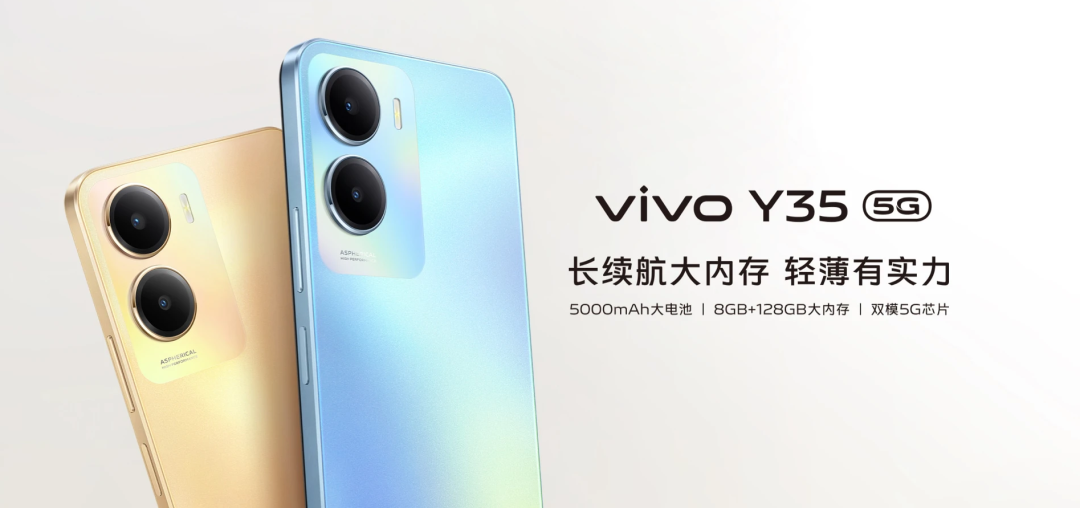
Image source: vivo
A typical example is the vivo Y35 series, which includes models such as the Y35, Y35+, and Y35m. They are highly similar in appearance and differ only in core configurations, priced a few hundred yuan apart and densely distributed across the thousand-yuan price segment.
Relying on the sea of phones strategy, vivo did take the lead in fierce market competition. Data disclosed by IDC shows that in 2022, vivo ranked first in China's smartphone market with an 18.6% shipment share.
By 2026, with memory prices soaring rapidly, the reason smartphone manufacturers' sea of phones strategy is difficult to sustain lies partly in the contraction of market space and partly in the growing memory cost pressure faced by mid-to-low-end phones.
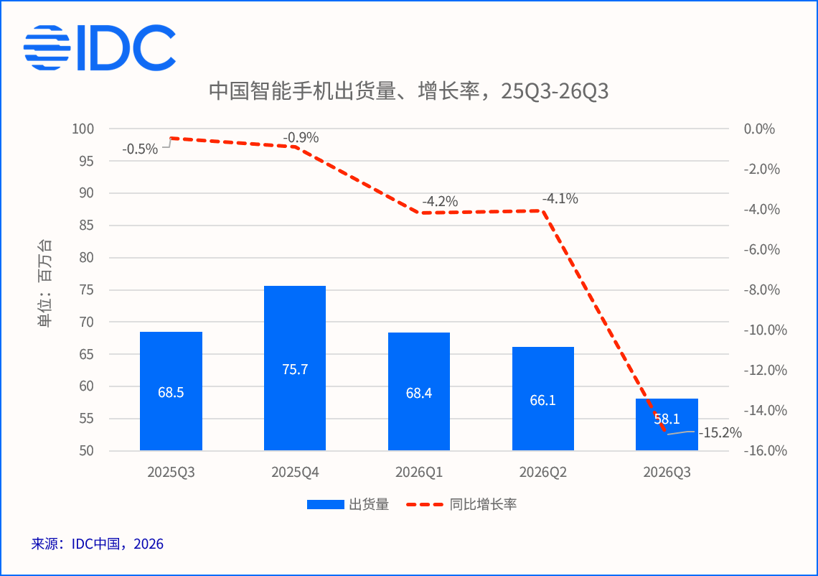
Image source: IDC
From the market perspective, under pressure from rising memory prices, phone prices have risen in tandem, greatly suppressing consumer demand. IDC data shows that from Q4 2025 to Q3 2026, China's smartphone market shipments fell 0.9%, 4.2%, 4.1%, and 15.2% year-on-year respectively, with the decline gradually widening.
Beyond market shrinkage, which makes the room for survival increasingly narrow, rising memory prices will also greatly weaken the profit space of mid-to-low-end phones.
Recently, in an interview with Cailian Press, Wang Xudong of Sigmaintell revealed that in Q3 2026, for a 4GB+128GB thousand-yuan phone, storage costs accounted for 64% of the whole device's BOM, up 42 percentage points year-on-year. "The increase in storage cost per device will swallow all the profits of terminal manufacturers (low-end products)."
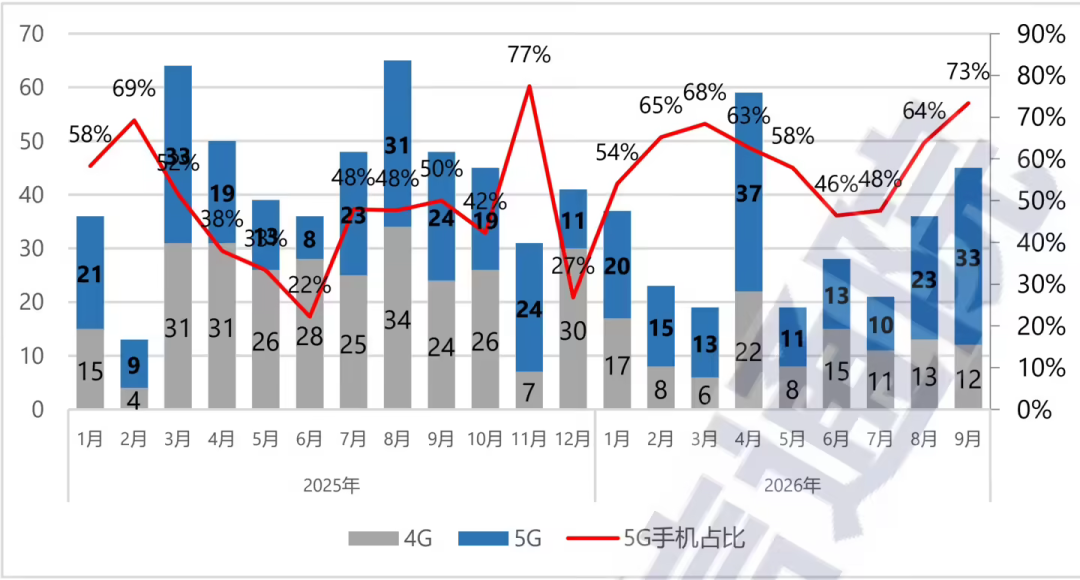
Image source: CAICT
Precisely because the marginal returns of the sea of phones strategy are continuously narrowing, since 2026 many smartphone manufacturers have begun strategic contraction. Data disclosed by CAICT shows that in the first nine months of 2026, 286 new phone models were launched in the Chinese market, down 28.1% year-on-year.
At the manufacturer level, since the beginning of this year, OPPO has continuously integrated the business resources of OnePlus and realme. On July 16, realme announced the suspension of product updates in the Chinese market, with subsequent new products mainly targeting overseas markets.
In September 2026, when Apple launched its annual flagship, it did not update the iPhone 18 standard version, and only launched the iPhone 18 Pro series and the foldable phone iPhone Duo. In addition, according to digital blogger "Digital Chat Station," series such as Xiaomi MIX Flip, Xiaomi Civi, and iQOO Ultra have stopped updates.
On October 24, "Digital Chat Station" further revealed, "Let's say a proper goodbye. Next, several familiar phone product lines or tablet lines will stop updates. Costs can no longer be contained; the more new phones are released, the more losses are incurred."
02 Profit and sales volume: a dilemma under cost pressure
In the past few years, smartphone manufacturers were extremely dependent on the sea of phones strategy largely because this approach could achieve significant economies of scale through component reuse.
Although in the era of rising memory prices many phone products have raised prices, for mid-to-low-end products, limited by product positioning, it is difficult to fully absorb upstream cost pressure through price increases. In this context, if smartphone manufacturers continue to follow their previous product strategies, they can easily fall into a "scale trap."
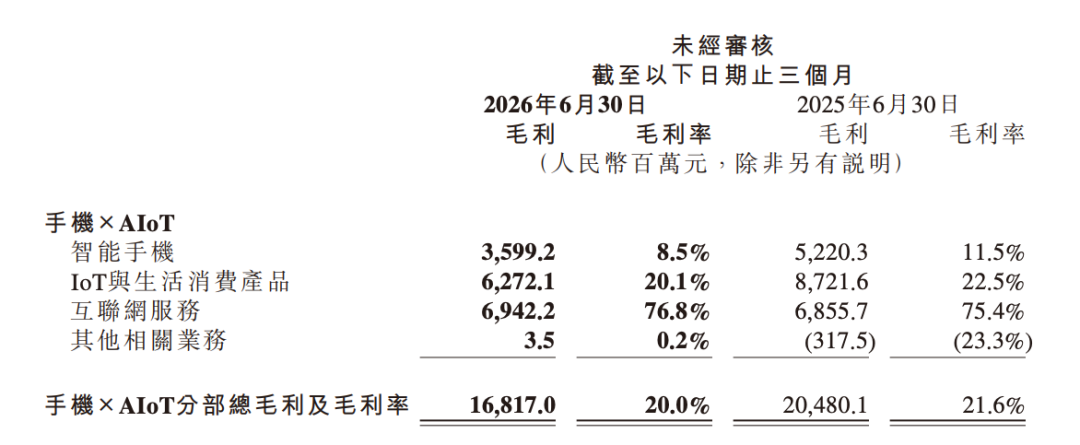
Image source: Xiaomi Q2 2026 financial report
For example, in Q2 2026, Xiaomi's average phone selling price was 1,351 yuan, up 25.9% year-on-year, but the gross margin of its phone business fell 3 percentage points year-on-year to 8.5%, "mainly due to the decline in the gross margin of the Chinese mainland business caused by rising prices of core components."
In April 2026, when promoting the REDMI K90 Max, Lu Weibing—Xiaomi Group partner, president, president of the phone department, and general manager of the Xiaomi brand—said with resignation that the phone's initial launch price of 2,999 yuan was a loss-making sale.
Due to heavy cost pressure, since 2026 the REDMI K90 series has repeatedly adjusted prices, among which the starting price of the REDMI K90 Max has risen to 3,899 yuan, an increase of as much as 30%.
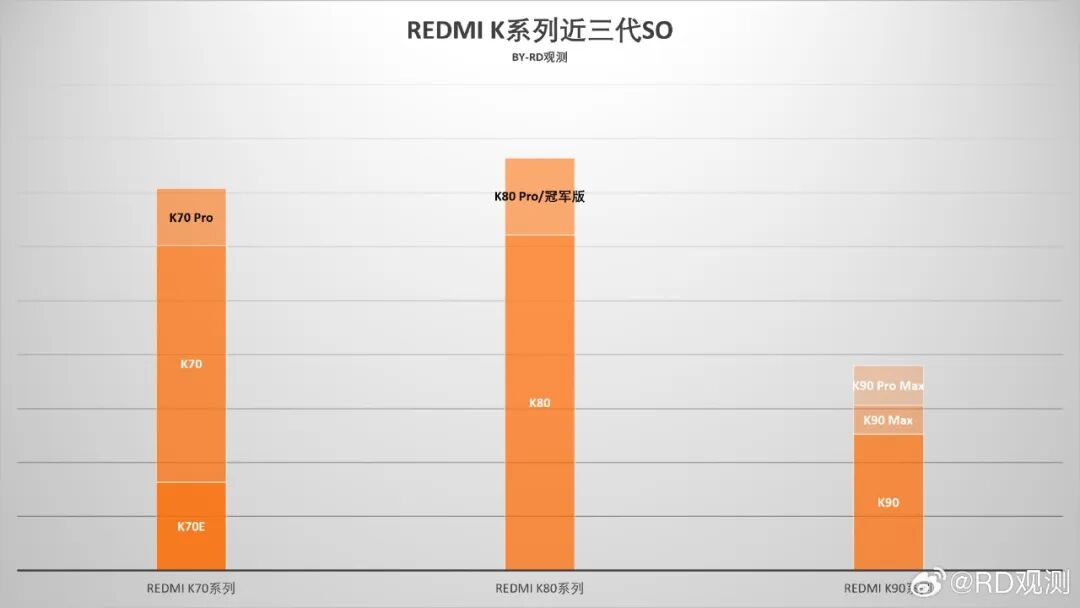
Image source: RD Observation
Although price increases help ease cost pressure, a higher purchase threshold will also suppress consumer demand. In August 2026, data disclosed by digital blogger "RD Observation" shows that sales of the REDMI K90 series were 53.6% of the K70 series and 49.7% of the K80 series.
For smartphone manufacturers, although a new phone can reuse existing components, it still requires investment in development adaptation, marketing, channel stocking, and after-sales support. Launching multiple products with similar positioning, if they cannot bring more sales, will in turn disperse investment, increase inventory and clearance pressure, and add to the operating burden.
03 After the sea of phones strategy recedes, the industry's key battleground shifts
The retreat of the sea of phones strategy does help improve smartphone manufacturers' ability to withstand pressure, but conservative business strategies can hardly help companies ride out the downturn cycle. If they want to show stronger competitiveness in the stock market, smartphone manufacturers need to create more user value.
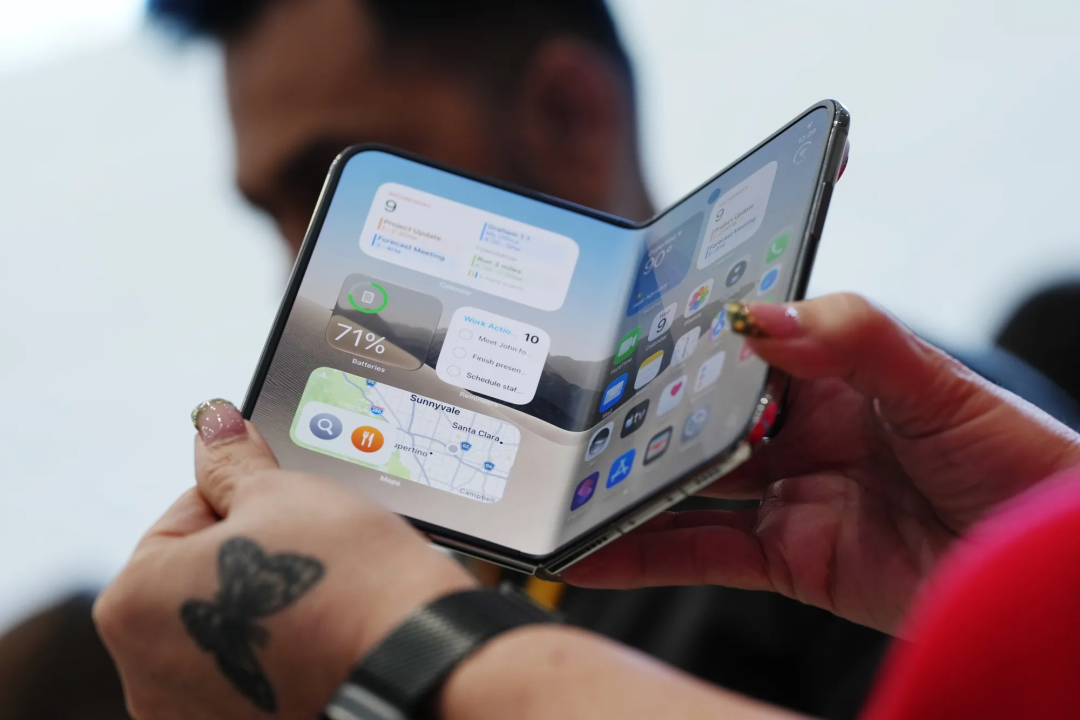
Image source: Apple
Take Apple as an example. Because the appeal of slab phones has weakened, in September 2026 it launched its first foldable phone, the iPhone Duo, adopting an inward horizontal fold design, with a 5.4-inch outer screen and a 7.6-inch inner screen, both with a 1.4:1 ratio, and a starting price of 15,999 yuan.
Although the foldable phone concept is no longer novel, the iPhone Duo shows strong differentiation. The product's inner and outer screens share the same ratio, and when opening and closing it is paired with continuous transition animations, making it more integrated. Moreover, Apple has strong ecosystem appeal, and the third-party app experience is also strongly guaranteed.
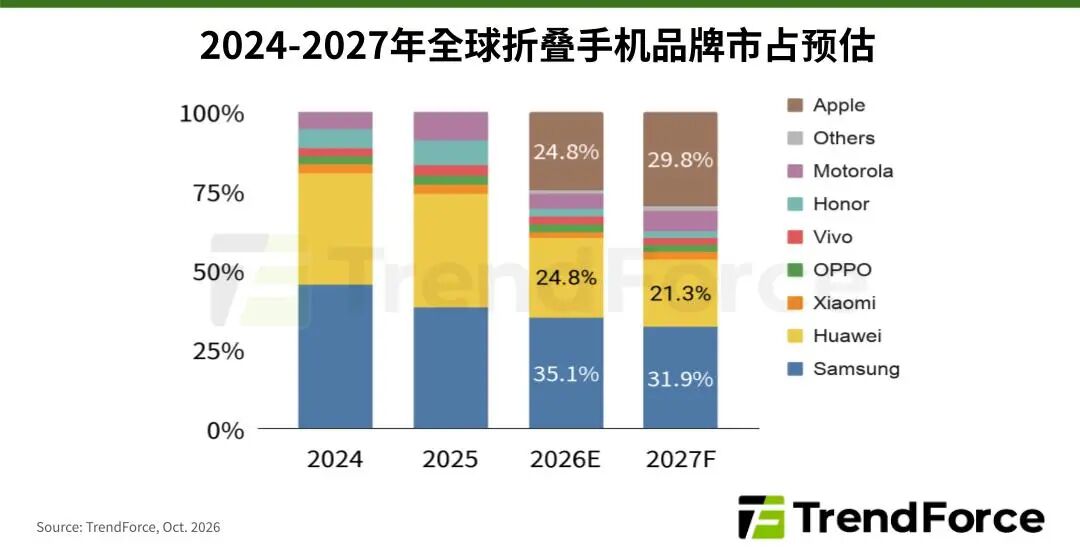
Image source: TrendForce
Thanks to this, despite its high price, the iPhone Duo captured a massive number of consumers. According to "RD Observation," in the first four days of launch, sales of the iPhone Duo approached 200,000 units. A TrendForce research report states that in 2026, iPhone Duo shipments are expected to reach 5 million units, taking a 24.8% share of the global foldable phone market.
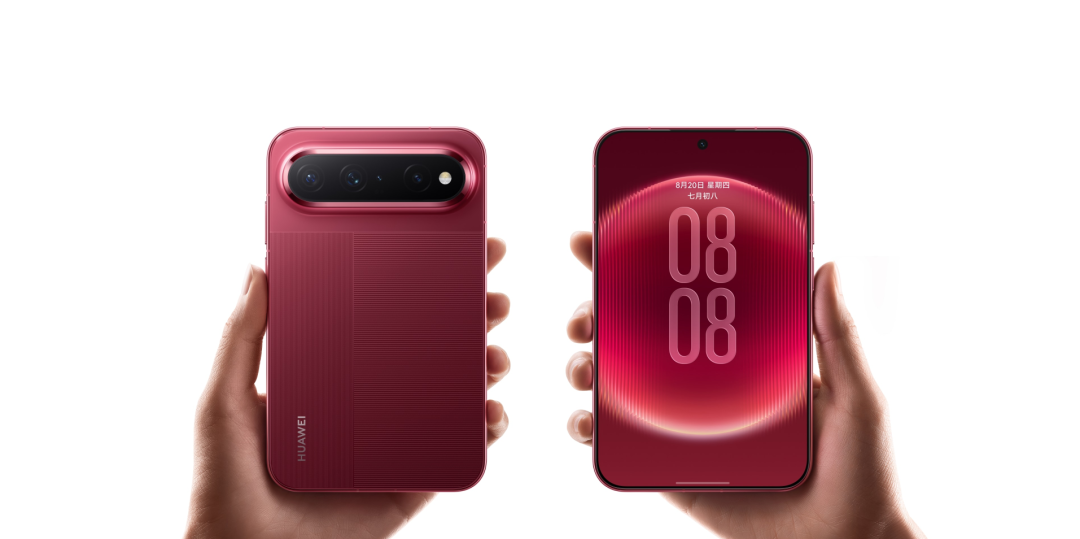
Image source: Huawei
Similarly, Huawei also took a different path and launched the wide slab phone Pura X View in September 2026. Unlike the "slim and long" ratio of traditional smartphones, the Pura X View adopts a "short and stout" design with a screen ratio of 16:9.5, bringing stronger immersion when watching dramas, reading, and gaming.
Because of its unique product form, the Huawei Pura X View also became a hit product. On October 29, "RD Observation" reported that the Pura X View's shipments exceeded 1 million units within 50 days of launch. Tencent Mobile Market Insight data shows that from October 5 to October 24, the Pura X View's highest weekly sales approached 100,000 units, ranking first in sales among domestic flagship phone single models in the 5,000-yuan price range.
Obviously, the successful experiences of products such as the iPhone Duo and Huawei Pura X View show that a market downturn does not mean new demand has completely disappeared. Through product innovation closer to user needs, manufacturers still have the opportunity to attract consumers' attention.
In short, Wang Teng's suggestion to "suspend releasing new phones" explained smartphone manufacturers' current cost dilemma, but also left a harder question—releasing fewer new phones can reduce investment, but where do sales and users come from?
The smartphone industry has long relied on scale to spread R&D investment, maintain channel operations, and strive for supply chain bargaining power. Rising memory prices put this operating model under pressure; low-profit models can hardly absorb costs, while actively reducing products may weaken scale advantages. For manufacturers, cutting a series is easy; judging whether it is duplicate investment or an important pillar for maintaining the sales base is much harder.
This is also why the early performance of new-form products is worth studying. Users may still replace phones for more suitable screens, more convenient operation, and new usage scenarios, but manufacturers need to bear the costs of R&D, adaptation, and market validation. The higher the cost, the easier it is for companies to concentrate resources on main models with greater certainty, and niche needs and new product exploration may therefore lose opportunities.
After the sea of phones strategy recedes, the smartphone market may become more efficient, or it may become more conservative. What will truly test leading manufacturers next is whether, while cutting inefficient models, they can continue to bear the risk of creating new demand.
Protecting profit is the foundation for survival in this cycle; only by creating sufficiently attractive reasons for users to upgrade can companies have the chance to seize the next round of growth.
Interactive topic
Have you changed your phone this year? Why?
This article is original content of Farsight. Reproduction is prohibited without authorization.
-
AI Enters the Deep Water Zone: The Logical Shift from Parameter Competition to Industry Integration
-
![]()
Inside Tesla's Cybercab "Unboxed" Approach: A New Manufacturing Logic for L4 Robotaxis, Working Backward from Production to Design
-
![]()
The Era of Rising Memory Prices: The "Sea of Phones" Strategy Recedes
-
![]()
Over 50,000! Xiaomi Auto's October Report Is Here — but the Annual Target Is Now Out of Reach
-
![]()
Xiaomi Pengcheng Seats Criticized for "Cheap Feel" as Bloggers Analyze Multiple Small Issues
-
![]()
Bizarre! After AITO's "In-Car Toilet" Patent, Deepal's "In-Car Foot Bath" Patent Exposed
-
![]()
Li Kaifu Scores Another Big Win? 01.AI Secures Hundreds of Millions in Investment from Two Levels of State-Owned Capital as Pre-IPO Strategy Accelerates
-
![]()
Fengshou Capital's Li Feng: The Hotter AI Gets, the More We Must Separate the Technology Cycle from the Capital Cycle