Inside Tesla's Cybercab "Unboxed" Approach: A New Manufacturing Logic for L4 Robotaxis, Working Backward from Production to Design
 11/02 2026
 471
In October 2026, Tesla Vice President of Vehicle Engineering Lars Moravy, Cybercab Chief Engineer Eric Earley, and others laid out the Unboxed engineering design of the Cybercab in detail during a public technical interview.
The interview also featured the leads for manufacturing, battery, drive, thermal management, and plastic parts on the Tesla Cybercab program.
On the surface, Unboxed looks like a manufacturing process. In essence, however, it is a set of rules for product development and design.
Given the rapid growth of China's automotive industry and the wave of new-model programs led by L4 robotaxis now stirring into action, this article draws on that in-depth technical interview, together with hands-on automotive design and manufacturing experience, to analyze and share:
The new manufacturing path for L4 robotaxis—how Unboxed frames development and design, how it propagates through the subsystems, and what lessons China's automotive industry can take from it.
01 Raising the Question: The Bottleneck Is in Design
Unboxed began with a blockage in automation.
According to Moravy, who heads Tesla's Product Engineering (PE) department, about five or six years ago Tesla hit a bottleneck while trying to keep raising the automation level of its production line. Here is how he framed the root cause:
The problem wasn't the automation. The problem was the design.
The problem wasn't automation, the problem was design.
— Lars Moravy, Tesla Vice President of Vehicle Engineering
The core principle is accessibility. Conventional final assembly requires operators to climb into an already enclosed body and bend and twist sideways to work in a cramped space. That is hard enough for a human, let alone a robotic arm.
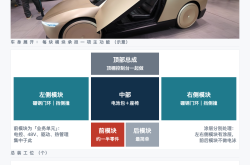
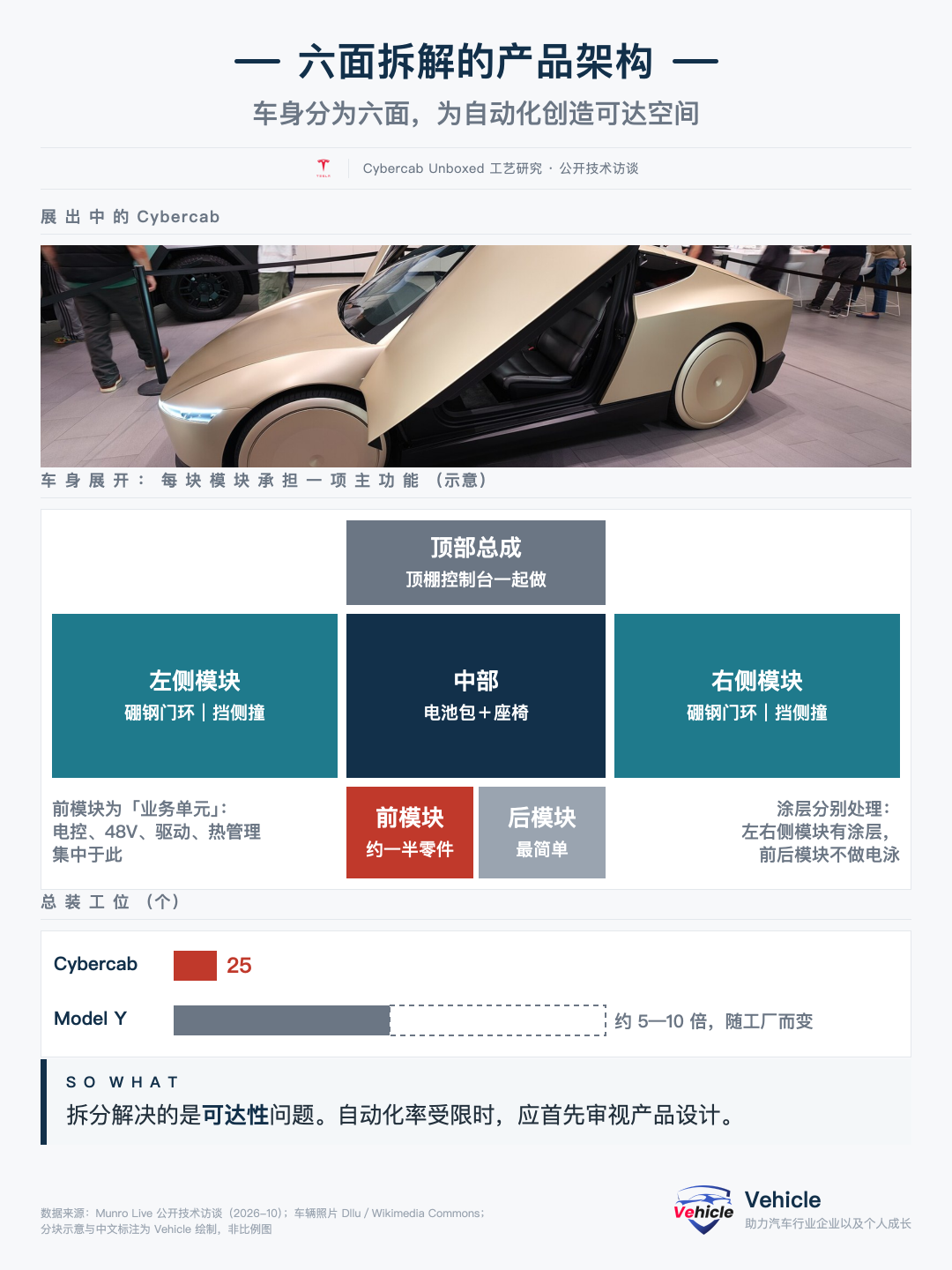
So Tesla shifted its perspective: treat the vehicle as a box with six faces—top, bottom, left, right, front, and rear—and solve accessibility first, before talking about automation.
According to Moravy, this split delivered two benefits: part blocks became smaller, letting robots work closer to the product; and the production line changed from one long line into multiple tributary lines converging on a single main line.
On the headline metrics of Unboxed, Tesla disclosed the following:
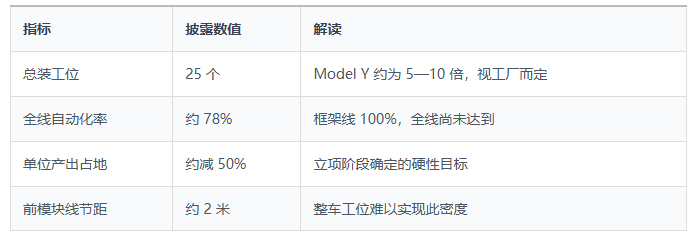
Here, the main takeaway for China's automotive industry—and for manufacturing more broadly—is this: when the automation rate is constrained, examine product design first and add robots second.
02 Production Line Structure: Tributaries and the Main Line
Complexity moves upstream so that main-line assembly can be simplified.
Compared with the generic term "modularization," Tesla's functional division of the six modules is more analytically useful. Moravy calls these the "super functions" of each module, which can be summarized as follows:
Front module (business unit): About half of the parts and content are concentrated here, including power electronics, the 48V battery, the drive unit, and thermal management.
Left and right side modules (safety modules): Two boron steel door rings sandwich the inner and outer panels, mainly providing side-impact protection; they can be assembled flat.
Middle section: Seats mount directly onto the upper cover of the battery pack—already the third generation of Tesla's battery-integration approach.
Top assembly: The headliner and console are made as one piece and can be assembled on a workbench.
Rear module: Relatively simple in structure, with less disclosed content.
The direction of vehicle marriage has also changed. Conventionally, the drive unit and subframe are lifted upward from below into the body. The Cybercab instead places them on a pallet, and the body drops down from above, positioned by the pallet, with spring alignment also completed automatically.
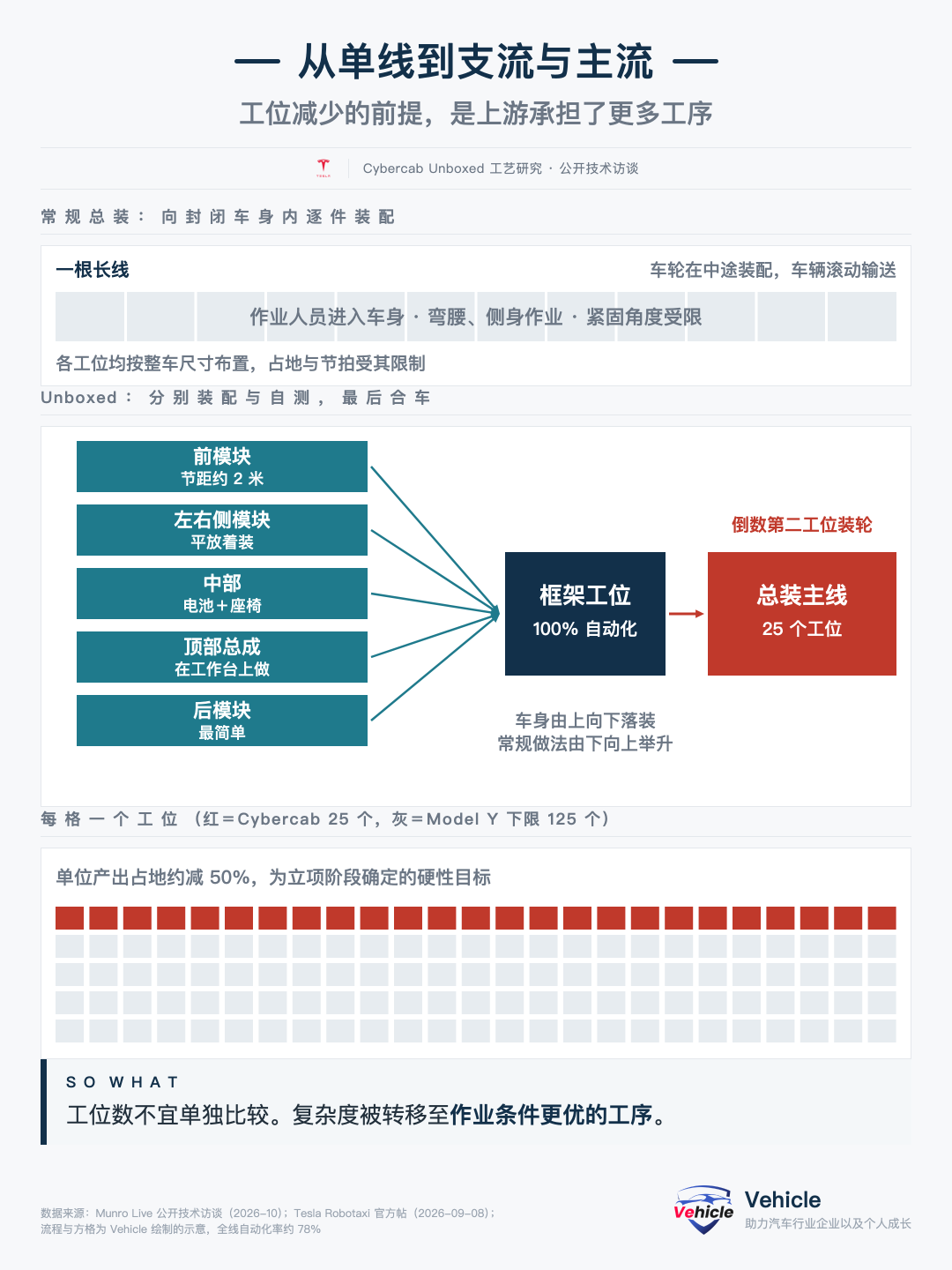
That said, the Unboxed structure does not reduce overall system complexity.
Earley described the front module as "almost insane integration." As a result, the 25 workstations also have to account for upstream processes.
03 Constraint Propagation: One Rule, Four Subsystems
This article considers this the most research-worthy part of Unboxed.
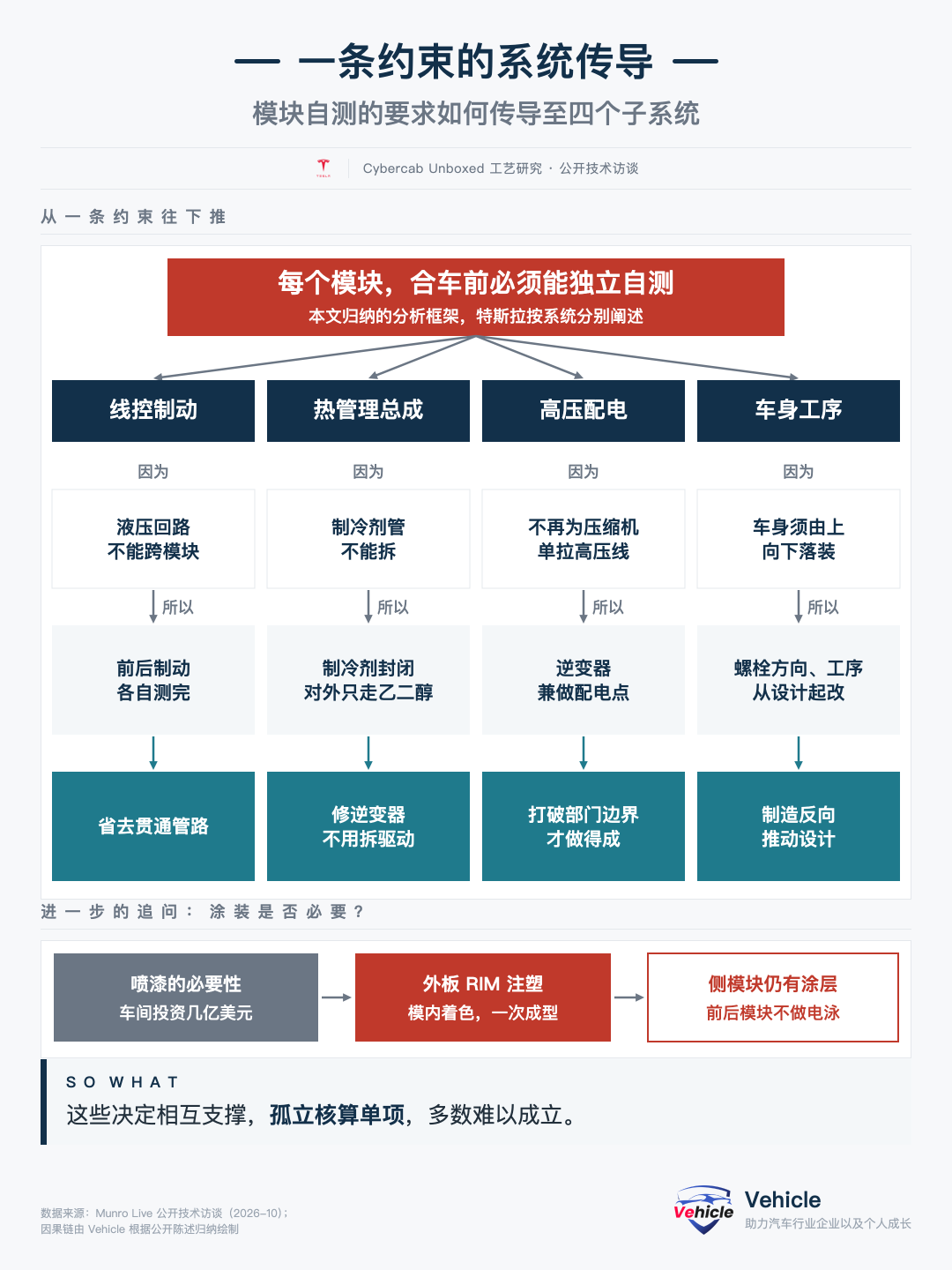
In my view, the most important rule in Tesla's subsystem division is this: each module must be able to self-test independently before vehicle marriage.
01 Braking: Hydraulic circuits cannot cross modules
Hydraulic braking is a closed-loop system. Once the vehicle is split into blocks, the circuit is interrupted and cannot be tested separately. The Cybercab therefore became Tesla's first model to adopt brake-by-wire, with front and rear braking tested within their respective modules—eliminating the need for a continuous oil circuit.
02 Thermal management: Refrigerant circuits cannot be disconnected
Tesla designed the refrigerant side as a closed loop, exchanging with the outside only through glycol. Assembly completes filling, leak detection, and performance testing off-line, and connects two integrated connectors when installed on the vehicle.
The after-sales benefit: servicing the inverter no longer requires lifting the vehicle or removing the suspension and drive unit.
03 High voltage: The inverter doubles as a power distribution point
The air-conditioning compressor no longer draws a separate high-voltage line from the battery pack; instead, one branch is routed from the inverter. Moravy calls this breaking "Conway's Law"—the idea that system structure often mirrors organizational structure, so breaking system boundaries requires first adjusting organizational boundaries.
04 Body: Eliminating painting triggers process and material changes
A paint shop requires hundreds of millions of dollars in investment and also involves VOC emissions; these are the environmental issues tied to painting and e-coating in the paint shop.
Tesla's exterior panels switched to polyurethane reaction injection molding, in which isocyanate, polyol, and colorant are mixed in the injection head, forming a Class A surface in one shot, after which robots trim the overflow.
For the Cybercab, though: although the front and rear modules are not e-coated, the left and right side modules still carry coating. The accurate statement is that the paint shop is eliminated—not that the entire vehicle has no coating.
In China, brake-by-wire already has a regulatory basis: GB 21670—2025 includes electric transmission braking in the national standard, effective January 1, 2026. Chery's Exeed EX7 also began mass production of its EMB system in October this year.
Another estimate holds that EMB costs 30%–50% more than existing solutions. If used only as a selling point for chassis and intelligent driving, its economic viability remains to be demonstrated.
So another reason Tesla adopted EMB brake-by-wire is accounting at the manufacturing and after-sales levels. For the same component, changing the accounting boundary may change the conclusion.
Note: EMB was a highlight of Chinese automotive investment in previous years. For details, see our earlier article "From Product and Investment Perspectives—A Brief Discussion of the Underlying Logic of Brake-by-Wire in Smart Vehicles," which spawned a batch of industry-chain players waiting for adoption.
04 Tolerance Management: Errors Stay Within Modules
The main risks of modular manufacturing—and how to address them.
Modular manufacturing first raises tolerance concerns. Moravy admitted the team was highly worried at first, but after returning to first principles they reached the opposite conclusion.
In conventional processes, parts are assembled one by one on the same body, with errors accumulating gradually, and e-coating and baking may also cause body deformation.
Unboxed first completes each module, then positions them at the theoretical location during vehicle marriage—keeping errors inside the modules and no longer passing them on to the final 25 workstations.
This conclusion has undergone process validation. The team once used Cybertruck, Model Y, and early Cybercab to build framing equipment to test clamping positions and datum settings. According to Earley, these trials did not enter mass production.
This point is rarely mentioned in discussions: part of the validation cost of Unboxed occurred on existing models.
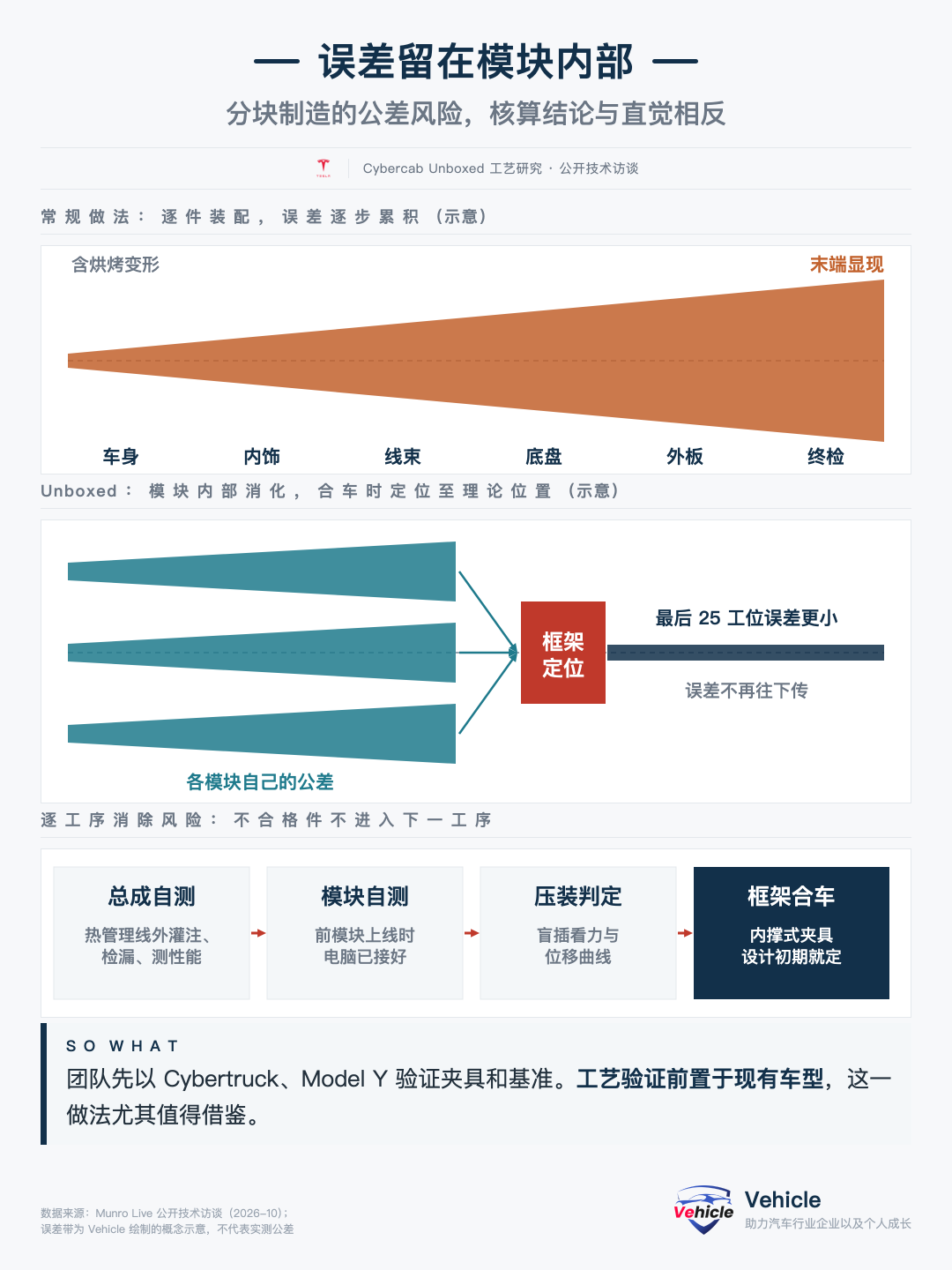
Module self-testing follows the same logic. According to Moravy, when the front module enters the main line, the computer is already connected and the vehicle can already drive, with risks gradually eliminated at each process step.
Its costs also need to be faced squarely. High-voltage blind mating has no latch, so insertion force and displacement curves must be used to confirm proper seating and rule out misjudgments caused by other interference. Tesla's battery lead also regards this as a new field.
The inspiration here for R&D teams is that Unboxed development can conduct its first round of review according to the following checklist:
Module Self-Test Review Checklist (can be copied directly)
Module name:
1. What is the main function of this module? (One sentence)
2. Which functions can be independently verified before entering the main line? Which cannot be verified?
3. How many cross-module pipes and harnesses remain? What is the reason each one cannot be deleted?
4. Where is the vehicle marriage datum? Who is responsible for the final gaps and flushness?
5. If this module fails, can after-sales replace it without removing other modules?
05 Battery Architecture: A Re-evaluation of Structural Batteries
This part is most directly relevant to China's industry.
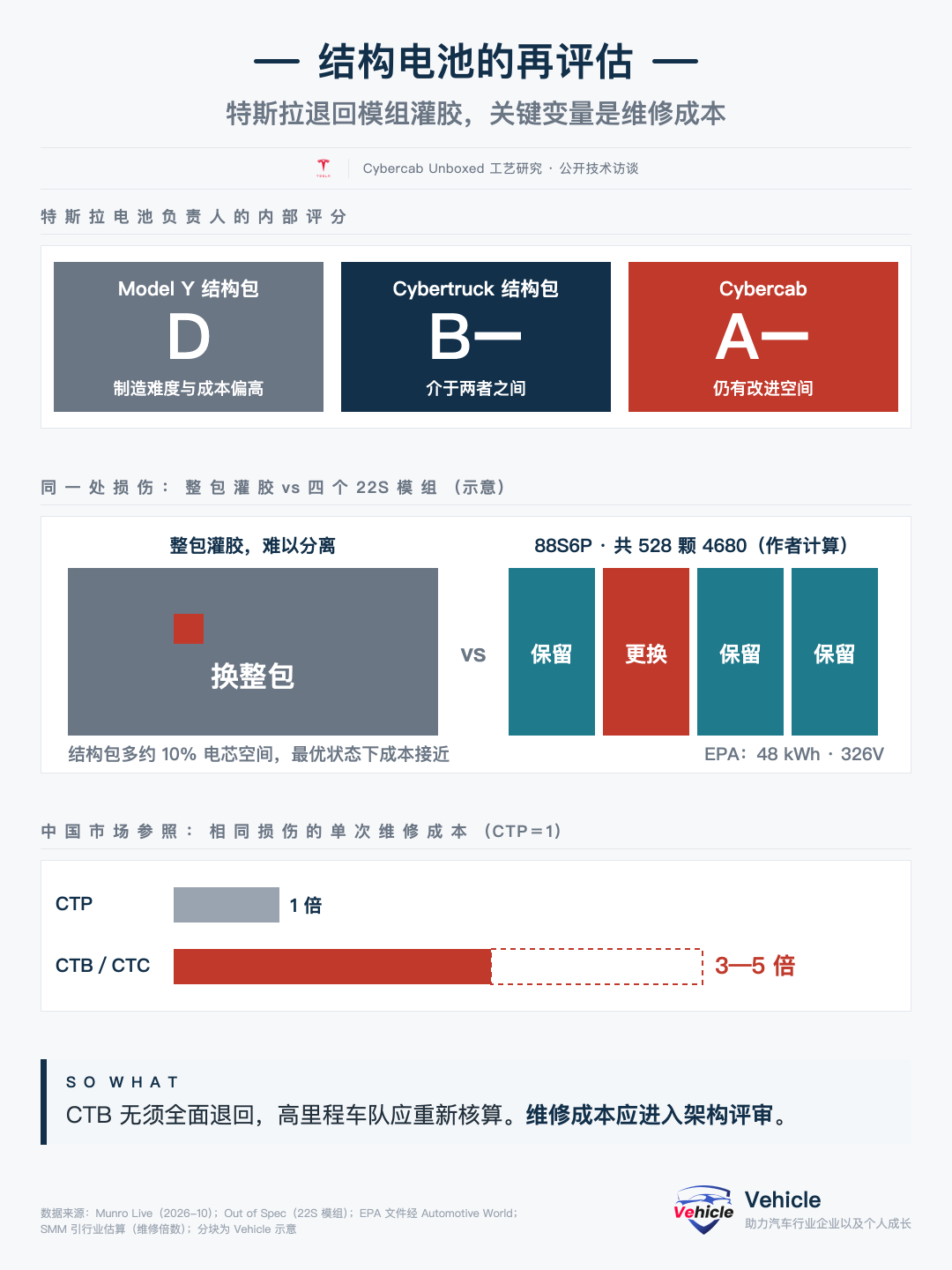
The Cybercab battery consists of 88S6P (i.e., 88 groups of 6 cells connected in parallel) 4680 cells, totaling 528 cells (total count based on Vehicle statistics; omissions are possible). EPA documents record 48 kWh and 326V.
Tesla's battery lead gave the following scores for battery structures from an internal perspective:
Model Y structural battery pack: D. Good user evaluation, but manufacturing difficulty and cost are high.
Cybertruck structural battery pack: B.
Cybercab: Module A. The potting range retreats from the whole pack to the module.
Of course, this score does not mean structural batteries are technically unfeasible. According to him, when both approaches are optimized, costs are close, and the structural pack offers about 10% more cell space.
The decisive variable is serviceability. Unless the cell failure rate is extremely low, structural packs are unlikely to gain the advantage, because the module approach can retain the other three modules when a single point fails. The battery lead added that if the whole pack is replaced once within 500,000 miles, the cost advantage disappears.
Domestic public data can serve as a reference:
SMM cites industry estimates: under the same damage, the single-repair cost of CTB/CTC is 3–5 times that of CTP.
An insurance industry study covering 59 electric vehicles: the average battery pack zero-to-whole ratio is 50.96%.
A dispute in Hangzhou in April 2026: the automaker refused partial repair and quoted about 130,000 yuan for whole-pack replacement, which the insurer did not fully recognize.
CATL's Ningjia Service carries out CTP repairs, usually costing 10,000–20,000 yuan.
However, the above data have inconsistent scopes and cannot be directly compared, but the direction is consistent: China's CTB and CTC are entering the mass-market price range, and their full-lifecycle repair costs still need to be fully accounted for.
That said, Vehicle believes China's industry does not need to consider retreating to modules. Because the annual mileage of private electric cars in China is relatively low, this contradiction is relatively mitigated.
Ride-hailing, Robotaxi, and other high-mileage fleets should recalculate. The lesson from the Cybercab is that repair costs should enter decision-making at the architecture review stage and should not be left to be absorbed in after-sales.
In addition, the battery pack reserves space at the side and bottom of the modules to allow a later switch to lower-energy-density LFP.
06 Cost Discipline: Accounting by System
The calculation examples below are engineer examples, not actual procurement costs.
One principle runs through the statements of Tesla's engineering team: do not waste a single gram of weight. The following examples illustrate its accounting method.
Wireless BMS: Adds 20–30 cents to the circuit board, saves about 1 dollar in wiring and 50 cents in assembly.
Steel instead of aluminum: Steel is about 1.90 dollars/kg, compared with 5–8 dollars/kg. After accounting for added weight, there is still a net saving. Here Vehicle should point out that the U.S. steel industry is developed.
Mechanical oil pump: Replaces the electronically controlled oil pump while deleting the corresponding circuits and firmware.
Inverter: Can be produced on the same line, with PCBA compatible with 12V and 48V, mainly saving capital expenditure.
Reduction ratio: Increased from about 9:1 to 11:1. If 14:1 could achieve the same efficiency, it would be further increased, but gear losses constitute a constraint.
Lubricating oil: Plans to reduce gear meshing losses by 7% through oil replacement within 2026.
Quality management is equally strict. According to Moravy, the crash and braking teams are not allowed to each add 20% margin. If test parts do not fail within the 95%–100% range of the specification, the design is considered not up to standard.
According to EPA documents reported in the media, the Cybercab has a curb weight of 1,412 kg and a gross vehicle weight rating of 1,692 kg.
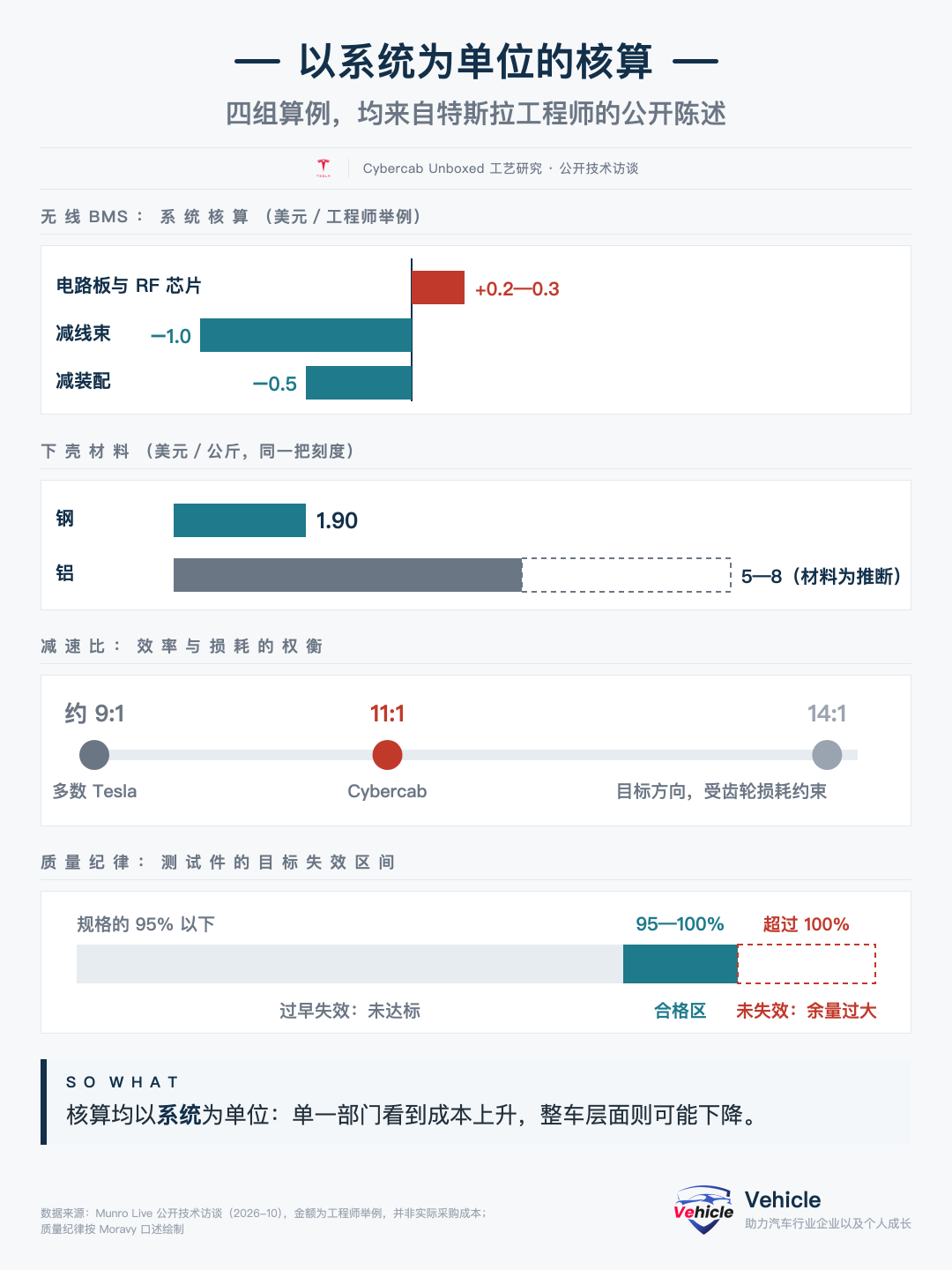
There is also a detail worth noting at the supply chain level: empty solder pads are left on the inverter circuit board to allow for dual-supplier switching, with A and B suppliers reserved for each component. Although this entails considerable engineering workload, it provides capacity assurance when chip supply is tight.
Speaking of cost pressure in China, Moravy pointed out that Tesla is also highly automated in China, and that the focus of competition is not labor hours.
Vehicle believes: Labor cost advantages can sustain competitiveness at a given stage, but they cannot replace cost optimization at the product design level.
07 Industry implications: Two paths and layered reference
This section presents the author's views for industry discussion.
Considering the progress of China's automotive industry, I believe the evolution of automation can be summarized into two paths.
Path 1: Adapt the product to the robot. Tesla Unboxed falls into this category.
Path 2: Adapt the robot to existing products. Several automakers are advancing humanoid robot factory training. Xiaomi's publicly disclosed self-tapping nut loading station has a two-sided success rate of 90.2%.
The two paths are not mutually exclusive. I believe some of the challenges faced by Path 2 can be eliminated in advance during the design phase of Path 1.
The manufacturing foundation of Chinese automakers is actually quite advanced. According to Xinhua News Agency, the automation rate of over 200 key processes at Xiaomi's factory is 100%; Nikkei reported that it rolls one vehicle off the line every 76 seconds. This figure refers to key processes and is not directly comparable to the 78% for the entire line.
The difference is that most Chinese Robotaxis are currently derivative vehicles based on existing models.
Pony.ai's seventh generation is based on BAIC, GAC, and Toyota models, targeting a full-vehicle BOM of under 230,000 yuan by mid-2027. XPeng Robotaxi is based on GX, and Geely Eva Cab plans to launch a Cao Cao Mobility custom version in 2027.
The derivative route has a short cycle and low risk, making it a reasonable choice. For companies planning to develop purpose-built dedicated models, Cybercab provides an important reference sample.
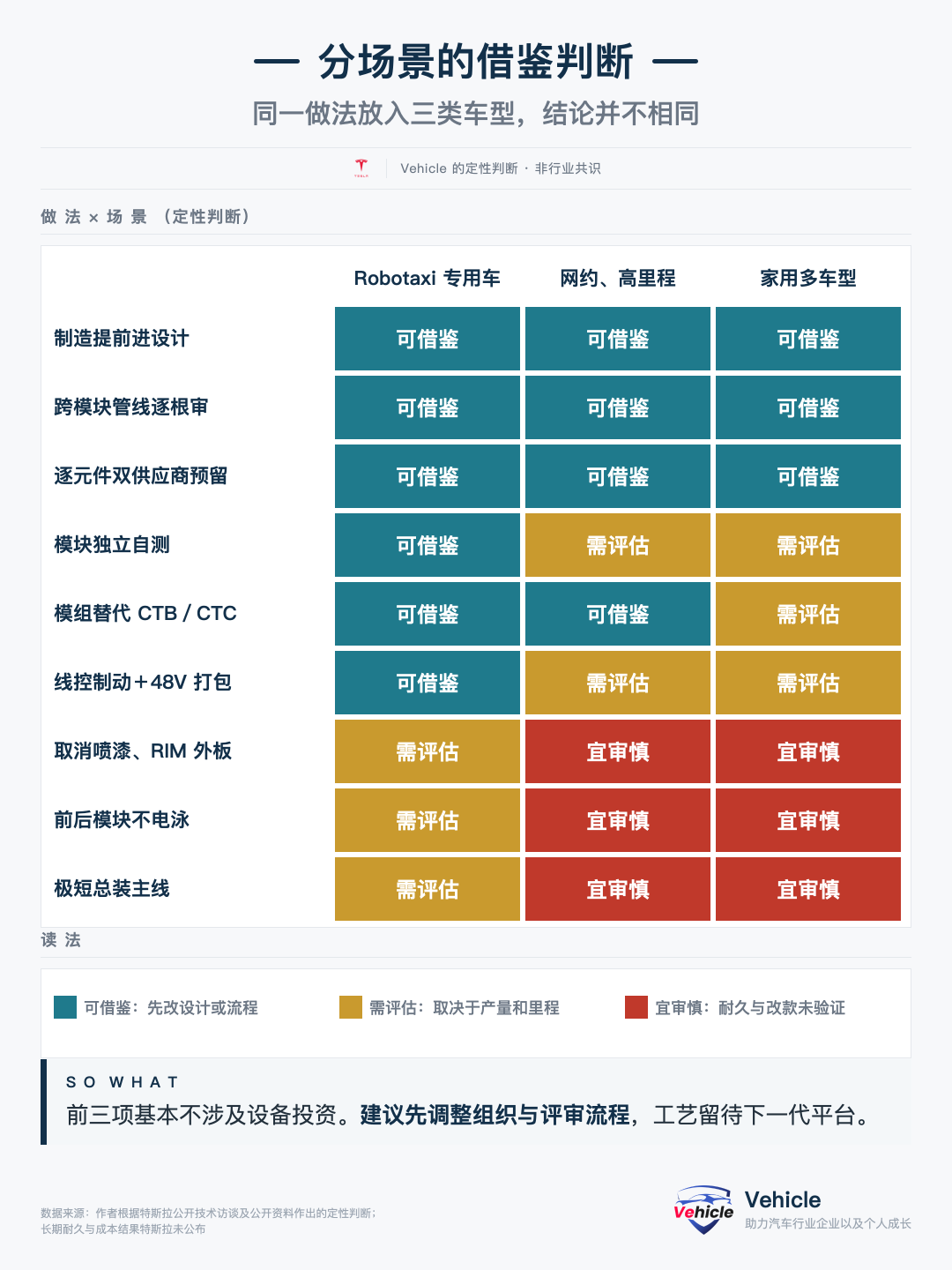
If you are also recently looking to develop Robotaxi models, the author suggests evaluating the reference value at three levels.
01 Near-term reference
Advance the point at which the manufacturing team intervenes in design reviews: in the Cybercab project, the manufacturing team proposed design modification requirements in reverse.
Review cross-module pipes and wiring harnesses one by one: no need to modify the production line, only design adjustments are needed.
Reserve dual suppliers for each component: small changes, but a large contribution to supply chain resilience.
02 Next-generation platform evaluation
Independent module self-testing and off-line filling of the thermal management assembly.
Recalculate CTB/CTC and module solutions based on fleet operating conditions.
Evaluate inverter power distribution, 48V, and brake-by-wire as a whole to avoid isolated item-by-item calculations.
03 Treat with caution
Eliminating paint: the Chinese market has high requirements for color selection and model update cadence, and the cost of switching colors and textures for RIM exterior panels has not yet been disclosed.
No electrophoresis for aluminum parts: the 500,000-mile durability claim currently only exists at the material level and lacks fleet data.
Extreme takt time: depends on sufficient single-model production volume; Tesla's premise is thousands of units per week. The calculation for a multi-model mixed-line factory is completely different.
At the project initiation stage, you can self-check against the following questions:
The five Unboxed questions at the project initiation stage can be directly copied
1. Are factory goals (floor space, takt time, automation rate) written into the product definition?
2. Do the manufacturing and automation teams have veto power before styling freeze?
3. Who is responsible for calculating each system? Can manufacturing savings offset R&D increments?
4. Are maintenance costs and downtime costs included in architecture reviews?
5. Can the current-generation process first use existing models as a validation platform?
08 Closing remarks
Research limitations and questions for further discussion
Of course, there are clear limitations to what we are discussing. Tesla has not disclosed production volume, per-vehicle cost, or measured takt time. Therefore, this article can discuss design logic, but the final cost outcome cannot yet be verified.
In addition, according to Moravy, the production line is currently not running every day, and line speed has exceeded deployment speed. According to the latest report by EVwire, its Texas registration count is 465 units, still a small base.
So, I believe the main bottleneck for Cybercab has shifted to FSD autonomous driving capability, regulation, operations, and demand.
Finally, back to L4 vehicle design, the following questions still need further industry discussion:
1. Is the complexity transfer brought about by modularization still economical in China's industrial environment with multiple models and multiple suppliers?
2. Maintenance costs for high-mileage fleets are actually proposed by the maintainability department for inclusion in architecture decisions during the development stage, but how to assess the decisions is very difficult?
3. At what production volume and model life cycle do Path 1 and Path 2 reach an economic inflection point?
4. With what public data should the long-term durability of RIM exterior panels and non-electrophoresed aluminum parts be verified?
Regardless, the vehicle manufacturing thinking and concepts for L4 models have begun to differ from those for passenger cars. Using passenger car thinking to develop L4 models may lead to mistakes.
This article is compiled based on public information and contains forward-looking judgments by the parties involved and the author's views. It is for reference only.
Thank you for reading. You are welcome to exchange views on the above questions in the comment section.
*Unauthorized reproduction and excerpting are strictly prohibited-
-
AI Enters the Deep Water Zone: The Logical Shift from Parameter Competition to Industry Integration
-
![]()
Inside Tesla's Cybercab "Unboxed" Approach: A New Manufacturing Logic for L4 Robotaxis, Working Backward from Production to Design
-
![]()
The Era of Rising Memory Prices: The "Sea of Phones" Strategy Recedes
-
![]()
Over 50,000! Xiaomi Auto's October Report Is Here — but the Annual Target Is Now Out of Reach
-
![]()
Xiaomi Pengcheng Seats Criticized for "Cheap Feel" as Bloggers Analyze Multiple Small Issues
-
![]()
Bizarre! After AITO's "In-Car Toilet" Patent, Deepal's "In-Car Foot Bath" Patent Exposed
-
![]()
Li Kaifu Scores Another Big Win? 01.AI Secures Hundreds of Millions in Investment from Two Levels of State-Owned Capital as Pre-IPO Strategy Accelerates
-
![]()
Fengshou Capital's Li Feng: The Hotter AI Gets, the More We Must Separate the Technology Cycle from the Capital Cycle