2.5x More Light Intake: Why Mobile Phone Cameras Need to Retire the 1974 Filter
 11/17 2026
 390
Metalenz has acquired Israeli company PxE, employing a diffractive layer built directly on the sensor to replace the 1974 Bayer filter. The company claims 2.5x greater light collection and simultaneous depth measurement. Consumer electronics adoption, however, will have to wait until the end of 2027.
The most critical layer of technology in mobile phone cameras was invented in 1974 and has barely changed since. When the shutter is pressed, the sensor converts light into electrical signals and assembles them into a digital image—but the Bayer filter covering the sensor is a red-green-blue array that defines pixel colors by blocking the other two colors. The cost: roughly 60% of incoming light is absorbed and wasted before it ever reaches the sensor. To capture one red pixel, blue and green light are discarded first.
Boston-based Metalenz has acquired Israeli startup PxE Holographic Imaging, betting on the latter's optical structure called HoloCoder. This microscopic structure is built directly on top of the image sensor and does not absorb light; instead, it diffracts light waves, redirecting them so they land in the corresponding pixels. Acquisition terms were not disclosed. According to the company, the sensor can therefore receive up to 2.5x more light.
Separating colors by diffraction instead of color filters
With increased light intake, the most direct benefits are low-light shooting and dynamic range. In high-contrast scenes—such as selfies with a bright window behind the subject—the sensor can take in more light, highlights are less likely to be overexposed, and shadows are less likely to be swallowed by noise. The claimed 2.5x figure is not yet supported by third-party measured data, and PxE's technology has not yet entered the market, so caution is warranted when judging its impact on mass production.
Another accompanying capability is obtaining three-dimensional depth information simultaneously. Today's phones rely on secondary cameras, dedicated depth sensors, or algorithmic estimation to determine the distance of subjects and then decide the degree of blur in portrait mode. HoloCoder combines light sensing and depth sensing into the same layer, theoretically eliminating certain components on the back of the phone, freeing up space, and consuming less computing power. It should be noted that HoloCoder is diffractive optics rather than a true metasurface, and Metalenz says it has already reproduced this technology in the lab using its own metasurface optics.
300 Million Units Shipped: The Real Confidence Behind the Acquisition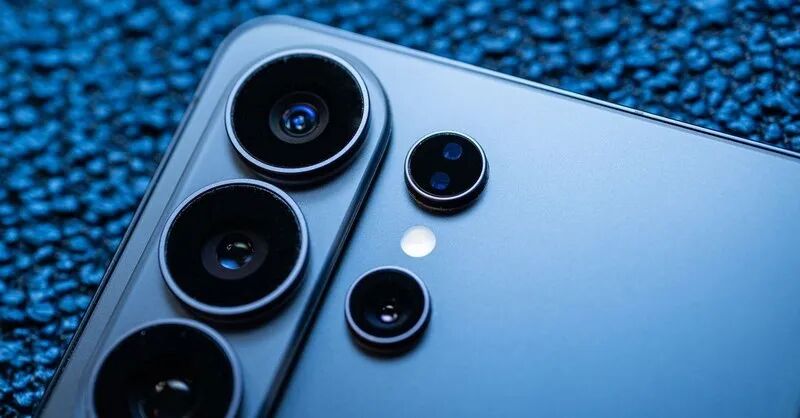
Image source: Wired
Metalenz emerged publicly in 2021 and commercializes metasurfaces: using flat lenses made of nanostructures to bend light, reducing the number of lenses needed above the sensor while taking in more light. The company says it has delivered more than 300 million such metasurface optical elements to consumer devices. The technology can also read polarization data, and Metalenz is working with Qualcomm on a facial biometric solution called Polar ID for Android devices, targeting Apple's Face ID and expected to enter consumer devices by the end of 2027.
CEO Rob Devlin puts it bluntly: Apple, Samsung, and Google compete every year to improve visible-light cameras, spending hundreds of millions of dollars on software—but once information is absorbed and lost at the filter, no amount of software can buy it back. Metalenz already has the supply chain, image processing pipeline, and machine learning algorithms to use the new data streams, and Devlin believes PxE's HoloCoder can be embedded directly into this platform, even describing the endgame as "one sensor rules all": a single image sensor simultaneously providing polarization, filter-free color, and depth channels. In the short term, the two technologies will still exist as separate products for different markets; convergence is the long-term plan, with consumer electronics applications expected as early as the end of 2027 or early 2028.
The Half That Academia Does Not Buy
Arka Majumdar, who studies low-energy optoelectronics at the University of Washington, acknowledges that light loss in filters is a real problem. He also notes that Samsung and a startup called Eyeo are researching alternatives to Bayer filters, known in the industry as color routers. In other words, Metalenz is not the only company pursuing this direction.
But he is skeptical about the robotics and autonomous driving part. Devlin believes a single-sensor solution can replace multi-sensor modules and bulky LiDAR with smaller, cheaper, and less compute-intensive structures—which would be transformative for autonomous robots and self-driving cars. Majumdar's rebuttal: there is plenty of room in a car for stereo cameras or LiDAR; the bottleneck has never been low light or image quality, but the computing power needed to make instantaneous decisions. In his words, better data could actually make things worse. The disagreement between the two judgments centers on compute cost—precisely the hardest link to verify before mass production.
The Sensor Supply Chain Will Need to Be Repositioned
If the color separation layer is to be built directly on the image sensor, value distribution will shift from lens modules toward sensor design and wafer-level optical integration. Image sensors are semiconductor devices to begin with, and once diffractive structures must align with pixel arrays at the wafer level, joint development relationships among sensor makers, optical design companies, and phone manufacturers will become much tighter than they are now. Chinese phone manufacturers and domestic image sensor suppliers have been catching up quickly in recent years in stacked structures, large sensors, and algorithms. If patents on the color separation step are locked up by a few metasurface companies, the room for compensating with algorithms in later stages will be significantly compressed. Devlin's line about lost information being unbuyable points precisely to this.
There are three verifiable milestones for judging the industry impact: whether Polar ID enters consumer devices on schedule by the end of 2027, when the first models equipped with HoloCoder appear, and whether the 2.5x light intake is verified by third parties. Until these three things happen, the more appropriate reading is a technology option acquisition rather than the mobile phone camera having already been upgraded. Something unchanged for 50 years will not immediately exit because of one acquisition—but combining color, depth, and polarization into one layer does point the sensor industry toward a new division of labor.
Today's Golden Quote
"The light blocked by the filter cannot be bought back no matter how expensive the software is. Moving color separation from chemical pigments to nanostructures on wafers changes the division of labor in the sensor industry—not just night photos."
Follow [De Gaohang Zhiqinglang] for three hardcore technology interpretations every day, to understand the industry and national fortunes behind technology.
-
![]()
XPeng: Cash Generation from Vehicle Sales Picks Up — How Long Before the Chinese Tesla's AI Dream Comes True?
-
![]()
Is Chery Eyeing a British Brand Acquisition? Could Jaguar Land Rover Be the Target?
-
![]()
Dealerships' Plea: Survive, Make a Profit, Live with Dignity
-
![]()
GAC Group Sells 143,687 Vehicles in October: How Should Aion and the Joint Ventures Redistribute Roles?
-
![]()
2.5x More Light Intake: Why Mobile Phone Cameras Need to Retire the 1974 Filter
-
![]()
What Chinese Automakers Look Like in the Eyes of European Policy Circles
-
![]()
Huawei Doesn't Build Robots, Yet 80% of Robot Companies Run on Its Cloud
-
![]()
Breaking! Changan Automobile Sells 10% Avatr Stake for 3.2 Billion Yuan—What's the Real Reason?