Breaking! Changan Automobile Sells 10% Avatr Stake for 3.2 Billion Yuan—What's the Real Reason?
 11/17 2026
 450
On the evening of November 12, a listing announcement on the Shanghai United Assets and Equity Exchange set the new energy vehicle industry abuzz.
Changan Automobile plans to sell a 10% stake in Avatr, with a floor price of 3.1828 billion yuan—commonly referred to as "3.2 billion"—corresponding to more than 300 million shares. The public notice period runs until December 10.
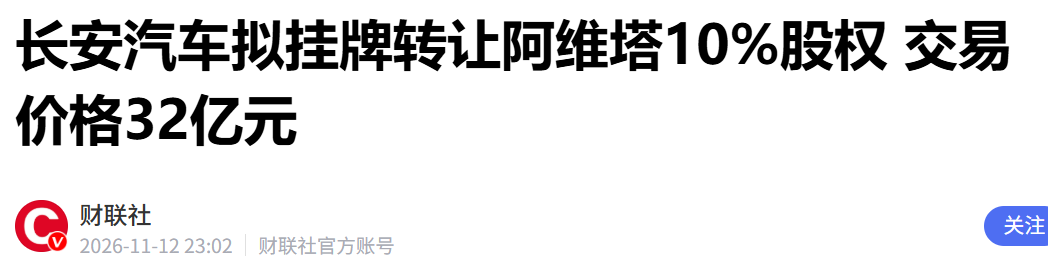
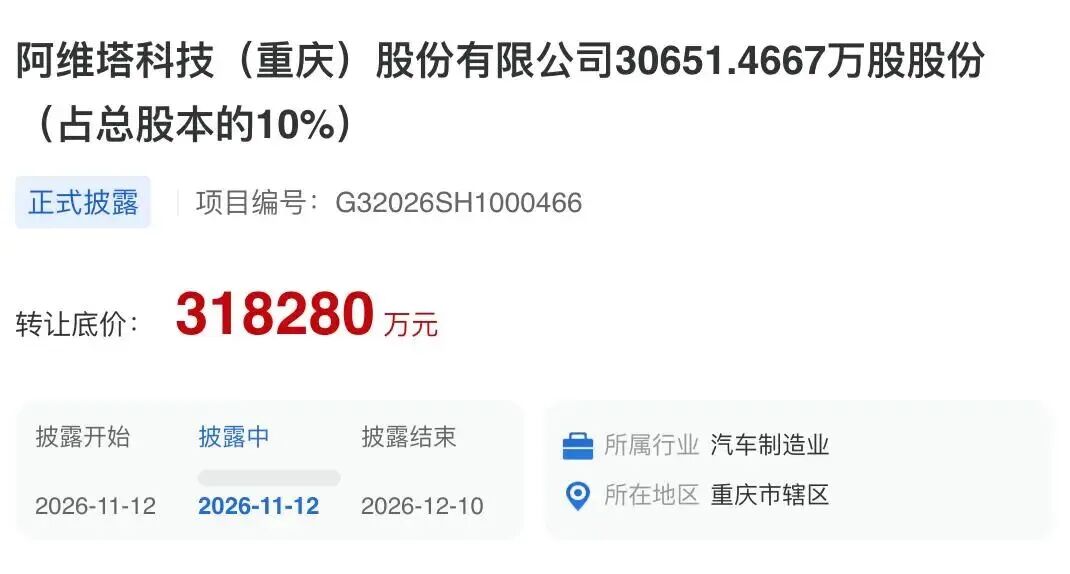 Image source: Shanghai United Assets and Equity Exchange
Public opinion immediately split into two camps: Is Changan unable to hold on and starting to offload burdens? Or does it simply not think highly of Avatr?
Image source: Weibo
Let's do the math first. Based on the floor price, Avatr's overall valuation is about 31.8 billion yuan, roughly on par with its post-Series C valuation. After the transaction, Changan's stake will drop from 40.994% to 30.994%—giving up one-tenth while its top position remains unchanged. CATL holds 9.1742% in second place; if this 10% is swallowed by a single buyer, the new shareholder would directly take the second chair.
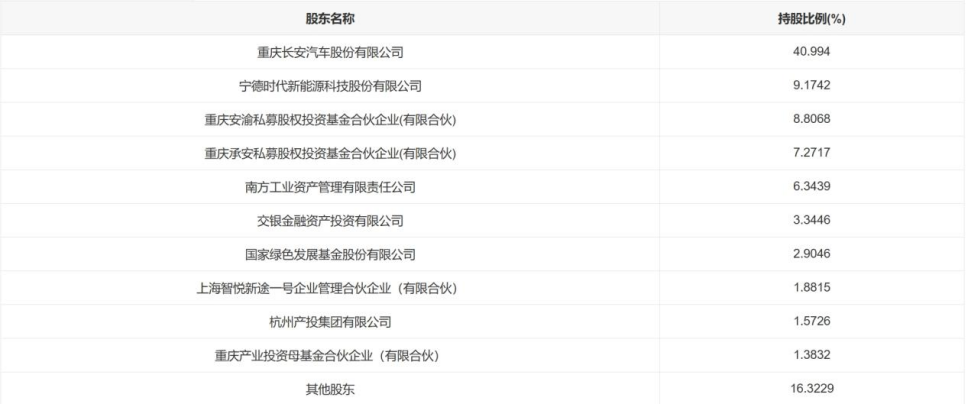 Image source: Weibo
Key point: this is a transfer of old shares. The 3.2 billion yuan goes into Changan's pocket—not a single cent reaches Avatr's account. What Avatr wants is not cash, but the set of resources in the new shareholder's hands.
The threshold is maxed out—it's not just about who has money
If you want to take over, first weigh whether you qualify. Changan set the threshold bluntly: financial players just looking to make quick money are not welcome.
Interested parties must first pay a 500 million yuan deposit, which must arrive within one day after qualification confirmation; once the contract is signed, full payment must be completed within three working days. There are also hard requirements: the money must be clean, the buyer must not compete with Avatr's business, and must promise not to disrupt the listing pace. A consortium is allowed, but management does not participate.
Such tight payment terms and picky conditions are essentially a screening process: having 3.2 billion yuan, making decisions quickly, possessing industrial resources, and not colliding with Avatr in the high-end segment—there are very few such buyers after a full search.
Avatr put it frankly: it does not lack money to burn right now. Now that the brand has reached the stage of going high-end and venturing overseas, it needs teammates who can help it set up high-end stores and open overseas channels.
Domestic EVs have long turned into a red ocean, and going overseas has become the way to survive. In October, domestic automobile exports reached 1.06 million units, up 60.2% year-on-year, breaking one million for five consecutive months, with BYD, Geely, Chery, XPeng, and Leapmotor all fighting for this increment.
Avatr's KPIs are not low: sales to hit 400,000 units by 2027 and revenue to exceed 100 billion yuan, with overseas an unavoidable part. Changan giving up this portion of equity is ultimately trading shares for a ticket to go global.
Stake dropped from 95% to 31%—independence was arranged long ago
Changan did not start loosening its grip today; it has been diluting its stake for years.
Avatr was originally called Changan NIO. After Changan's capital increase in 2020, its stake soared to 95.38%, basically making it an internal project. Later, CATL, state-owned capital funds, and local investment platforms came to the table one after another, and Changan's stake was gradually lowered all the way to 40.994% before the listing. This transfer is another step in a long-term plan, not a sudden impulse.
The three-party combination is not unfamiliar: Changan handles vehicle manufacturing, chassis, and supply chain; CATL supplies batteries and electric drive systems; Huawei holds no equity, and Avatr paid 11.5 billion yuan for 10% of Yinwang in exchange for Qiankun smart driving and HarmonyOS cockpit, namely HI PLUS. Someone in the comments added: "If Huawei also took 10% of Avatr, Avatr could take off." Crude as it is, the point stands—with the same Huawei empowerment, whether or not it holds equity, the imagination space the market gives is not on the same level.
But to really list in Hong Kong, there is an obstacle that cannot be avoided: the major shareholder's stake is too high. Once the outside world treats Avatr as Changan's high-end business unit rather than a company that can make its own decisions, related-party transactions and independent decision-making will be repeatedly questioned.
Proactively reducing the stake, bringing in external industrial shareholders, and diluting for diversification are all aimed at suppressing this concern. Changan also stated: even with fewer shares, it will still provide R&D, manufacturing, and supply chain support.
This move aligns with the AD synergy at the end of September: Changan established an AD synergy department, with AD taken from Avatr AVATR and Deepal DEEPAL, led by Deepal's Deng Chenghao, with one core goal—connecting the back offices of the two brands and sharing costs together.
The difficulty lies in: front offices independent, back offices shared to save money, and still having to pass Hong Kong audit. Zeekr tackled this problem back then: signing fair related-party agreements in advance, independent director review, and later, when it wanted to integrate further, simply going private.
Changan's solution is clear: on one hand, back-office synergy to reduce costs; on the other, proactively giving up shares to fade the "Changan sub-brand" label. Front-office independence, back-office sharing, and diversified equity to make listing compliance complete—selling equity is just one part of it.
The story sounds nice, but sales and losses are on the table
Once the data is laid out, Avatr's true colors show—and this is also the hardest part of the IPO.
There are discrepancies between the two sets of figures, caused by revenue recognition and audit adjustments, but the facts remain unchanged: revenue surged in 2025, gross margin turned positive, and losses continued. Under the prospectus basis, revenue was 25.631 billion yuan with a gross margin of 9.4%; under the audit basis, revenue was 25.869 billion yuan with a net loss of 3.489 billion yuan. Over three years combined, from 2023 to 2025, losses totaled about 11.2 billion yuan.
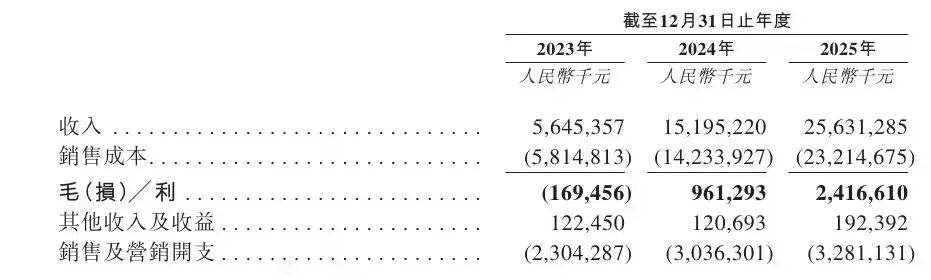 Image source: financial reports
Someone in the comments did another calculation for Changan: "Look at Avatr's performance—even if you were Changan, you wouldn't think that way. You underestimate the determination of state-owned enterprises to monopolize high-quality resources." Harsh, but it hits the point—SOEs' patience in strategic tracks never follows quarterly financial reports.
Cash flow is even more worrying. At the end of 2024, cash on the books was 19.323 billion yuan; by the end of 2025, only 9.687 billion yuan remained; by the end of April this year, it had slid to 6.249 billion yuan. More than ten billion disappeared in just over a year, the bulk of it the 11.5 billion invested in Yinwang, with the rest burned on R&D and marketing.
The chill in sales is visible to the naked eye. Deliveries of 122,700 units in 2025 were still decent; in 2026 it dropped a notch directly—7,056 units delivered in October, nearly halved year-on-year and still declining month-on-month, with no single month this year exceeding 10,000. The blame is not Avatr's alone; Aito and Luxeed are also under pressure domestically, and competition in high-end EVs has long become white-hot. The comments are even more direct: "Changan still has Qiyuan in the 100,000-yuan class, selling no worse than MONA, but traditional automakers really can't keep up with the pace of new forces—big ships are hard to turn." Others summed up the HarmonyOS Smart Mobility landscape: "Five realms, three states, one tower—the one tower is the hardest." Some also got to the root: no matter the brand, after-sales must be handled well—this tests reputation more than monthly sales.
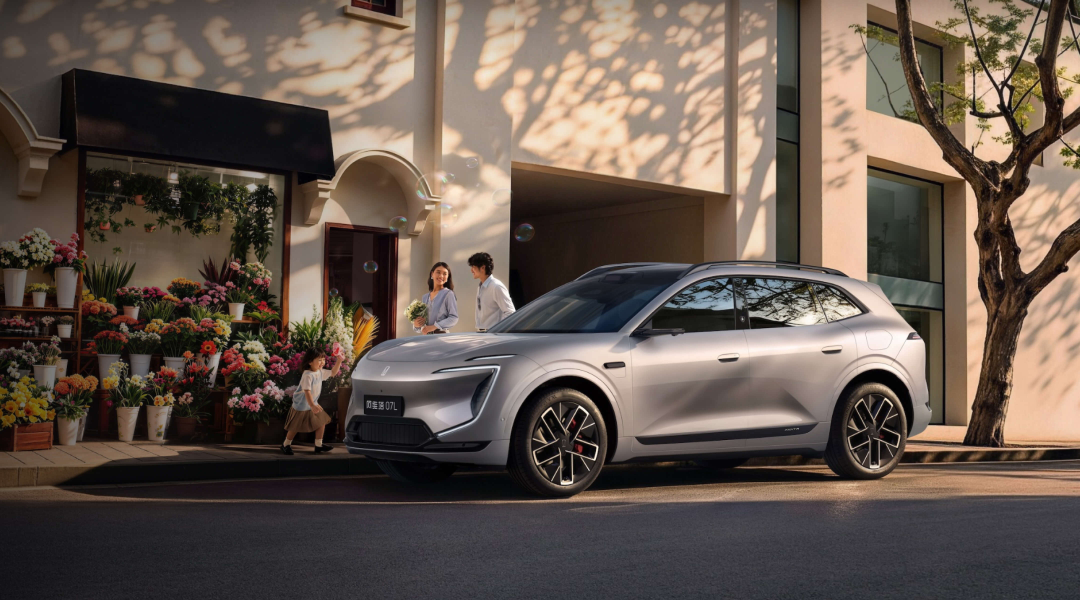
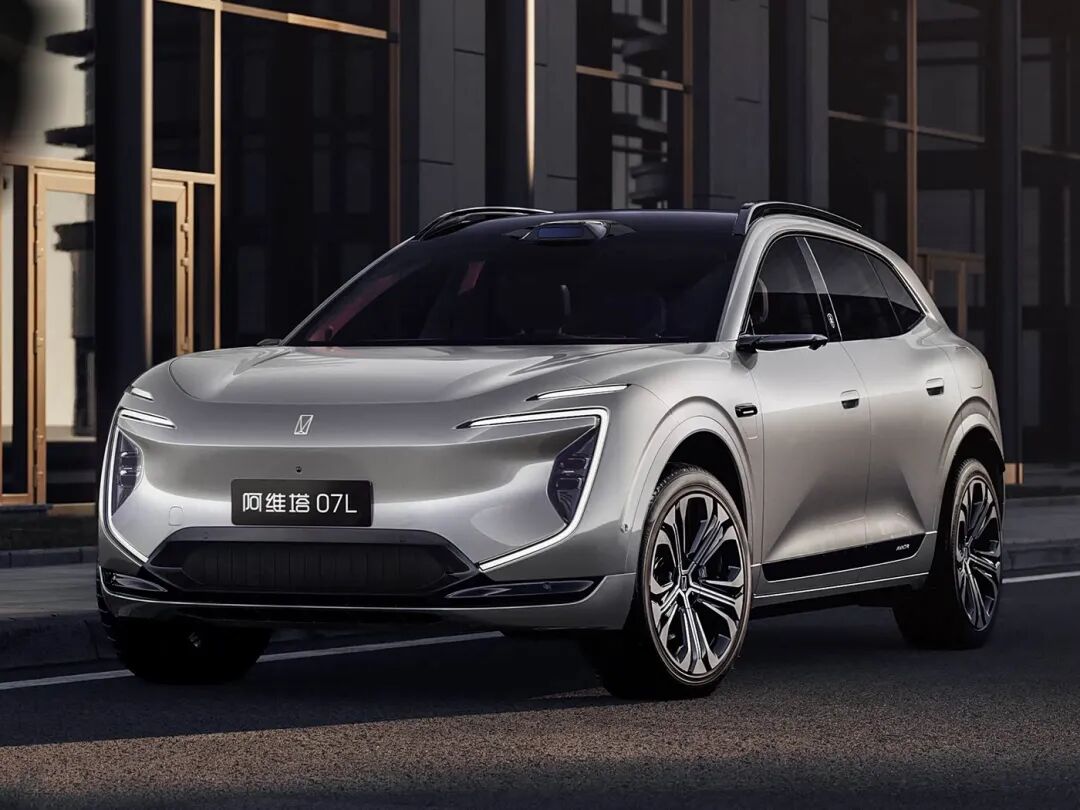 Image source: Weibo
The model matrix is not narrow: 11, 12, 07, 06, covering 200,000 to 700,000 yuan, walking on both pure electric and extended-range legs, with the new flagship T09 in line. But in today's market, relying solely on the old story of "Changan + Huawei + CATL" cannot satisfy capital's appetite. Some netizens aimed their cannons at design: "There's a problem with the car-making approach—way, way, way too flashy, especially the interior; they should hire an aesthetics master to check it. The sedan exterior is nice, but the SUV is hard to describe." Aesthetics are in the eye of the beholder, but a brand positioning itself as "emotional intelligence new luxury" being repeatedly criticized for design is itself a signal.
There is also a rather piercing comparison: back then Avatr spent 11.5 billion yuan to buy 10% of Huawei's Yinwang, corresponding to a Yinwang valuation of 115 billion yuan; after a few years, looking back at itself, its overall valuation is only 31.8 billion yuan. Whether that is low ultimately depends on whether the Hong Kong stock market buys it and whether overseas volume can take off.
Not offloading a burden, but seizing the IPO window
Avatr's Hong Kong listing path has been bumpy. It first submitted in November 2025, and the prospectus lapsed six months later; on June 30 this year it submitted for the second time, with CITIC Securities and CICC as sponsors. Now the validity period of the second prospectus has entered countdown.
Market voices are split: one camp believes it is paving the way for listing by optimizing equity and straightening out governance; the other is cautious—changing equity during the application period is a big deal, materials need updating, commitments need re-signing, and if the pace is not controlled well, it could slow down the hearing instead.
Changan and Avatr speak with one voice: market-oriented reform continues, and the IPO proceeds according to the original pace—it is not a lack of confidence. That said, Changan was upgraded to a central SOE only a little over a year ago, high-end new energy is a strategic battleground, and Avatr is a key piece in charging toward the high end—so how could there be any simple fire sale? This equity concession is more like proactively cutting a piece of long-term return in exchange for independent identity and global resources, making the listing story solid.
The previous promise was "give money when money is needed, give technology when technology is needed," later upgraded to "give mechanisms, give ecosystem," and now it is roughly three words—give whatever is needed.
Conclusion
3.2 billion yuan does not carry much weight in Changan's asset pool, but it is enough to screen out a few capable players. Someone in the comments saw it clearly: "Transfer does not equal lack of money. Looking deeper, Changan's controlling position has not moved at all; giving up one tenth in exchange for resources coming in, against the backdrop of the industry's investment phase, is proactive capital operation, not passive helplessness." This sentence is almost the annotation of the whole matter.
Where this deal finally lands is all suspense: Who will take this 10%? Can the newcomer really bring overseas channels? Can Avatr pass the hearing and knock on the HKEX door within the validity period?
Changing equity only cures governance-level diseases, not the root. The hard bones are still the same three: stop the sales decline, narrow the losses, and make overseas work. The equity structure is only the shell; whether the products can fight, whether channels can be expanded, and whether going global works—these determine whether the 31.8 billion valuation can hold.
Over the next month or so, who will become the new shareholder is probably the juiciest gossip to watch in the new energy circle.
Interactive topic: Who do you think is most likely to take Avatr's 10% stake? After this adjustment, can Avatr successfully list in Hong Kong? Welcome to share your views in the comments.
Disclaimer: This article is only a financial commentary on major companies and does not constitute any investment advice. The corporate data and regulatory events involved in the article are all from public information and are for reference only; specifics are subject to official releases. Images are from the internet; if there is any copyright issue, please contact us for deletion.
-
![]()
XPeng: Cash Generation from Vehicle Sales Picks Up — How Long Before the Chinese Tesla's AI Dream Comes True?
-
![]()
Is Chery Eyeing a British Brand Acquisition? Could Jaguar Land Rover Be the Target?
-
![]()
Dealerships' Plea: Survive, Make a Profit, Live with Dignity
-
![]()
GAC Group Sells 143,687 Vehicles in October: How Should Aion and the Joint Ventures Redistribute Roles?
-
![]()
2.5x More Light Intake: Why Mobile Phone Cameras Need to Retire the 1974 Filter
-
![]()
What Chinese Automakers Look Like in the Eyes of European Policy Circles
-
![]()
Huawei Doesn't Build Robots, Yet 80% of Robot Companies Run on Its Cloud
-
![]()
Breaking! Changan Automobile Sells 10% Avatr Stake for 3.2 Billion Yuan—What's the Real Reason?