0 yuan phone purchase, ends in 2026
 09/28 2026
 380
380
Hitting the brakes on '0 yuan phone purchase': Store KPIs take the first hit
Sudden halt to '0 yuan phone purchase'
Recently, Sina Tech reported that the three major carriers have fully suspended new applications for financial installment services since September 24.
China Mobile's "Hebao Credit Purchase", China Telecom's "Orange Installment", and China Unicom's "Wo Installment"—products once marketed in stores as "free phone" or "0 yuan phone purchase"—have all stopped accepting new applications. Employees from multiple regions have received notifications, and customer service representatives from all three carriers have confirmed the suspension.
For many consumers, this is not good news.
Over the past few years, "0 yuan phone purchase" has been a key channel for many to upgrade their phones: sign up for a plan, get the phone for free, and pay the monthly bill as usual—it seemed almost like getting it for nothing.
For carriers, this service locks in high-value users and boosts terminal sales; for offline stores, it's a crucial tool for meeting performance targets; for phone manufacturers, it provides a stable sales channel.
Users get a deal, stores meet targets, carriers retain users—on the surface, it's a win-win-win business.
So, the question arises: Why halt a service that benefits users, boosts store performance, and retains carriers' customers? And what impact will this suspension have on ordinary users, offline stores, carriers, and even the broader phone supply chain?
01
From 'free phone' to 'small loan burden'—just one signature away
If you search the names of the three major carriers on Black Cat Complaints, it's easy to see that installment phone purchases have become their most complained-about service.
Thousands of related complaints on the Black Cat platform share striking similarities: unaware of taking out a loan, thinking it's a 0 yuan deal but actually signing an installment contract, overdue payments leading to loan defaults, damaged credit scores, and difficulties canceling.
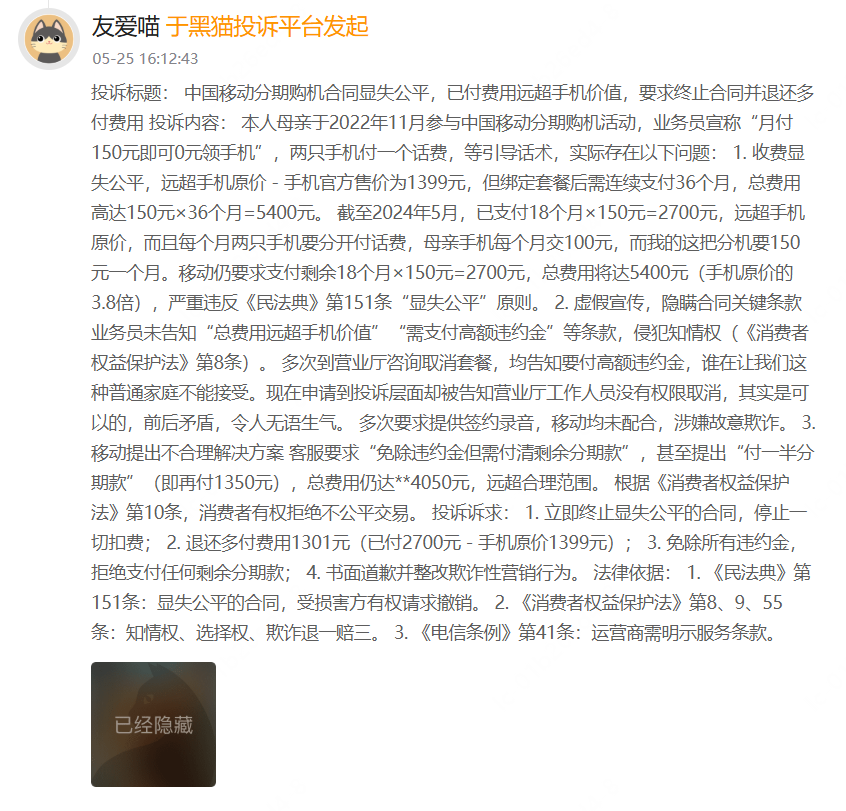
One consumer complained that in 2022, their mother participated in China Mobile's installment plan, where the salesperson said, "Pay 150 yuan monthly to get a phone for 0 yuan." The phone's official price was only 1,399 yuan, but with the bundled plan, it required 36 consecutive monthly payments totaling 5,400 yuan—3.8 times the original price. Multiple requests to cancel were denied without hefty penalties.
On social media, users also shared experiences with China Telecom's Orange Installment: originally planning to buy a tablet, the store staff said switching plans would offer a 1,440 yuan discount, which seemed like a great deal. During the process, they were asked to scan their face and sign multiple times. Only later did they realize it wasn't a discount at all—and ended up paying back the difference.
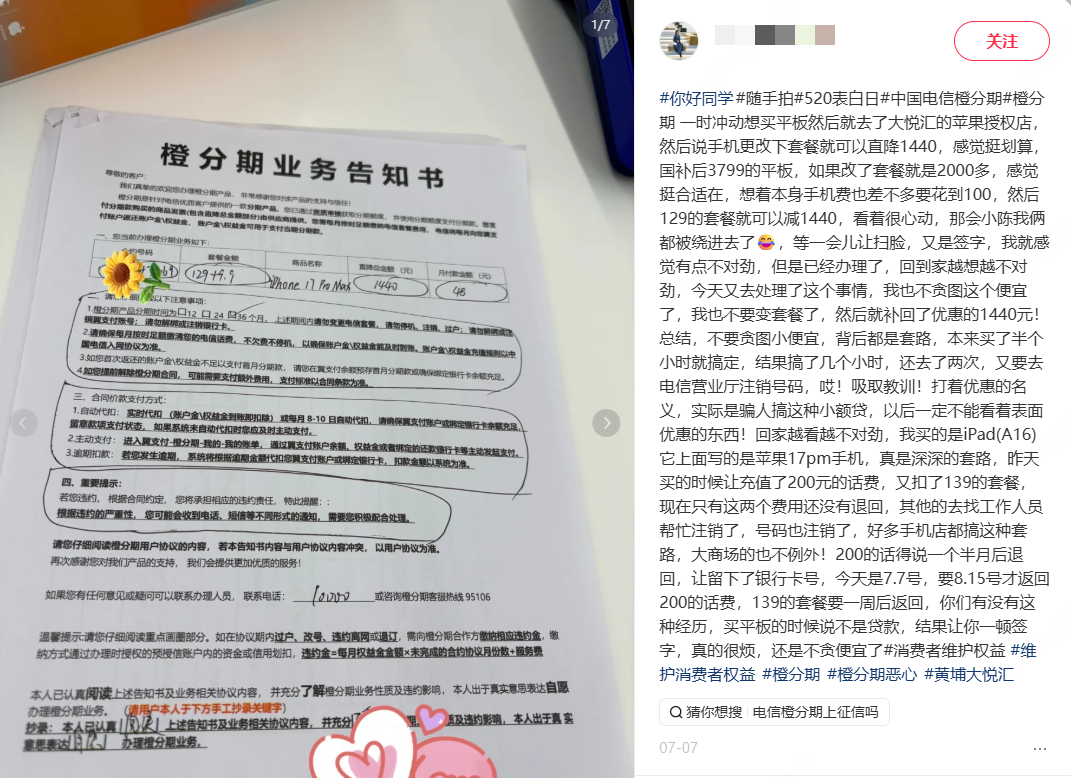
Many such complaints point to the same issue: users think they're receiving subsidies but end up with loans. Complaints are just the surface; the real problem lies in the model itself.
When users sign up for a specified plan and " by the way " (incidentally) buy a phone on installment, it appears to be "free" or "0 yuan," but in reality, they're signing a consumer loan contract in their name, with the carrier repaying the loan monthly through phone bill subsidies.
The crux of this model is that carriers tie communication payments to credit compliance.
Independent telecom analyst Fu Liang pointed out to 21st Century Business Herald that in Orange Installment's process, consumers pay their plan fees on time each month, and Telecom returns a portion of the bill as a Red envelope (red packet) or subsidy to the "Best Pay" account, which then repays the commercial factoring company on behalf of the user.
This means that if the phone bill is overdue and service is suspended, the carrier's subsidy stops, but the loan contract continues. Without the subsidy, the loan immediately becomes overdue, and the record is reported to the central bank's credit bureau, affecting mortgage, car loan, and credit card approvals.
More critically, such products involve multiple entities—carriers, payment institutions, and financial institutions—making it hard for ordinary consumers to understand the product structure.
In other words, forgetting to pay your phone bill in the past might just mean a service suspension; but after getting a "free" phone, forgetting to pay could leave a stain on your credit report.
This "free phone" model thrived in the past due to lax regulatory oversight, but as authorities cracked down on illegal lending, it got caught up in the fallout from "high-interest rental loans."
In recent years, regulators have conducted multiple rounds of crackdowns on disguised usury (annualized rates above 24%) and loan facilitation agencies, while the "phone rental loan" market, which caters to sink (lower-tier) demand, has also faced comprehensive cleanup.
Rental platforms promote "low threshold (low threshold), flexible rentals," but the actual buyout price is far higher than retail, with annualized funding costs exceeding 80%—even over 300% in some cases—making them obvious targets.
China Securities Journal noted that "rental cash-out" schemes, marketed as "credit leasing," "0 yuan phone purchase," or "rent-to-own," are essentially illegal high-interest loans disguised as leases.
This year, rental agents in multiple regions have been detained for investigations, numerous rental apps have been penalized for illegal data collection, and courts nationwide have issued criminal or civil rulings to define this industry's illegal chain.
Critically, the "Measures for the Online Marketing of Financial Products" took effect on September 30, 2026.
Jointly issued by eight departments, including the People's Bank of China, the new rules stipulate that bundled financial product sales must prominently remind consumers, prohibit illegal tie-ins, and ensure combo options aren't default-selected. For installment payments, Induced consumption (inducing consumption) through one-sided publicity (promotion) of initial fee discounts is prohibited.
The eight departments explicitly required financial institutions and third-party internet platforms to accelerate cleanup of marketing content and practices inconsistent with the Measures before implementation. The carriers' past sales model—relying on information asymmetry and downplaying the loan nature—directly conflicts with these transparency requirements.
Regulations are tightening year by year, but carriers' profit margins are shrinking.
Starting January 1, 2026, VAT rates for mobile data, SMS/MMS, and broadband access rose from 6% to 9%, bringing core carrier services fully under "basic telecom service" classification.
Under current policies promoting faster and cheaper internet, tax-inclusive plan prices must remain stable, forcing carriers to absorb the additional 3% tax cost internally. The industry expects a net revenue loss of 25–30 billion yuan, with net profits facing a 10–15% reduction.
Installment plans were once key tools for offline stores to acquire new customers, lock them in, and increase average spending. Low barriers attracted users, boosted terminal sales, and locked them into long-term contracts.
Some stores, to meet KPIs, simplified complex financial products into "0 yuan phone purchase" or "free phone" pitches, leading many consumers to believe they were signing phone contracts without realizing they were taking out consumer loans.
The combination of complaints, tighter regulations, and channel chaos ultimately led to this full suspension. But what comes next?
02
After the suspension: What's next for carriers?
In the report, an insider summed up the direct impact: "This will certainly affect carrier stores' performance." But "certainly affect" carries different weights for different people.
"This hits our store hard," said Lao Zhang, who runs a carrier-partnered store in a third-tier city in eastern China. He noted that installment contracts accounted for most terminal sales, especially during holidays, when "0 yuan deals" were the best hook.
"Customers might just browse, but hearing 'free phone' and that they need a plan anyway makes them sign up easily. Now that hook is gone, foot traffic will drop, and performance will suffer in the coming months," he said. "It's not just phones—if we can't lock users into contracts, broadband and secondary SIM card sales will also take a hit."
But not all staff are worried. Xiao Li, a new hire at a Telecom-partnered store, sees the 0 yuan deal suspension as a relief.
She told Super Focus, "Honestly, I'm relieved. Mid-Autumn and National Day used to be the busiest times, with huge pressure to close deals—every order required face scans, signatures, and explanations. Some customers would realize later something was off and come back to complain, leaving us stuck in the middle. Now that it's stopped, there'll be far fewer disputes, and the workload is lighter."
As for filling the gap left by installment plans, industry sources reveal a "replacement" scheme already in place at the frontline: prepaid phone bills with monthly rebates.
Opinions vary on its appeal to customers. "Previously, you got the phone first and paid later—it felt like free money. Now you pay upfront and get rebates slowly—far less attractive. It can't possibly fill the void left by installment contracts," said Hua Jie, a carrier staff member.
Some insiders believe the suspension might not be the end but just a pause.
Lao Zhou, a channel dealer in a certain city, said this isn't the first downtime. "There were adjustments before, and it came back after rectifications. The key is compliance."
This time, he noted, regulators are clearer: "Previously, it was gray-area tactics; now they demand you display loan contracts openly, explain risks clearly, and give users choice. If carriers can do that, installment plans might return. But the question is: If they do, will it still be the same '0 yuan phone purchase'? Will users still rush to sign up on impulse?"
These voices point to the same reality: The old playbook for offline channels no longer works after the installment plan suspension.
In the short term, store performance will suffer, and staff experiences will diverge; in the long term, user credit safety gains protection, but carriers and channels must find new ways to retain customers—perhaps the biggest challenge for carrier stores.
- END -
-
![]()
Contrast! Xiaomi Pengcheng SUV's Order Volume Drops in Second Week: Are Netizens Right to Say It's Below Expectations?
-
![]()
0 yuan phone purchase, ends in 2026
-
![]()
Explosive News! Xu Jiayin’s Evergrande Auto Launches a 'New Business Venture' Amid 186 Million Yuan H1 Profit
-
![]()
Quantum AI Track Begins to Explode: Tsinghua-Affiliated Sober Heterogeneous Secures Nearly 100 Million Yuan Across Two Financing Rounds in Three Months
-
![]()
QClaw Is Ultimately Acquired by WorkBuddy
-
![]()
China Launches Space Computing Initiative: A 'Data Center' in the Sky Comprising Over 1,000 Satellites
-
![]()
Why Is Starship Planning to Orbit Earth Six Times on Its 14th Flight?
-
![]()
Detailed Explanation of Zhuoyu ZYT World: While the Industry is Still Reviewing Recordings, Zhuoyu has Already Thrown AI into the 'GTA World' for Driving Practice