Contrast! Xiaomi Pengcheng SUV's Order Volume Drops in Second Week: Are Netizens Right to Say It's Below Expectations?
 09/28 2026
 406
406
Is it inevitable for a newly launched car to experience a decline in popularity after its initial peak? This seems to be a recurring pattern in the new energy vehicle (NEV) industry.
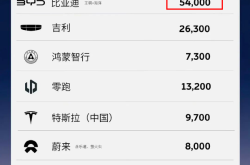
Xiaomi's first family-oriented extended-range SUV, Pengcheng, has been the center of attention in the automotive industry since its launch on September 7. It made a splash right from the start: over 10,000 units were locked in within just four minutes, setting high expectations. In its first week (Week 37 of NEVs, from September 7 to 13), Xiaomi Cars secured 55,200 weekly orders, surpassing BYD's 54,000 units and taking the top spot. Some data indicated that Xiaomi's weekly new orders surged to 47,750 units, while BYD (Wangchao + Ocean series) still led with 57,000 orders. Nonetheless, Xiaomi Cars set a record for itself this week.
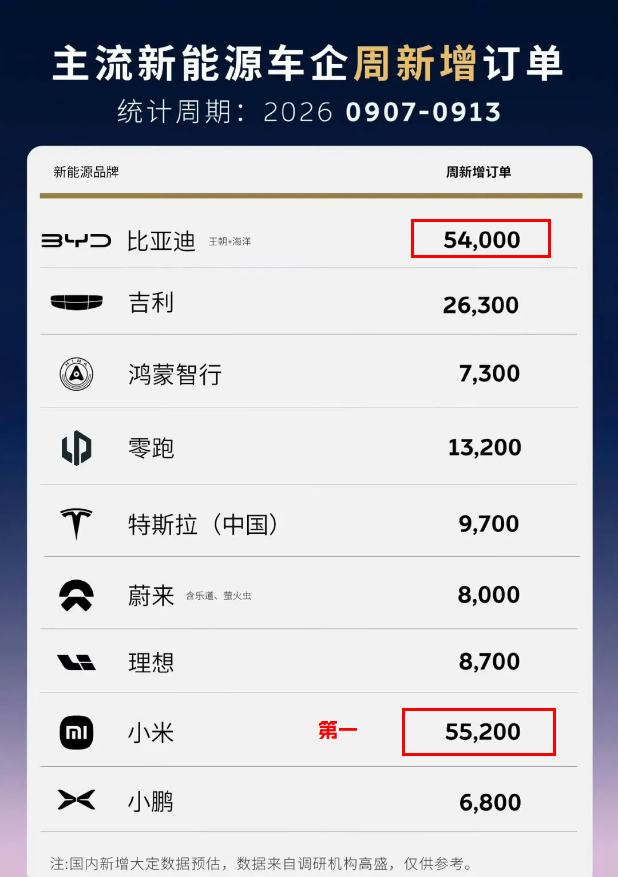
Image Source: Weibo Data: Goldman Sachs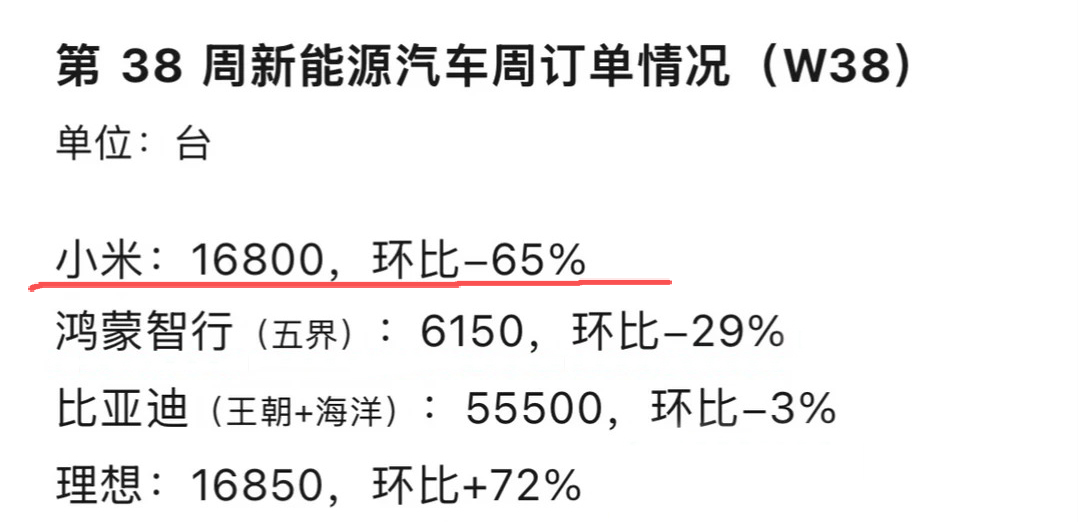 Image Source: Weibo
Curiously, after its strong debut, Xiaomi went silent officially, releasing no further phased order data.
In the absence of official data, the internet was abuzz with speculation, leaks, estimates, and rumors. Now, two weeks after its launch, third-party weekly sales data has finally surfaced, sparking heated debate among netizens: Are these results really below expectations?
Lei Jun Announces New Strategy: Shift Focus from Frequent Order Updates to Core Milestones
Amidst the speculation, Lei Jun took charge, reshaping Xiaomi Cars' approach and dispelling online rumors through a camping livestream.
On September 21, Lei Jun hosted an outdoor camping livestream featuring Pengcheng, showcasing the model's family-friendly and outdoor attributes while announcing Xiaomi Cars' new data disclosure strategy.
Source: Weibo
In essence, Xiaomi will no longer provide daily battle reports or weekly order updates for new cars. All models will only disclose two key data points: the initial wave of immediate order lock-ins on launch day and the final total for the first full sales month.
Xiaomi Pengcheng is the first model to benefit from this "new approach."
According to the new rules, the 4-minute, 10,000+ lock-in volume announced on September 7 is the first official data release; the next update will come after the first sales month ends on October 7. Until then, all order and sales data will remain undisclosed and unaddressed by the official.
Xiaomi's strategy is notably clear-headed and rational. Previously, automakers' daily or weekly order updates, while seemingly boosting hype, often led to a short-term data obsession, where minor fluctuations were exaggerated into "sales collapse" scandals. Now, by voluntarily stepping back and avoiding short-term data games, Xiaomi demonstrates a highly strategic move.
Second Week Order Lock-in Revealed: Over 50,000 Units in Two Weeks, Why Still Deemed Below Expectations?
However, the market and netizens remain skeptical. Without official updates, third-party data became the sole reference, fueling controversy.
Currently, two authoritative versions of Xiaomi Cars' sales data for Week 38 (September 14-20) are circulating online, with significant discrepancies, leaving Pengcheng's true sales figures unclear.
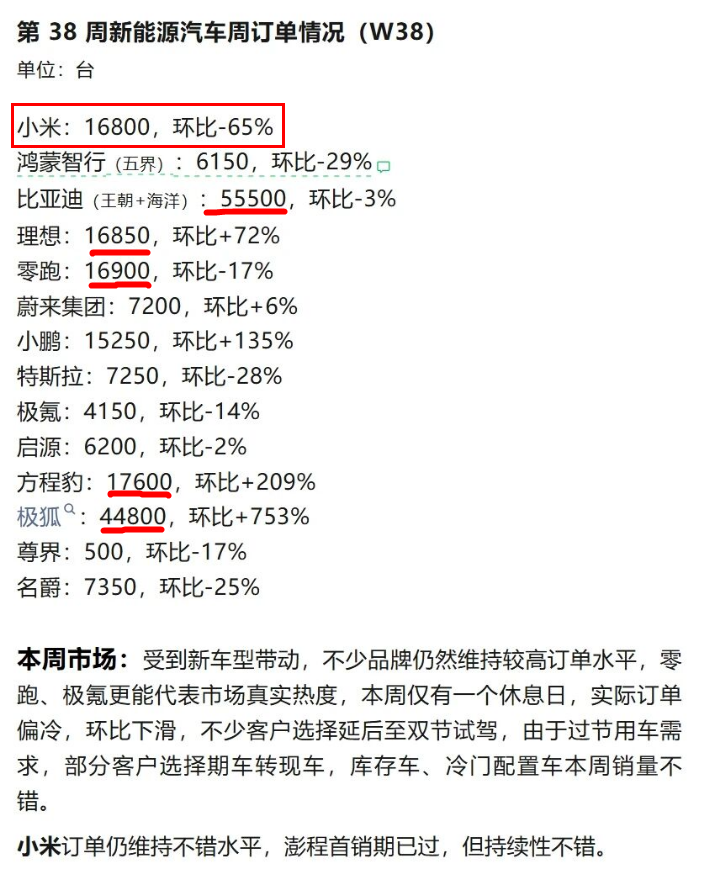 Image Source: Weibo
The first, from Goldman Sachs and ThinkerCar, states that Xiaomi Cars' total orders last week reached 20,000 units. Based on the stable ~7,000 weekly sales of Xiaomi SU7 and YU7, Pengcheng's second-week order lock-in volume is estimated at around 13,000 units.
The second, from top auto blogger "New Energy Exploration Record," reports Xiaomi's total weekly sales at 16,800 units, implying Pengcheng's second-week estimated sales at ~9,000 units after excluding SU7 and YU7's regular sales.
The 2,200-unit discrepancy between the two datasets suggests Pengcheng's true second-week order lock-in volume likely hovers around 10,000 units when averaged.
Combined with the impressive 40,000 units locked in during the first week, the industry offers two calculation methods: conservatively, Pengcheng's two-week order lock-in volume exceeds 50,000 units; optimistically, it approaches 60,000 units.
On paper, 50,000+ units in two weeks places Pengcheng among the top-tier blockbusters in the new energy SUV market, outperforming most peers.
But here's the catch: This is Xiaomi.

 Image Source: Weibo
With its inherent high level of hype and overwhelming online popularity, expectations for Xiaomi's new car have never been merely "qualified" but "dominant." Thus, what the industry considers impressive falls flat for netizens, with "below expectations" dominating discussions. Some netizens also express greater concern for HarmonyOS Intelligent Mobility's models, citing even "weaker" sales.
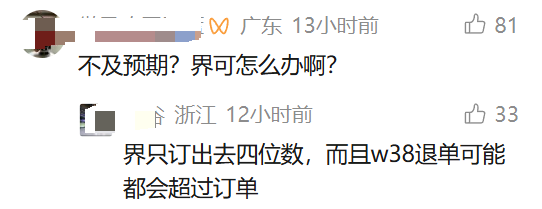 Image Source: WeChat Channel
User Demographics Revealed: No Competition with SU7/YU7, Precisely Addressing Product Gaps
However, many overlook a crucial detail: Pengcheng is not a replacement for SU7 or YU7; the three models do not compete for the same customers.
Lei Jun's livestream revealed user demographics that shattered conventional assumptions. Pengcheng's core buyers differ entirely from Xiaomi's previous coupe users.
Data shows over 46% of Pengcheng's initial order lock-in users are aged 35+, with upgrade/replacement purchases accounting for 80%.
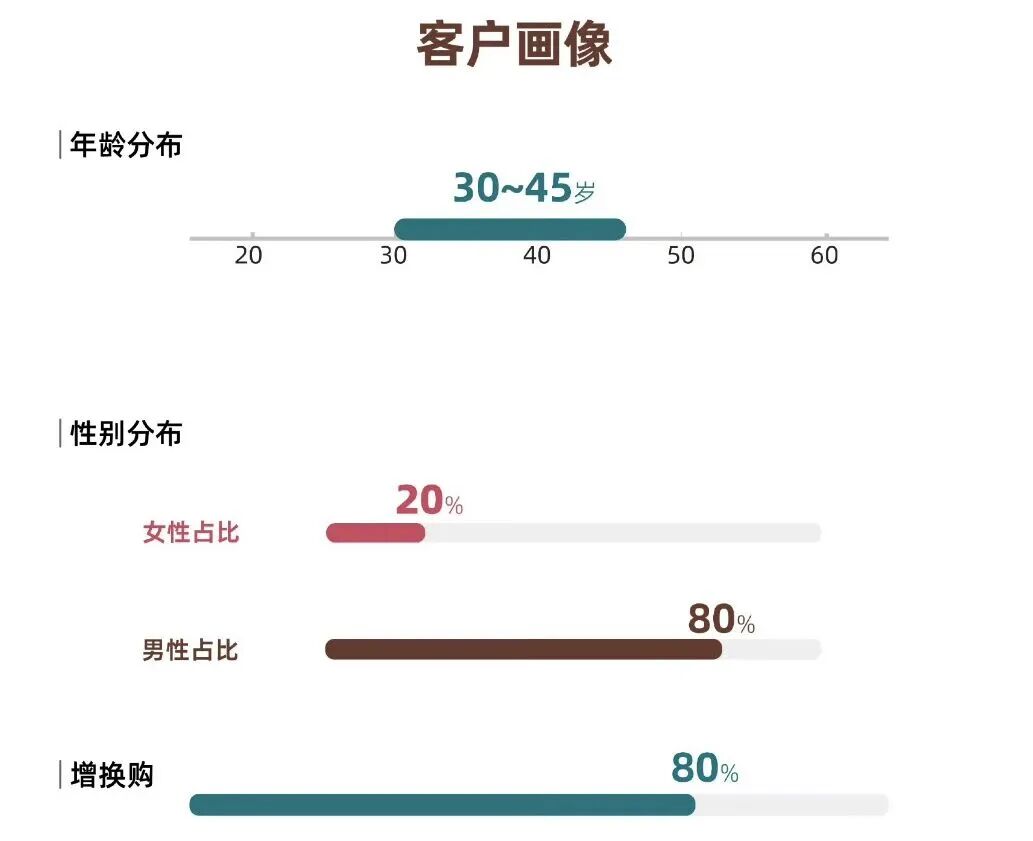 Image Source: Weibo
These users are primarily middle-aged families prioritizing spaciousness, practicality, family travel compatibility, and outdoor camping suitability over extreme performance or flashy designs.
In contrast, SU7 and YU7 target young consumers with a focus on performance and driving excitement.
This precise user differentiation not only prevents internal competition among Xiaomi's models but also creates unexpected synergies. According to dealership feedback, Pengcheng's launch has driven a surge in store visits nationwide, with many family buyers also becoming interested in SU7 and YU7, boosting orders across the entire lineup.
Of course, the auto market remains fiercely competitive, and Pengcheng's rise coincides with new challenges from rivals.
Recently, Fangchengbao S officially launched, priced precisely at 189,900 RMB to directly compete with Xiaomi SU7. Data shows its weekly orders doubled post-launch, diverting potential SU7 customers and pressuring Xiaomi's pure electric coupe lineup, though Pengcheng (family-focused) remains unaffected for now.
With internal new models driving sales growth and external competitors entering the fray, Xiaomi Cars' second-half battle promises intense action.
Double Festival Shopping Season Arrives: Could Inaugural Month Hit 100,000 Order Lock-ins?
More excitingly, the Mid-Autumn and National Day shopping peak has arrived. As seasoned auto market observers know, holidays traditionally drive sales surges, with orders typically rising 2-3x week-over-week.
Given current growth momentum, Pengcheng's inaugural month order lock-in volume could realistically challenge 100,000 units by October 7.
Production capacity also brings positive news: as Xiaomi Cars' production lines ramp up and output stabilizes, industry forecasts suggest November will see Xiaomi's peak annual sales, with monthly volumes across all models potentially exceeding 60,000 units, making year-end higher targets achievable.
Auto Industry Landscape Shifts: AITO Stumbles, Pengcheng Seizes Market Opportunities
Beyond this, the auto industry's biggest recent upheaval involves Huawei and Seres' partnership split, indirectly benefiting Xiaomi Pengcheng.
Recently, Huawei and Seres officially announced their separation: Huawei fully withdrew from brand operations and marketing services, retaining only its role as a technology supplier, while Seres took full control of AITO's branding, marketing, and after-sales.
This move left AITO vulnerable.
AITO's previous brand premium and high-end reputation relied heavily on Huawei's HarmonyOS Intelligent Mobility halo. Without Huawei's brand empowerment, AITO's hidden weaknesses surfaced, compounded by Seres' nearly 2 billion RMB H1 loss and ineptitude in marketing and services, causing market confidence to plummet.
Secondary and used car markets reacted first: AITO M9, launched less than a year ago and priced at 600,000 RMB new, now sees used prices crash below 200,000 RMB, leaving early adopters feeling "burned." More concerning for consumers is the lack of Huawei's backing for after-sales support and problem resolution, heightening purchase hesitations.
AITO's core market—the 250,000-350,000 RMB premium family segment—aligns perfectly with Pengcheng's main strategy.
As AITO's reputation, hype, and orders decline, a massive market gap has emerged, swiftly filled by Xiaomi Pengcheng. No wonder the auto circle jokes: "When Huawei AITO falls, Xiaomi Pengcheng feasts!"
Controversy Revisited: Lack of Strength or Overhyped Expectations?
Objectively, short-term hype doesn't guarantee long-term success.
The "below expectations" controversy surrounding Pengcheng stems from the fact that netizens hold Xiaomi to far higher standards than ordinary automakers. While 50,000 orders in two weeks would be exceptional for most new cars, Xiaomi's offerings must deliver explosive performance to meet expectations.
Beyond the hype, Pengcheng's true strength, delivery stability, and long-term ownership reputation will determine its ability to sustain market leadership.
By shifting from obsessive daily/weekly data updates to focusing on monthly core results, Xiaomi introduces rationality to the auto industry.
With just two weeks until the October 7 inaugural month data release, the question remains: Can Xiaomi Pengcheng maintain 100,000 order lock-ins in its first month? Is "below expectations" a genuine underperformance or simply inflated anticipation? Share your thoughts in the comments!
Disclaimer: This article is for financial commentary by major companies only and does not constitute investment advice. All corporate data and regulatory events mentioned derive from public information and are for reference only; official releases prevail. Images sourced from the internet; contact us for copyright removal if needed.
-
![]()
Contrast! Xiaomi Pengcheng SUV's Order Volume Drops in Second Week: Are Netizens Right to Say It's Below Expectations?
-
![]()
0 yuan phone purchase, ends in 2026
-
![]()
Explosive News! Xu Jiayin’s Evergrande Auto Launches a 'New Business Venture' Amid 186 Million Yuan H1 Profit
-
![]()
Quantum AI Track Begins to Explode: Tsinghua-Affiliated Sober Heterogeneous Secures Nearly 100 Million Yuan Across Two Financing Rounds in Three Months
-
![]()
QClaw Is Ultimately Acquired by WorkBuddy
-
![]()
China Launches Space Computing Initiative: A 'Data Center' in the Sky Comprising Over 1,000 Satellites
-
![]()
Why Is Starship Planning to Orbit Earth Six Times on Its 14th Flight?
-
![]()
Detailed Explanation of Zhuoyu ZYT World: While the Industry is Still Reviewing Recordings, Zhuoyu has Already Thrown AI into the 'GTA World' for Driving Practice