Stellantis' Global Strategy Divided into Two Halves: Half North American Independence, Half Alliance with Leapmotor and Dongfeng
 09/14 2026
 451
451
Recently, Stellantis CEO Antonio Filosa shared a new judgment and perspective on the global automotive market at the Jefferies Global Industrial Conference: the world has been divided into two halves, so they will operate the automotive business under two sets of rules:
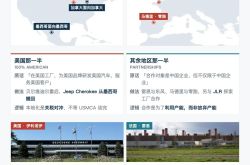
The U.S. business will be 100% localized, with American engineering, American factories, American brands, and American customers;
In Europe, he is bringing Leapmotor into the Madrid factory and Dongfeng into the Rennes factory, and plans to replicate the 51/49 equity template used by Leapmotor International with Dongfeng.
A giant with annual production and sales of approximately 6 million vehicles, having weathered various challenges and now advancing the FaSTLAne 2030 strategy (details can be found in the previous article "Stellantis Investor Day 2026 — A Comprehensive Analysis of the FaSTLAne 2030 Strategy"), indeed resembles a tragic odyssey homecoming, though its success remains uncertain.
Therefore, this article shares and interprets Stellantis' global strategy divided into two halves, helping everyone understand this global company, how it is placing its bets in various regions, and what this approach means for Chinese automakers currently expanding overseas. Finally, we hope to provide some information and inspiration.
The World Divided into Two Halves
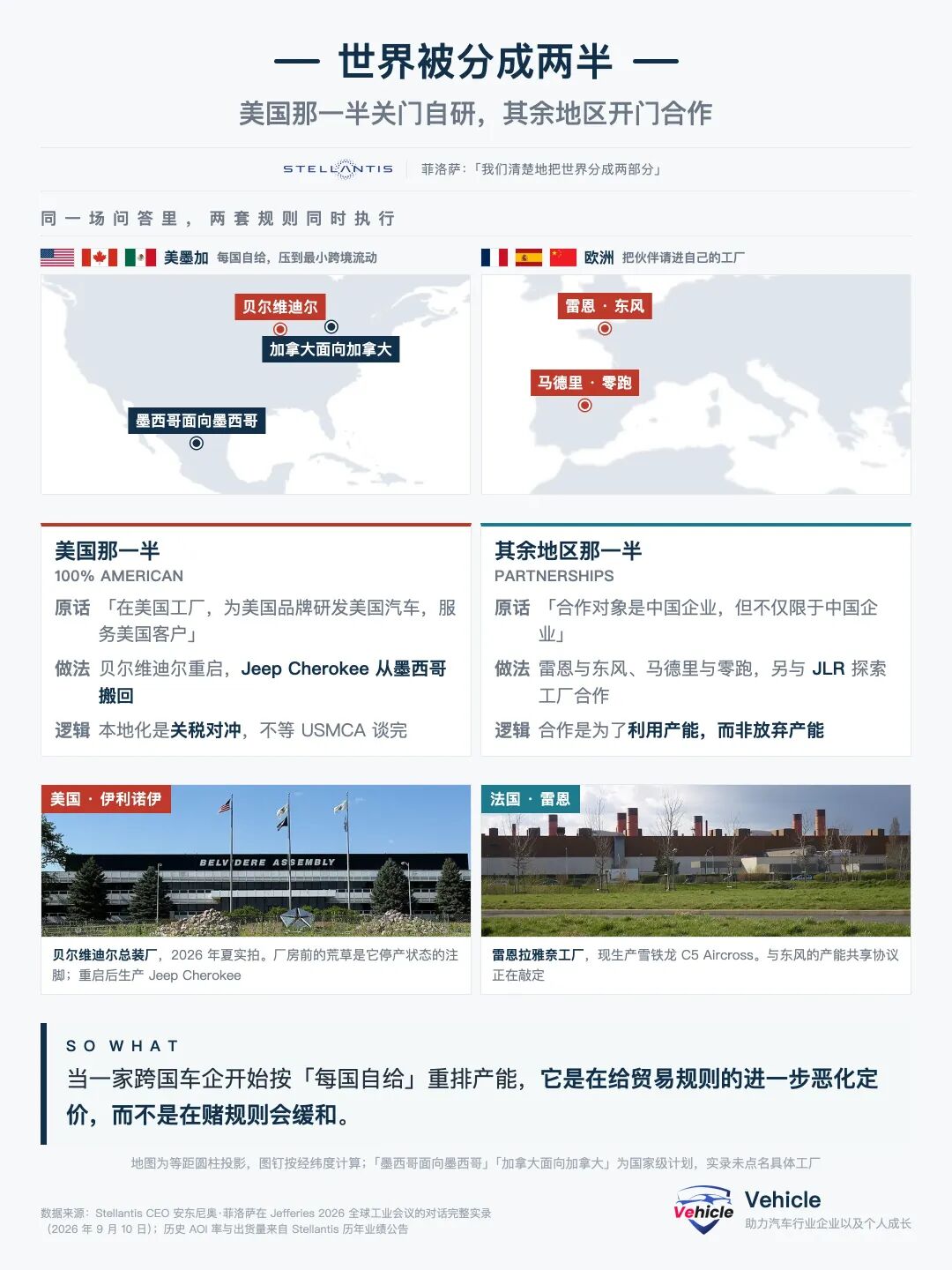 The U.S. half closes the door for independent R&D, while other regions open the door for cooperation, with both sets of rules implemented simultaneously
When Filosa was asked by the host at the conference whether the Leapmotor cooperation was a "Trojan Horse," his response forms the core of this article, representing the most significant information from the event:
First, regarding global operations: As Stellantis, we clearly divide the world into two parts. The first part is the United States. The U.S. will rely 100% on American engineering capabilities: manufacturing cars for American brands in American factories to serve American customers. Therefore, this will be a 100% American story.
The other part is the rest of the world. In other regions, we see—and have already begun to see—the benefits of partnering; these partners include Chinese companies but are not limited to them.
This is not a conclusion drawn by analysts but a formal statement made by the CEO of a multinational automaker with annual production and sales of 6 million vehicles in front of investors. It clearly delineates organizational and investment boundaries for something that has been vaguely felt over the past two years.
The U.S. Half: Localization as a Tariff Hedge, Not Industrial Sentiment
When discussing the renegotiation of the USMCA (United States-Mexico-Canada Agreement), Filosa said it was too early to judge, as negotiations were still ongoing. However, he emphasized that the FaSTLAne 2030 strategy already includes hedging plans tailored to each of the three countries.
United States: Restart the Belvidere plant in Illinois, moving production of the Jeep Cherokee, currently manufactured in Mexico, back to the U.S., along with another model. He said this would "automatically reduce our current tariff exposure."
Mexico: The "Mexico for Mexico" plan involves producing products tailored for Mexican customers in Mexican factories, with one project launching next year.
Canada: The "Canada for Canada" plan leverages local industrial Layout to produce products for the Canadian market.
This arrangement aims to have each country's factory primarily serve its domestic market rather than relocating all production back to the U.S., minimizing cross-border vehicle flows regardless of the final outcome of USMCA negotiations. Filosa stated, "No matter how the framework ultimately evolves, the plan already includes a highly localized approach."
Those involved in overseas expansion should note the implicit premise of this statement: When a multinational automaker begins rearranging production capacity based on "self-sufficiency per country," it is essentially pricing in further deterioration of trade rules rather than betting on their relaxation.
Europe: Idle Capacity, Two Sets of Regulations, and Five Florists
In the other half of the world, Europe is the main battleground. Filosa discussed three key points in this segment: how to utilize capacity, how to reform regulations, and a specific story about light commercial vehicles.
Insufficient capacity utilization: Two solutions
When the host mentioned Volkswagen's increased efforts to address European capacity issues and asked whether Stellantis planned to follow suit by diversifying into non-automotive businesses like defense and data centers, Filosa proposed two automotive-focused solutions.
The first is to fill capacity with new products, primarily targeting volume brands—Peugeot, Fiat, Citroën, and Opel.
The second is to share remaining capacity with partners: the Rennes factory with Dongfeng and Madrid with Leapmotor. The North American approach relies solely on the first solution, boosting sales through new products driven by 40% investment.
Regarding data centers and defense, his response was restrained: Any diversification into other businesses is not part of the FaSTLAne 2030 strategy or core focus, but he is open to discussing potential collaborations with participants outside the automotive industry. He also mentioned exploring potential cooperation with JLR at a specific factory.
Two sets of regulations, with a window from late this year to early next year
Filosa said two critical sets of regulations are rapidly advancing in Europe:
One is CO2 emissions regulations, and the other he referred to as the "Made in Europe" regulations. He described the latter as a mechanism that "should and will establish a level playing field for all competitors in Europe." This "Made in Europe" regulation is the IAA Industrial Accelerator Act discussed in our previous article "A Deep Dive into the EU's Industrial Acceleration Act: Rewriting the 'Rules of the Game' for Chinese Automakers' Overseas Expansion."
This statement requires translation. In the European context, "establishing a level playing field for all competitors" typically refers to tools like local content requirements, local production ratios, or linking subsidies to local investments, targeting imported vehicles. Filosa expects significant changes by the end of this year or early next year.
He also named names: Policymakers are listening to Stellantis, Volkswagen, Renault, and the industry association ACEA. This list does not include Chinese companies—not his problem, but a hint for Chinese automakers.
Five florists and total cost of ownership
Within the CO2 regulations, Filosa focused on light commercial vehicles, citing a straightforward reason: Stellantis holds a 28% market share in Europe's light commercial vehicle segment, which is a highly profitable niche.
He shared a specific example. Imagine a business owner with five flower shops operating five vans. When it comes time to replace the vehicles, he calculates the costs: For a business with moderate mileage, traditional internal combustion engine vans are significantly more advantageous in terms of total cost of ownership. Thus, he decides not to replace the vehicles and continues using the old ones.
Filosa concluded that this is detrimental to everyone: bad for the business owner due to higher maintenance costs for old vehicles, bad for the industry due to five fewer new vehicle sales, and bad for the environment because old vans, regardless of powertrain, are dirtier than new ones. He directly attributed industry contraction to regulation.
This example holds merit because the chosen scenario is verifiable: Electric vans are currently "primarily suitable for businesses with very high mileage," and moderate-mileage users find them uneconomical—a verifiable factual judgment. If Europe indeed relaxes CO2 requirements for light commercial vehicles, the most affected will not be European automakers but Chinese commercial vehicle companies relying on electric vans as their mainstay for overseas expansion—possibly referring to Ford's JMC partnership in China, which recently began exporting electric vans to Europe.
His "China Strategy" Isn't Actually in China
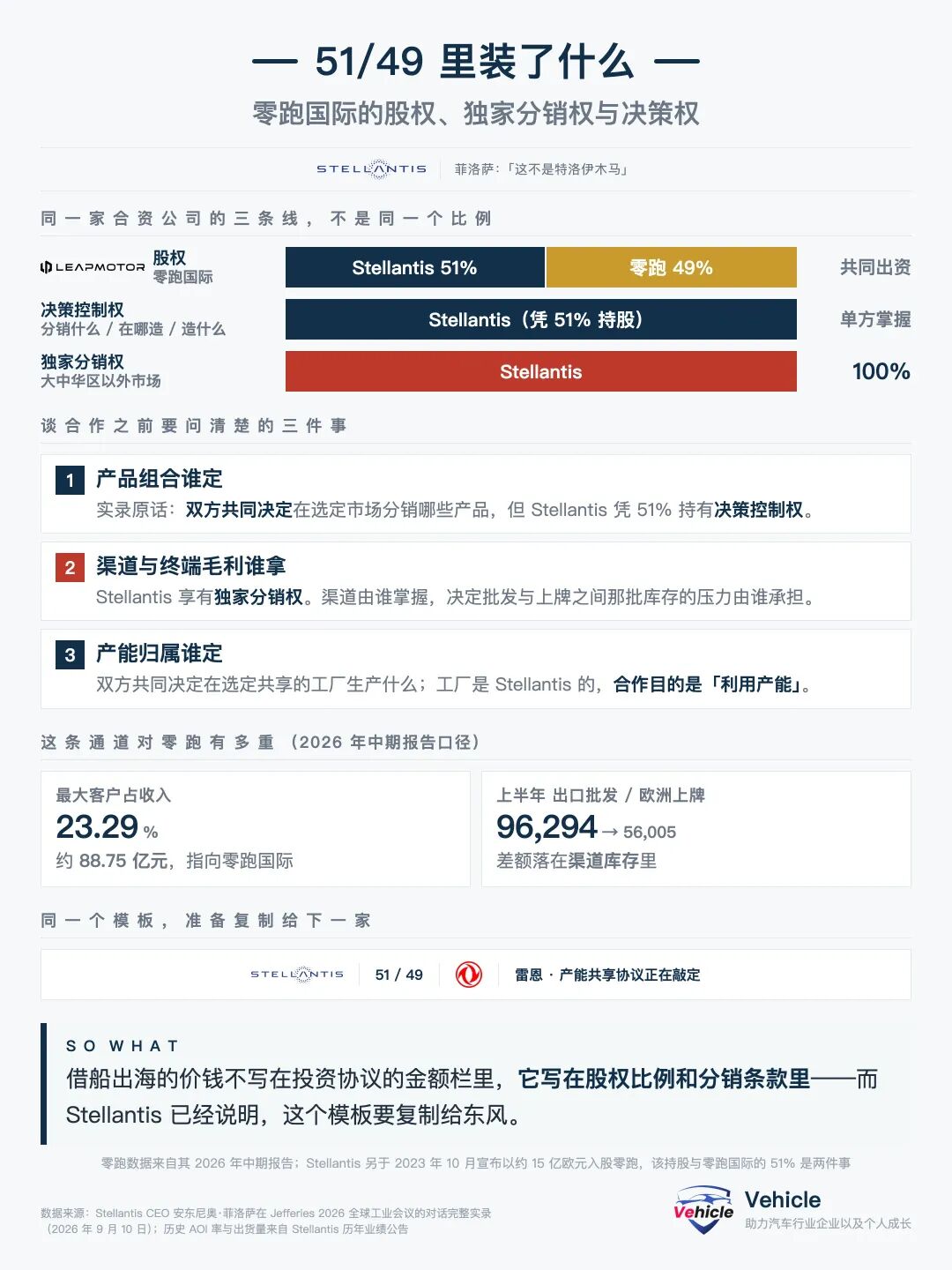 The 51/49 equity ratio determines not just dividends but also distribution rights and product portfolio decision-making power
The most frequently follow-up question China-related topic during the Q&A was Leapmotor, and Filosa's response never once mentioned the Chinese market itself.
This is not avoidance. Stellantis' complete vehicle (vehicle) business in China significantly contracted after GAC Fiat Chrysler's bankruptcy liquidation in 2022, with brands like Jeep shifting to imports. Its joint venture with Dongfeng, Dongfeng Peugeot Citroën Automobile (DPCA), remains but at a much smaller scale than before. After announcing a €1.5 billion equity investment in Leapmotor in October 2023 and establishing Leapmotor International in May 2024, Stellantis' "China strategy" has substantially shifted: leveraging Chinese products and production capacity as supplements for markets outside China.
Incidentally, the Rennes factory's partnership with Dongfeng is not surprising. Dongfeng's joint venture with PSA (one of Stellantis' predecessors) in China dates back to DPCA in 1992, and over three decades of cooperation have aligned their engineering languages, quality systems, and procurement practices to a communicable level. The hardest part of capacity-sharing agreements has never been about equity ratios but whether the two companies' engineering systems can effectively collaborate on the same production line.
What the 51/49 Figure Represents
Filosa provided a detailed description of the cooperation structure, worth dissecting point by point:
Leapmotor International is a joint venture where Stellantis holds 51% and the partner holds 49%. Both sides jointly decide which products to distribute in selected markets; Stellantis, with its 51% stake, holds decision-making control and exclusive distribution rights. They also jointly decide which products to manufacture in selected shared factories.
He also outlined expansion plans: Stellantis hopes to replicate the same 51/49 model in its cooperation with Dongfeng. The pending agreement with Dongfeng involves capacity sharing at the Rennes plant, which currently produces the Citroën C5 Aircross and will continue doing so while adding a complementary brand product jointly selected by both parties.
In response to the "Trojan Horse" accusation, his rebuttal was simple: "We hold 51%, and the partner holds 49%. As partners, we jointly decide what to distribute, what assets to use for manufacturing, and what vehicles to produce."
Whether this rebuttal holds depends on your perspective. From Stellantis' standpoint, it indeed controls decision-making, distribution channels, and capacity ownership, with the cooperation purpose being, in its own words, "utilizing capacity rather than abandoning it." From the Chinese automaker's perspective, the same statement implies: The Chinese side provides products, costs, and technology, while the other side provides channels, factories, and decision-making power.
How Critical Is This Channel for Leapmotor?
Numbers from Leapmotor provide context for this structure's scale. In our previous article "Leapmotor's Three Fronts: Products, Overseas Expansion, and Intelligence," we noted a single-customer concentration in Leapmotor's 2026 mid-year report: Leapmotor International accounted for 23.29% of revenue, approximately ¥8.875 billion. In other words, nearly one out of every four yuan in Leapmotor's revenue flows through a channel 51% controlled by Stellantis.
Concurrently, another set of numbers warrants comparison: In the first half of the year, approximately 96,294 units were exported wholesale, while around 56,005 units were registered in Europe. The difference between wholesale and registrations represents channel inventory, and who controls the channel determines who ultimately bears the inventory pressure.
The cost of "shipping via another's boat" is not written in the investment agreement's monetary terms but in equity ratios and distribution clauses.
What Does This Approach Mean for Chinese Automakers?
Combining the insights from the previous sections, here are six directly applicable points for those involved in China's automotive product strategy and overseas markets:
1.Plan based on two sets of rules, not one rule with an exception. Preparing for the U.S. market as "temporarily inaccessible but will loosen later" versus treating it as "structurally closed, requiring a separate logic" leads to entirely different capacity Layout , product definitions, and personnel allocations. Filosa has already provided the answer, and he is spending money based on the second approach.
2.When negotiating cooperation, first clarify who holds decision-making power over three key areas: product portfolio, terminal pricing, and channel margins. Leapmotor International's 51/49 structure resolves these three issues at once, and Stellantis explicitly plans to replicate this template with Dongfeng. This is not to say this structure should be rejected—trading three years and 49% decision-making power for ready-made channels in a dozen countries could be a lucrative deal—but rather that one must understand what they are buying and selling before accepting, as well as where the bargaining leverage lies for the second-phase contract.
3.Your vehicles are being disassembled. The STLA One platform was explicitly developed "through extensive teardown and benchmarking analysis" to achieve market-leading competitiveness. Cost advantages have a half-life: Those gained through supply chain pricing and scale compress rapidly once competitors replicate them item by item. What cannot be replicated are development speed, decision-making chain length, and generational gaps in electrical/electronic architectures. When planning costs, assume competitors' material costs will approach yours in three years rather than maintaining today's gap.
4.The regulatory window in Europe closes between late this year and early next year. The simultaneous advancement of CO2 regulations and "Made in Europe" regulations, with Stellantis and ACEA at the table, means two things for Chinese automakers: The timeline for localizing production in Europe may need to accelerate rather than following the original plan; simultaneously, electrification requirements for light commercial vehicles are the most likely to be relaxed, so the pace of electric van exports should account for potential delays.
5.Idle capacity is a purchasable asset. Stellantis has underutilized European factories and is explicitly seeking partners at marked prices. For Chinese automakers, renting existing capacity is significantly cheaper in time and capital than greenfield construction, but the trade-off is filling others' financial reports and accepting their brand and channel arrangements. This window will not remain open indefinitely—as Filosa made clear, capacity sharing occurs "where we have surplus capacity." Once new products fill the capacity, the terms will change.
6.Competitors' profit margin targets are lowering, pushing price floors downward. Stellantis set its 2030 target at 8%–10%, below its actual levels in 2022 and 2023. A company that writes structural downgrades into its five-year plan will price more aggressively than one clinging to double-digit margins. The logic of relying on "European cars being expensive" to create pricing space needs recalculating based on this new profit margin Center (center).
One final point is less an insight than a reminder: Filosa repeatedly emphasized an organizational principle of "global scale, local pride"—global assets developed centrally, with market entry decisions delegated to six regional teams. Thousands of engineers work on global platforms, while thousands others focus on understanding customer needs in California, Michigan, Florida, Patagonia, and Italy. For Chinese automakers expanding overseas, the "global scale" half is already in place, but the "local pride" half is just beginning—and the latter hinges on organization, not products.
In Conclusion
The most practical sentence in this Q&A session might be what Philosa said in response to 'investors' lack of patience': Quality improves through day-to-day work and is ultimately reflected in lower warranty costs; new product waves require an average development cycle of 24 months; the first ramp-up of the VCP (Value Creation Plan) will only be visible in the fourth quarter.
None of these three things can be accelerated. For a company producing and selling 6 million vehicles annually, the time required for a turnaround is simply this long. That's why 2026 will be a year with almost no news for Stellantis, but one that will determine its success or failure in 2028.
For Chinese readers, another aspect of this Q&A session is even more noteworthy. When an Europe and America (European-American) giant announces 100% localization of its U.S. operations while inviting its Chinese partners into its European factories, it sends two signals simultaneously: one door is closing, while another is opening—but the doorframe is set by itself. Understanding the doorframe matters more than understanding the door.
References and Image
Interview with Stellantis (STLAM) at the Jefferies 2026 Global Industrial Conference
*Reproduction and excerpts are strictly prohibited without permission-
-
![]()
Stellantis' Global Strategy Divided into Two Halves: Half North American Independence, Half Alliance with Leapmotor and Dongfeng
-
![]()
The Paris Motor Show Amplified by Chinese Automakers: The Next Step for China's Auto Industry Going Global
-
![]()
Rumors Abound: Is BYD Set to Halt Profit-Sharing Bonuses? Cash Reserves Reach 164.7 Billion Yuan Despite 20.5% Profit Drop in First Half
-
![]()
Shining in Pengcheng, Pursuing Light with Ingenuity | Zolix's Successful Participation in CIOE2026 Shenzhen, Paving the Way for a New Journey in Optoelectronics
-
![]()
Domestic Computing Power Firms Favoring Private Placements: The New Capital Market Favorites
-
![]()
Blockbuster! Can NIO Auto ‘Rise Like a Phoenix’? Netizens Say: Only Taiyi Can Resurrect Nezha!
-
![]()
Latest Developments on Huawei’s ‘MaJie’ Collaboration? Maserati Announces Official Launch of December Brand Strategy
-
AI Office: The Race Intensifies