LiDAR Titans All Shift Gears: Some Streamline, Some Broaden, Some Diversify
 09/16 2026
 331
331
Recently, each of the three leading LiDAR firms has made significant strategic moves.
RoboSense has announced plans to divest its complete machine business and related assets in embodied robotics for 59.878 million yuan, explicitly stating its intent to "concentrate on advancing long-term strategic goals" and "develop key incremental components for embodied robot manufacturers beyond LiDAR."
Innovusion has entered into a strategic cooperation agreement with Wuhan Changan Automobile, securing a designated supply position for front-view main LiDAR, thereby further diversifying its client portfolio.
At the 2nd China Spatial Intelligence Conference, Hesai Technology forged a strategic partnership with 3D native world model company Yingsu Technology, propelling "spatial intelligence" from a strategic concept to an ecological reality.
These three directions mirror the distinct strategic paths chosen by the three companies.
RoboSense is "streamlining," offloading its complete machine business in embodied robotics to focus resources on components.
Innovusion is "broadening its client base," striving to reduce its sole dependence on NIO.
Hesai is "diversifying," transitioning from LiDAR to physical AI infrastructure. Hesai CEO Yi Fan Li previously outlined the company's three-tier architecture at a Q2 earnings call as "perception—understanding—action." The Kosmo prototype received its inaugural orders in July 2026, with revenue anticipated in Q3. The partnership with Yingsu Technology zeroes in on the "understanding" layer—converting real-world environments into reusable, AI-ready 3D spatial assets.
Streamlining: RoboSense Divests Complete Machine Business
RoboSense's move appears the most "counterintuitive." Embodied intelligence is currently the hottest sector, yet RoboSense is selling this business.
Isn't robotics the industry's recognized second growth curve? Even without considering the entire sector, look at RoboSense itself. In the first half of the year, RoboSense sold 282,600 robot LiDAR units, up 510.4% year-on-year, with robotics revenue accounting for nearly half of product revenue and contributing almost all revenue growth in H1. Why sell such a booming asset?
The answer lies in the distinction between "complete machines" and "components."
RoboSense is divesting its complete machine business in embodied robotics while retaining core components. Baima believes this is a typical streamlining focus—complete machine operations entail building production lines, managing inventory, finding customers, and bearing profit/loss responsibilities, with heavy investment, slow turnover, difficult sales, and uncontrollable gross margins. Components, however, are RoboSense's forte, with robot LiDAR already accounting for half of its product revenue. Concentrating resources here means leveraging strengths over weaknesses.
Moreover, if RoboSense continues its complete machine business in robotics, it will become a direct competitor to other embodied intelligence companies, undermining sales of its robot LiDAR products.
Financial data is also compelling RoboSense to streamline. Last Q4, RoboSense achieved single-quarter profitability for the first time, a fact prominently highlighted in its earnings announcement. However, after excluding government subsidies, customer compensation, and fair value changes in financial assets, its operating profit remained in the red. Baima previously argued that RoboSense's quarterly profitability was highly uncertain.
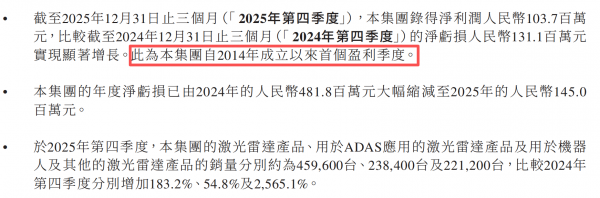
By H1 this year, RoboSense returned to losses, with the deficit widening year-on-year.
RoboSense faces the greatest pressure among the LiDAR trio for automotive products. In H1, it sold 436,600 ADAS LiDAR units, up 98% year-on-year. The numbers seem promising, but RoboSense, once the market share leader, now sells about half as many units as Hesai, while Innovusion is gaining rapidly—416,300 ADAS units sold in H1, nearly matching RoboSense, but with a 346% growth rate far outpacing it.
Worse, the automotive market continues to "intensify competition." In H1, the "gap" between the trio's shipment and revenue growth rates widened. Hesai, RoboSense, and Innovusion saw LiDAR shipment growth of 100.8%, 169.6%, and 364.8%, respectively, with revenue growth of 25.1%, 30.2%, and 127.9%. Their shipment growth rates were 4x, 5.6x, and 2.9x their revenue growth rates.
RoboSense's "gap" is the largest. A widening "gap" directly implies accelerating price declines per LiDAR unit. More sales, thinner profits. If this "intensity" persists, losses will only escalate. Complete machines in robotics require heavy investment—rather than splitting focus, RoboSense opted to concentrate on its core business. The 59.878 million yuan from the sale isn't substantial, but its strategic clarity is evident: RoboSense is abandoning the "complete machine narrative" to return to its "comfort zone."
Broadening: Innovusion Offsets Single-Client Reliance with New Clients
If RoboSense is streamlining, Innovusion is pursuing standard expansion.
Its September strategic cooperation with Wuhan Changan Automobile secured a designated supply position for front-view main LiDAR. Not a massive order, but significant for Innovusion's client structure.
Innovusion's most criticized flaw has been its heavy reliance on NIO—NIO once accounted for over 90% of its revenue, falling to 86.2% in 2025. While still dominant, the decline is clear. This year, Innovusion added OEM clients like GAC Group, initiating mass production deliveries. Its Lingque E series now equips mainstream brands like GAC Aion, Trumpchi, Hyper, and NIO's LeDao, with seven new models launching in H1. The Changan Automobile designated supply deepens Innovusion's client diversification strategy.
Innovusion's confidence in continuous expansion stems from being the only company among the three to "grow revenue while reducing losses" simultaneously: H1 revenue hit $139 million (~945 million yuan), up 127.9% year-on-year (highest among the trio); gross margin improved from 10.1% to 11.17%; net loss narrowed by 23.16% year-on-year; operating expenses as a percentage of total revenue fell 26.3 percentage points year-on-year.
Innovusion is rapidly closing the revenue gap with RoboSense—945 million yuan vs. RoboSense's 1.02 billion yuan in H1, a much narrower margin than last year.
At the product level, in automotive LiDAR, Innovusion sold only 20,000 fewer units than RoboSense in H1, nearly catching up. According to Gasgoo Auto, Innovusion surpassed RoboSense in H1 installation market share, ranking third.
Diversifying: Hesai Moves from LiDAR to Physical AI Infrastructure
Among the trio's recent moves, Hesai's "vaguely worded" strategic partnership holds the greatest potential.
In H1, Hesai reclaimed the global market share lead from Huawei. According to Yole Group's "2026 Global Automotive LiDAR Market Report," Hesai ranked first globally in ADAS main LiDAR shipments with a 43% market share.
But Hesai's ambitions extend beyond LiDAR. In its mid-year earnings announcement released in mid-August, Hesai frequently mentioned its SGI (Strategic Growth Initiative) business, which contributed revenue for the first time and was listed separately.
In Hesai's terminology, SGI refers to strategic growth businesses. Currently, Hesai's SGI portfolio includes two major product lines: the spatial intelligence platform Kosmo and the robot power module.
Public information shows Kosmo is a platform integrating AI spatial cameras, algorithms, and cloud services, with the core capability of efficiently transforming real physical environments into high-quality, editable, and interactive 3D spatial assets. Kosmo delivered its first prototypes in July this year, securing orders from humanoid robot companies like Galaxy General, with revenue expected from Q3.
The robot power module business is more straightforward—its core products act as "joints and muscles" for robots. By Q2 this year, Hesai had delivered over 10,000 units, expanding from dexterous hand modules to full-body joint modules. The company expects shipments to grow to six figures (over 100,000 units) by 2027.
Based on SGI's commercial progress, Hesai raised its 2026 full-year SGI revenue guidance from 100 million yuan to 200-300 million yuan, projecting ~700 million yuan in SGI revenue and break-even by 2027. Hesai's H1 R&D spending reached 436 million yuan, up 13.9% year-on-year, with most incremental investment going to SGI.
Evidently, Hesai's core "narrative" has shifted beyond LiDAR, focusing on strategic growth businesses. In Q1 this year, Hesai announced its strategic evolution from "spatial perception" to "spatial intelligence," positioning itself not just as a global LiDAR leader but as a builder of foundational infrastructure for physical AI's frontier.
From selling LiDAR to selling spatial intelligence solutions, then to physical AI infrastructure—this is the essence of "diversification." Hesai aims to redefine its role in the AI era beyond being a mere component supplier.
From a business progress perspective, Hesai's strategic shift is moving beyond slogans, gradually reflecting in financial numbers.
Industry Context: Rising Volume, Falling Prices—Which Model Withstands Pressure?
The differing choices of the LiDAR trio ultimately return to the same industry reality: volume is rising, but prices are falling faster.
As mentioned earlier, a massive "gap" exists between LiDAR companies' shipment growth and revenue growth rates—more sales, but slower revenue growth, the clearest sign of industry "intensification."
Calculating revenue per LiDAR unit shipped: Hesai's average unit price is ~1,401 yuan, gross margin 39.7%, unit gross profit ~556 yuan; RoboSense's average unit price is ~1,418 yuan, gross margin 21.8%, unit gross profit ~309 yuan; Innovusion's average unit price is ~2,096 yuan, gross margin 11.2%, unit gross profit ~235 yuan.
These figures explain why the three companies took different paths. Hesai's unit gross profit is 1.8x RoboSense's and 2.4x Innovusion's, supported by self-developed chips and cost advantages, giving it confidence to "diversify." RoboSense, with only 309 yuan in unit gross profit and the burden of complete machine operations, can only "streamline" and focus. Innovusion, with the lowest unit gross profit but improving margins and narrowing losses, chooses "expansion" to gain scale and time.
But even Hesai's gross margin is declining—39.66% in H1, down 2.54 percentage points year-on-year. No winner emerges from price wars; Hesai just withstands them better.
Market Structure and Uncertainties: Duopoly Solidifies, Third-Place Battle Undecided
From a market structure perspective, the "duopoly" in automotive LiDAR has further solidified.
According to Gasgoo Auto Research Institute, in 2025, Huawei ranked first with 41.5% market share (including blind-spot LiDAR installations); Hesai ranked second at 33.8%, with both companies "dominating the field." In H1 this year, the "duopoly" trend continued, with Hesai and Huawei maintaining the top two positions at 34.2% and 31.1%, respectively, far ahead of Innovusion and RoboSense.
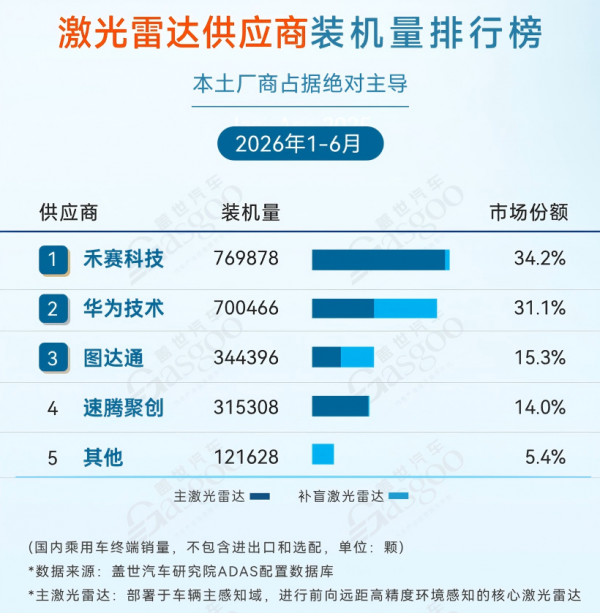
The real uncertainty lies in the "battle for third place." RoboSense's automotive LiDAR market share in H1 declined further from last year's full-year data, but its overseas design wins are increasing: as of August 26, mass production design wins reached 194 models, with 37 from overseas OEMs and joint ventures covering Japan, North America, and Europe. Whether overseas orders convert to actual revenue will determine if RoboSense can halt its automotive market share decline. Innovusion, meanwhile, advances steadily through client diversification. Which path succeeds will directly decide the second-tier ranking.
For RoboSense, another risk variable exists. On August 21, China's State Administration for Market Regulation disclosed Geely Auto's recall plan: due to potential damage in LiDAR's internal power ICs, Geely recalled five models under its Lynk & Co and Geely Galaxy brands, totaling ~93,000 units, with RoboSense as the LiDAR supplier. Media reports indicate this is China's first large-scale LiDAR recall. Market analysts believe the recall will increase RoboSense's after-sales costs and shake customer confidence in the short term; whether it affects RoboSense's cooperation with Geely on future models remains to be seen.
Conclusion: Three Approaches, Uncertain Futures
Returning to our central question—can selling LiDAR turn a profit?
In H1, the answers were: Hesai achieved "paper profitability," RoboSense "sold more but lost more," and Innovusion "traded losses for scale." Meanwhile, the trio responded with three approaches: RoboSense streamlined, Innovusion expanded, and Hesai diversified.
Behind these three approaches lie three distinct situations. Hesai holds the thickest safety net with 7.05 billion yuan in cash reserves (including cash, cash equivalents, short-term investments, restricted cash, and long-term time deposits), generating 153 million yuan in interest and investment income in H1—exceeding total net profit. In other words, excluding interest and investment income, Hesai was actually net loss-making in H1. While cash and income don't reflect main business health, they do give Hesai greater resilience. RoboSense and Innovusion have thinner financial cushions—in sustained losses, their financing ability, cash burn rate, and path to profitability will determine who survives.
None of the LiDAR titans have reached the point of "stable profitability from main businesses." Who gets there first requires time to tell.
The content and views in this article are for reference only and do not constitute investment advice. Investment involves risk; decisions should be made cautiously.
-
![]()
AITO Model Adjustment: Seres' Strategic Shift to Reclaim Profit Control
-
![]()
Annual Production of 7 Million Optical Waveguides: Can the AR Glasses Market Absorb This Surge?
-
![]()
When a Decade-Old Feishu Meets a Newborn Doubao Work: What’s the Outcome?
-
![]()
Seres Faces Pressure to Mature, as New Energy Vehicle Sector Braces for Major Realignment
-
![]()
Can Feishu Lead the Way? Will Qianwen and WorkBuddy Seal the Deals?
-
After shouting 'transfer to human agent' more than ten times, why is it still saying, 'Dear customer, I understand how you feel?'
-
Is Hongmeng’s Five-Realm Strategy Shifting to Four? Are Seres and Huawei Going Separate Ways? Actually, It’s a Synergistic Evolution
-
Leapmotor: A Stealthy Achiever Excels Without Boasting