Seres ‘Rebels’ Against Huawei, Revealing the Contradiction in Its ‘Non-Car-Manufacturing’ Position, with ‘Soul’ as the Crux
 09/17 2026
 455
455
By Qiaofu
People, Cars, and the Competitive Arena
Witnessing the Ascent of China's Auto Industry Together
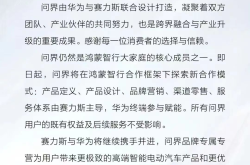
In a flurry of announcements, Seres and Huawei have unveiled a shift in their collaborative framework. This automotive partnership has transitioned from a close-knit 'Smart Selection Vehicle' alliance to a new paradigm where Seres takes the helm in operations, while Huawei offers a more streamlined, asset-light form of support. While not a complete severance, characterizing it as a parting of ways is not an exaggeration.
Some observers attribute the rift between the two entities to Huawei's allegedly excessive profit extraction.
It has been revealed that Seres' financial obligations to Huawei primarily consist of two components:
The first is the hardware procurement fee, coupled with a 2% technology licensing fee payable to Yinwang Intelligent.
The second is an 8% channel service fee remitted to Huawei's Consumer Business Group (BG), with all proceeds from user value-added services also directed to the Consumer BG.
Collectively, these fees amount to a fixed, rigid commission of approximately 10%.
By 2025, the annual outflow attributable to channel fees alone is projected to reach billions.
Last year, buoyed by Huawei's Harmony Intelligent Mobility technology, Seres transformed from a loss-making entity to a profitable one. When the money was flowing, all seemed well.
However, since the onset of this year, market dynamics have shifted, and Seres has once again dipped below the profitability threshold. Amid losses, both parties have valid reasons to seek a redistribution of profits in line with their respective interests.
Yet, reducing the downgrade in their cooperation to mere financial interests is clearly shortsighted.
In truth, Seres' defiance has been brewing for some time, with the 'Saidou Automobile' initiative earlier this year serving as Zhang Xinghai's exploratory move.
Both Harmony Intelligent Mobility and 'Saidou' share a common denominator: the 'soul'.
In the era of smart vehicles, intelligence embodies the soul. When Seres mentions 'Saidou,' it is a clarion call for reclaiming its soul and a rebellion against Huawei's 'non-car-manufacturing' stance.
Huawei's 'non-car-manufacturing' policy was instituted by Ren Zhengfei. However, in the case of Aito, aside from the absence of the Huawei logo, Huawei's influence permeates every aspect of the product, with brand operations fully managed by Huawei.
At this juncture, whether Huawei manufactures cars or not has become a moot point.
Seres must be thinking, 'You claim not to manufacture cars, yet I'm practically reduced to being your OEM (Original Equipment Manufacturer).'
Hence, Seres' rebellion is understandable.
In the business realm, interests often overshadow questions of right or wrong.
Seres' rebellion this time around has significant repercussions for Huawei, compelling it to re-evaluate the boundaries of 'car-manufacturing.' Huawei's strategy of not manufacturing cars is clear, but has there been a deviation in its execution?
There's a saying in the market: when things are going well, it's attributed to Huawei; when things go awry, it's blamed on Seres.
Among the five brands, Seres is the first to rebel, but it is unlikely to be the last.
Previously, an Avatr executive stated that cooperation with Huawei is not obligatory, hinting at underlying discontent among Huawei's five brands.
Fundamentally, this represents a trial and error (adjustment) phase for Huawei's envisaged business model in the automotive industry. Deeper still, it is the struggle of automakers to assert their 'soul.' For Huawei, it is time to contemplate how to effectively assume the 'Bosch role' in the era of smart vehicles.
In fact, to put it simply, Bosch never promotes itself as exceptional to end consumers; its influence is subtly conveyed through automakers to the consumers.
Automakers desire their own soul, and Huawei's intention of not manufacturing cars is to empower automakers with their soul. However, if Huawei aggressively promotes itself to consumers in the market, it will diminish the influence of automakers and hurt their pride. After all, in the industrial chain, automakers occupy a central position.
Therefore, Huawei stepping back and providing a tailored soul for automakers would be the optimal solution.
For automakers, most lack the capability to forge their own soul. Customizing their soul based on the Harmony Intelligent Mobility platform may also represent the optimal solution.
Such a division of labor could very well be the most harmonious arrangement in the automotive industry chain in the era of smart vehicles.
-
![]()
GAC Acquires Stake in FAW Toyota: The Merger of North and South Toyota Unveils the Complex Landscape of China’s Auto Market
-
![]()
[Electrical Equipment] 45 BRT Pure Electric Mining Trucks Supplied to Chaonaoliang Coal Mine
-
![]()
FAW Acquires Stake in Leapmotor
-
![]()
From Booming Stocks to Trading Halt: Why is the Market So Optimistic About FAW's Investment in GAC?
-
![]()
US and Europe Act in Unison, Chinese Automakers Confront Dual Barriers in Global Expansion
-
![]()
Will the 'Size Arms Race' in the Auto Industry Reach Its End?
-
![]()
AITO Takes the Helm: Smart Selection Car Model Faces Pivotal Challenge
-
![]()
Seres Regains Autonomy: AITO's Front-End Operations Shift Back to Automaker, Huawei Returns to Supplier Role