AITO Takes the Helm: Smart Selection Car Model Faces Pivotal Challenge
 09/18 2026
 346
346
Introduction
SERES Aims for Greater Independence by Reasserting Control Over AITO
On September 15, AITO and Harmony Intelligent Mobility Alliance unveiled the "Explanation of the Cooperation Model of Harmony Intelligent Mobility Alliance" simultaneously.
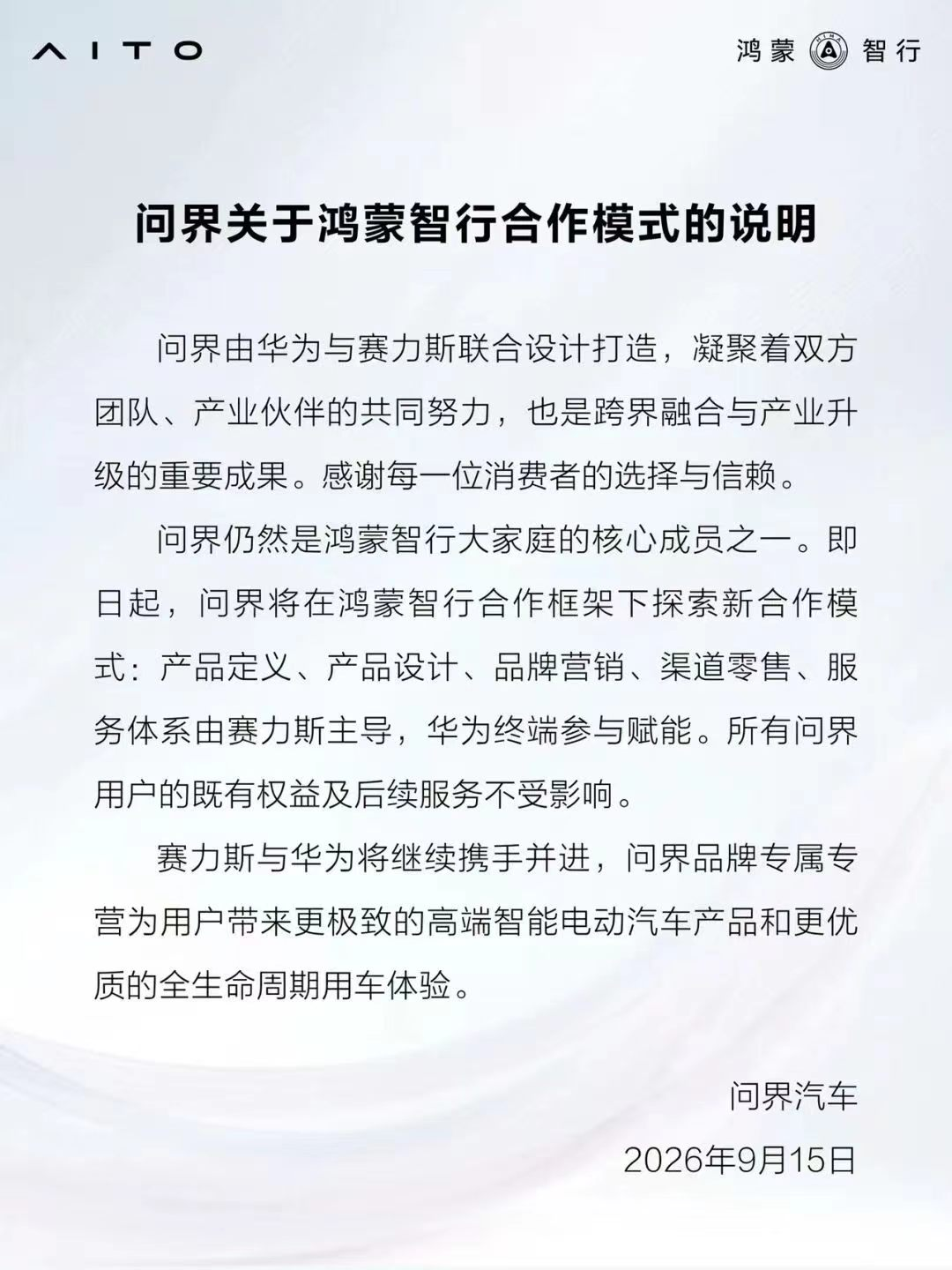
These two statements, characterized by a mild tone and consistent language, marked an unprecedented power shift within the Harmony Intelligent Mobility Alliance system. SERES now leads the product definition, design, brand marketing, channel retail, and service systems for AITO, while Huawei's Consumer Business Group transitions from a leading role to one of participation and support.
Harmony Intelligent Mobility Alliance clarified that the models under Zunjie, Xiangjie, Zhijie, and Shangjie would continue to adhere to Huawei's full-process-led cooperation model. This marks the first instance within the Harmony Intelligent Mobility Alliance operation where a "Jie" brand has seen Huawei's role diminish from leading to participating and enabling.
SERES's decision to reclaim control comes at a crucial juncture when AITO must address the question of "where its next growth trajectory will emerge."
Declining Sales Compel AITO to Explore New Avenues
Let's examine the figures first. According to SERES's production and sales report, in August 2026, SERES's automotive sales (primarily AITO series) reached 20,652 units, reflecting a year-on-year decline of 49.68%. From January to August, cumulative sales stood at 201,902 units, down 14.07% year-on-year. In contrast, Harmony Intelligent Mobility Alliance's official Weibo account revealed that in August 2026, total deliveries across all models reached 42,101 units, with cumulative deliveries of approximately 328,000 units in the first eight months and total cumulative deliveries surpassing 1.52 million units.
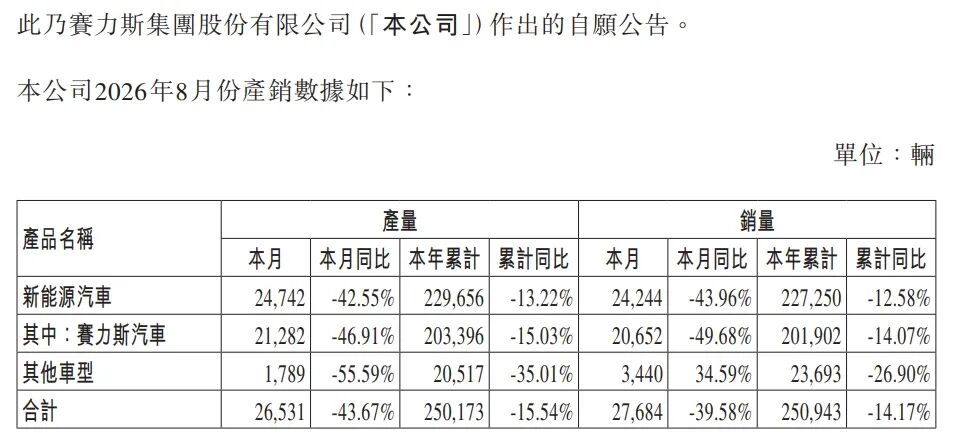
Among competitors also positioned as extended-range benchmarks, Li Auto delivered 37,679 units in August, Xiaomi delivered over 30,000 units in the same month, and Leapmotor soared to 103,129 units. While the overall pressure on the extended-range and hybrid vehicle segments provides a backdrop, AITO's sales are under significantly greater strain.
In the first half of the year, AITO achieved sales of 160,770 units, showing a slight year-on-year increase of 5.6%. This growth was primarily driven by the M6 and M9 models, rather than a comprehensive expansion of the product lineup. In the first half of 2026, AITO's sales were highly concentrated on the M7, M6, and M9 models. From August retail data, the M9 accounted for approximately 44.68%, the M6 for about 34.99%, with these two models contributing nearly 80% of total sales. Meanwhile, the M7's share dropped to 13.32%, and the M5's to just 0.66%.
The structural implications are evident: AITO's growth is not broad-based but relies on a few key models. The M7, once AITO's sales mainstay, has witnessed a noticeable decline amid competitive pressure. The M5, which initially helped AITO gain a foothold, has now completely exited the market. The models truly holding the fort are the M6 and M9—one making a high-end breakthrough, the other targeting younger consumers. This exposes AITO's deepest issue: it lacks a stable, volume-selling model in the mid-price range that can sustain long-term growth. Once a key model undergoes a generation transition, the entire sales structure can swing violently.
Meanwhile, the extended-range market itself is transitioning from a blue ocean to a red ocean. In recent years, AITO and Li Auto have largely dominated the perception that "extended-range equals premium family vehicles." However, the extended-range route has now become a crowded, homogeneous competition due to an influx of competitors.
According to media reports based on insurance data, in 2025, extended-range models accounted for 73.3% of Harmony Intelligent Mobility Alliance's total sales, with pure electric models making up only 26.7%. Within the AITO brand, the extended-range share is estimated to be between 75% and 80%. When a technological route reaches market saturation and all brands are playing the same hand, incremental gains inevitably decline, leaving only fierce competition.
This is the real brake on AITO's growth. And precisely at this critical juncture for a shift, AITO has been notably slow in developing its pure electric lineup.
Previously, product definition and design for AITO were in Huawei's hands. Huawei's framework naturally prioritized the routes it excelled in and could best deliver ecological value. Within a "Huawei-led definition" cooperation system, AITO had limited room to adjust its structure or accelerate its pure electric pace based on its own market judgments. It's not that SERES didn't want to develop pure electric models, but under this framework, it lacked decision-making power.
The fading of extended-range benefits is an objective market condition; the slow pace of pure electric development is a structural lag left by the previous cooperation framework. Together, these two factors represent AITO's true motive for regaining control: it needs to take back decision-making power over "which technological path to follow, how to arrange models, and how fast to iterate" rather than remaining tied to Huawei's rhythm.
Thus, regaining control is not a panacea. After gaining the power to independently define products, whether SERES can respond more swiftly to market changes is the real test it now faces.
AITO Takes the Helm: Will It Alter the Balance of Harmony Intelligent Mobility Alliance?
After regaining control, AITO faces two major hurdles.
The first, and most critical, is whether SERES can effectively manage the autonomy over product strategy. The fading of extended-range benefits is irreversible, and filling the gap with pure electric models is essential. However, this involves more than just launching a few pure electric models; it requires an entire engineering system different from extended-range vehicles, including charging networks, thermal management, and battery cost control.
Fortunately, SERES is not starting from scratch. In 2025, SERES reported revenue of 165.054 billion yuan and net profit attributable to shareholders of 5.957 billion yuan, providing it with financial resources. In the first half of 2026, R&D spending reached 3.7335 billion yuan, up 27.44% year-on-year, indicating substantial investment in engineering capabilities, platformization, and manufacturing systems. However, in the same period, net profit attributable to shareholders fell to a loss of 1.717 billion yuan, and the gross margin dropped to 20.92% in the second quarter—profits are being earned, R&D is ramping up, but losses are inevitable.
The question remains: after breaking away from Huawei's rhythm, can SERES independently determine its product path, arrange models, and convert R&D investment into consistently high-selling vehicles? This will take time to verify.
The second issue is whether the tech branding can hold up. Huawei remains a core member of AITO, continuing to provide support, with deep integration of intelligent driving and HarmonyOS ecosystem. However, the focus of brand narratives will inevitably shift from "vehicles built by Huawei" to "Huawei-empowered vehicles led by SERES." Whether user trust in Huawei's involvement will waver is not about product quality but directly affects conversion rates and pricing power at the terminal level.
The most disruptive part of this event for the industry is not AITO itself but its potential to shift the balance of Harmony Intelligent Mobility Alliance.
In the first half of 2026, Harmony Intelligent Mobility Alliance delivered approximately 242,400 units across all models, with SERES (primarily AITO) accounting for about 160,800 units, making it the largest brand among the five "Jie" brands. According to public delivery data, Zhijie delivered about 19,300 units, Xiangjie about 21,000 units, Shangjie about 32,000 units, and Zunjie about 7,000 units in the first half. AITO alone supports the foundation of Harmony Intelligent Mobility Alliance, giving it negotiating leverage that the other four brands currently lack.
For the other four brands, the temptation is clear. Zunjie S800 targets the luxury segment, Zhijie guards the mid-to-high-end market, Xiangjie focuses on executive sedans, and Shangjie explores the youth market—all are bound to Huawei's full-process-led framework, with product definition and design controlled by Huawei.
It's not hard to imagine that if the AITO model succeeds, the bargaining chips for "deep binding—gradual decentralization" within Harmony Intelligent Mobility Alliance will be redistributed. Whether Zunjie, Xiangjie, Zhijie, and Shangjie will make similar demands at their respective development stages depends on each brand's sales scale, technological accumulation, and equity structure.
Looking deeper, the real challenge lies with Huawei.
Huawei's greatest asset has never been a specific product but its empowerment system of "Huawei brand + intelligent driving + HarmonyOS ecosystem," which requires deep binding with automakers to deliver value. However, if AITO proves that "Huawei can step back, the brand can still survive, and the cars can still sell," it effectively tells all partners that deep binding is not mandatory and that empowerment can be obtained more easily. This directly undermines the foundation of the Smart Selection car model.
Therefore, after AITO regains control, the industry's biggest doubt is whether Huawei still wants to remain the dominant player in car manufacturing. Although ceding control over AITO represents a pragmatic reallocation of resources for Huawei—freeing up limited Consumer Business Group energy and channel resources from the already established AITO to focus on the four still-climbing brands—the next power shift among the five "Jie" brands may already be on the horizon.
-
![]()
GAC Acquires Stake in FAW Toyota: The Merger of North and South Toyota Unveils the Complex Landscape of China’s Auto Market
-
![]()
[Electrical Equipment] 45 BRT Pure Electric Mining Trucks Supplied to Chaonaoliang Coal Mine
-
![]()
FAW Acquires Stake in Leapmotor
-
![]()
From Booming Stocks to Trading Halt: Why is the Market So Optimistic About FAW's Investment in GAC?
-
![]()
US and Europe Act in Unison, Chinese Automakers Confront Dual Barriers in Global Expansion
-
![]()
Will the 'Size Arms Race' in the Auto Industry Reach Its End?
-
![]()
AITO Takes the Helm: Smart Selection Car Model Faces Pivotal Challenge
-
![]()
Seres Regains Autonomy: AITO's Front-End Operations Shift Back to Automaker, Huawei Returns to Supplier Role