The “De-CATL-ization” Trend: Can CATL Weather the Storm?
 09/22 2026
 463
463

Image source: AI-generated, not an actual scenario
A new buzzword has surfaced in the automotive industry lately: “De-CATL-ization.”
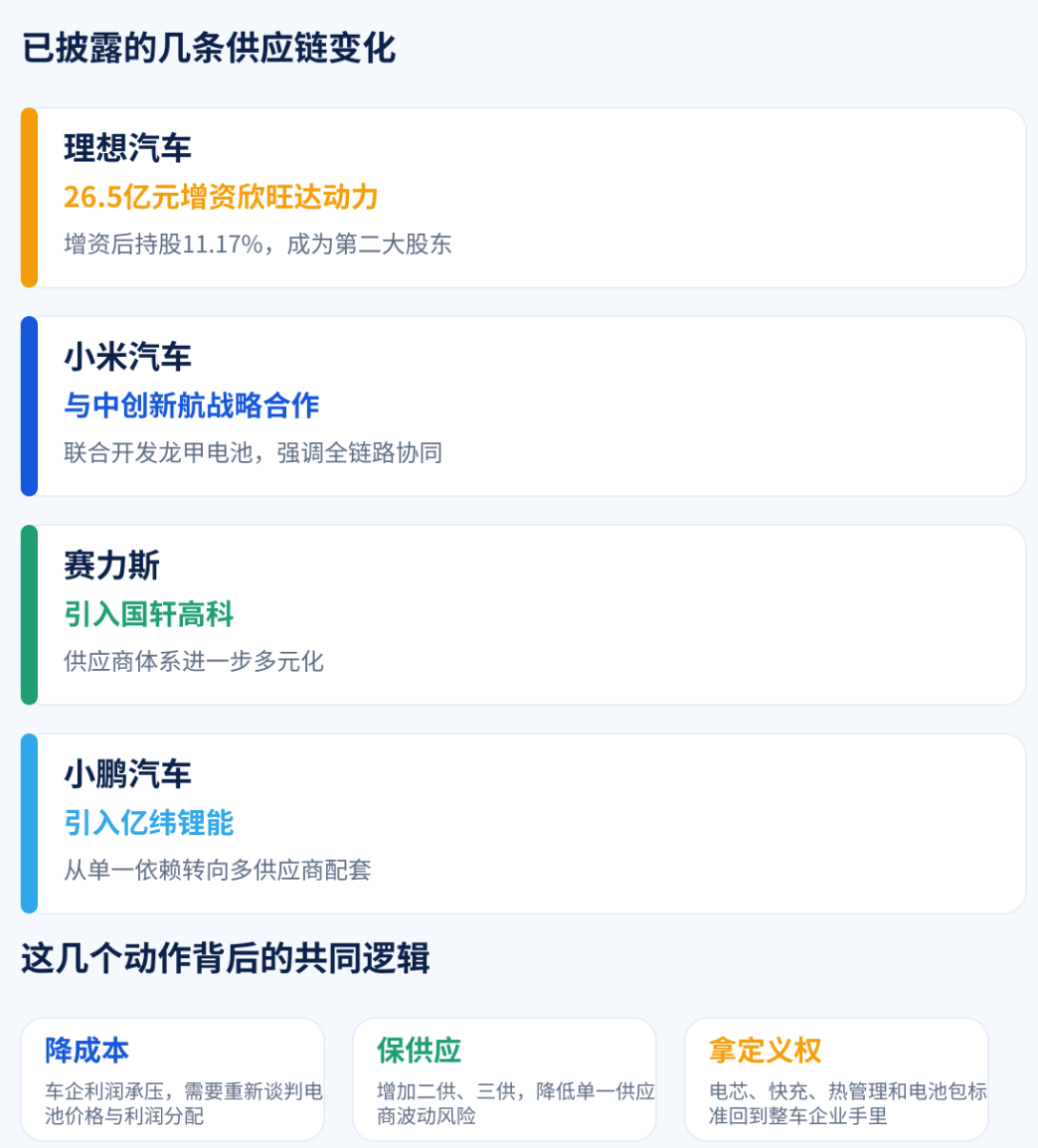
It sounds like a massive shift in the supply chain. Li Auto is investing in Sunwoda, Xiaomi is forging a deep partnership with CALB, Seres is teaming up with Gotion High-Tech, and XPENG is expanding its collaboration with EVE Energy.
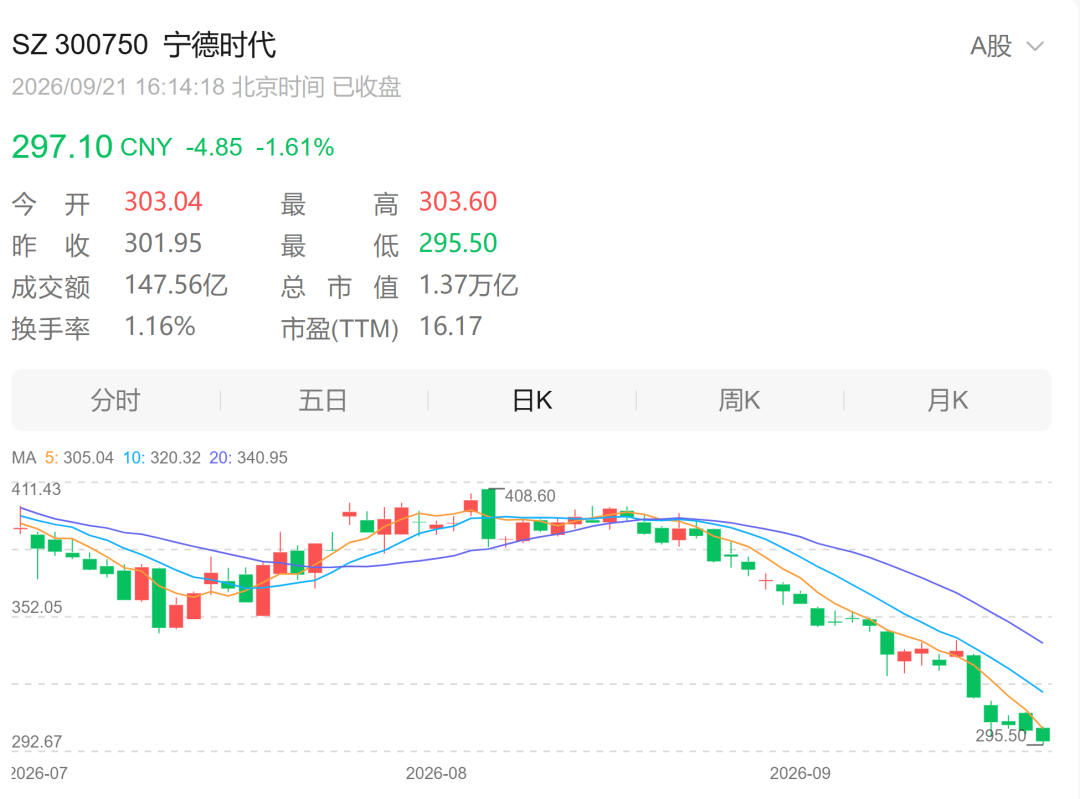
Meanwhile, CATL’s stock price is feeling the heat. As of September 21, it dropped below RMB 300, prompting the market to wonder: Are automakers collectively distancing themselves from CATL?
A more precise interpretation of “De-CATL-ization” is that automakers are diversifying their battery supply chains, moving away from reliance on a single supplier.
The battle is not just about saving a few hundred yuan on cell costs; it’s about who gets to define the battery, develop the product, allocate the profits, and ultimately control the most critical component of an electric vehicle.

The Rise of “De-CATL-ization”
On September 4, Sunwoda announced that Li Auto planned to invest RMB 2.65 billion to increase its stake in Sunwoda Electric. Once completed, Li Auto would hold approximately 11.17%, becoming Sunwoda Electric’s second-largest shareholder.

Three days later, Li Auto revealed that the first batch of its new-generation Li MEGA would use CATL’s 5C ternary lithium batteries. However, it would gradually switch to its self-developed 5C batteries once production was up and running.
The new-generation Li L8, launched in June 2026, already uses Sunwoda cells, with CATL removed from the supply list.
Xiaomi’s strategy is equally clear. On September 4, Xiaomi Group announced a strategic partnership with CALB to jointly develop the Dragon Scale battery, emphasizing end-to-end collaboration. Previously, models like the Xiaomi SU7 and YU7 primarily relied on CATL batteries.
Other automakers are also diversifying their battery sources.
Public reports indicate that Seres has brought Gotion High-Tech on board, while XPENG is deepening its partnership with EVE Energy.
Their common strategy isn’t to completely sever ties with CATL but to shift from a “single primary supplier” model to a “primary plus secondary supplier, with some in-house R&D” approach.
So far, public reports on CATL’s response mainly mention media reports that the company plans to address related rumors, but no systematic public statement on “De-CATL-ization” has been issued.
Recent public information on CATL’s official website still focuses on passenger vehicles, energy storage, manufacturing, and global business expansion.
Why Are Automakers Suddenly Vying for Battery Control?
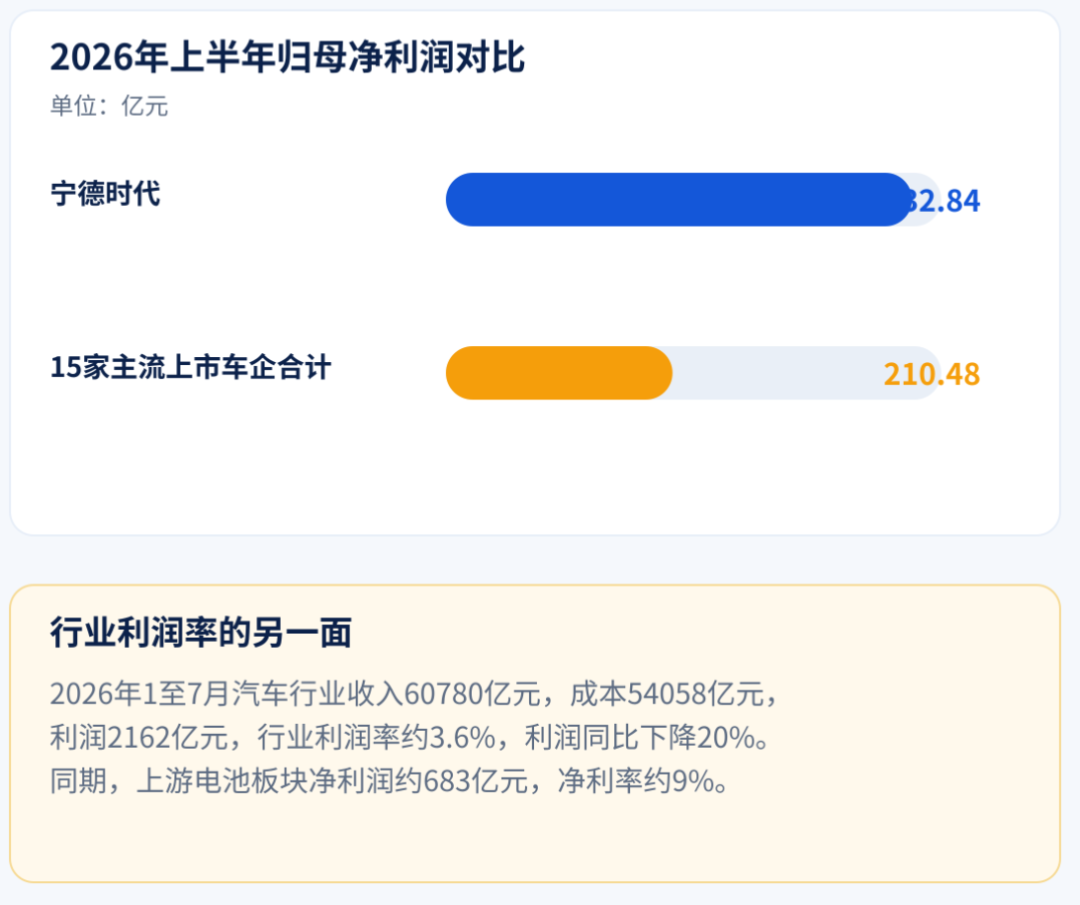
The first reason is profit pressure. In the first half of 2026, CATL’s net profit attributable to shareholders was RMB 43.284 billion. In contrast, the combined net profit of 15 mainstream listed automakers on the A-share and HKEX markets was approximately RMB 21.048 billion.
In other words, one battery company’s half-year profit surpassed the combined profits of over a dozen mainstream automakers.
This doesn’t mean CATL is “over-earning.” Behind battery companies lie R&D investments, long-term capacity building, quality responsibilities, and delivery risks. However, when automakers are embroiled in price wars, the stronger upstream profits become, the greater the incentive for automakers to renegotiate terms.
From January to July 2026, the automotive industry generated RMB 6.078 trillion in revenue, up 2.7% year-on-year; costs were RMB 5.4058 trillion, up 3.8% year-on-year; profits were RMB 216.2 billion, down 20% year-on-year, with an industry profit margin of about 3.6%.
During the same period, the net profit of upstream battery companies, led by CATL, was approximately RMB 68.3 billion, with a net profit margin of about 9%.
This is the reality for automakers. Selling more cars doesn’t necessarily translate to higher profits.
Batteries remain one of the highest-cost and most technically critical components of new energy vehicles. Whoever controls battery costs and specifications gains an extra layer of profit protection.
The second reason is supply chain security. Introducing a secondary supplier isn’t about immediately replacing the primary one but about having an extra bargaining chip.
Today, you can procure; tomorrow, you can switch; the day after, you can co-develop. Supply chain resilience often becomes apparent not during smooth sailing but during market fluctuations.
The third reason is automakers’ redefinition of “in-house R&D.” Automakers don’t need to handle everything from mines, materials, and cells to battery packs. A more practical path is for automakers to define requirements while battery companies handle engineering and mass manufacturing, with both sides binding through equity stakes, joint development, and long-term agreements.
Li Auto’s investment in Sunwoda Electric isn’t just about procurement but elevating the partnership to capital and product levels.
Xiaomi’s collaboration with CALB isn’t a temporary supplier switch but joint development around product standards, quality systems, and battery systems.
What automakers truly want to regain is definition power.
CATL’s Report Card
Data from the China Automotive Power Battery Industry Innovation Alliance shows that CATL’s power battery installations in 2025 reached 333.57 GWh, with a market share of 43.42%, down 1.67 percentage points year-on-year.
From January to July 2026, CATL’s domestic market share rebounded to 45.37%, still absolutely dominant.
Globally, Reuters cited industry data stating that CATL’s global power battery market share in 2025 was about 39.2%, remaining the world leader.
The company’s 2025 profits grew 42.3% year-on-year, with energy storage battery revenue accounting for 14.7%, indicating CATL’s efforts to reduce reliance on passenger vehicle power batteries.
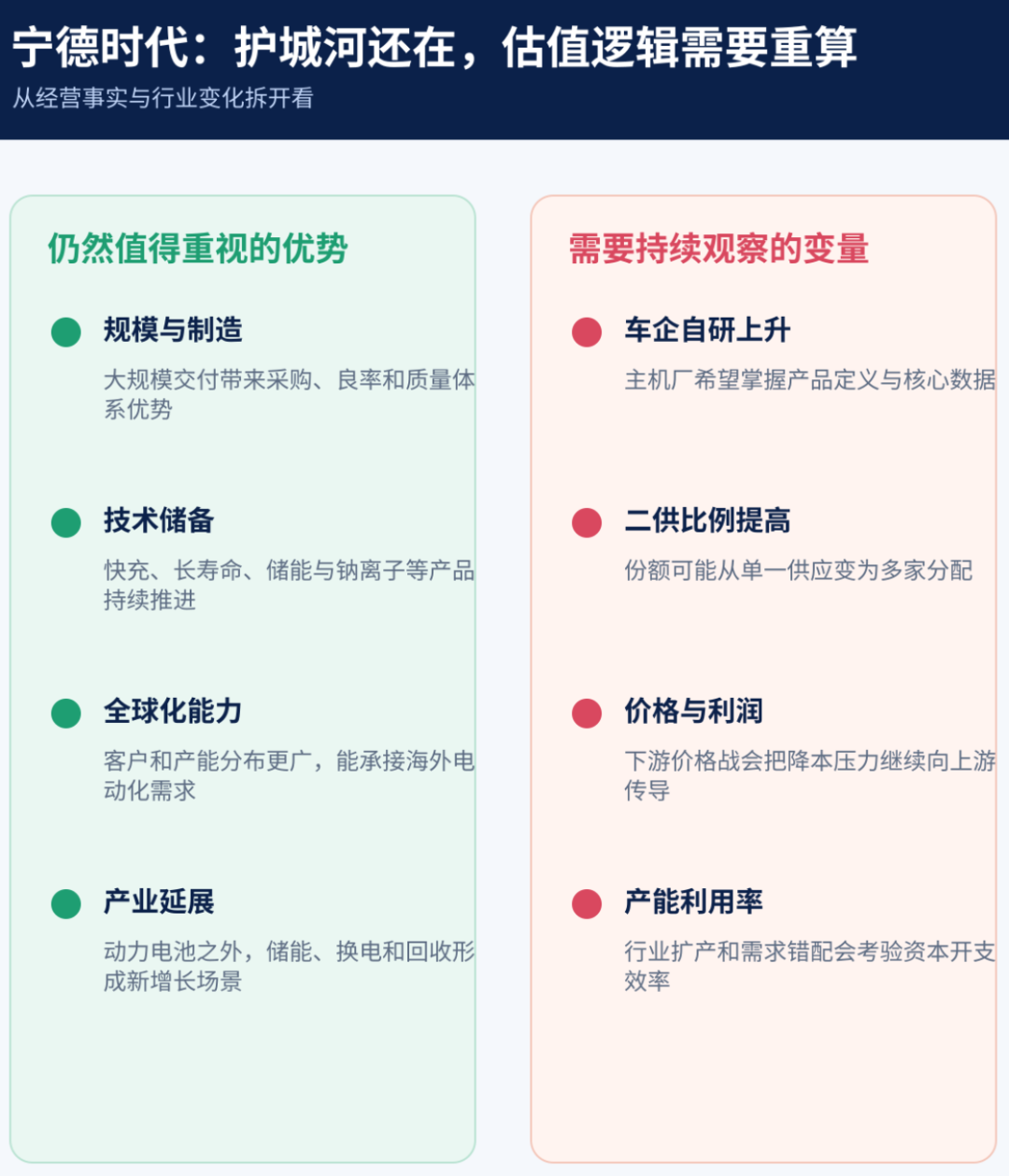
CATL’s strength lies not in a single technical parameter but in a comprehensive system capability.
It boasts mass manufacturing, broad customer coverage, robust quality systems, and a continuously evolving product matrix.
Fast charging, long life, energy storage, sodium-ion batteries, and battery swapping services form multiple business lines. Public reports show that the company added 3,210 new patents in the first half of 2026.
More importantly, developing sample batteries doesn’t equate to mass production, validation, or long-term stable delivery. The automotive industry fears not unimpressive launch parameters but consistency issues after mass delivery.
This is why “De-CATL-ization” is hot, but CATL’s market share hasn’t collapsed in tandem.
What CATL truly needs to watch isn’t replacement but revaluation.
CATL’s First Pressure: Automaker In-House R&D and Joint Development
As automakers gradually master battery pack structures, thermal management, software control, and fast-charging standards, battery companies’ value may shift from “system solution leaders” to “high-quality manufacturers.”
This isn’t necessarily bad but will affect profit margins and bargaining power.
The Second Pressure: Second-Tier Battery Companies Catching Up
In mature systems like lithium iron phosphate, the technical gap between second-tier companies and leaders is narrowing.
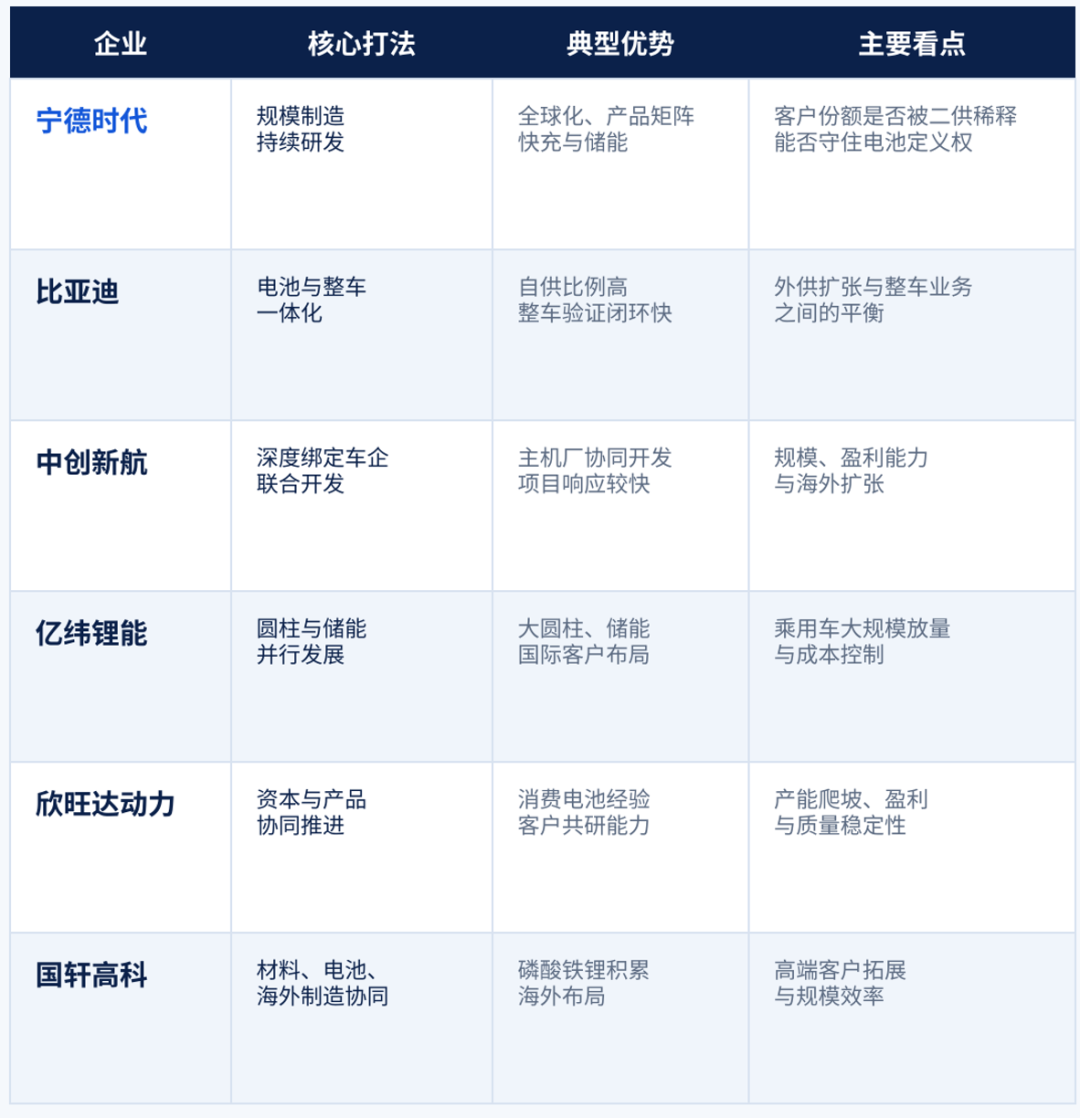
CALB excels in deep collaboration with automakers, Sunwoda Electric emphasizes consumer battery experience and joint R&D with clients, EVE Energy differentiates in large cylindrical cells and energy storage, and Gotion High-Tech continues investing in material systems and overseas manufacturing.
These companies haven’t fully challenged CATL’s scale advantage but are pushing competition to “becoming the preferred choice for certain vehicle models or battery systems.”
The Third Pressure: Valuation Expectations
Capital markets once valued CATL highly for its high growth, strong profitability, and high certainty.
Now, growth and profitability remain strong, but certainty is being re-evaluated.
The market asks three questions: Can CATL maintain a nearly 40% global share? Will automakers’ multi-supplier strategies reduce single-customer allocation ratios? Can energy storage and overseas businesses fill the profit gap left by diverted power battery profits?
Industry Transformation
The power battery market remains a growing one.
Reuters reported on September 21 that global new energy vehicle sales continued to rise from January to August 2026, with Europe’s EV penetration increasing and China maintaining high electrification levels while boosting exports.
Global electrification hasn’t halted due to policy changes in some markets; battery demand persists.
However, a growing market doesn’t mean all companies will profit. Future power battery industry changes will include:
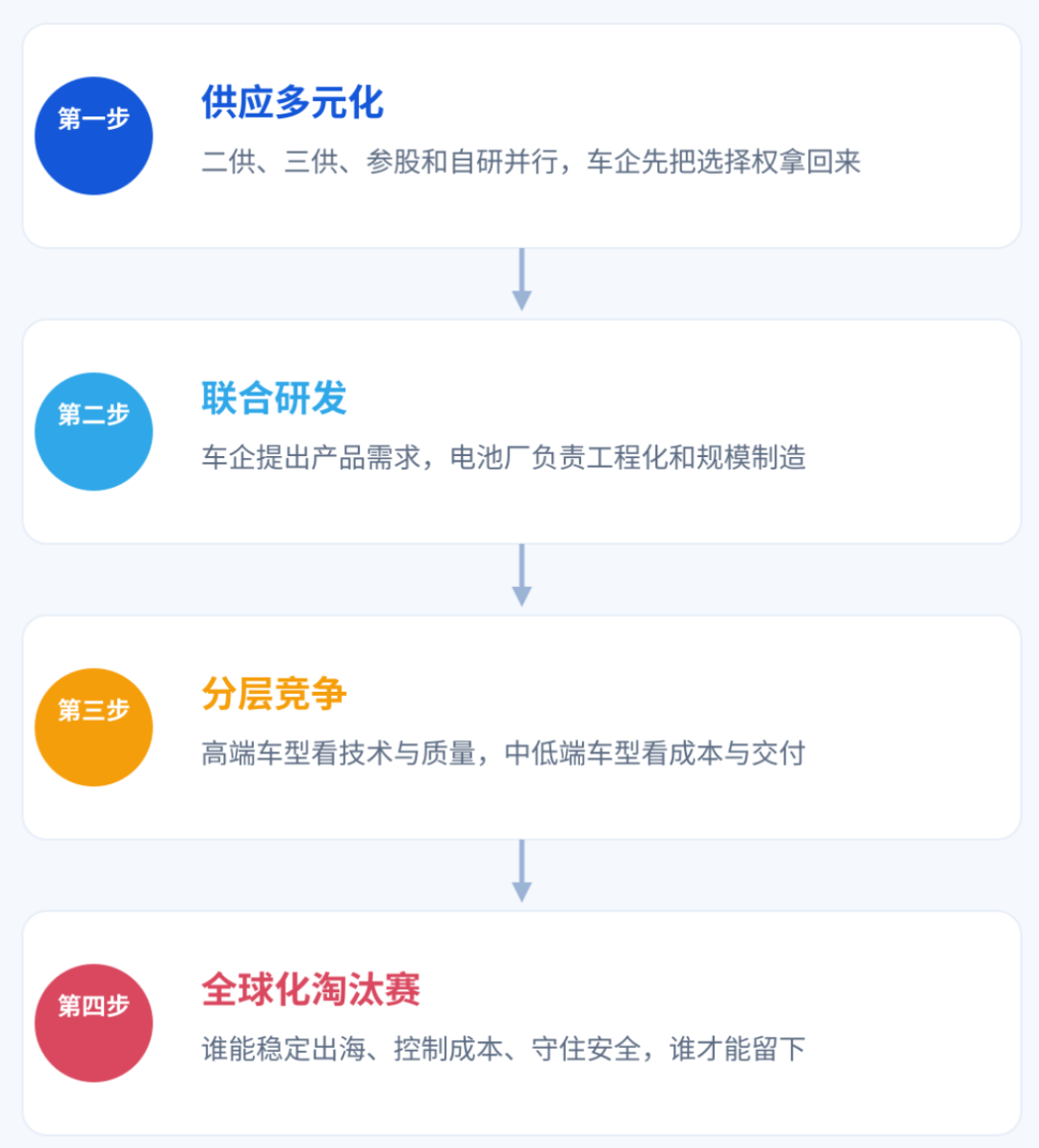
First, more suppliers but no unlimited scale expansion. Low-utilization capacity will become a cost burden. Ultimately, the survivors won’t be those with the most factories but those with high yields, stable delivery, and low costs.
Second, closer partnerships between automakers and battery companies. Automakers will bind capacity through equity stakes, joint R&D, and long-term agreements, while battery companies will secure stable orders through technology, manufacturing, and global delivery capabilities.
Third, competition will expand beyond cells to battery packs, software, thermal management, fast-charging networks, energy storage, and recycling.
CATL’s strength lies in its long business chain, while second-tier companies’ opportunities lie in being more agile and closer to specific clients.
From this perspective, “De-CATL-ization” isn’t about excluding CATL from automakers’ supply chains but altering the past structure where a single leader held excessive influence.
This isn’t necessarily bad for CATL. More competitors will force the leader to continue cutting costs, innovating, and improving services.
For automakers, multi-sourcing isn’t free; management complexity and quality responsibility boundaries will become harder to navigate.
The truly rational choice isn’t “De-CATL-ization for its own sake” but placing different suppliers in the most suitable roles.
Final Verdict
CATL’s current crisis is more about influence and valuation than operational collapse.
Automakers’ moves indicate that the past supply chain relationship, heavily reliant on a single battery giant, is loosening.
CATL still leads in market share, profitability, and technical and manufacturing barriers. However, automakers are already redistributing battery profits and power through equity stakes, secondary suppliers, and in-house R&D.
The endpoint of this change is unlikely to be total replacement.
A more likely scenario is automakers controlling product definitions while battery companies handle professional manufacturing, with deeper binding through capital and R&D.
CATL will remain the industry leader but must transition from “irreplaceable” to “continuously proving itself worthy of choice.”
This is a question all giants eventually face.
When the market stops asking only “how strong you are” and starts asking “why only choose you,” competition truly enters the next phase.
The real focus shouldn’t be on how much automakers “De-CATL-ize” today but on who still uses CATL batteries three years later—and what products they use.
If the answer is “premium models use Qilin, mid-range use Shenxing, entry-level use Naxin,” then “De-CATL-ization” is a false alarm. If the answer is “only export models use them,” the story will need rewriting.
The answer lies not in today’s stock price but in next year’s orders.
-
Re-evaluating AI Penetration Rates Among Three Internet Veterans
-
![]()
Decoding Tesla FSD's EU Certification: Two Pathways for China's L2++ Intelligent Driving to Go Global
-
![]()
Unistrong Sheds Overseas Assets After 7.5 Years of Losses Totaling Nearly RMB 3.7 Billion, Operating Cash Flow Plunges by 4532%
-
![]()
Profits and Stock Prices Plunge in Unison! Volkswagen Ousted from Europe's Elite Stock Index
-
![]()
Don't Just Fixate on RMB 59.88! The True Catalyst for Sanhua Intelligent Lies in Its 'Third Growth Curve'
-
![]()
Starting from 100,000? Honda's new car suddenly revealed: Launching on October 6
-
![]()
Mobile Phone Prices Soar: Can Changxin Offer a Cost-Effective Solution?
-
![]()
The “De-CATL-ization” Trend: Can CATL Weather the Storm?