Don't Just Fixate on RMB 59.88! The True Catalyst for Sanhua Intelligent Lies in Its 'Third Growth Curve'
 09/22 2026
 352
352

Don't navigate away just yet—this is far from bad news.
On September 21, Sanhua Intelligent unveiled a modification to the upper limit of its A-share buyback price, reducing it from RMB 60.00 per share to RMB 59.88 per share, effective September 30.
The rationale is simple: the company is executing its 2026 interim dividend distribution, allocating RMB 1.20 per 10 shares (inclusive of tax), equating to RMB 0.12 per share. The ex-dividend date is also set for September 30. The RMB 0.12 reduction in the buyback price cap is a standard adjustment, not indicative of a sudden loss of confidence in the company.
The pertinent questions to ponder are: Why is the company still repurchasing shares? What is the source of the funds? And what does the future hold?
I. Confidence Bolstered by Robust Cash Flow
According to the disclosed 2026 interim results, Sanhua Intelligent's revenue and core net profit (excluding non-recurring items) continued to exhibit growth, with operating cash flow nearly doubling year-on-year. Net profit attributable to shareholders encountered temporary pressure, primarily attributable to non-recurring factors such as securities investment gains and losses, rather than a deceleration in its core business.
The minor tweak to the buyback price is merely a technicality; sustained repurchases are a testament to confidence. In the current climate, the willingness to continue investing substantial funds underscores management's faith in its cash flow and the fundamentals of its core business.
II. Three Growth Trajectories: Legacy, Expansion, and Innovation
Sanhua Intelligent's narrative can be encapsulated in three growth trajectories.
The First Trajectory: Refrigeration and Air Conditioning Components. This forms the bedrock of Sanhua's operations. Core products such as electronic expansion valves, four-way reversing valves, and solenoid valves command a global leadership position in market share. Although mature, this market still presents growth opportunities—the company is extending its thermal management technology into energy storage and data center liquid cooling. With the AI computing boom fueling demand for liquid cooling, this 'legacy trajectory' is spawning fresh growth.
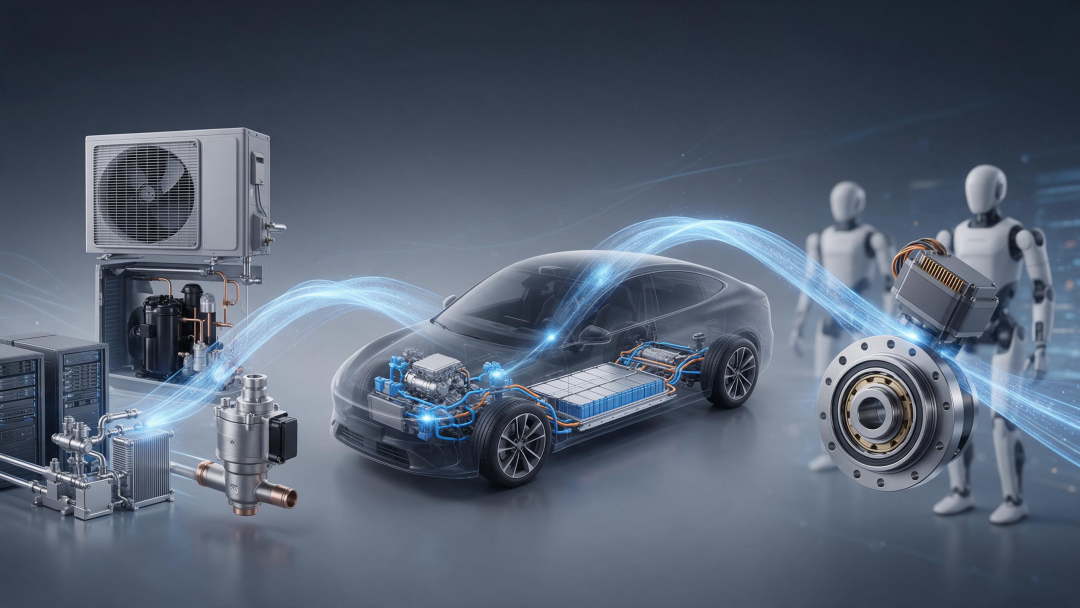
The Second Trajectory: Thermal Management for New Energy Vehicles. Sanhua was an early entrant in this domain, serving global automakers such as Mercedes-Benz, BMW, BYD, Volkswagen, Ford, and General Motors, as well as major thermal management integrators like Denso and Valeo. With global NEV sales continuing to escalate in the first half of 2026, Sanhua's orders surged. This trajectory now underpins its current growth.
The Third Trajectory: Electromechanical Actuators for Bionic Robots. This represents the market's most eagerly anticipated new chapter. Actuators dictate the motion precision and response speed of robotic joints. In the first half of 2025, Sanhua was collaborating with clients on R&D, prototyping, iteration, and sampling; by August 2026, core products had progressed to mass delivery and production ramp-up, garnering positive client feedback.
The transition from 'sampling' to 'mass delivery' signifies a qualitative leap. It indicates that the robotics business is transitioning from R&D investment to revenue generation.
The industry's potential is burgeoning. Industry research projects the global robotic actuator market to expand from $18.62 billion in 2026 to $47.02 billion by 2035, at a CAGR of approximately 10.8%. Domestic humanoid robot shipments are anticipated to surge in 2026 compared to 2025. Companies that secure positions ahead of the mass production inflection point will hold the key to the next round of growth.
III. Institutional Optimism, Yet Risks Persist
Over the past six months, multiple institutions have issued research reports on Sanhua Intelligent, with a generally favorable outlook. CICC rated it 'Outperform,' Orient Securities recommended 'Buy,' and J.P. Morgan maintained 'Overweight.' Institutions forecast an average net profit of approximately RMB 4.8 billion for 2026, up approximately 18% year-on-year.
The RMB 59.88 buyback price cap aligns with the median of some institutional target prices, creating an anchoring effect. However, institutional forecasts are not infallible, nor are repurchases a guarantee of stock performance.

Risks must also be acknowledged: NEV thermal management faces intensifying competition and pricing pressure; robotic actuator orders, client concentration, and mass production timelines remain uncertain; geopolitical tensions and tariff fluctuations could impact overseas factory profitability. The third trajectory is still 'promising' rather than a proven 'engine.'
Conclusion
RMB 59.88 is merely a figure in an announcement.
What truly matters is Sanhua Intelligent's metamorphosis from an air conditioning valve leader to a new energy thermal management platform, and now to a pivotal player in robotic actuators. Technological progress is not an overnight phenomenon but a gradual industrial accumulation. The first trajectory ensures stability, the second drives growth, and the third bets on the future.
When will the third trajectory shift from 'promising' to 'engine'? Upcoming quarterly delivery data will provide the answer.
Are you optimistic about Sanhua Intelligent's 'third growth trajectory'? Share your thoughts in the comments.
-
Re-evaluating AI Penetration Rates Among Three Internet Veterans
-
![]()
Decoding Tesla FSD's EU Certification: Two Pathways for China's L2++ Intelligent Driving to Go Global
-
![]()
Unistrong Sheds Overseas Assets After 7.5 Years of Losses Totaling Nearly RMB 3.7 Billion, Operating Cash Flow Plunges by 4532%
-
![]()
Profits and Stock Prices Plunge in Unison! Volkswagen Ousted from Europe's Elite Stock Index
-
![]()
Don't Just Fixate on RMB 59.88! The True Catalyst for Sanhua Intelligent Lies in Its 'Third Growth Curve'
-
![]()
Starting from 100,000? Honda's new car suddenly revealed: Launching on October 6
-
![]()
Mobile Phone Prices Soar: Can Changxin Offer a Cost-Effective Solution?
-
![]()
The “De-CATL-ization” Trend: Can CATL Weather the Storm?