All Models to Feature Self-Developed Batteries: Will Others Follow Li Auto's Lead?
 09/22 2026
 399
399
Lead
Introduction
Self-development marks both a significant milestone in automotive manufacturing and a new launchpad for Chinese automakers to expand globally.
As automakers achieve breakthroughs in self-development, a flurry of related news is being released.
For instance, Li Auto has started marketing technologies such as range extenders, silicon carbide, and chips, while newcomers like Xiaomi and XPeng are also joining the self-developed battery trend.
However, this endeavor comes with high research and development costs, the challenge of building market recognition from scratch, and uncertain outcomes. For automakers, is deep self-development the key to brand competition or a new starting point for industry advancement?
01 Self-Developed Batteries: A Growing Trend Among Manufacturers
Self-developed batteries by automakers are exemplified by BYD and Li Auto. BYD has transitioned from a battery supplier to an automaker, while Li Auto represents a typical case of a complete vehicle manufacturer venturing into core hardware development.
As one of the few leading automakers in China to achieve full-link self-development and production of batteries, BYD inherently possesses deep battery manufacturing technology and supply chain advantages. The success of its second-generation blade batteries demonstrates that systematically addressing battery density, range, charging speed, and safety can significantly enhance the overall competitiveness of vehicles and boost automobile sales.
BYD's consistently strong sales performance validates the long-term industrial value of full-stack self-developed battery development.
Compared to BYD's inherent advantages, Li Auto's path to self-development aligns more closely with the growth trajectory of most automakers and is more replicable.
When planning the micro-electric vehicle model SEV, Li Auto aimed to integrate self-developed battery packs and formed a battery development team for this purpose. However, from existing experience, it is unrealistic for automakers to develop batteries in-house during the initial stages. Subsequently, Li Auto recognized this issue and opted for joint development instead. The extended-range large battery equipped in the Li ONE was developed in collaboration with CATL.
Later, Li Auto began to venture into self-development and contract manufacturing. The ternary lithium batteries used in the Li L7 and L8 are products of this approach. Taking the Li L7 as an example, the suppliers for the Pro and Max versions are CATL, while the Air model uses Li Auto's self-developed battery PACK, produced on a dedicated production line established by SVOLT Energy.
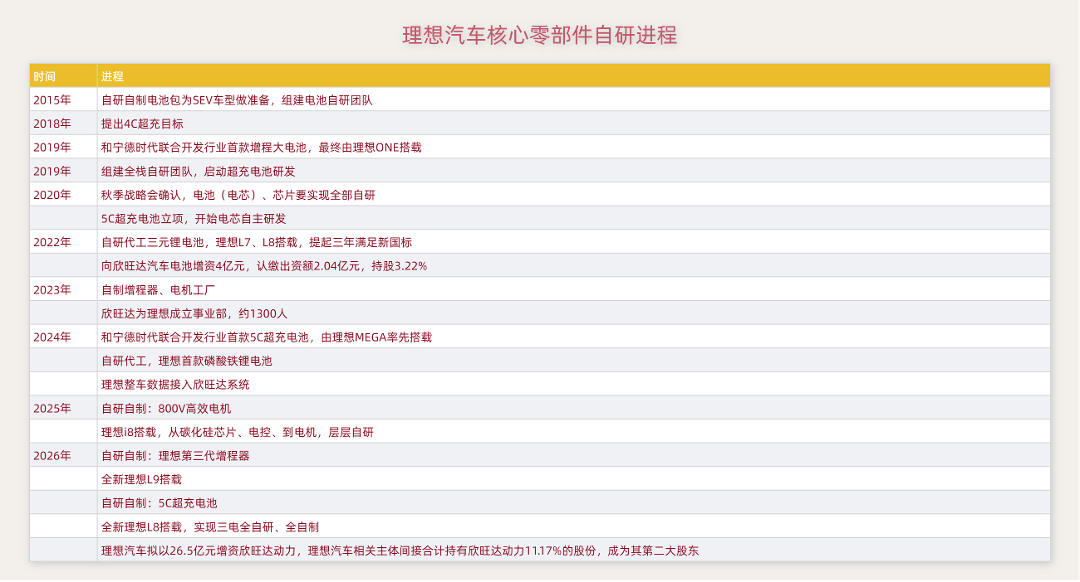
Also in 2022, with enhanced self-development capabilities, Li Auto began to strengthen its cooperation with Sunwoda. It invested 400 million yuan through related entities to participate in Sunwoda Electric's Pre-A round of financing, acquiring approximately a 3.2% stake. Subsequently, Sunwoda established a dedicated business unit for Li Auto, with a team of over a thousand people.
At the same time, Li Auto's cooperation with CATL continued. In 2024, with the launch of the Li MEGA, the 5C battery jointly developed by the two companies was officially introduced. However, with standardized configurations, the i8 also switched entirely to CATL batteries.
After gradually solidifying its self-development technology and bargaining power, Li Auto accelerated the process of scaling up self-developed battery production. Shortly after the launch of the Li i8, Li Auto and Sunwoda each contributed 50% to establish Shandong Li Auto Battery Co., Ltd.
In this cooperation, Li Auto assumed greater dominance, with final say over product definition, processes, performance, materials, quality standards, and core development, while Sunwoda was primarily responsible for implementation capabilities.
Subsequently, self-developed battery packs were gradually integrated. From the all-new Li L8 to the Li MEGA and Li i9, the battery production line switch was clear: CATL was used initially, followed by a switch to self-developed battery packs. The 2026 i6 model, set for delivery starting in November, will be fully equipped with Li Auto's self-developed 5C lithium iron phosphate batteries.
Beyond batteries, Li Auto's self-development scope now covers multiple core components and intelligent systems.
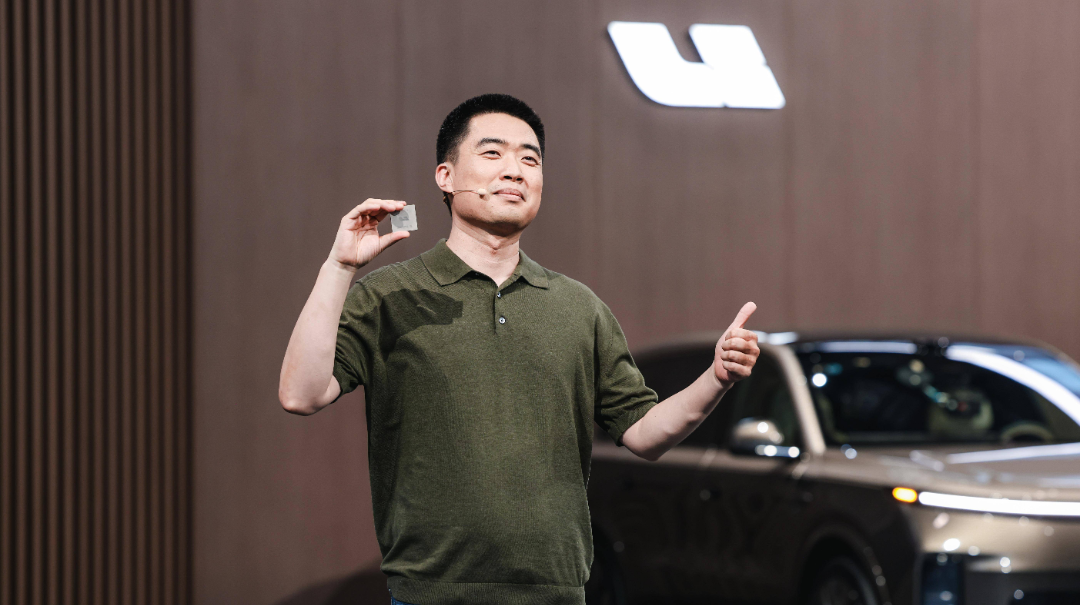
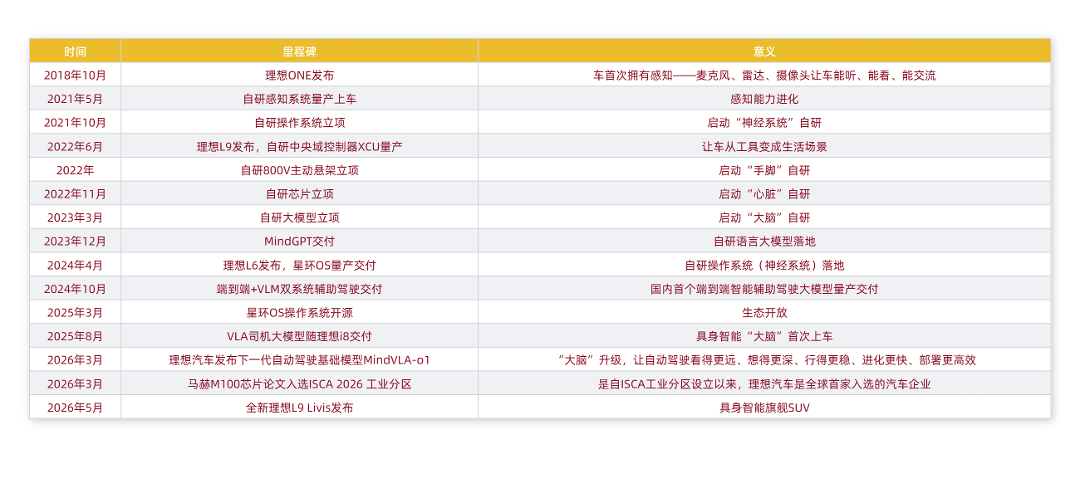
Key technologies such as the Mach chip, silicon carbide power devices, range extender systems, and VLA in-vehicle large models have all achieved independent iteration and have been integrated and implemented across multiple technologies in the new L9 Livis version. The upcoming new i6 model will simultaneously feature self-developed chips and batteries, realizing the formation of a core hardware self-development system.
In addition to self-use, Li Auto, like NIO, is also seeking external supply of core components. According to 36kr, Li Auto's self-developed Mach chips, silicon carbide, and range extenders will be available for external supply, with embodied intelligence companies already having discussed with Li Auto's senior management, who "clearly promoted the Mach chips."
02 Is Self-Development Really Necessary?
Is self-development by automakers necessary?
As more and more automakers develop batteries in-house, Ni Jun, CATL's Chief Manufacturing Officer, recently stated publicly, "Just because you can build cars doesn't mean you can build batteries. It's still about having professionals do professional things."
In 2023, when Gongshe interviewed He Xiaopeng, a similar question was raised, which can almost be seen as a response from automakers three years ago to the suppliers' statements three years later.
Gongshe's question was: "Suppliers say that professionals should do professional things, so some technologies should be handled by suppliers. How does XPeng consider its insistence on self-development of some technologies? Will it procure them externally in the future?"
While He Xiaopeng's specific response cannot be accurately quoted, the general gist was: "When exploring the right direction, one must understand it through self-development. After achieving scale, procurement can be considered based on cost."
In this statement, self-development by automakers is the starting point for exploring the right direction, but in reality, self-development of core technologies is the common endpoint for manufacturers in automobile manufacturing.
The persistent cost pressure is a significant factor attracting automakers to pursue self-development.
Taking Li Auto as an example, its delivery volume declined in the first half of the year, putting significant pressure on revenue and net profit. Previously, Li Auto's core pillar model was the Li L6, which sold over 160,000 units in 2025, capturing the mid-to-large SUV sales crown.
After the facelift this year, the L6's battery capacity increased from 36.8kWh to 51kWh. Against the backdrop of soaring lithium iron phosphate prices, the cost of the battery alone increased by 8,000 yuan. Coupled with the assurance of chips and memory, the cost per vehicle undoubtedly rose. However, the price of the new car remained below 250,000 yuan, highlighting the underlying cost pressure.
Through self-development, although cost pressures still exist, profits extracted by suppliers can be reduced, which is particularly valuable in a market where costs remain high and vehicle prices are being pushed to their limits.
Beyond cost pressure, self-development also allows for greater control. Many automakers have experienced situations where they have orders but cannot keep up with production capacity due to insufficient supplier scheduling and the need to wait for parts. Especially in today's market, where the popularity of new cars only lasts for a while, failing to keep up with production capacity in the early stages can be devastating for automakers. Self-manufacturing ensures production capacity supply and better aligns parts with vehicle models, resulting in a more harmonious overall product.
Looking deeper, as He Xiaopeng said, self-development is a necessary path for automakers to transition to higher-level competition. In the stage of inventory competition, the market is shifting from price wars to value wars. Consumers increasingly value technological hard power and are willing to pay for differentiated technologies. The fact that Huawei's ADS, BYD's, and CATL's batteries have become core marketing selling points directly reflects changes in market preferences.
Long-term R&D investment is also a strategic reserve for companies facing the future. Li Xiang mentioned in an interview that Li Auto's ultimate goal is to become an embodied intelligence company, and everything it does now is to secure tickets for AGI's L3 and autonomous driving's L4. Having autonomous control over core hardware is undoubtedly a prerequisite for achieving long-term goals.
Of course, large-scale self-development also comes with multiple practical challenges. The most pressing issue is the time required to establish market recognition and consumer trust.
The initial launch of the Li i8 adopted a mixed supplier approach with CATL and Sunwoda, but market feedback fell short of expectations, leading to a subsequent uniform switch to CATL batteries. Geely also has self-developed batteries, but its Galaxy TT and the highly successful Xingyuan models still choose CATL batteries. For automakers' self-developed batteries to gain widespread recognition, they must go through the pain of market validation.
In such a market environment, Li Auto's announcement that all its models will be equipped with self-developed batteries, while demonstrating significant courage from the automaker, is also somewhat aggressive and carries substantial risks.
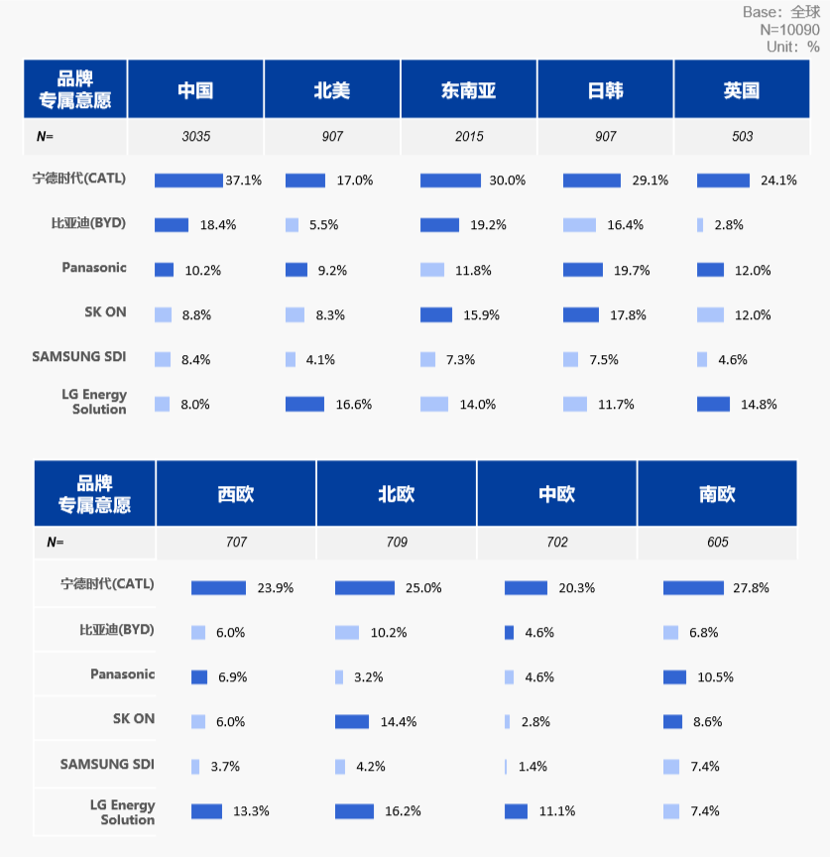
According to Nielsen IQ's "2026 Global New Energy Vehicle Consumer Research Report," 37.1% of Chinese consumers stated that they might abandon their intention to purchase if the model is not equipped with CATL batteries. Consumer preference for supplier brands will pose a significant challenge for automakers that is difficult to overcome in the short term.
Beyond acceptance, self-development also implies substantial upfront investment and a long return cycle. Similar to NIO's battery swap network layout, battery and chip self-development require continuous years of financial investment, with short-term economic benefits difficult to realize, testing a company's cash flow and long-term strategic resolve.
However, the self-development model also offers bidirectional benefits. For automakers themselves, self-development enables hardware autonomy, especially since range extender vehicle battery packs need to be deeply coupled with the range extender system, with high customization demands. Self-development can better match the overall vehicle architecture.
In the long run, after achieving scale, it can dilute unit manufacturing costs. External supply of components can also convert R&D achievements into external revenue, share self-development investments, improve profit structures, and expand technological ecosystem influence. Li Auto's current model sales fluctuations make it difficult to quickly dilute R&D costs. If external supply operations are successfully implemented, this challenge will be effectively alleviated.
For contract manufacturing partners, automakers, with their deeper understanding of vehicle scenarios, can propose technical standards and performance requirements that better align with vehicle installation needs, driving iterative improvements in component manufacturers' processes. The joint development of large cylindrical batteries by BMW and CATL is a typical case that has rapidly enhanced the supplier's manufacturing capabilities.
The automotive competition is fierce, with restructuring and eliminations entering a new phase, shifting from price wars to technological wars. Technology will undoubtedly be an extremely important breakthrough point in the future.
Self-development represents both a significant milestone in automotive manufacturing and a nodal point in a phase. As more brands reach this point, the technological accumulation of Chinese brands will undoubtedly become increasingly robust, and the market will shift more towards technology-driven growth. At that point, this nodal point will also become a new starting point for Chinese automobiles to advance to the next stage.
From a longer-term perspective, this nodal point is also a new starting point: Just as Li Auto is laying out for embodied intelligence, current self-development investments are essentially paving the way for the era of smarter cars and intelligent robots in the more distant future.
Editor-in-Chief: Cao Jiadong Editor: He Zengrong

THE END
-
![]()
【Intelligentization】Li Auto to Supply Mach Chips, Silicon Carbide, and Range Extenders Externally
-
![]()
Announcement Related to AITO from Huawei's Yinwang
-
![]()
Selling Cars Proves Unprofitable: 'NIO, Xpeng, Li Auto, Leapmotor' Step into Supplier Role, Challenging Bosch and Huawei!
-
![]()
Chery’s Overseas Brands Set to Make a Comeback in the Domestic Market
-
AI Computing Power Surges, Colliding with the Most Vulnerable Metal Supply Chain
-
![]()
All Models to Feature Self-Developed Batteries: Will Others Follow Li Auto's Lead?
-
5G Private Networks and Physical AI: A Mutually Reinforcing Development Process
-
![]()
Why Do AI Glasses No Longer Need Cameras?