Announcement Related to AITO from Huawei's Yinwang
 09/22 2026
 374
374
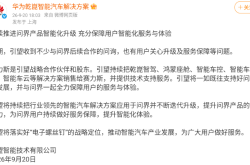
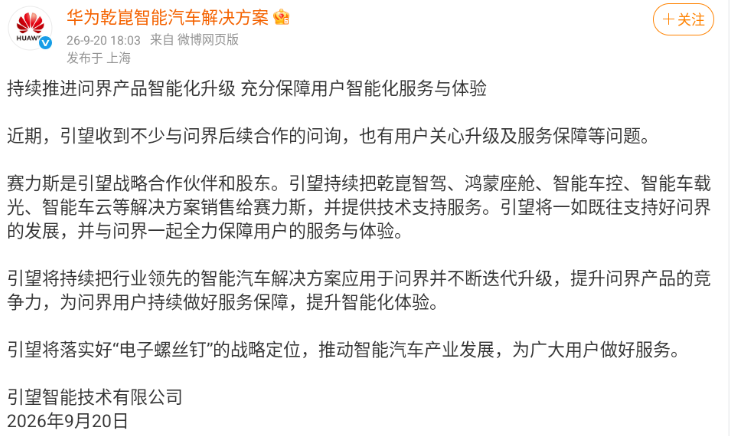
On September 20, Yinwang Intelligent Technology Co., Ltd. (referred to as "Yinwang" hereafter) issued a statement via its official Weibo account, "Huawei Qiankun Intelligent Automotive Solutions," in response to recent external inquiries about the ongoing cooperation with AITO. The statement also addressed user concerns regarding vehicle upgrades and service guarantees.
Key points from the full statement include:
"Seres is a strategic partner and shareholder of Yinwang. Yinwang continues to supply solutions such as Qiankun Intelligent Driving, HarmonyOS Cockpit, Intelligent Vehicle Control, Intelligent In-Vehicle Lighting, and Intelligent Vehicle Cloud to Seres, along with providing technical support services. Yinwang will continue to support the development of AITO and collaborate with AITO to fully safeguard user service and experience."
"Yinwang will continue to apply industry-leading intelligent automotive solutions to AITO, continuously iterating and upgrading them... providing ongoing service guarantees and enhancing the intelligent experience for AITO users."
"Yinwang will fulfill its strategic role as an 'electronic screw,' driving the development of the intelligent automotive industry."
Later, Kang Bo, Director and Vice President of Seres Group, forwarded the statement, adding, "Huawei: Yinwang will continue to fully support AITO's development and safeguard user experience."
This marks Yinwang's first public statement since Hongmeng Zhixing announced adjustments to AITO's cooperation model on September 15.
Adjustments to Huawei and Seres' Cooperation Model
To understand the implications of this statement, we must revisit the announcement made five days earlier.
On September 15, Hongmeng Zhixing released a "Clarification on AITO's Cooperation Model," stating that "AITO remains a member of the Hongmeng Zhixing family." It clarified that, henceforth, AITO would explore a new cooperation model within the Hongmeng Zhixing framework—with Seres taking the lead in product definition, design, brand marketing, channel retail, and service systems, while Huawei Terminal provides support. The announcement also emphasized that "all existing rights and ongoing services for AITO users remain unaffected." It further noted that the adjustments do not apply to other Hongmeng Zhixing brands, with Unibound, Luxeed, Stelato, and MAEXTRO continuing under Huawei's full-process-led cooperation model.
These changes in the division of labor have sparked two interpretations in public discourse: one views it as "Huawei exiting AITO" or "AITO becoming purely Seres-driven," while the other sees it as a mere realignment of business responsibilities rather than a termination of cooperation. Some AITO owners have raised concerns: Will the Qiankun Intelligent Driving and HarmonyOS Cockpit in their purchased vehicles continue to receive updates? Will OTA upgrades for existing users be disrupted? Who will handle after-sales service?
On September 18, Kang Bo responded, stating that Seres is a 10% shareholder of Yinwang, which aggregates many of Huawei's core intelligent vehicle technologies. As a shareholder, AITO will receive Huawei's latest technologies, products, and supply guarantees.
Yinwang's September 20 statement can be seen as a further written confirmation of these concerns.
The Context of Their Relationship
From publicly available information, the relationship between AITO and Huawei's ecosystem has undergone multiple adjustments over the past two years, making this change not an isolated event.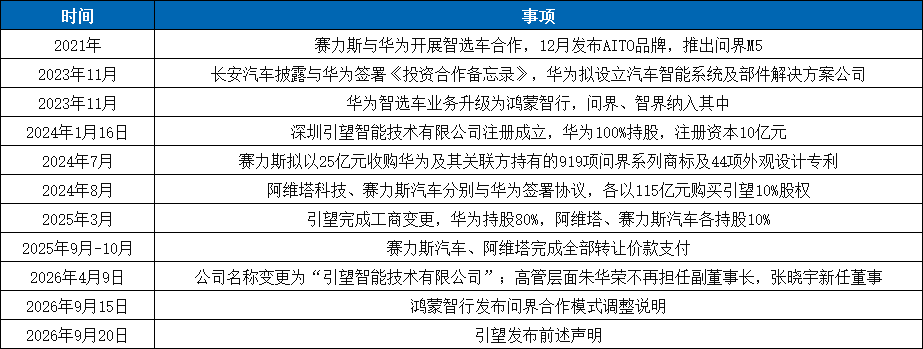
Several figures are noteworthy:
In terms of equity, Seres Automobile holds a 10% stake in Yinwang, valued at 11.5 billion yuan, fully paid. This means Seres serves as both a "customer" and "shareholder" of Yinwang.
Procurement scale has also significantly increased. According to Seres' semi-annual report, in the first half of 2026, it procured goods and services from Yinwang (Huawei's Automotive BU entity) worth 9.84 billion yuan, up 4.24 billion yuan from 5.6 billion yuan in the same period last year.
Seres' financial performance has declined. In the first half of 2026, its revenue was 57.493 billion yuan, down 7.87% year-on-year; net profit attributable to shareholders swung from a 2.941 billion yuan profit in the same period last year to a 1.717 billion yuan loss, with a net loss exceeding 2.2 billion yuan in the second quarter alone. Meanwhile, its new energy vehicle sales reached 178,800 units, up 3.87% year-on-year, with AITO deliveries growing approximately 10.2%. The coexistence of sales growth and profit decline has been cited by multiple media outlets as one of the real-world backgrounds for this division of labor adjustment.
On the day of Hongmeng Zhixing's announcement, the capital market reacted noticeably. On September 15, Seres' A-share price closed down 5.09% at 45.46 yuan.
What Yinwang's Statement Clarifies—and What It Doesn't
What has been clarified:
The technical supply relationship remains unchanged. Yinwang will continue to supply Seres with a full suite of solutions, including Qiankun Intelligent Driving, HarmonyOS Cockpit, Intelligent Vehicle Control, Intelligent In-Vehicle Lighting, and Intelligent Vehicle Cloud, while providing technical support. This aligns with the September 15 statement's assurance that "users' existing rights and ongoing services remain unaffected."
The capital link persists. Seres holds a 10% stake in Yinwang, with no information suggesting a possible exit.
Yinwang's role boundaries. The statement reaffirms its positioning as an "electronic screw," focusing on technical output for intelligent incremental components without intervening in product definition or brand operations for complete vehicles. This explains why product definition, channels, and after-sales are led by Seres, which does not necessarily imply a contraction in technical supply.
After-sales responsibility. The channel retail and service systems are led by Seres, with Huawei Terminal providing support. Routine maintenance and repairs will still be conducted through Seres' authorized networks, largely consistent with previous operational practices.
What remains unclear and warrants further observation:
OTA cadence and priorities. The statement mentions "continuous iteration and upgrades" but does not specify who will lead update frequency, version planning, or the deployment sequence of new technologies between AITO and other brands. This will depend on actual rollout situations.
The specific depth of "empowerment." There is no publicly detailed explanation of Huawei Terminal's level of involvement in brand marketing and product design.
Changes to commercial terms. Some media reports claim that Seres previously paid Huawei a certain percentage of fees per vehicle sold, but this has not been officially confirmed by both parties. Specific procurement and licensing terms are commercial secrets and cannot be verified externally.
Long-term impacts. Whether Seres can independently maintain a premium brand image after the division of labor adjustment, and whether Yinwang can further dilute its "AITO-exclusive" label to attract more automakers for procurement, will require longer-term data validation.
Diverse Market Perspectives
Several viewpoints exist in the market regarding this event, each with its own rationale:
Vehicle owners are primarily concerned about whether software iterations for existing vehicles will be disrupted. Both Yinwang's statement and Seres' responses have provided negative answers to these concerns.
From an industry perspective, one view holds that Huawei's intention in establishing Yinwang as an independent entity was to output technical solutions to the entire industry. If the market equates "Yinwang" with "AITO," it would hinder its ability to attract other clients. Therefore, reaffirming its supplier positioning aligns with Yinwang's own commercial interests.
Some remain skeptical, pointing out that the statement consists of principled statements lacking quantifiable commitments (e.g., upgrade timelines, service standards). Its actual binding force depends on contractual arrangements between the parties, which have not been disclosed.
Analysts have noted that Seres' revenue and profit declines amid sales growth can be partially attributed to rising procurement costs. Against this backdrop, the adjustment in operational control could be either a proactive strategic choice or a consideration of cost structures. Both explanations currently lack direct evidence for confirmation or exclusion.
Overall, the September 20 statement itself does not alter any substantive cooperative relationships—it clarifies existing arrangements rather than introducing a new cooperation agreement. The real change lies in the division of labor adjustments announced on September 15 regarding product definition, brand marketing, channel retail, and service system leadership.
For consumers, the directly verifiable aspects are: Yinwang remains the technical supplier, Seres' network remains the after-sales service provider, and official statements confirm that existing users' rights remain unaffected. As for the effectiveness of the new division of labor in actual operations and whether software iteration rhythms change, these will need to be tested through subsequent product release schedules, OTA rollout records, and sales data. At this stage, excessive speculation is unwarranted.
-
![]()
【Intelligentization】Li Auto to Supply Mach Chips, Silicon Carbide, and Range Extenders Externally
-
![]()
Announcement Related to AITO from Huawei's Yinwang
-
![]()
Selling Cars Proves Unprofitable: 'NIO, Xpeng, Li Auto, Leapmotor' Step into Supplier Role, Challenging Bosch and Huawei!
-
![]()
Chery’s Overseas Brands Set to Make a Comeback in the Domestic Market
-
AI Computing Power Surges, Colliding with the Most Vulnerable Metal Supply Chain
-
![]()
All Models to Feature Self-Developed Batteries: Will Others Follow Li Auto's Lead?
-
5G Private Networks and Physical AI: A Mutually Reinforcing Development Process
-
![]()
Why Do AI Glasses No Longer Need Cameras?