New Breakthrough: GAC Group Reveals Plans to Purchase 50% Stake in FAW Toyota
 09/30 2026
 478
478
This marks a significant stride in strategic cooperation between central and local state-owned enterprises, actively pioneering a new route for leveraging complementary strengths, fostering coordinated development, and achieving deep integration.
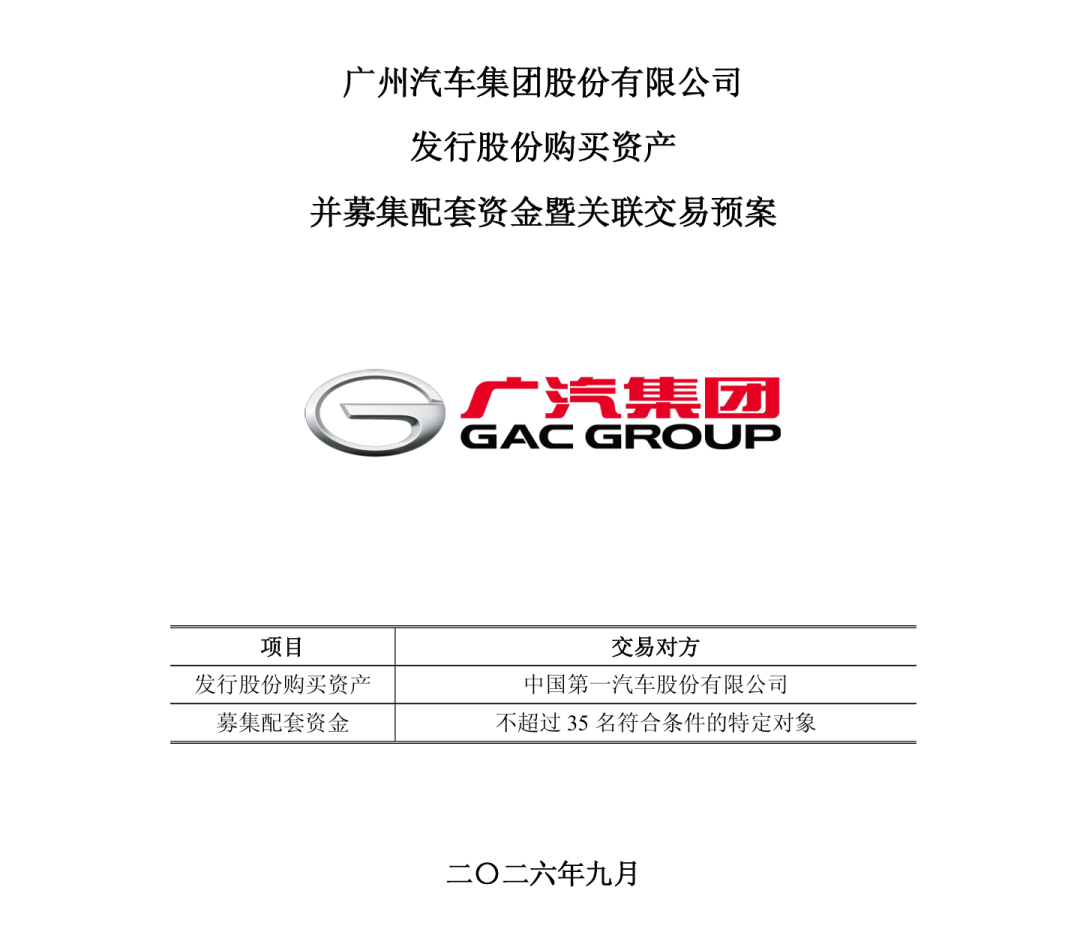
On September 29, Guangzhou Automobile Group Co., Ltd. (hereinafter referred to as "GAC Group") issued a series of announcements, including the "Plan for GAC Group to Issue Shares for Asset Purchase and Raise Supporting Funds, along with Related Party Transactions" (hereinafter referred to as the "Transaction Plan"). The announcement revealed GAC Group's intention to acquire a 50% stake in FAW Toyota from FAW Group through share issuance and raise supporting funds in the same manner.
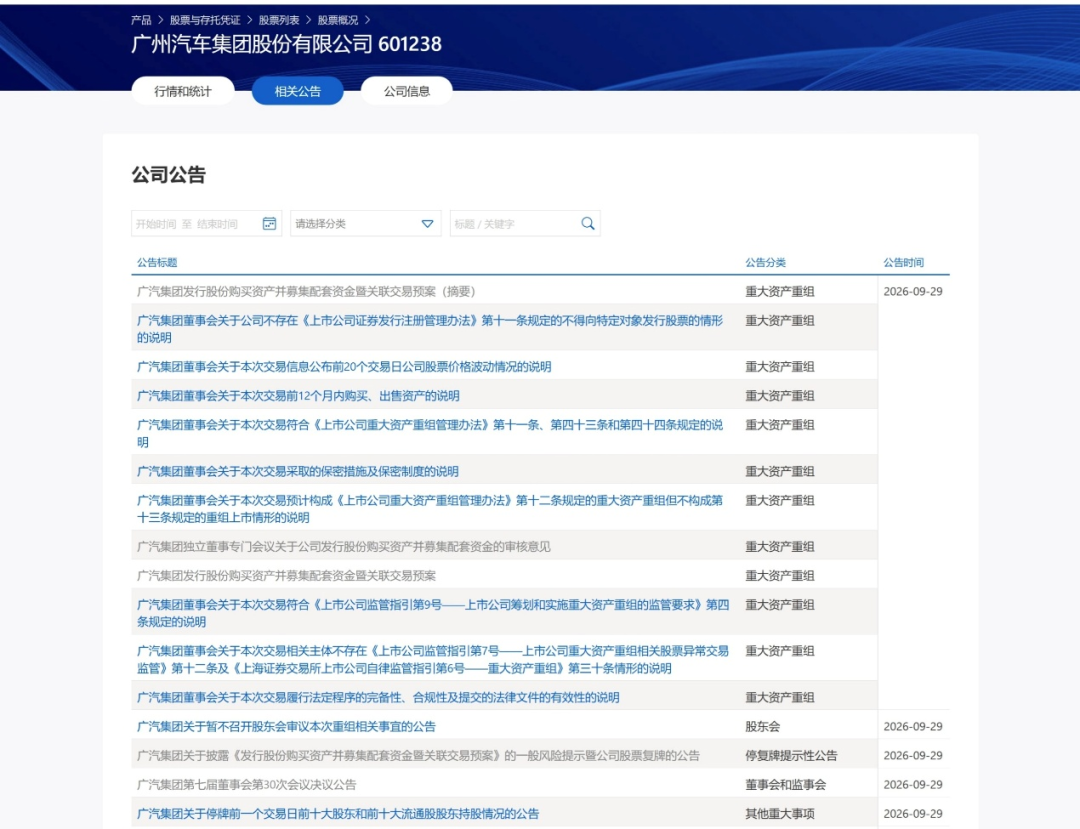
On the same day, both China FAW Group Co., Ltd. (hereinafter referred to as "FAW Group") and GAC Group issued announcements, stating that FAW Group and Guangzhou Automobile Industry Group Co., Ltd. (the controlling shareholder of GAC Group) had officially signed a strategic cooperation framework agreement. Leveraging asset and capital linkages and driven by technological innovation, both parties will gradually deepen and expand the scope of cooperation, promote efficient cross-regional collaboration of industrial resources, and jointly achieve qualitative and quantitative improvements in operations, fostering the development and upgrading of China's automotive industry.
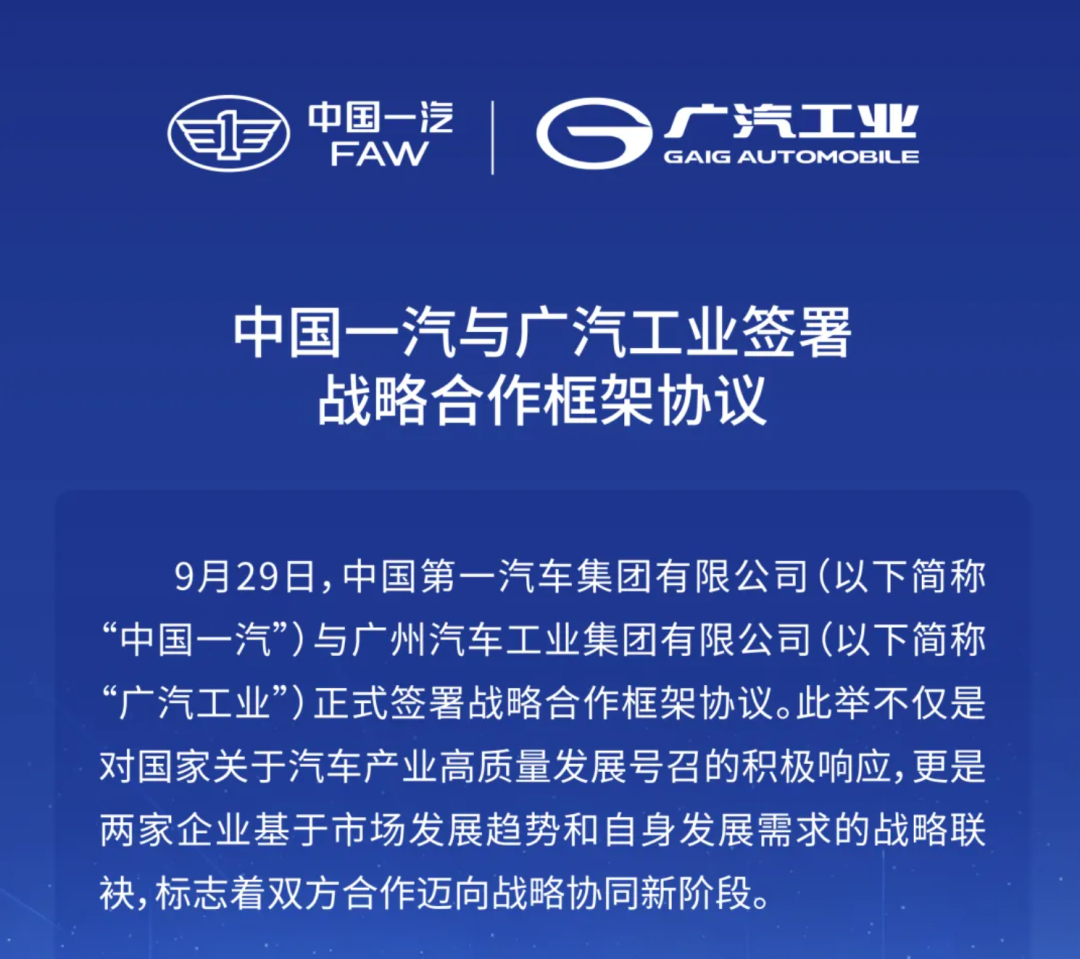
This signifies another major breakthrough in the cooperation between FAW Group and GAC Group, following GAC Group's announcement on September 14 regarding the suspension of trading due to planning a major asset restructuring.
The China Association of Automobile Manufacturers commented that this collaboration represents a significant move in the automotive industry to implement the "15th Five-Year Plan for the Development of the Intelligent Connected New Energy Vehicle Industry." It promotes strategic restructuring and cooperation among enterprises through market-oriented and legal means, deepens cross-regional resource integration, and optimizes industrial structure. It holds symbolic significance for driving industrial quality and efficiency improvements and accelerating the construction of China as an automotive powerhouse.
Complementary Strengths and Optimized Industrial Layout
Regarding the impact of this transaction, the Transaction Plan states that FAW Group, a key central enterprise in China's automotive industry, boasts extensive experience in vehicle R&D and manufacturing, industrial chain layout, and brand operations. GAC Group, on the other hand, is a large domestic automotive group continuously investing in new energy and intelligent transformation, independent brand development, and industrial ecosystem construction. Both parties will engage in strategic collaboration based on their respective resource endowments and strengths, further promoting resource sharing and leveraging complementary advantages, and deepening synergies in technology, supply chains, and markets. This transaction will capitalize on FAW Group's accumulated strengths and layout advantages in vehicle manufacturing and industrial chains, as well as GAC Group's advantages in new energy and intelligent transformation, independent brand development, and industrial ecosystem collaboration, further unlocking synergistic value.
Entering the new era of the "15th Five-Year Plan" development, China's automotive industry is transitioning from "scale expansion" to "efficiency enhancement" and from "individual competition" to "collaborative win-win." On September 11, nine departments, including the Ministry of Industry and Information Technology, issued the "15th Five-Year Plan for the Development of the Intelligent Connected New Energy Vehicle Industry," explicitly proposing to "increase the intensity of mergers, acquisitions, and cross-regional integration of automotive enterprises in accordance with the law." On the same day, Shao Ji, Deputy Director-General of the Industrial Development Department of the National Development and Reform Commission, stated that mergers and acquisitions among enterprises will be promoted through market-oriented and legal means to "avoid homogeneous competition in product design and technological research and development." However, as is widely known, numerous attempts at integration and restructuring among automotive state-owned enterprises have been made, yet many challenges and difficulties persist, with some even having to be abandoned midway.
The cooperation between FAW Group and GAC Group explores a new path for the integration of central and local state-owned enterprises in the automotive industry: it is neither a takeover of local state-owned enterprises by central enterprises nor a simple asset transfer. Instead, it adopts a new approach of "issuing shares to purchase assets," enabling central enterprises to enter local state-owned enterprises as strategic shareholders and achieve deep integration while maintaining the independent operation of GAC Group. This will undoubtedly provide new references and insights for the restructuring of state-owned enterprises in the automotive and other industries.
Potential for Synergistic Operations Between North and South Toyota
A key revelation in the Transaction Plan is that once GAC Group successfully acquires a 50% stake in FAW Toyota, the long-standing parallel development of North and South Toyota is expected to transition from an "individual competition" pattern to a new era of synergistic operations.
Industry experts believe that for many years, Toyota Motor Corporation has established joint venture vehicle companies with both FAW Group and GAC Group. During the period of rapid market growth, this north-south layout could expand Toyota's product coverage and market scale. However, today, as the market has entered a phase of intense competition, the two relatively independent product, channel, and marketing systems have gradually revealed their shortcomings. Especially under the strategy of "twin models," if the main products of North and South Toyota are from the same platform and positioning, coupled with overlapping price ranges, internal competition will arise, increasing unnecessary internal friction.
The aforementioned situation is expected to change. According to the Transaction Plan, this transaction will promote synergistic operations between North and South Toyota, stabilize the profitability of the joint venture business, and amplify economies of scale by integrating resources such as localized R&D, supply chain systems, production bases, and market expansion from both sides. This will reduce redundant investments, share technological innovation costs, concentrate efforts on tackling key core technologies, further enhance the company's comprehensive competitiveness, and help enterprises seize opportunities in the restructuring of the automotive industry chain and accelerate the creation of internationally competitive leading automotive groups.
According to data from the China Association of Automobile Manufacturers, in 2025, the combined sales of North and South Toyota accounted for 17.03% of the sales of joint venture passenger vehicles, ranking among the top in market share among joint venture brands. The Transaction Plan points out that the implementation of synergistic operations between the north-south joint venture companies will help enhance the company's market position among joint venture brands and provide strong support for its long-term stable development.
The Integration Curtain Has Just Been Raised
The disclosure of the Transaction Plan is only the beginning. The audit and evaluation of the target assets have not been completed, and the transaction price has not been finally determined. Subsequent steps will require multiple reviews by the board of directors, shareholders' meetings, and regulatory approvals. Issues such as the specific share ratio that FAW Group will ultimately hold in GAC Group, how the equity structure of FAW Toyota will evolve, and how the synergistic path between North and South Toyota will be implemented still await answers over time.
However, the direction is clear. The cooperation between GAC Group and FAW Group may indicate that the curtain has been raised on the integration of China's automotive industry. "Looking at the history of international automotive development, strong alliances and resource integration are common paths to enhance corporate core competitiveness and optimize global industrial layout," the China Association of Automobile Manufacturers pointed out. Currently, the automotive industry has entered a critical period of deepening competition, accelerating structural optimization, and moving towards high-quality development. In the future, the domestic market size is expected to remain stable, and the focus of industrial development is shifting from scale expansion to quality and efficiency. Further enhancing industrial concentration and cultivating backbone enterprises with global competitiveness is the only way to build a healthy industrial ecosystem and achieve high-quality development.
Industrial integration is not the goal; enhancing the global competitiveness of China's automotive industry is the fundamental objective. As the competitive threshold of the global automotive industry continues to rise, Chinese automakers aim to become leaders on the world stage not through "quantity over quality" but through "precision and strength." In this sense, the handshake between FAW Group and GAC Group represents a small step but may actually open a new window for China's automotive industry to move towards high-quality development. When redundant investments and internal competition gradually give way to resource integration and efficiency improvements, the competitive landscape of the global automotive industry will also be rewritten.

Image: Sourced from the Internet
Article: Auto Review
Layout: Auto Review
-
![]()
New Breakthrough: GAC Group Reveals Plans to Purchase 50% Stake in FAW Toyota
-
![]()
Is an Extra 60,000 Yuan Worth It for L3 Autonomous Driving?
-
![]()
Leveraging DSec as a Framework? Unveiling How Muse Significantly Elevates CPU Demand
-
![]()
US Lawmakers Attempt to Impose a Permanent Ban on Chinese Cars: 'Otherwise, Annual Sales Will Reach 1.9 Million Units'
-
![]()
GAC Takes Stake in FAW Toyota: Good News for BYD and Geely
-
![]()
The RSI Craze Hits Embodied AI: Ideals, Realities, and an Unreachable Endpoint
-
![]()
Queen of Chips Teams Up with AI Godmother to Take on Nvidia's Huang
-
![]()
Changsha Offers a 'New Solution' to China's Robot Industry