How to Manufacture Pure Electric Vehicles? Geely Has Found the Solution!
 09/30 2026
 466
466
Introduction
Balancing Rapid Charging and Battery Swapping
How fierce has the competition grown in China's automotive sector? Price wars have raged for more than ten years, transitioning from traditional fuel-powered vehicles (internal combustion engine vehicles) to new energy vehicles, extending from vehicle prices to features, and now even encompassing charging infrastructure—each company is constructing its own network, none of which are fully developed, and all are incurring substantial costs.
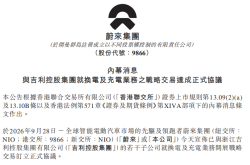
On September 28, NIO and Geely both released announcements: This all-encompassing strategic partnership in the charging and battery swapping domain signifies a new approach: Rather than expending resources to independently establish their own networks, why not consolidate their assets?
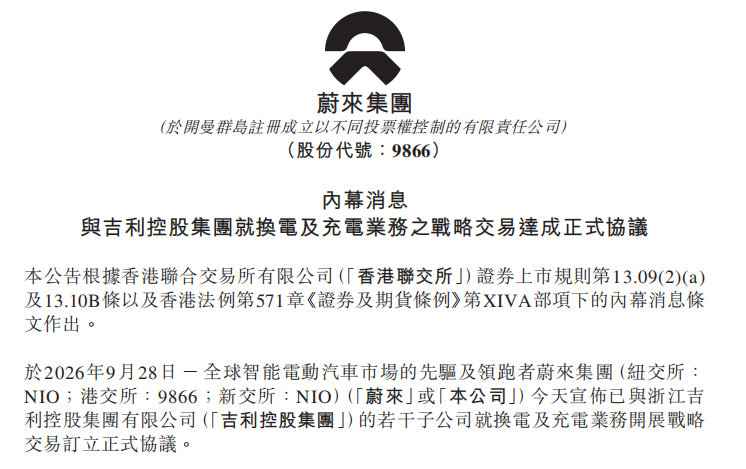
Geely contributed its entire stake in Yiyi Interconnect Technology, along with 640 million RMB in cash, to subscribe to newly issued shares in NIO Power. Following the transaction, Geely will own 30% of NIO Power, while NIO will maintain a 63.6% controlling interest. Conversely, NIO also invested cash in Geely's Haohan Energy, acquiring a 10% stake.
This is not merely another addition to the battery swapping alliance; instead, the two companies are divesting (spinning off) their energy replenishment businesses and reshuffling their strategies.
Yiyi Interconnect, a subsidiary of Geely, specializes in battery swapping for commercial vehicles—including taxis, ride-hailing cars, and logistics vehicles. Operating in over 40 cities with more than 460 battery swapping stations and a cumulative battery swapping mileage exceeding 2.5 billion kilometers, this asset is poised for renewed growth after being integrated into NIO Power.
Geely does possess battery swapping technology and has contemplated establishing its own network. However, it ultimately opted to relinquish control and become a shareholder. The rationale is straightforward: Battery swapping inherently involves a business model with significant network effects, substantial asset requirements, and lengthy payback periods. Launching another network would entail substantial financial risk with no assurance of success. It is more prudent to integrate into an existing operational network and reap the benefits as a shareholder. This move represents the first tangible evidence of the winner-takes-all dynamic in the battery swapping sector. The entire industry has now taken a significant stride from fragmentation towards consolidation.
The real excitement lies ahead.
One notable clause in their agreement deserves emphasis: The joint establishment of unified C-end (consumer-end) battery swapping technologies and standards, with Geely developing C-end battery swapping vehicle models and NIO Power providing the services.
In simpler terms: Geely is poised to introduce C-end battery swapping vehicles, likely adhering to NIO's standards. If realized, NIO's battery swapping stations will no longer be exclusive to NIO vehicle owners but will evolve into a multi-brand energy network. Changes in the composition of vehicle sources will enable, for the first time, cross-brand validation of the network's scale effects.
Of course, the official wording allows for flexibility—"preliminary plans subject to further discussion and implementation." Aligning battery pack specifications, vehicle structures, and interface protocols cannot be accomplished with a mere signature. The direction is clear, but significant work remains.
Viewing this agreement within a broader context, its significance extends beyond the two companies involved.
Over the past decade, competition among Chinese automakers has primarily focused on products—who launches more models, who innovates faster, who offers lower prices. Energy replenishment networks, as supporting infrastructure, were constructed and guarded by each company, reminiscent of how gas station brands once demarcated their territories. However, the scale of these networks has now reached a critical juncture: The economics of single-company nationwide networks no longer make sense, while users demand seamless energy access regardless of brand.
Unlike intelligent driving systems that can be encapsulated within vehicles, battery swapping stations and charging piles are public resources once installed along roadsides—anyone running low on power can utilize them. This characteristic makes it challenging for a single automaker to monopolize them. As the economics of standalone networks deteriorate, open sharing becomes inevitable. The official press release mentions "responding to calls to prevent excessive competition and improving industrial resource allocation efficiency," indicating a regulatory stance: Cease redundant construction and mutual depletion.
NIO and Geely's initiative carries more symbolic significance than immediate financial value. It signals that China's automotive industry is transitioning from cutthroat competition to dialogue. Energy replenishment networks are just the beginning, but not necessarily the end.
When NIO launched its first battery swapping station in Shenzhen in 2018, the industry consensus was "this won't last three years." Eight years later, there are over 4,100 battery swapping stations, over 30,000 charging piles, and a cumulative total of over 125 million battery swaps. This network has not only survived but has also become a valuable asset to Geely.
Whether more companies follow suit depends on the compelling nature of the network's performance data. However, the direction is clear: For heavy assets like energy replenishment infrastructure, no one can succeed in isolation—integration is the path forward.
The second half of China's new energy vehicle era may not be about who outcompetes whom, but who first opens up their heavy assets and collaborates to build a truly viable network.
-
![]()
New Trend in the US Auto Market: Electric Vehicle Families Returning to Fuel Vehicles in Bulk, Electrification Enters a Period of Rational Restructuring
-
![]()
Transsion Holdings: Leveraging 1.6 Billion African Consumers as the Foundation for China's Energy Storage Market
-
Is Lei Jun's World Falling Apart? Smartphones Priced Below $200 to See a 40% Drop
-
![]()
OpenAI Unleashes Game-Changer: Chinese Robots Already Working 24/7 in Factories, Igniting a Trillion-Dollar Race
-
![]()
How to Manufacture Pure Electric Vehicles? Geely Has Found the Solution!
-
![]()
Nexteer’s H1 Performance: Half of Revenue Yields Just 7% Profit
-
![]()
Dongfeng's Independent Brands Make Significant Strides
-
![]()
Breaking News: Next-Gen AI Model Release Scrapped! OpenAI Pulls the Plug