September Sales Rankings for Emerging Auto Brands: Leapmotor Exceeds 100,000 Units, Xiaomi Surpasses 40,000, Harmony Intelligent Mobility Hits 37,000+, Multiple Brands Show Recovery | Mirror Pro
 10/07 2026
 525
525
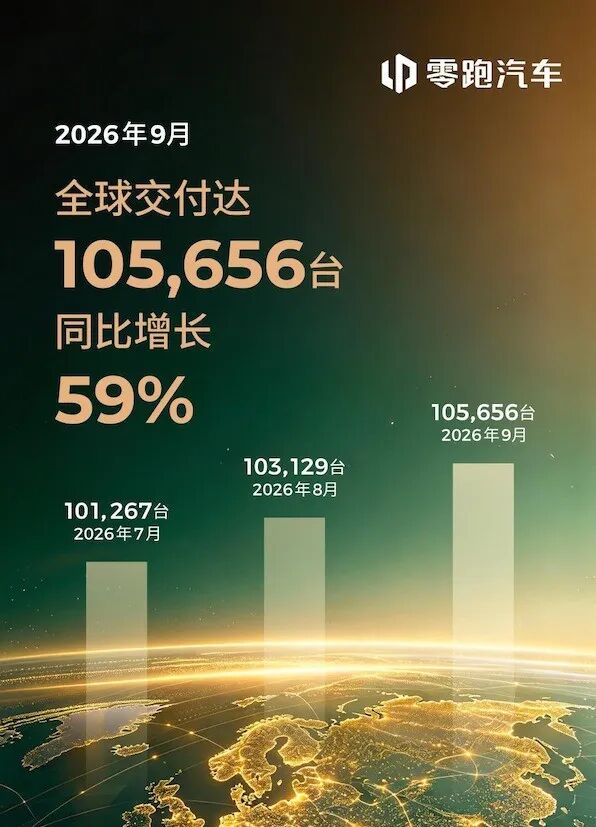
On October 1st, several emerging automobile brands released their delivery figures for September 2026. Despite the industry's traditional expectation of a strong September and October, this year's sales figures did not align with this trend. We continue to classify automaker brands into two categories: new brands from cross-industry entrants and new brands established by traditional automakers. Among these, Leapmotor and Galaxy emerged as frontrunners. Both brands achieved monthly sales exceeding 100,000 units, with Leapmotor maintaining sales above this threshold for three consecutive months, cementing its position as the sixth strongest independent brand in the industry.
Harmony Intelligent Mobility was impacted by the controversy surrounding AITO's exclusive franchising, leading to performance below expectations in September. Xiaomi, which expanded its lineup to include extended-range vehicles, sold 10,000 units of its Pengcheng model in its debut month. It remains uncertain whether this was due to constrained production capacity or other factors, but the results fell short of external expectations. Among the new brands from established automakers, several, including Zeekr, Arcfox, and Aion, showed significant improvements, while brands like Zhiji and Avatr also began to recover. However, Seres experienced a sales decline.
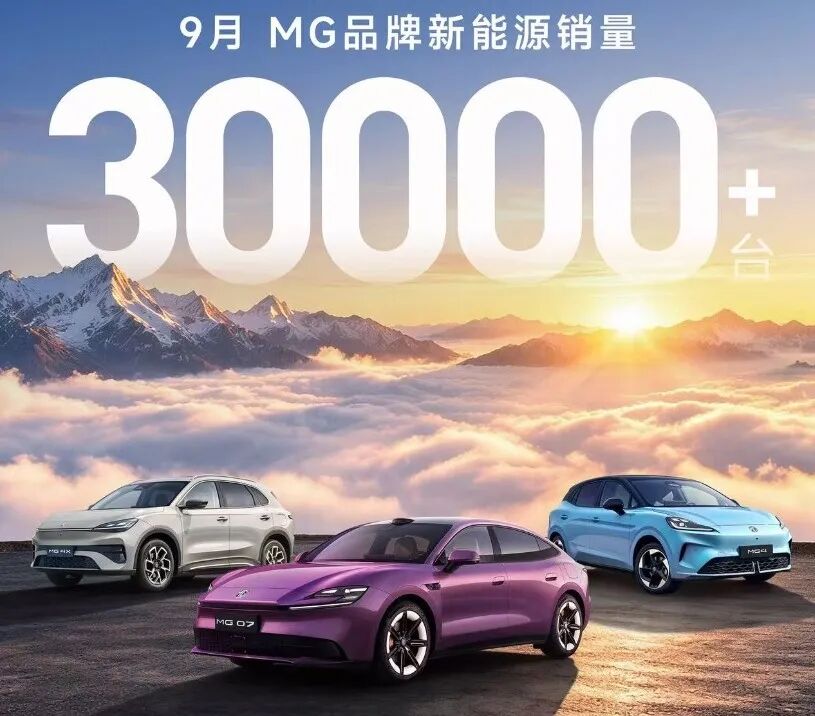
Interestingly, SAIC's MG brand, after undergoing a transformation, has exhibited the sales momentum of an emerging brand, with monthly sales exceeding 30,000 units in September, placing it among the top-tier performers for the month. Notably, MG's sales were driven not by a wide array of products but by two standout models: the MG07 and MG4. The all-new MG07 achieved over 14,000 deliveries in its first month, while the MG4 sold over 16,000 units monthly. Given its strategy and growth rate, MG can be considered a dark horse among the emerging brands.
01 Cross-Industry New Forces: Leapmotor Surpasses 100,000 Again, Xiaomi Exceeds 40,000
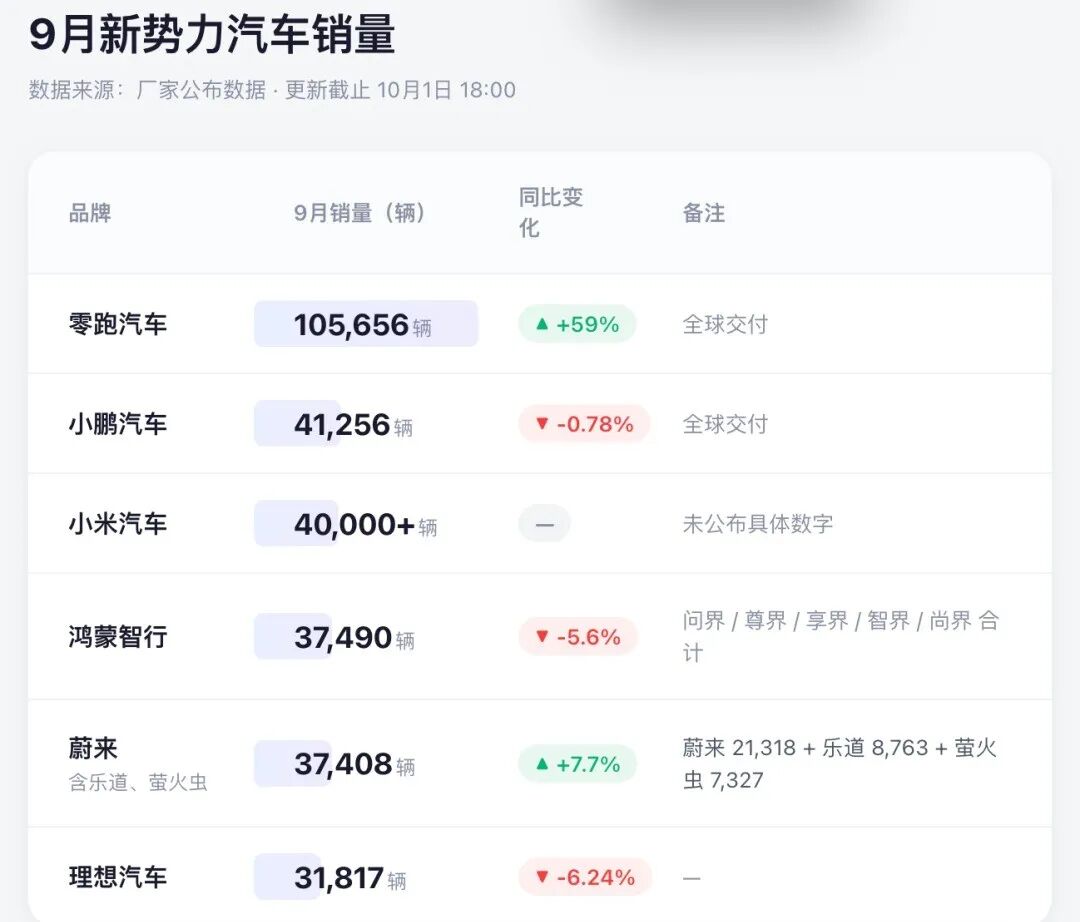
Leapmotor once again claimed the top spot in September, delivering 105,656 units, marking a 59% year-over-year increase and a slight 2.45% month-over-month rise. This represents the third consecutive month of over 100,000 monthly deliveries. In the first nine months of the year, Leapmotor has exported over 150,000 vehicles overseas, with its European sales and service network surpassing 1,000 locations. Based on these figures, the company is on track to achieve its annual target of 1 million vehicles. To sustain future growth, Leapmotor plans to launch a second brand in the fourth quarter of next year. Thus, in 2027, Leapmotor's primary focus will be on its high-end brand and exports, both expected to experience explosive growth.
XPENG rose to second place in September with approximately 41,300 vehicles sold. Specifically, XPENG delivered 41,256 units in September, experiencing a slight 0.78% year-over-year decline but a 5.5% month-over-month increase. This year, XPENG has continuously launched popular models, including the XPENG GX and MONA L03, with each subsequent model receiving higher order volumes. Currently, XPENG is facing production capacity constraints, preventing it from fully capturing market share, which is unfortunate. Otherwise, XPENG could have achieved its target of 50,000 monthly sales.
Xiaomi Automobile secured third place, delivering over 40,000 units in September, including over 10,000 units of the Xiaomi Pengcheng in its first month. This marks Xiaomi's first time surpassing 40,000 monthly sales this year. Of course, Xiaomi has not disclosed specific figures, so this 'over 40,000' could range up to 49,000 units. Previously, Xiaomi's SU7 and YU7 models maintained sales around 30,000 units. According to CPCA data, Xiaomi's sales from March to July were 36,702, 32,759, 34,738, and 31,267 units, respectively. In the past two months, Xiaomi Automobile has offered significant discounts to boost sales.

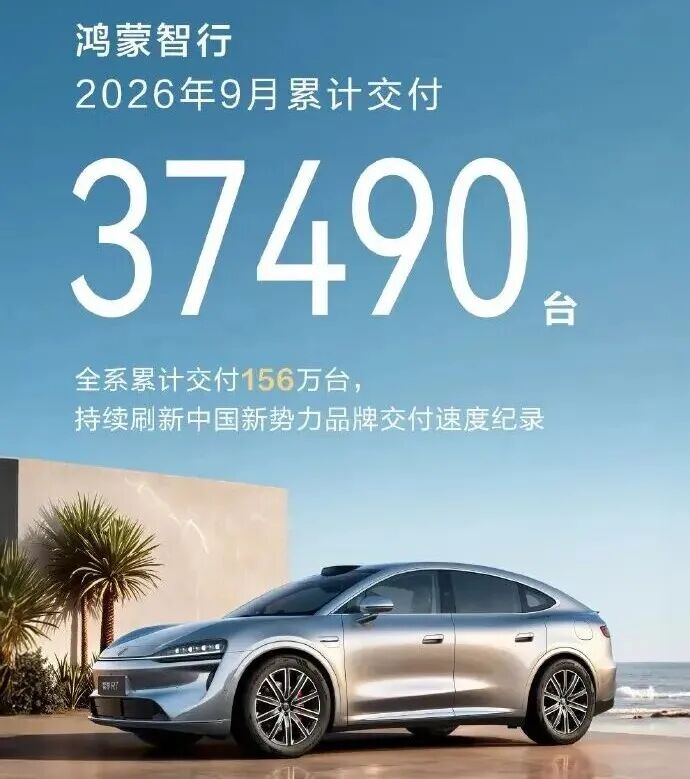
Harmony Intelligent Mobility delivered 37,490 units in September, experiencing a 5.6% year-over-year decline and a 10.95% month-over-month decrease. Its cumulative deliveries surpassed 1.56 million units, continuously setting records for the fastest achievement among Chinese emerging brands. Harmony Intelligent Mobility's September sales were affected by multiple factors, primarily changes in AITO's sales strategy. In September, AITO faced controversy over exclusive franchising, along with delayed launches of the M8 and M7, which did not contribute to sales. The mainstay M9 Ultimate also experienced delayed deliveries. Additionally, the volume-driving Smart Series R7 only switched at the end of the month. These product changes impacted its market performance. Achieving 37,500 units was commendable. On October 1st, AITO announced its reintegration with Huawei, returning to Harmony Intelligent Mobility, which should quickly change its momentum.
Fifth place went to NIO. In September, NIO delivered 37,408 new vehicles, marking a 7.7% year-over-year increase and a 4.4% month-over-month rise. Among them, the NIO brand delivered 21,318 new vehicles, a 55.3% year-over-year increase; the Onvo brand delivered 8,763 new vehicles; and the firefly brand delivered 7,327 new vehicles, a 26.9% year-over-year increase. In the first three quarters of 2026, NIO delivered a total of 300,301 new vehicles, a 49.2% year-over-year increase, with all three brands achieving record-high sales in the first three quarters. The NIO brand delivered 181,988 new vehicles, a 63.4% year-over-year increase, setting a new record; the Onvo brand delivered 70,191 new vehicles, setting a new record; and the firefly brand delivered 48,122 new vehicles, a 136.7% year-over-year increase, setting a new record.
Li Auto secured sixth place, delivering 31,817 new vehicles in September, down from 37,679 units in August. As of September 30, 2026, Li Auto's cumulative deliveries reached 1,833,651 units. Li Auto launched the Li MEGA Home in September, receiving strong order numbers, but actual sales contributions will only be seen in October. Additionally, the launch of the Li i6 has been delayed, with sales contributions expected only after late October. Li Auto is currently in a critical adjustment period, but overall, its extended-range performance remains stable, while its pure electric market expansion is rapid, forming a dual-line growth strategy.

Additionally, Loxton Automobile, which previously released data, has not disclosed any figures since June this year. Similarly, Skywell Automobile, which occasionally released data, did not announce September figures. Both brands have relatively low market presence and face greater uncertainty in their future development.
02 New Brands from Established Automakers: Fangchengbao and Zeekr See Significant Growth, Multiple Brands Rebound
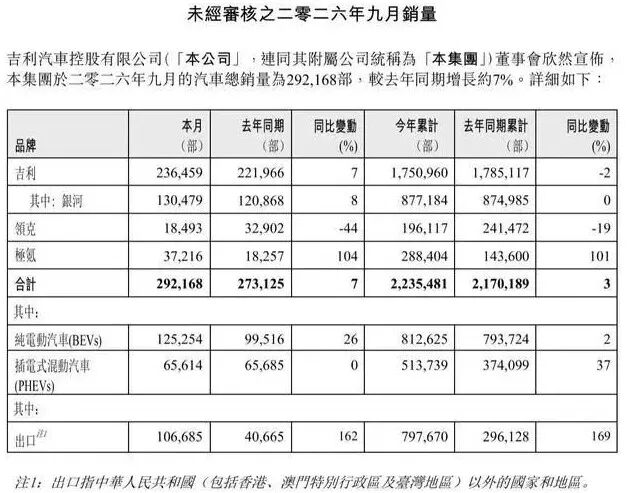
Among traditional automakers' new brands, Geely's Galaxy brand took the lead. In September, Geely Galaxy sold 130,479 units, an 8% year-over-year increase, with cumulative sales from January to September reaching 877,184 units, an increase of over 2,000 units. Galaxy has recently unveiled major moves, such as the significantly redesigned E5 and the popular 'Battleship' model, indicating its potential in the subsequent market. Therefore, Galaxy should have notable highlights in the fourth quarter.
Second place went to BYD's Fangchengbao, which sold over 43,000 units in a single month. In the 'boxy' vehicle segment, Fangchengbao has achieved remarkable success, with expected further sales growth. Its newly launched sedan has performed well. During BYD's first extraordinary general meeting in 2026, the company stated that the Fangcheng S model has received better-than-expected reservations, with enthusiastic store visits, predicting monthly sales of over 10,000 or even 15,000 units for the Fangcheng S. This suggests that monthly sales could exceed 50,000 units in the future.
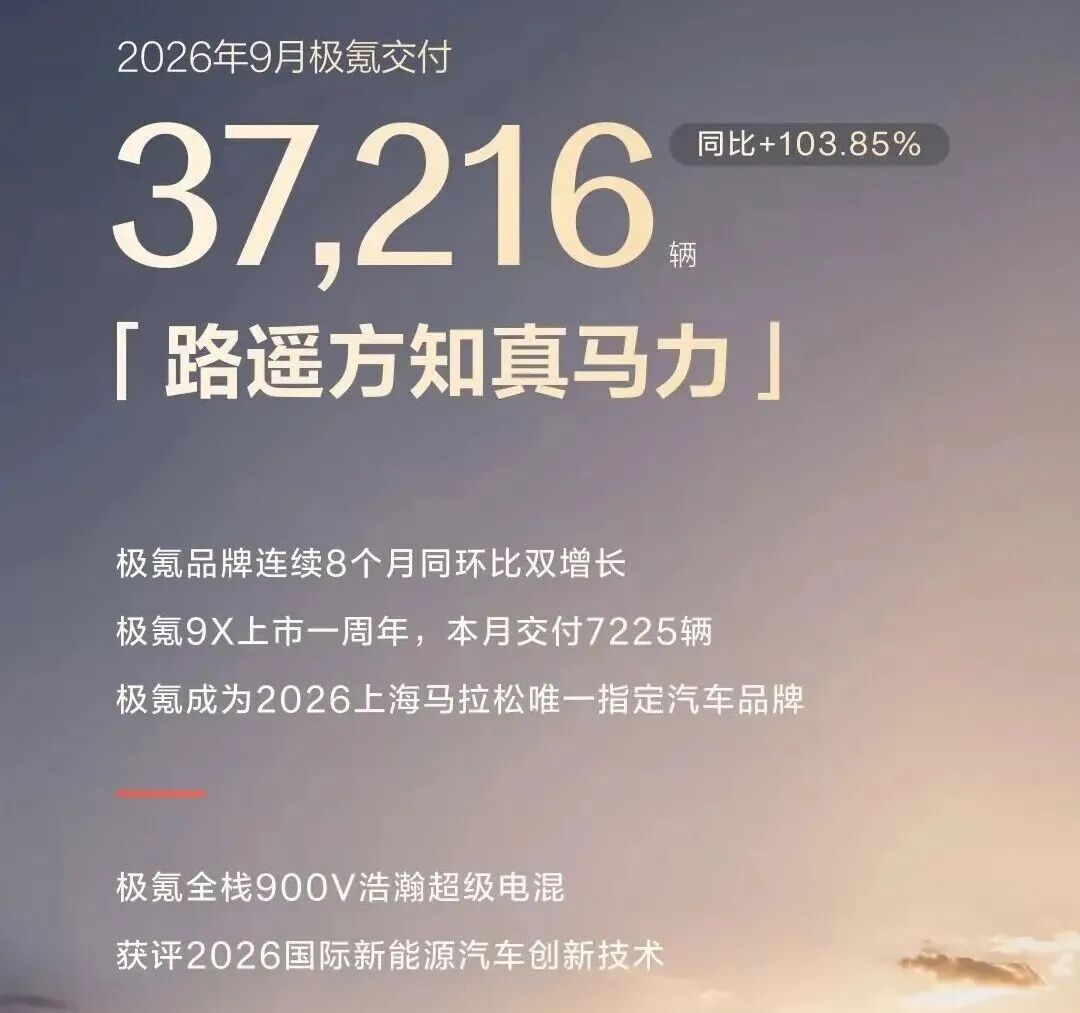
Third place went to Geely's Zeekr. In September 2026, Zeekr delivered 37,216 units, a 103.85% year-over-year increase and a slight 0.64% month-over-month rise (36,981 units delivered in August). From January to September 2026, Zeekr delivered a cumulative total of 288,400 units, a 100.84% year-over-year increase, achieving eight consecutive months of double-digit year-over-year and month-over-month growth. This growth rate is likely the highest in the industry. After launching models like the Zeekr 9X last year, Zeekr has established a strong brand presence and recognition in the high-end market, further opening up the market and sustaining its vitality.
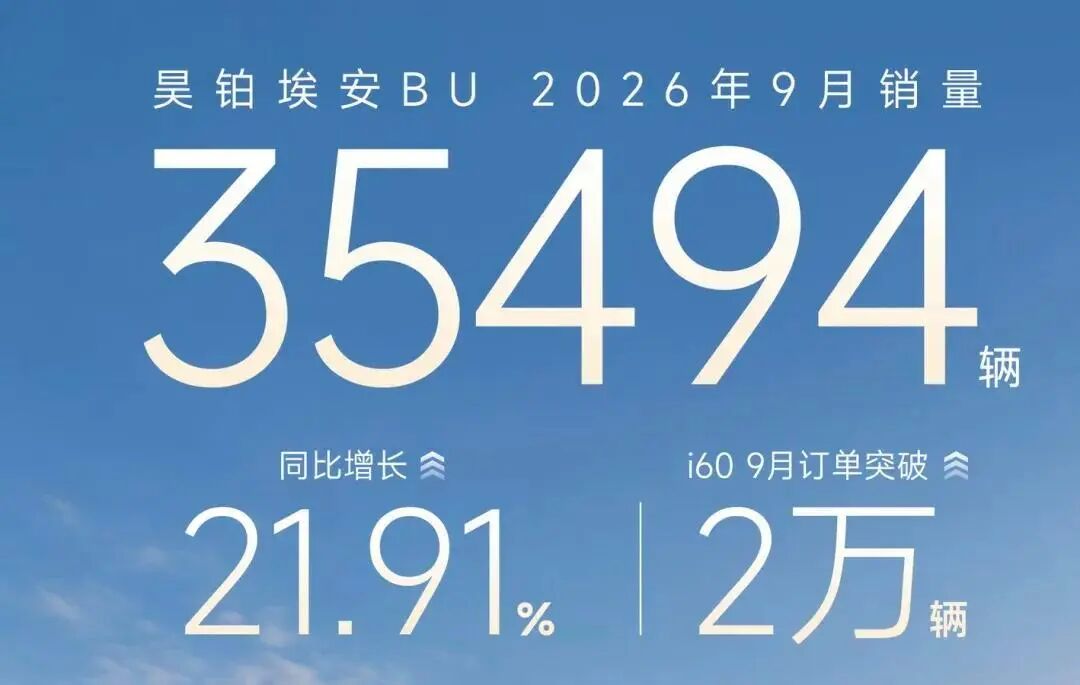
Fourth place went to Hyper Aion, GAC's sales mainstay, which has finally begun to recover after reforms in the past six months. In September, Aion sold 35,494 units, a 21.91% year-over-year increase, achieving seven consecutive months of positive growth against the market trend. Relying on the continuous evolution of key models, the launch of new models, and growth in overseas markets, Aion has maintained a stable upward growth trajectory. Models like the Aion i60 have performed well. Aion recently launched the new Ray series, with the first model, the Ray7, unveiling its interior and starting an early access program. This will serve as a new growth point for Aion after phasing out its reliance on ride-hailing vehicles.
Fifth place went to Seres, which delivered 30,185 units in September, with cumulative deliveries from January to September 2026 reaching 252,213 units, an 8.59% year-over-year increase. Based on sales, Seres has maintained monthly sales of around 30,000 units, including international sales. However, compared to last year, when Seres delivered 33,626 units in September 2025, the key focus for Seres is how to further strengthen its market position and return to its previous high level of performance. Breaking through 40,000 monthly sales is crucial for its development.
Additionally, SAIC's MG has reached monthly sales of 30,000 units, but MG only offers two models. From this perspective, MG has significant potential for future growth. Currently, MG has only announced monthly sales of 30,000 units, with specific figures undisclosed. For now, it is tied for fifth place.
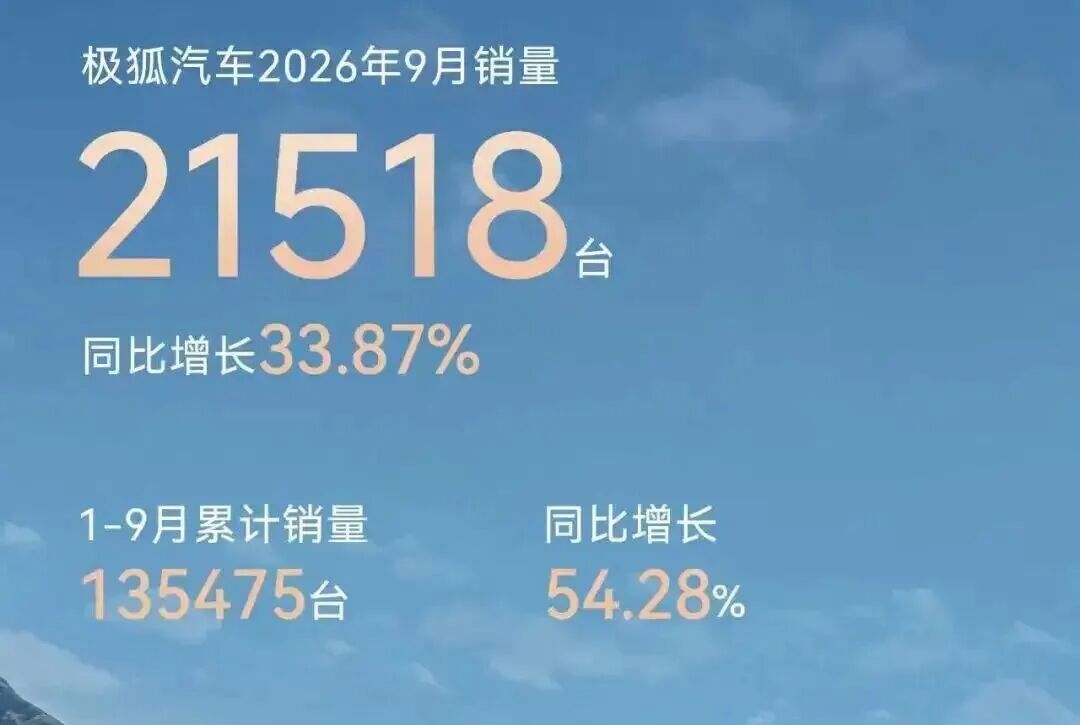
Sixth place went to Arcfox, which sold 21,518 units in September, a 33.87% year-over-year increase. From January to September 2026, Arcfox's cumulative sales reached 135,475 units, a 54.28% year-over-year increase. Arcfox has made significant progress in the past two years, creating multiple popular models. Arcfox's future challenge lies in scaling its Way series based on its current sales volume, as this is crucial for ensuring future profitability.
Seventh place went to BYD's Denza. Denza's previous sales mainstay was the MPV model Denza D9, but its product mix is now changing. In September, Denza sold 18,198 units, still below 20,000 units, remaining in the 10,000-unit range. Currently, the launch of the Z9S in September can be seen as the beginning of Denza's transformation, with sales growth depending on the subsequent launch of the Denza N8.
Next is Voyah. In September, Voyah delivered 15,995 vehicles, a 46% month-over-month increase. From January to September 2026, Voyah delivered a cumulative total of 166,833 vehicles, outperforming industry trends year-over-year, with continuous breakthroughs in overseas markets and a 58% year-over-year increase in cumulative exports. Entering the fourth quarter, Voyah will see a concentrated launch of new models. The '150,000-yuan-class intelligent driving comfort dual-flagship' Dongfeng Fengon L8+, the Dongfeng Voyah large six-seater equipped with Dongfeng's self-developed Tianyuan intelligent driving and Tianyuan cockpit systems, and the upgraded Voyah 007 will be launched sequentially. Therefore, the fourth quarter promises further sales growth for Voyah.
IM Motors sold a total of 60,000 vehicles from January to September, marking a 40.1% year-on-year increase. The brand-new IM LS6 received over 11,000 new orders within just 57 minutes of its launch. As of August 2026, IM Motors' cumulative sales reached 49,413 units. This implies that IM Motors sold 10
-
![]()
September Sales Soar: BYD Shifts 464,000 Vehicles, with Half of Growth Driven by Overseas Markets. Fangchengbao Shines!
-
![]()
HiMode Intelligent Travel Sees September Dip with 37,000 Units; AITO Rebounds Amid Seres-Huawei Five-Year Pact
-
![]()
September Sales Rankings for Emerging Auto Brands: Leapmotor Exceeds 100,000 Units, Xiaomi Surpasses 40,000, Harmony Intelligent Mobility Hits 37,000+, Multiple Brands Show Recovery | Mirror Pro
-
![]()
OpenAI Hits the Brakes, Meta Accelerates
-
![]()
Tech Titans Compete for Dominance in the ‘AI Personal Assistant’ Market
-
![]()
Transsion's Mobile Phone Profits Halved, Yet Energy Storage Revenue Surges 825% in Two Years! Africa's Mobile Phone King Pivots to Energy Storage—Can Channel Strength Outpace Technological Barriers?
-
Undoubtedly, Xiaomi's Goal of 550,000 Vehicle Sales This Year Is Unattainable!
-
Tencent, ByteDance, and Kimi All Dispatch Staff to Customer Locations