Don't Be Too Hasty to Dismiss Internal Combustion Engine Vehicles
 10/19 2026
 343

Lead
Introduction
The trend of electric vehicles surging while fuel vehicles decline is evident, yet it's premature to proclaim the demise of a market still commanding a 50% share.
This year's auto market has experienced an earlier-than-usual downturn.
According to data from the China Passenger Car Association (CPCA), retail sales of passenger vehicles in September reached 1.618 million units, a 28% year-on-year decrease, marking the largest monthly decline of the year. This occurred during the traditionally peak sales period known as "Golden September," but instead of a sales boom, the market saw a significant correction.
In September, retail sales of new energy passenger vehicles hit 1.084 million units, with a retail penetration rate soaring to 67.0%, marking the third consecutive month of record highs. Conversely, retail sales of fuel-powered passenger vehicles stood at only 530,000 units, a 43% year-on-year decrease, with purely fuel-powered models plunging by 49%, nearly halving their sales.
With new energy vehicles experiencing a steady rise in penetration and robust retail sales, while fuel vehicles face a sharp decline, the sentiment that "fuel vehicles are no longer viable" has resurfaced in the market.
However, according to CPCA's retail data, fuel vehicles still accounted for about 33% of the passenger vehicle market in September. Based on broader data from the China Association of Automobile Manufacturers (CAAM), which includes commercial vehicles, new energy vehicles accounted for 61.6%, leaving fuel vehicles with a 38.4% share.
Clearly, the fuel vehicle market, with a single-month market share exceeding 30% and a cumulative share of around 40% in the first nine months, cannot be dismissed as a dying market. This is a vast market selling millions of units annually and tens of thousands monthly.
While the trend of "electric vehicles advancing and fuel vehicles retreating" is undeniable, it pertains to the future. The current market is far from reaching its final state, so it is inappropriate to equate decline with demise. Declaring fuel vehicles obsolete now is neither objective nor responsible.
01 Fuel Vehicles Still Hold 40% Domestic Market Share, Far from Global Retreat
Examining the domestic market performance, fuel vehicles have indeed been declining faster in the first nine months, as evident in various data statistics.
CAAM data shows that domestic sales of traditional fuel vehicles from January to September reached 6.599 million units, a 33.6% year-on-year decrease. In September alone, retail sales of conventional fuel passenger vehicles stood at 530,000 units, a 43% year-on-year decrease. Such a decline would be alarming for any product category.
However, several easily overlooked details emerge.
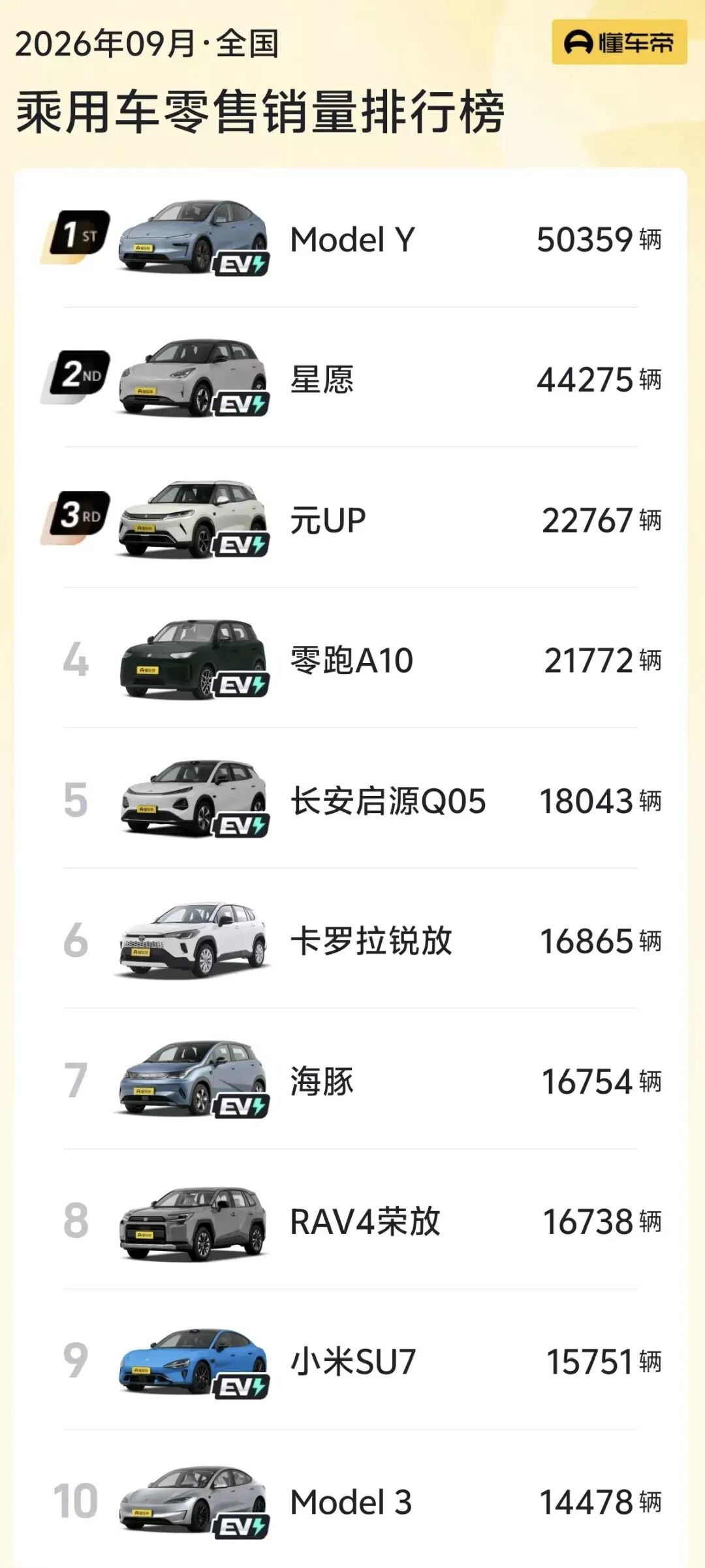
For instance, the September best-seller list was not entirely dominated by new energy vehicles; two fuel vehicle models appeared—the Toyota Corolla Cross and RAV4 from FAW Toyota, ranking sixth and eighth, respectively. Although the remaining spots were occupied by new energy vehicles, this marked an improvement from August, when no fuel vehicles made the top 10.
This suggests that fuel vehicles have their own seasonal rebound rhythm. From dealers pushing sales at the start of the year, pre-Spring Festival car purchases (car purchases before the Spring Festival), to the peak seasons of "Golden September and Silver October," fuel vehicle shares tend to rise periodically. This has been a long-standing pattern in the Chinese auto market, and 2026 is no exception. Although fuel vehicle sales in September were down 43% year-on-year, they only dipped slightly by 0.3% month-on-month—indicating that the peak season effect is still at play, albeit overshadowed by the overall market decline.
Furthermore, examining fuel vehicle performance globally, Mobility Global data shows that the global share of purely gasoline-powered vehicles dropped to 49% in the first half of this year. This marks the first time in over a century of widespread automobile adoption that purely gasoline-powered vehicles have lost their majority share in the global new car market.
While this news sounds dramatic, the situation is not as dire as it seems.
In the global auto market during the first half of the year, purely gasoline-powered vehicles accounted for 49% of sales, non-plug-in hybrids (HEVs) 18%, battery electric vehicles (BEVs) 17%, and diesel and plug-in hybrids (PHEVs) accounted for about 16%. In other words, purely electric vehicles that do not burn any fuel only hold a 17% share. For every two vehicles sold, more than one still has an internal combustion engine.
Moreover, a closer look at sales data reveals that the global average for electrification has been significantly inflated by the Chinese and European markets.
Take the U.S. market, for example. According to Cox Automotive data, ICE (gasoline + diesel) vehicles still held a 76.8% share in the second quarter of this year, with electric vehicle penetration at only around 6%. After the phase-out of federal tax incentives, EV sales in the third quarter dropped by about 45% year-on-year. Buyers did not shift to pure electric vehicles but flocked to HEVs as an alternative.
In addition, in populous countries and emerging markets such as India, Southeast Asia, Latin America, and the Middle East, where charging infrastructure is far from adequate, fuel vehicles remain the absolute mainstream. Mobility Global data shows that while BEV sales in Southeast Asia surged by 81% year-on-year, the base is extremely small, with fuel vehicles still accounting for over 90% of the market.
Even in the seemingly aggressive European market, the new energy penetration rate in nine countries from January to September was only 36.24%, meaning nearly two-thirds of vehicles sold were not pure electric.
In other words, fuel vehicles are not retreating globally but are exiting first-tier Chinese and developed European markets. On a global scale, they remain a mainstream category covering billions of people and generating sales in the tens of millions.
02 Fuel Vehicles Are Not Dying So Fast
From another perspective, while fuel vehicles have performed poorly this year, much of this is due to the overall market decline.
CPCA data shows that retail sales of new energy passenger vehicles reached 1.084 million units in September, a 16.7% year-on-year decrease. Moreover, all three routes—pure electric, plug-in hybrid, and extended-range electric—have experienced varying degrees of decline in the first nine months. Among them, A00-class pure electric vehicles were hit hardest by the phase-out of subsidies, with wholesale sales in September plummeting by over 50% year-on-year.
In other words, it is not just fuel vehicles that are declining; the entire market is shrinking. When the market cake gets smaller, no one gets a full meal.
Therefore, despite nearly all automakers betting heavily on electrification in recent years—with new entrants launching brands and models en masse and traditional giants announcing timelines for phasing out fuel vehicles—the auto industry's sales profit margin has fallen from 4.3% in 2024 to 4.1% in 2025 and further to 3.6% from January to August 2026.
Amid market evolution and industry development, making money in the auto industry has become increasingly difficult. Especially in the new energy sector, behind the myths of blockbuster models lie countless failed ones, quietly disappearing after selling only a few hundred or thousand units monthly.
In contrast, Toyota, the world's largest automaker, has taken a different approach amid industry-wide calls for full electrification. It has made HEVs its global mainstay.
In the second quarter of 2026, HEVs' market share in the U.S. rose to a record high of 16.3%. While consumers complained about subsidy phase-outs, they voted with their wallets for fuel-efficient HEVs that do not require charging. Toyota's logic is straightforward: before charging networks, battery costs, and recycling systems are ready, HEVs serve as both a transition and a business opportunity.
The same is true domestically. In recent years, fuel vehicles have not remained idle. After new energy vehicles introduced features like "refrigerators, TVs, and sofas," fuel vehicle camps quickly adopted similar experiences, offering dual-linked screens, seat massage, L2+ intelligent driving, and 8295 in-vehicle chips—features previously unimaginable in 200,000-yuan-class fuel vehicles, now available for under 200,000 yuan.
Additionally, with the phase-out of new energy subsidies and the reduction of purchase tax incentives being the general direction, markets driven by policies will eventually return to real demand. As a result, choosing fuel vehicles or vehicles with internal combustion engines has become a viable option for consumers.
In summary, while the long-term trend of electric vehicles advancing and fuel vehicles retreating is undeniable and an industry consensus, it is important to note that this transition has taken over a decade. Currently, fuel vehicles still sell in the tens of millions monthly, hold nearly half of the global market share, and are undergoing self-transformation through intelligence and HEVs to enhance competitiveness. Therefore, it is premature to declare that fuel vehicles are no longer viable.
Editor-in-Charge: Du Yuxin Editor: He Zengrong

THE END
-
![]()
Could Hard-to-Sell Sedans Finally Be Making a Comeback?
-
![]()
The 412th Batch of New Cars from MIIT: Mutual Inspiration Becomes the Norm
-
![]()
Don't Be Too Hasty to Dismiss Internal Combustion Engine Vehicles
-
![]()
104th in Ultrafast Nonlinear Optics: Mid-Infrared Dual-Comb Spectroscopy and Compressive Sensing Sampling
-
![]()
Delving into AI-Native Smartphones with the Release of STEPX Neo
-
![]()
Geely's 'Resilience': A Testament to Adaptive Strength
-
![]()
Major Breakthrough for Luxeed! Chery Takes a Daring Step
-
![]()
Collective Negative Growth in Metropolises: Beijing, Shanghai, Guangzhou — Who’s Behind the Slump in Car Sales?