Who Dares to Invest in the Tech of Emerging EV Players?
 10/19 2026
 339
Lead
Introduction
It's common knowledge that selling shovels can be lucrative, but it's truly a job that requires technical prowess.
The internet age gave rise to giants like Alibaba and Tencent; the AI era propelled NVIDIA and OpenAI to the forefront; in the era of new energy vehicles (NEVs), who will emerge as the true trailblazers?
Whether your answer is Tesla, the 'big disruptor,' BYD, the 'market leader,' or the emerging EV players that 'dare to innovate,' the focus inevitably returns to one key point—technology.
While discussing technology may seem abstract, to simplify, the core technologies in the era of fuel-powered vehicles were the 'big three': engine, transmission, and chassis. With this mechanical system, German, American, and Japanese automakers erected barriers that Chinese cars struggled to overcome.
Now, with the advent of the NEV era, the technological core has shifted to the three electric systems (battery, motor, electric control) + smart cockpit + autonomous driving, completely rewriting the market rules.
It is precisely because of this shift in underlying logic that Chinese cars have the opportunity to overtake on bends. Similarly, due to the improvement in China's automotive technological capabilities, once-proud automotive 'masters' have begun to learn from us.
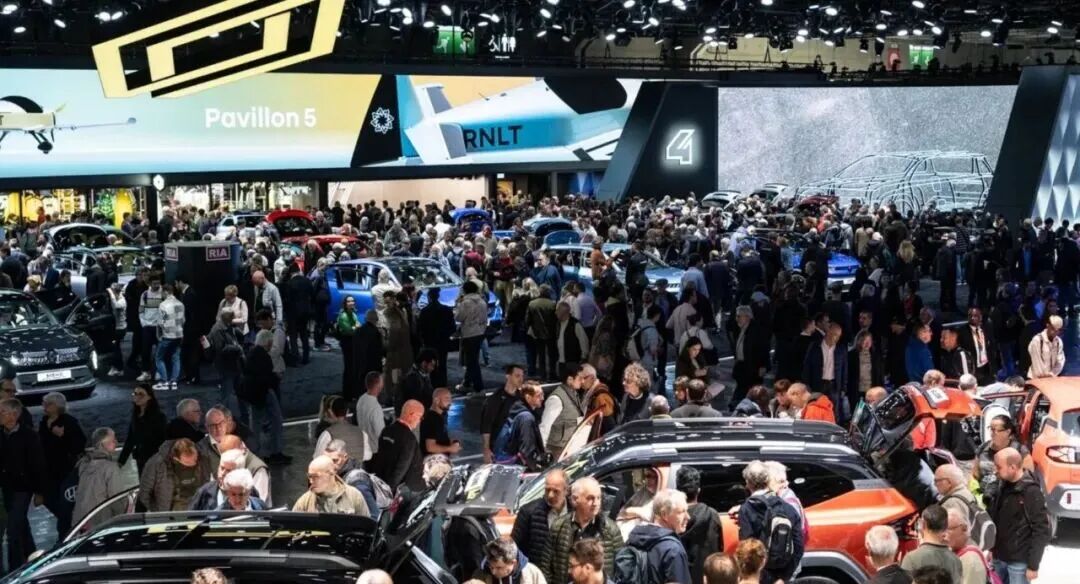
During the Paris Motor Show, two European automotive giants, Volkswagen and Stellantis, signaled their intention to draw on the experience of Chinese automakers to develop their electric vehicle businesses.
Stellantis CEO Carlos Tavares stated that they are relying on joint venture projects to study the technological competitiveness of Chinese companies and seek complementary spaces between the two sides.
Volkswagen CEO Oliver Blume said that the Chinese market is like the industry's 'gym,' where Volkswagen has accumulated sufficient practical experience over the years.
These multinational automotive giants are not, of course, learning from Chinese automakers how to engage in 'intense competition,' but rather a series of capabilities derived from technology—technology implementation, product definition, standardization for quality improvement, cost reduction through scale, and more.
Undoubtedly, in the global automotive market, new energy is the inevitable future; and in the emerging field of NEVs, China holds significant sway.
It is precisely because of these advantages that the emerging EV players, worn down by intense competition, have seen a new opportunity to 'exchange technology for profits.'
01 Real Investment, Forging Technological Autonomy
One-time R&D, lifelong benefits! Technology in the era of NEVs is being elevated to a pedestal. During the chaotic period when the industry has not yet 'solidified,' all automakers are pursuing 'maximizing technological benefits.'
Actually, it's not surprising that everyone is rushing, considering the hardships Chinese automakers endured in the era of old fuel-powered vehicles:
They had to pay patent taxes because the patents for the core 'big three' were locked overseas; they also had to pay market taxes, with little success in exchanging market access for technology; ultimately, they had to pay profit taxes, trapped in the low-end market earning meager assembly profits.
Learning from past mistakes, in the era of NEVs, Chinese automakers are first and foremost seizing technological autonomy.
Driven by a strong will, 'self-research' has become the 'basic narrative' for various automakers, with emerging EV players investing real money in the 'technology label.'
According to statistics, from 2018 to 2025, over eight years, NIO has invested a cumulative 63.5 billion yuan in R&D, Li Auto 46.1 billion yuan, XPeng 36.6 billion yuan, and Leapmotor 13.3 billion yuan.
The feedback has been deeply satisfying: NIO has obtained a globally unique battery swap system, XPeng's intelligent driving dares to compete head-on with Tesla's FSD, Li Auto has self-developed a third-generation range extender system and intelligent driving chips, and Leapmotor has successfully reduced costs by integrating six core modules of the vehicle.
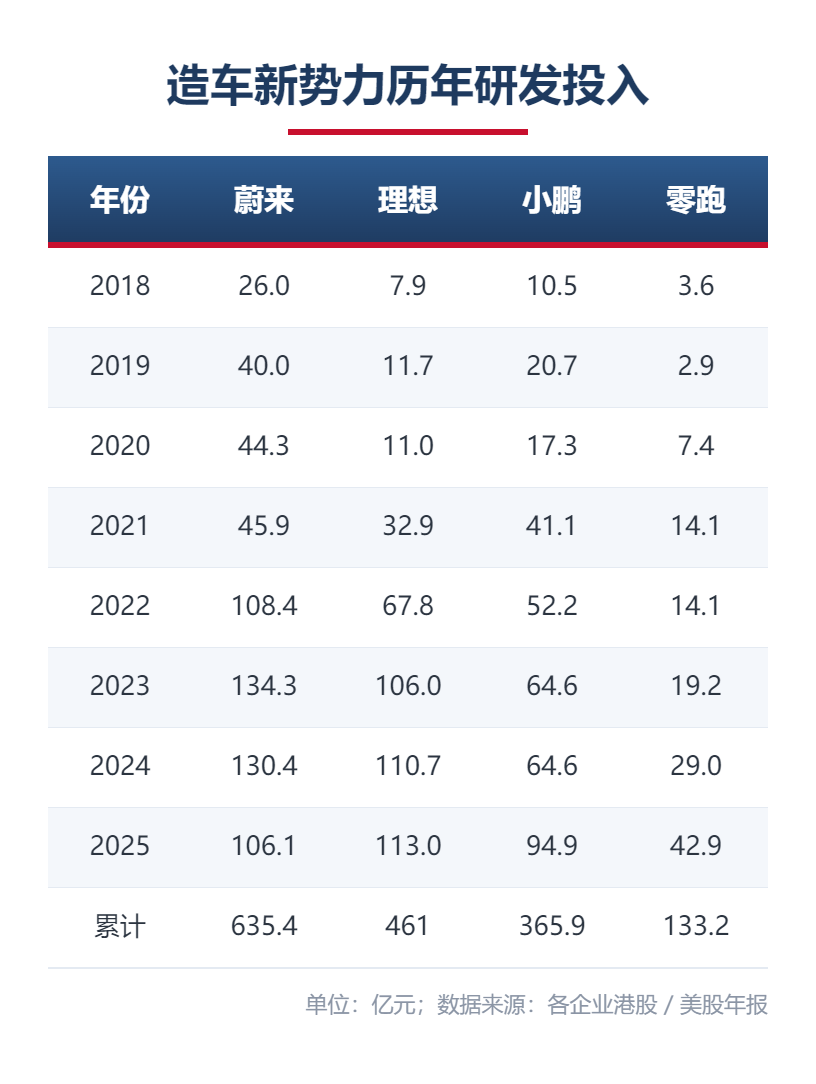
Of course, the R&D investments of NIO, XPeng, Li Auto, and Leapmotor cover multiple technologies, but through their brand images, each has its own emphasis.
NIO's strong label is battery swapping, but it has also self-developed a world model in intelligent driving, tape-out the NIO Adam chip, and even conducted in-depth research in chassis, with the 'Champagne Tower Challenge' Tianxing intelligent chassis causing a stir in the industry.
XPeng excels in intelligent driving, and its self-developed range extender system is also noteworthy. It's worth mentioning that XPeng's self-developed vehicle-level electronic and electrical architecture has already been supplied to Volkswagen for mass production.
Li Auto has pioneered the 'golden age of range extenders,' with its self-developed third-generation range extender system, Mach M100 automotive-grade chips, Mach VLA intelligent driving large model, and globally mass-produced full-line-control chassis, grasping the three core underlying technologies of power, intelligent driving, and chassis.
Leapmotor focuses on cost reduction through technology, with self-developed six major areas: LEAP vehicle platform, Clover central domain control electronic and electrical architecture, eight-in-one oil-cooled electric drive, CTC battery-chassis integration, intelligent cockpit, and LWM world model intelligent driving, controlling 65% of the high-value core components of the vehicle.
Now, the practical question arises: Can these technologies, developed at great expense, be sold to third parties to 'subsidize household expenses'?
02 More Than One Player in Selling Technology
At the 2026 Paris Motor Show, He Xiaopeng announced that XPeng Motors would open up intelligent automotive technology cooperation globally, covering three core areas: vehicle platform, modular technology, and a complete set of toolchains.
Among them, the vehicle platform includes vehicle platform architecture and electronic and electrical architecture; modular technology covers intelligent driving, AI BOX, chips, batteries, and electric drives; the supporting toolchain includes remote XCP calibration, vehicle EOL, AI diagnostics, etc.
In fact, XPeng can be considered one of the first to 'sell technology.' Especially in its cooperation with Volkswagen, it has made a substantial profit.
According to XPeng's financial report for the first half of 2026, the gross profit margin for vehicle sales was 12.1%, while the company's comprehensive gross profit margin was as high as 20.6%; with the addition of services such as outputting the vehicle platform and electronic and electrical architecture to Volkswagen, the relevant gross profit margin soared to 71.4%.
Perhaps seeing the profit potential here, XPeng has firmly embarked on the path of 'selling technology.'
Meanwhile, other competitors are also accelerating their actions.
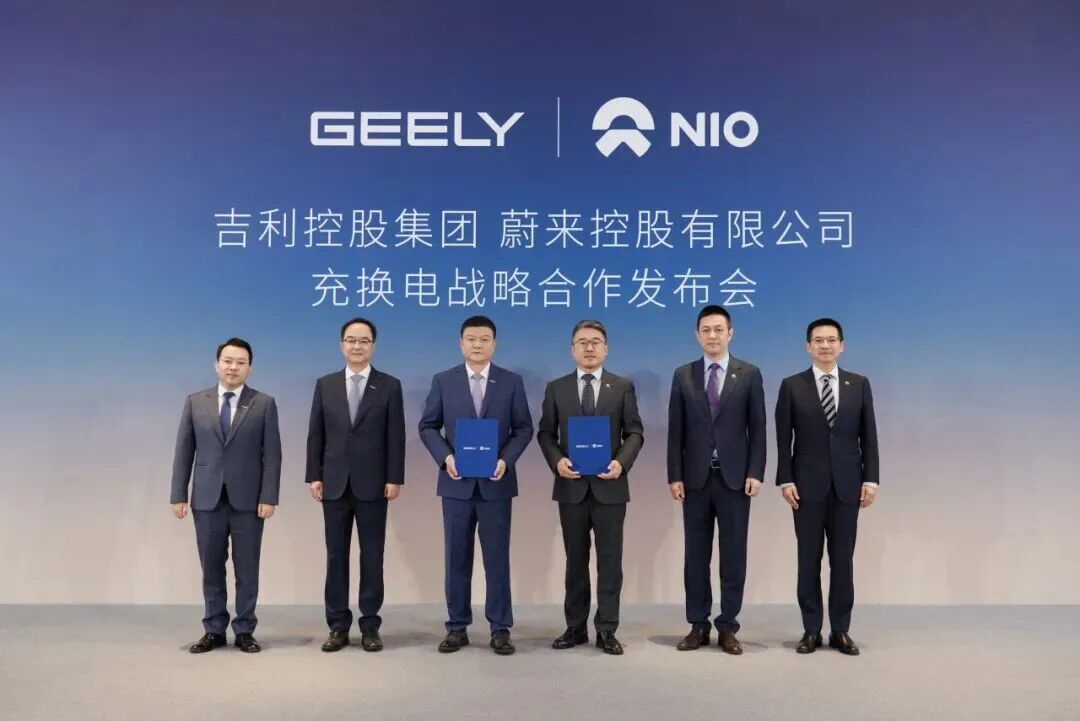
On September 28, NIO and Geely reached a comprehensive strategic cooperation in the field of charging and battery swapping. The two sides will 'jointly invest' in their respective charging and battery swapping business entities, share charging and battery swapping technologies and standards, and jointly build a charging and battery swapping service network.
According to the agreement, Geely will contribute its 100% stake in YiYi Interconnect and 640 million yuan in cash to NIO Power. After the transaction, Geely Holding Group will hold a 30% stake in NIO Power, and YiYi Interconnect's operational vehicle battery swapping business will be merged into NIO Power.
Subsequently, the two sides will jointly establish unified C-end battery swapping technologies and standards. Geely Holding Group will develop battery swapping models for the C-end, and NIO Power will provide services for Geely Holding Group's C-end battery swapping models.
From another perspective, NIO is 'making money' by packaging and selling its battery swapping technologies and standards to Geely, also selling a sufficiently certain 'technology implementation.'
Similarly, Leapmotor is quietly making a fortune.
It is understood that Leapmotor is simultaneously providing FAW and Stellantis with 'platform + three electric systems + domain control complete supply + technology authorization,' not just selling scattered parts but outputting a packaged whole-vehicle electric solution.
The Hongqi G117 model, a collaboration between Leapmotor and FAW, will be jointly developed based on Leapmotor's platform, targeting the Middle East and European overseas markets, with planned mass production in the second half of 2026.
The Opel O3U, a collaboration between Leapmotor and Stellantis, adopts the same B platform as Leapmotor's B10, with Leapmotor supplying the entire set of core components for the three electric systems, while Opel is responsible for the exterior and interior design. The new car will be produced in Zaragoza, Spain (Opel's local factory), sharing the production line with the B10.
It should be noted that Leapmotor has equity ties with both sides. Perhaps it is precisely because of this connection that Leapmotor's 'technology sales' are more natural.
03 Automotive Industry: A Game for the Brave
After all is said and done, the prerequisite for being able to sell technology is first having strong capabilities and second having buyers.
Over the past few decades, Chinese automakers have basically been purchasing platforms and technologies from foreign parties and paying hefty patent fees; now, the tables have turned. The willingness of established giants like Volkswagen and Stellantis to pay essentially admits that:
In the new rules of the NEV era, the technological solutions of Chinese emerging forces possess sufficient mass production value.
But every coin has two sides.
The sale of core technologies by emerging EV players is itself a high-risk gamble. Once the technology is packaged and delivered, various unavoidable issues arise, such as intellectual property protection, technology leakage, and division of quality control responsibilities.
In other words, after the partner obtains the platform, will they quickly digest this capability and turn into a competitor?
If a fault occurs in the cooperative model, who will take the blame—the vehicle manufacturer or the technology provider?
Even involving geopolitical-level scrutiny and the game theory of localized market competition, these are the Sword of Damocles hanging over this business.
So, let's return to the initial question: Who dares to buy the technology of the emerging EV players?
The answer actually lies in the cooperation cases. The automotive industry has always been a game for the brave.
Daring to sell is because years of real investment have forged a complete self-research foundation, no longer just an assembly plant reliant on external procurement, with real technology and even more confidence.
Daring to buy is because, after crunching the numbers, traditional giants do not want to start from scratch with lengthy R&D, using purchased technology to save time and money to secure a ticket to the racetrack.
Undoubtedly, the barriers of the fuel era have been broken. Entering the NEV era, the automotive market is no longer a stage where whoever sells the most can sit comfortably.
The true market competitiveness lies in whose technology can be standardized, reusable, and bring about sufficient cost reduction or strong product strength, only then can they grasp the discourse power to define the industry.
This 'technology trade' belonging to the Chinese NEV era has just begun. Whether it can continue to run smoothly and maintain core barriers ultimately depends on whether the emerging forces can continuously iterate their technology.
After all, only by preserving their competitiveness while outputting technology can they avoid being eliminated by the new era and their partners.
Editor-in-Chief: Du Yuxin Editor: Wang Yue

THE END
-
![]()
SAIC Volkswagen ID.ERA: The Art of Catching Up
-
![]()
Changan’s Leadership Overhaul: Zhu Huarong Relinquishes Chairman Role, Zhao Fei Ascends; Ye Pei Elevated to President | Mirror Pro
-
![]()
Elon Musk Actually Did It: This Car Can Soar
-
![]()
Auto Evaluators: The Impossibility of Being Both Players and Referees
-
Mobile Phone Screens: The Triumph of Domestic Collaboration and the Growing Pains of Reality
-
![]()
Commercial Aerospace Stocks Have Tesla to Thank for Today’s Surge! Give a Cheer if You See Why
-
![]()
How US Media Views Chinese Cars: Beloved by Americans, Yet Unattainable
-
![]()
Tesla’s “Flying Car” Stuns Automotive and Aerospace Experts