Auto Evaluators: The Impossibility of Being Both Players and Referees
 10/19 2026
 513
「 MIIT and Two Other Departments Investigate Brake Pedal Bracket Fracture in Zunjie V800 」
The highly publicized brake pedal fracture incident involving Zunjie is finally set for a comprehensive resolution.
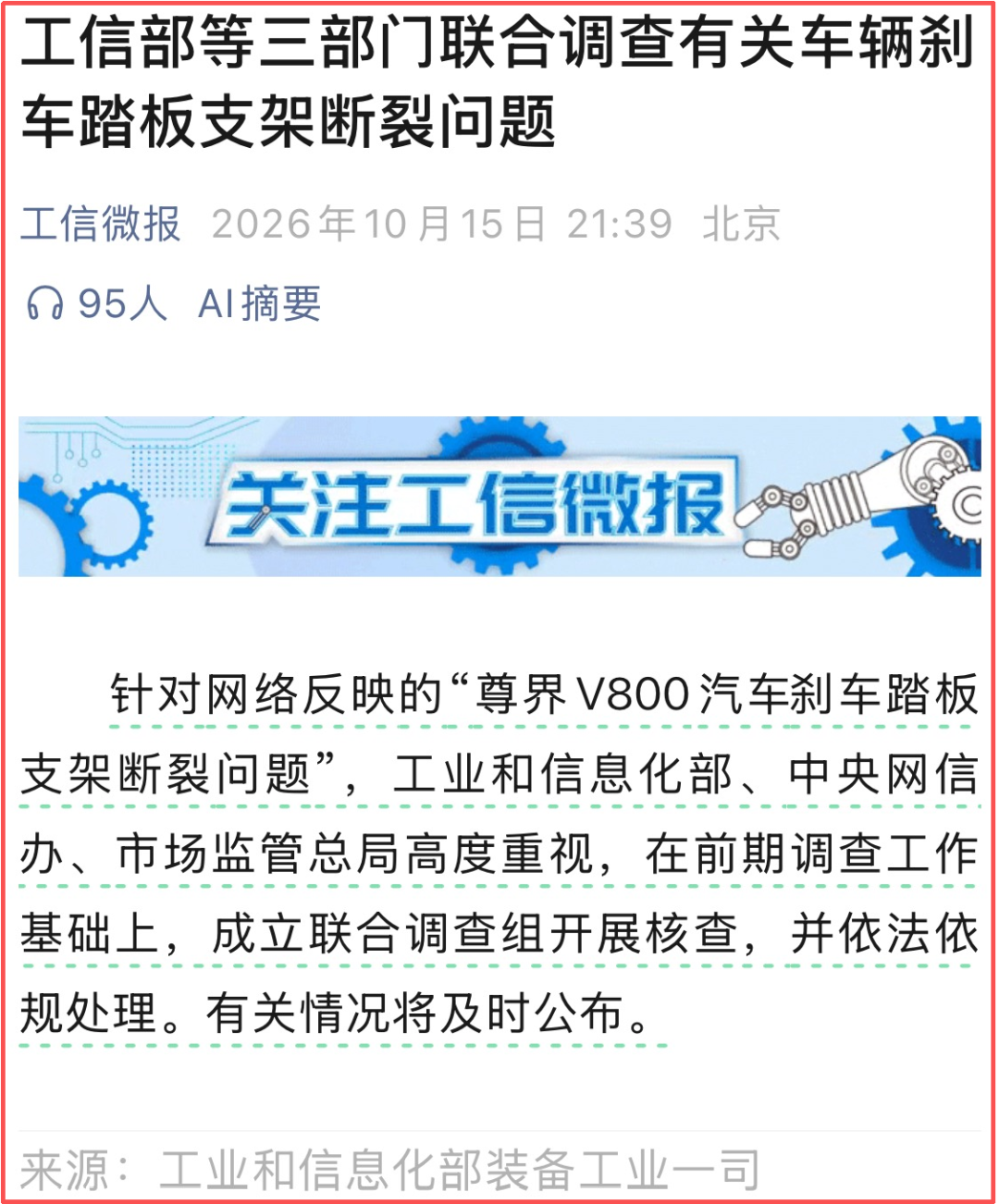
On October 15, the Ministry of Industry and Information Technology (MIIT), the Cyberspace Administration of China (CAC), and the State Administration for Market Regulation (SAMR) issued a statement expressing their serious concern over the online reports of a 'brake pedal bracket fracture in the Zunjie V800 automobile.' Building on preliminary investigations, these three departments have formed a joint investigation team to thoroughly verify the incident and address it in accordance with the law and regulations, with updates to be shared promptly.
Zunjie Auto subsequently released a statement, expressing its active cooperation and full compliance, and pledging to work closely with the joint investigation team. The company reiterated its commitment to safeguarding the legitimate rights and interests of consumers and promoting the overall development of the new energy vehicle industry.
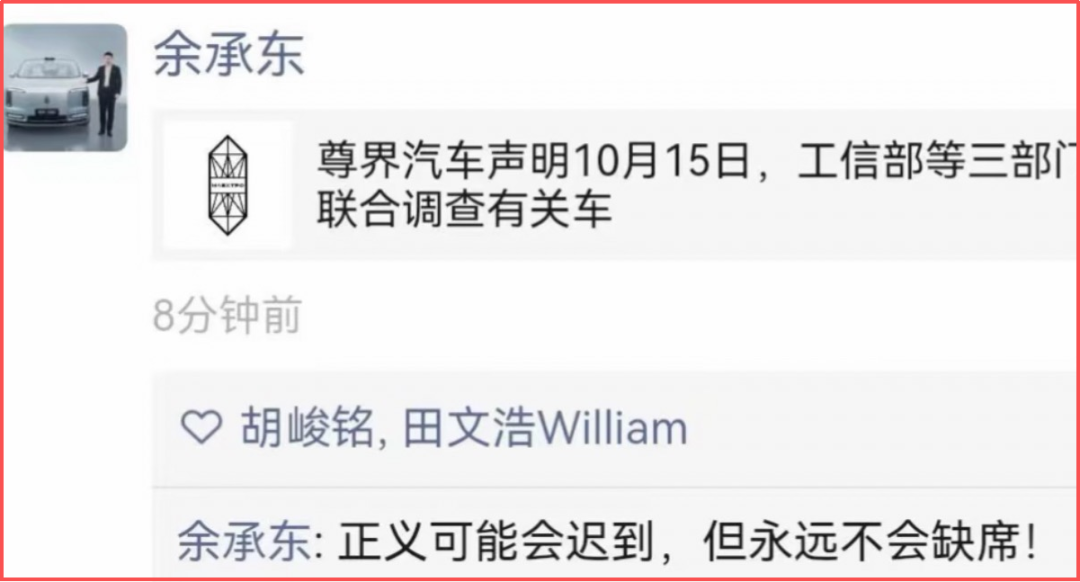
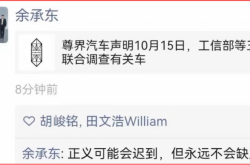
That evening, Yu Chengdong, Executive Director and Chairman of Huawei's Terminal BG, reposted Zunjie's statement on his social media and commented, 'Justice may be delayed, but it will never be absent.'
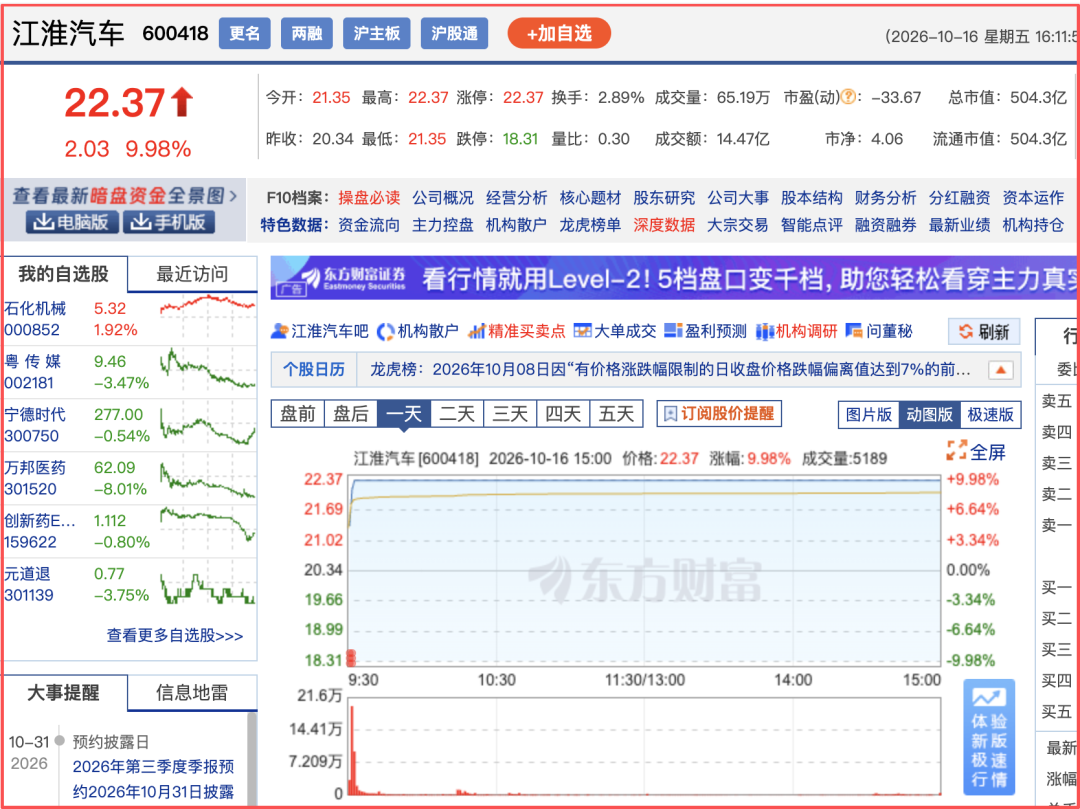
On October 16, JAC Motors' stock hit the daily limit, with its total market value surpassing 50 billion yuan. Previously impacted by the incident, its stock had hit the daily limit for two consecutive days, resulting in a market value loss of over 11.7 billion yuan.
As of now, Dongchedi, the other party involved in the controversy, has not yet issued a public statement. On October 8, Dongchedi released a test video alleging that the brake pedal brackets of three brand-new Zunjie V800 vehicles fractured during emergency braking at 100 km/h, sparking widespread public concern.
Why are these three departments conducting a joint investigation into this incident? According to their respective responsibilities, the MIIT oversees the automotive industry, the CAC manages online content governance, and the SAMR enforces product quality standards and advertising regulations.
The joint investigation by these three departments aims to address key public concerns, such as the quality of Zunjie's brake pedals, the compliance of Dongchedi's evaluations, the legality of the information released, and any potential hidden circumstances behind the incident. It is anticipated that the findings will provide the public with truthful and transparent answers.
Moreover, this collaborative effort by the three departments will have a significant impact on the automotive industry.
Firstly, the investigation will focus on product quality, serving as a stark reminder to automotive companies to prioritize quality as their core value and maintain stringent quality control measures.
Secondly, the investigation may involve automotive evaluations.
Automotive companies have mixed feelings about evaluations: they appreciate the opportunity to showcase their product advantages and drive industry progress, but they resent unfair and biased evaluations that mislead the public and cause substantial losses.
Currently, automotive evaluation entities in China can be broadly categorized into three groups. The first group comprises qualified professional evaluation institutions, such as the China Automotive Technology & Research Center (CATARC) and the China Automotive Engineering Research Institute (CAERI). These institutions, often backed by central or state-owned enterprises, possess strong technical capabilities and high professional standards, wielding significant influence internationally, within the government, and across the industry. They primarily release professional evaluation results.
The second group consists of automotive information platforms. These platforms have established strong brand presence and a clearly differentiated competitive landscape. Traffic is largely concentrated among the top three platforms in the first tier, which enjoy broad audience reach and strong influence.
The third group comprises automotive industry self-media and influencers. This group is large and diverse, with a low barrier to entry and varying levels of quality. They often lack professional technical support and base their evaluations primarily on subjective feelings. Some resort to attention-grabbing topics and exaggerated tones to quickly capture public attention.
These three types of evaluation entities, although mostly operated as companies, differ fundamentally in their operations:
Professional evaluation institutions generally conduct evaluations cautiously, adhering to regulations and rarely making public statements. They also conduct challenge-based evaluations beyond regulatory requirements but rarely release results unfavorable to automotive companies.
In contrast, automotive information platforms and self-media often release sensational evaluation results, but their impartiality is often questioned. The main reasons are their lack of professionalism and their inherent position within the automotive commercial chain, which naturally raises suspicions of bias and conflict of interest.
It is believed that this joint investigation by the three departments will further clarify the compliant boundaries for automotive evaluations and, consequently, promote the governance of evaluation chaos and hidden rules.
Finally, this joint investigation and its results will also serve as a valuable educational resource for the public, helping them better understand what constitutes scientific, objective, and impartial automotive evaluations.
-
![]()
SAIC Volkswagen ID.ERA: The Art of Catching Up
-
![]()
Changan’s Leadership Overhaul: Zhu Huarong Relinquishes Chairman Role, Zhao Fei Ascends; Ye Pei Elevated to President | Mirror Pro
-
![]()
Elon Musk Actually Did It: This Car Can Soar
-
![]()
Auto Evaluators: The Impossibility of Being Both Players and Referees
-
Mobile Phone Screens: The Triumph of Domestic Collaboration and the Growing Pains of Reality
-
![]()
Commercial Aerospace Stocks Have Tesla to Thank for Today’s Surge! Give a Cheer if You See Why
-
![]()
How US Media Views Chinese Cars: Beloved by Americans, Yet Unattainable
-
![]()
Tesla’s “Flying Car” Stuns Automotive and Aerospace Experts