Why Hella's Automotive Lighting Business Earned Only €7 Million in Half a Year: Why Are Traditional Tier 1s Scrambling for Battery Electronics Orders?
 10/20 2026
 490
On October 8, Forvia Hella announced the acquisition of two mass production orders for its EnergyCore series: a three-in-one high-voltage battery management system and a 48V PowerPack. The total contract value falls within the mid-range of several hundred million euros, with customers from the Americas and Europe. Mass production is set to commence in December 2027 and spring 2028, respectively.
The order value is not substantial. Hella's financial report for the first half of 2026:
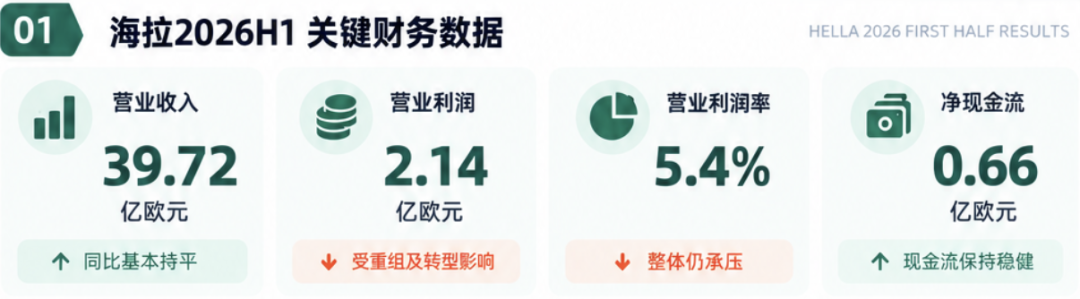
◎ Group revenue reached €3.972 billion, with an operating profit of €214 million and a profit margin of 5.4%.
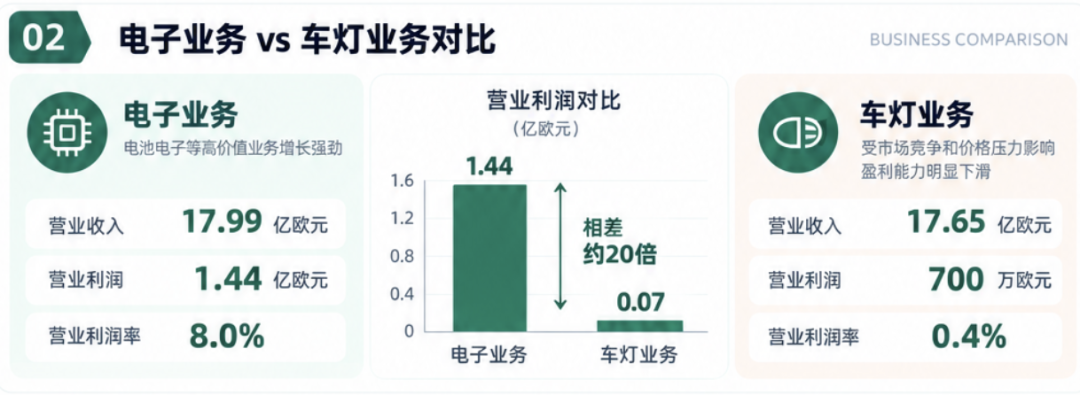
◎ Electronics business revenue was €1.799 billion, contributing €144 million in operating profit.
◎ Lighting business revenue was €1.765 billion, with operating profit dropping to just €7 million.
Revenue for both businesses is nearly identical, but profitability has diverged by dozens of times.
The lighting industry is indeed too competitive now! How can Tier 1s survive when their cash cows are bleeding?
Part 1
First-Half Financial Report: Electronics Are Profitable, Lighting Is Losing Money
Group revenue remained largely flat year-on-year:
◎ Revenue ranged from €3.979 billion to €3.972 billion.
◎ Operating profit decreased from €237 million to €214 million.
◎ Net cash flow dropped from €114 million to €66 million, with capital expenditures also compressed.
The electronics business has become Hella's most important source of profit.
◎ Revenue was €1.799 billion, up 4.0% year-on-year, with organic growth of 6.6%.
◎ Operating profit was €144 million, up 18.2% year-on-year, with the profit margin increasing from 7.0% to 8.0%.
Growth was primarily driven by 77GHz millimeter-wave radar, energy management, low-voltage DC/DC converters, and battery management systems.
◎ Gross profit for the electronics business decreased slightly from €421 million to €419 million, with the gross margin slipping from 24.3% to 23.3%.
◎ R&D expenses during the same period decreased from €210 million to €188 million.
◎ Operating profit increased by €23 million year-on-year, with €22 million saved on R&D spending.
Profit improvement currently relies mainly on R&D efficiency and resource adjustments, as product gross margins continue to be squeezed by project costs and inflation. With more and more new orders being accepted, this issue cannot be avoided.
The lighting business faces much harsher conditions.
◎ Revenue was €1.765 billion, down 5.3% year-on-year.
◎ Operating profit plummeted from €63 million to €7 million, with the profit margin dropping from 3.4% to 0.4%.
In Europe, mass production projects ended, and there were insufficient new energy orders. In North America, major projects were discontinued, and customer take-up volumes declined. There were also warranty issues with lighting projects in the first half of the year.
Lighting is a typical fixed-cost business, requiring upfront investments in optical design, molds, and production lines. A drop in vehicle model production volumes leads to immediate losses.
Smart lighting, ADB, and pixelated lighting bring higher revenue per vehicle but also introduce more software validation, thermal design, and warranty responsibilities. Technological upgrades do not automatically translate into profits.
In contrast, the smallest business segment, Lifecycle Solutions, provides a stark contrast.
◎ Revenue was €521 million.
◎ Operating profit was €65 million, with a profit margin of 12.4%.
This segment focuses on commercial vehicles, construction machinery, and aftermarket parts. Long vehicle lifecycles, dispersed demand, and sustained aftermarket needs have made it the group's most stable profit pool.
Operating cash flow decreased from €458 million to €343 million, capital expenditures were reduced from €344 million to €277 million, and the workforce was reduced by 5.4% year-on-year.
Another figure that is easily misinterpreted: net profit increased from €70 million to €99 million, moving in the opposite direction of operating profit. This was primarily due to a reduction in business restructuring expenses from €94 million in the same period last year to €22 million.
Part 2
Why Compete for Battery Electronics: From Selling Components to Controlling Entire Systems
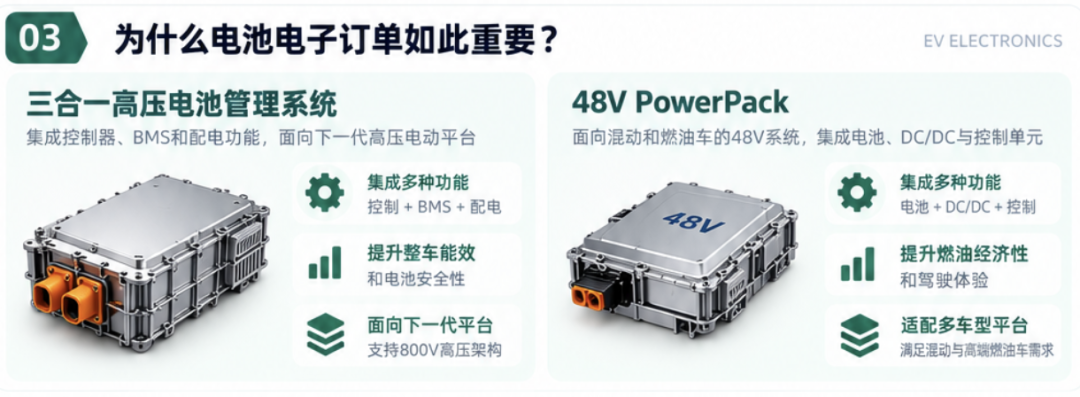
The three-in-one high-voltage battery management system integrates the traditional BMU (Battery Management and State Estimation), CMU (Cell Voltage and Temperature Sampling), and BJB (High-Voltage Connection and Distribution Protection) into a unified architecture while optimizing cell measurement methods and reducing the number of sampling units.
This reduces the number of wiring harnesses, connectors, and control units within the battery pack, saving assembly steps, costs, and space for automakers. Hella's delivery scope expands from individual electronic controllers to the entire battery electronics system.
This system is initially developed for large full-hybrid vehicles and will later extend to pure electric vehicles.
Hybrid vehicle batteries have a smaller capacity but require continuous handling of dynamic currents due to frequent starts, energy recovery, and power switching, imposing high demands on measurement, control, and high-voltage protection. European and American car companies (European and American automakers) are currently making significant investments in hybrids, making this a pragmatic entry point.
The 48V PowerPack integrates low-voltage DC/DC conversion with low-voltage battery management, working in conjunction with 12V batteries to support energy recovery and coasting fuel cutoff power supply. While it shares a similar voltage level with the recently discussed 48V zone power supply architecture, their application targets differ. Hella is initially focusing on hybrids.
Hella is vying for a larger integration scope within the vehicle's power supply system.
◎ In the past, automakers separately procured BMS controllers, sampling boards, high-voltage distribution boxes, and low-voltage converters, completing the integration themselves.
◎ Now, suppliers combine functions into platform-based products, taking responsibility for hardware design, functional safety, thermal management, and system matching.
Automakers aim to reduce the total number of parts, interfaces, and validation costs. While suppliers expand their delivery scope, they also shoulder development and quality risks. The cost savings will be reallocated in subsequent rounds of pricing.
Battery electronics is the most mature competitive arena for Chinese companies.
Chinese automakers, battery companies, and electronics suppliers have established a vast BMS, high-voltage distribution, and power conversion industrial chain. Some automakers even possess overall development capabilities from battery pack structure to electronic control software.
◎ Hella's strengths lie in automotive electronics design, global validation systems, and functional safety engineering capabilities, serving international clients' cross-regional platforms.
◎ Chinese suppliers' strengths lie in development speed, local supply chains, and cost.
Hella must now adapt to two different rhythms simultaneously: developing platform-level systems and providing long-term warranties in Europe and America while compressing quotation, prototype, and mass production ramp-up cycles in China to the fastest possible pace.
The two orders represent cumulative lifecycle amounts. Assuming a total of €500 million covering six years, this translates to approximately €83 million in annual revenue.
Based on an 8% operating profit margin for the electronics business, this would yield around €6.6 million in annual operating profit, a mere fraction for Hella, which generates over €7 billion in annual revenue. During the early stages of mass production, software development, validation, and production line expenses must be absorbed first.
The true value lies in securing system supply qualifications for international clients' next-generation battery electronics platforms: once a platform is validated, hardware, software, and testing resources can be reused for subsequent models. As reuse rates increase, R&D efficiency and project profitability will improve.
Part 3
Overseas Tier 1s' Path Forward: Contracting Old Businesses, Competing for New Systems
Placing Hella within the industry context, European suppliers' adjustment directions in the first half of 2026 are highly consistent.
◎ ZF generated €19.3 billion in revenue, a nominal decline of 2.0%, with its adjusted EBIT margin increasing from 4.3% to 5.0%. R&D spending decreased by approximately 7%, and net debt remained close to €9.8 billion.
◎ Valeo reported revenue of approximately €10.4 billion, with an operating profit margin of 5.0% and free cash flow of €242 million, driving profitability through its Elevate 2028 plan.
◎ AUMOVIO, spun off from Continental, generated €8.6 billion in revenue, with an adjusted EBIT margin of only 1.8%.
All are cutting costs and improving cash flow, but none have stopped competing for new projects in electronic electrical architectures, power management, sensors, and control systems.
Behind these moves are three key changes.
◎ First, international Tier 1s are beginning to proactively contract their business boundaries.
Forvia's IGNITE strategy designates electronics and seating as growth businesses, while lighting, clean mobility, and aftermarket are classified as value management businesses. Simultaneously, it is advancing the sale of its interior business at an enterprise value of €1.82 billion. In the first half of the year, the group's revenue decreased by 4.3%, but its operating profit margin increased from 5.7% to 6.0%.
Hella's electronics business is classified as a growth area, while lighting falls under value management, following the same resource allocation logic: continue investing in areas capable of securing system orders, harvest profits and cash flow from mature businesses, and place assets with insufficient long-term returns on the restructuring or divestiture list.
◎ Second, suppliers are vying for more critical interfaces within the vehicle's electronic system.
As computing tasks concentrate in domain controllers and central platforms, the value of standalone controllers is being squeezed. However, cell measurement, high-voltage protection, power conversion, actuator driving, and millimeter-wave radar still require dedicated hardware, analog front ends, and power electronics close to the battery and wheels.
Even if the computational functions of BMS shift upward in the future, measurement and safety protection must remain within the battery pack. Tier 1s' value space lies in system interfaces, functional integration, and cross-platform reuse.
◎ Third, rebuilding development and cost systems for the Chinese market is essential.
Chinese new energy automakers have short development cycles, rapid configuration changes, and retain core definition capabilities for batteries, electric drives, intelligent driving, and central computing in-house.
Overseas suppliers must either relocate more R&D capabilities closer to Chinese clients, utilizing local component, manufacturing, and testing supply chains, or face elimination in successive bidding rounds.
In Hella's interim report, its Asian electronics business benefited from demand for low-voltage converters and battery management, while its lighting business relied on new model launches in the Chinese market for support.
Summary
European suppliers' new strategy: delve deeper into functional areas such as battery management, power conversion, and system integration, using platform supply relationships to lock in next-generation models. Securing new business is essential for survival!
-
![]()
In the First Three Quarters, 8.2 Million Vehicles Sold: Overseas Markets Emerge as a Competitive Frontier for Chinese Automakers
-
![]()
China and the EU Both Achieve Success! Will the Export Volume of New Energy Vehicles to Europe Rise or Fall?
-
![]()
After a Year of Restructuring, WM Motor Encounters Fresh Hurdles in Production Restart
-
![]()
German Luxury Car Brands Encounter Group Pressure in Q3, with Porsche Seeing the Sharpest Drop
-
![]()
Sales of Fuel Vehicles Drop Below One-Third for the First Time, Now It's New Energy's Turn to Face Intense Competition
-
![]()
Why Hella's Automotive Lighting Business Earned Only €7 Million in Half a Year: Why Are Traditional Tier 1s Scrambling for Battery Electronics Orders?
-
![]()
Kling 4.0 Hands-On Review: Long Takes Shine, but AI Direction Still Has Room for Improvement
-
![]()
Jev Sparks the Era of Decision-Making Models: Large Models Dive into the Infinite Game