Li Bin’s Bold Claim Becomes Reality: NIO Crowned China’s ‘No.1 Luxury Brand’!
 10/21 2026
 532
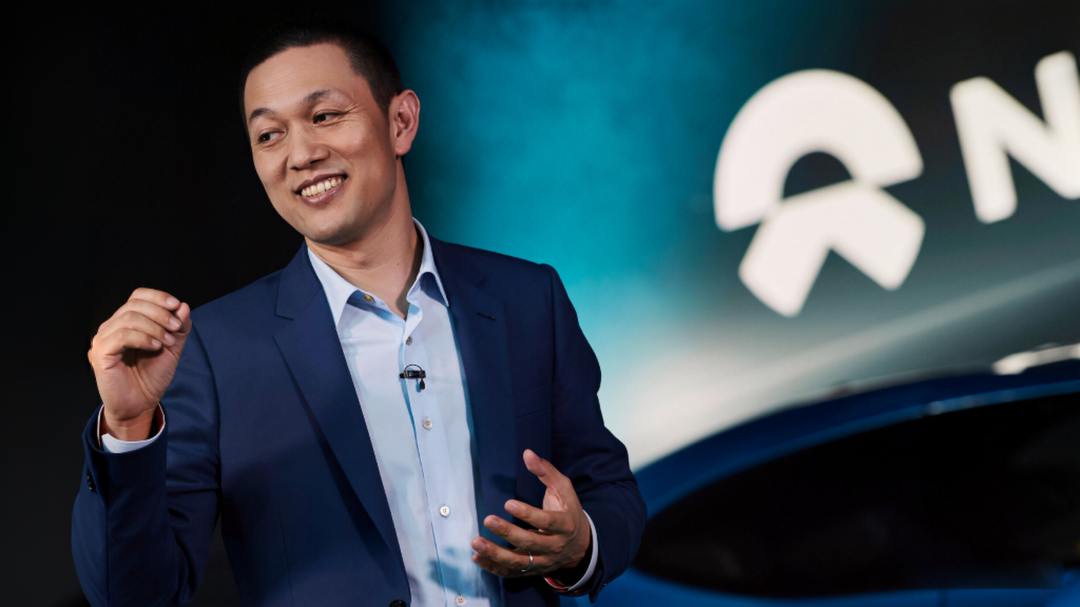
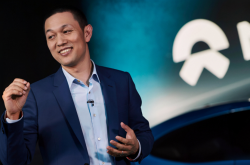
“BBA’s next car will be a NIO”—for five years, Li Bin repeated this line, only to face relentless mockery.
Over that half-decade, his prediction was dismissed as arrogant bragging, becoming an inside joke in automotive circles. To the public, BBA had long held an iron grip on China’s premium luxury market (vehicles priced above RMB 400,000), with seemingly impenetrable brand loyalty. For domestic automakers, surpassing them seemed like a pipe dream.
On October 17, NIO’s Qin Lihong dropped a bombshell with data that sent shockwaves through the industry:
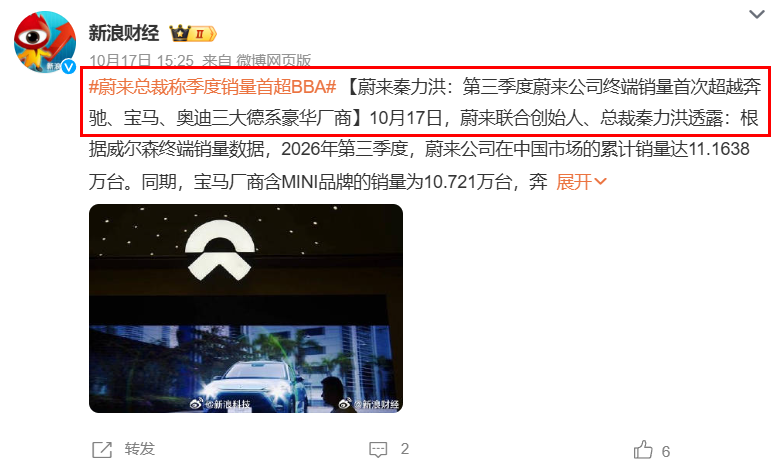
Image source: Weibo
In Q3 2026, NIO’s total domestic sales hit 111,638 units, outpacing BMW (107,210, including MINI), Mercedes-Benz (99,592, including Maybach & Smart), and Audi (94,597) in a single quarter for the first time. These figures reflect group-wide terminal sales (including imports)—a scenario few dared to envision just a few years ago.
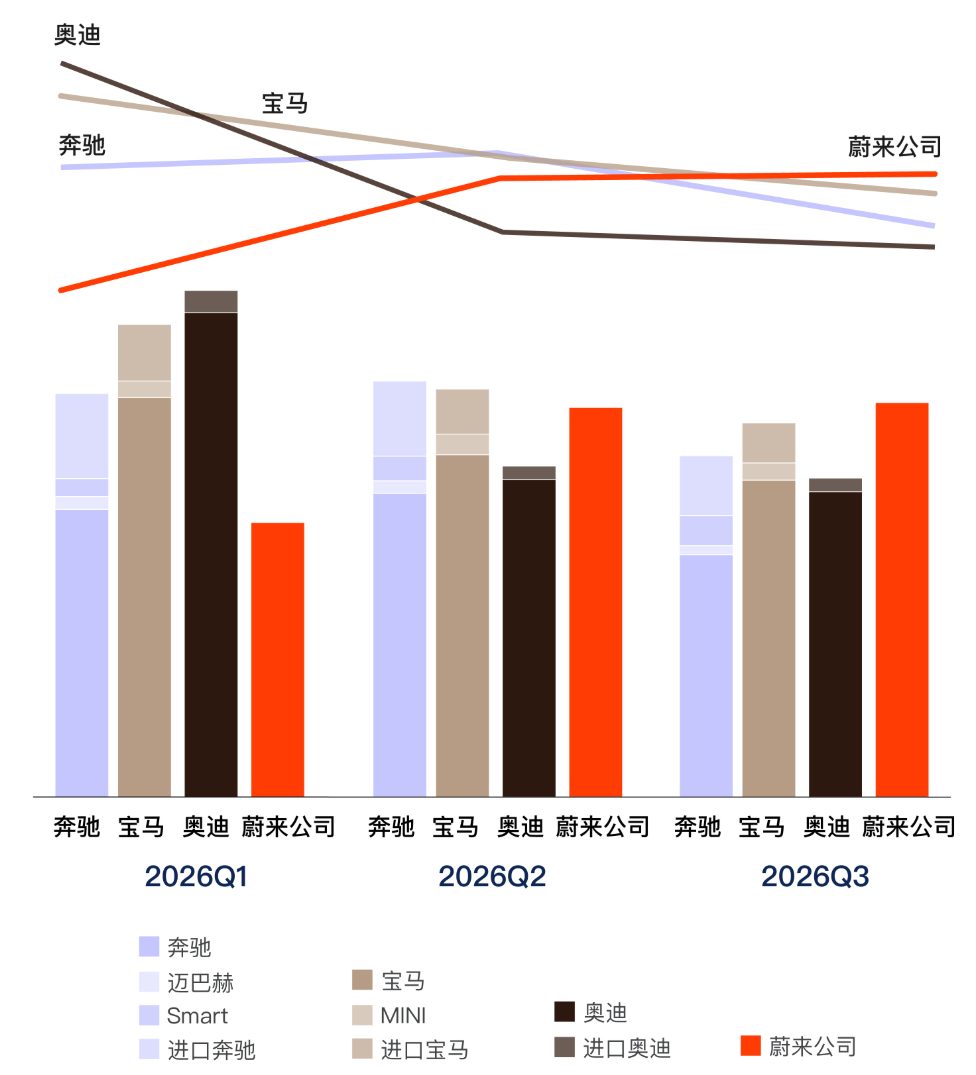
Image source: Weibo
The news sparked both excitement and skepticism. Many questioned: Has NIO truly become China’s top luxury brand? The answer isn’t straightforward—it demands nuanced analysis.
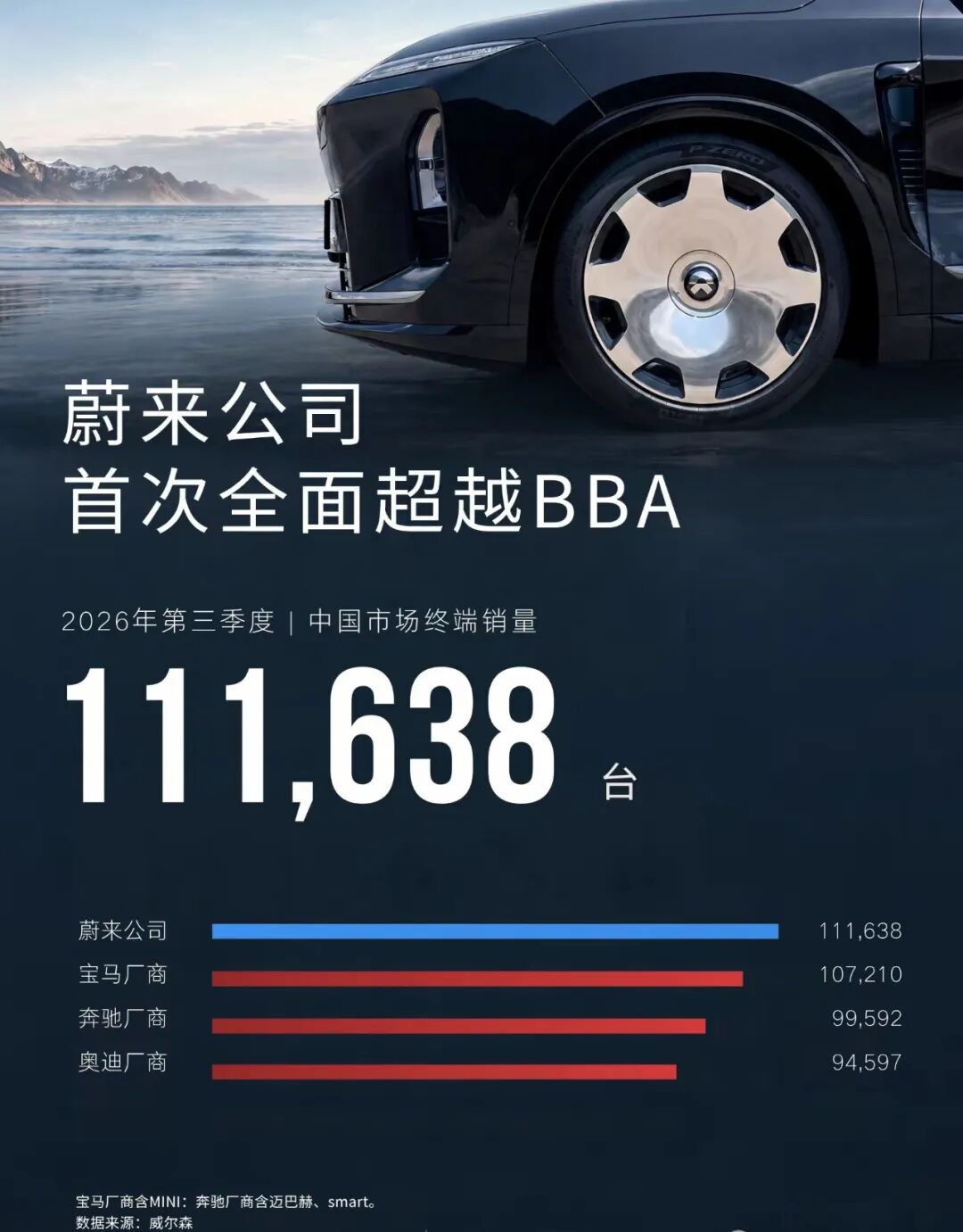
Image source: NIO
From Niche Breakthrough to Market Dominance: The Luxury Landscape Shifts
The true significance lies not in raw numbers but in geographic expansion:
In Q3, NIO outsold BBA in 40 cities across 8 provinces, while surpassing at least one BBA brand in 94 cities across 12 provinces. Economic powerhouses like Beijing, Shanghai, Guangdong, Zhejiang, Jiangsu, Anhui, Shaanxi, and Hainan saw collective reversals. The cities included both luxury strongholds (Shanghai, Beijing, Guangzhou, Shenzhen, Hangzhou, Suzhou, Chengdu) and lower-tier markets (Shantou, Yichang, Hegang). Premium buyers are no longer concentrated in first-tier cities alone. The growth trajectory is striking: from 2 provinces/8 cities in January to 4 provinces/30 cities in April, 7 provinces/36 cities in June, and nationwide dominance by Q3. As one netizen aptly put it: “Leading in one city is easy; regional dominance creates unstoppable momentum. Once the flames connect, no wind can extinguish them.”
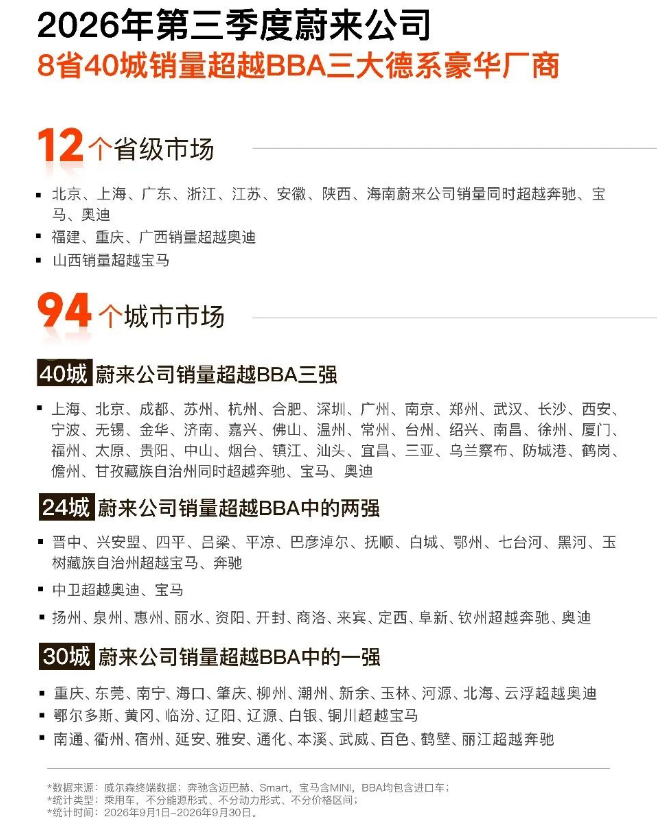
Image source: Weibo
Some critics argue: “Remove LEADIM and Firefly for a fair comparison.” In reality, NIO operates three parallel brands: the main brand targets premium EVs above RMB 400,000, LEADIM focuses on RMB 200,000 family cars, and Firefly offers compact premium models—all without relying on low-price volume strategies. In the first three quarters, NIO Group delivered 300,301 units (+49.2% YoY): main brand 181,988 (+63.4%), LEADIM 70,191, and Firefly 48,122 (+136.7%), all setting new records.
The main brand’s ASP stabilized above RMB 400,000, reaching RMB 434,600 in July and RMB 427,700 in August. LEADIM surpassed 200,000 cumulative deliveries in two years (ASP: RMB 234,000), rivaling traditional luxury models. The ES8 and ES9 anchored the portfolio: the ES9 claimed the 500,000-level pure EV sales crown for four consecutive months, while the ES8 exceeded 10,000 monthly deliveries in September.
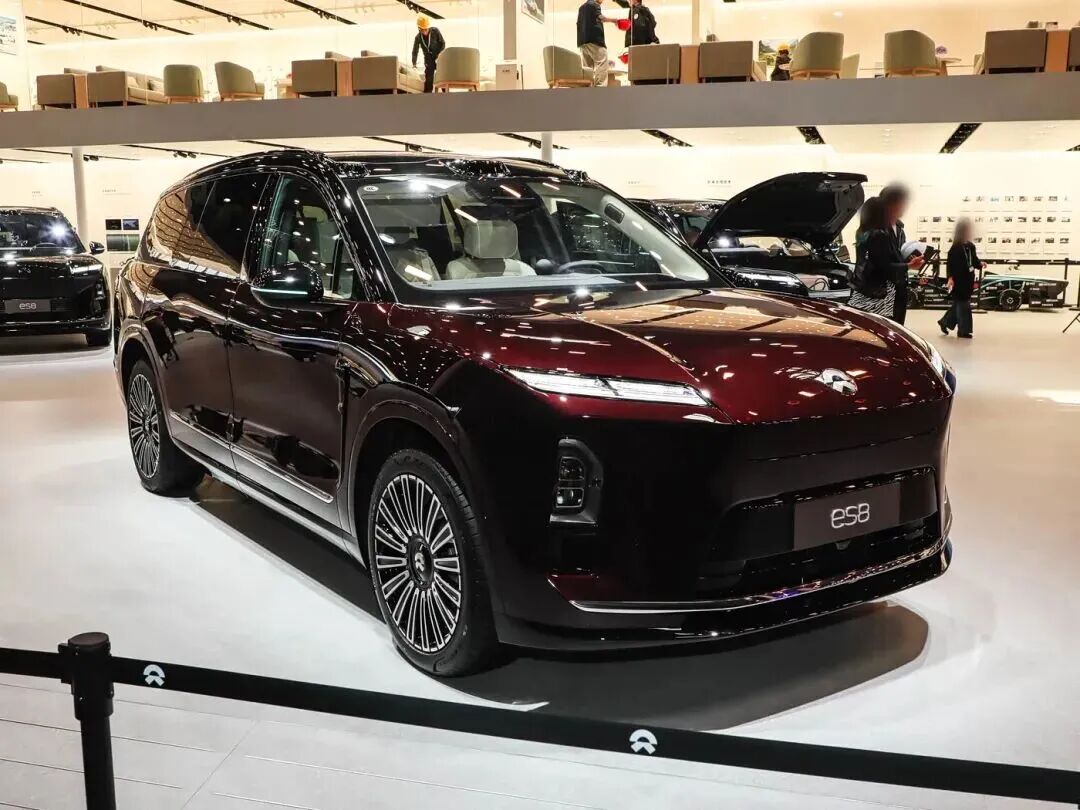
Owner reviews are polarized yet authentic: “The ES8 is the best SUV under RMB 10 million” and “Battery swapping makes long-distance travel effortless.” Some intended ES8 buyers opted for L90 instead: “The L90 is sufficient for family use.” Product viability ultimately hinges on hard power, as one netizen noted: “The ES8 and ES9 ride the trend while delivering strong product fundamentals.” Volume growth without price collapse defines the significance of this breakthrough.
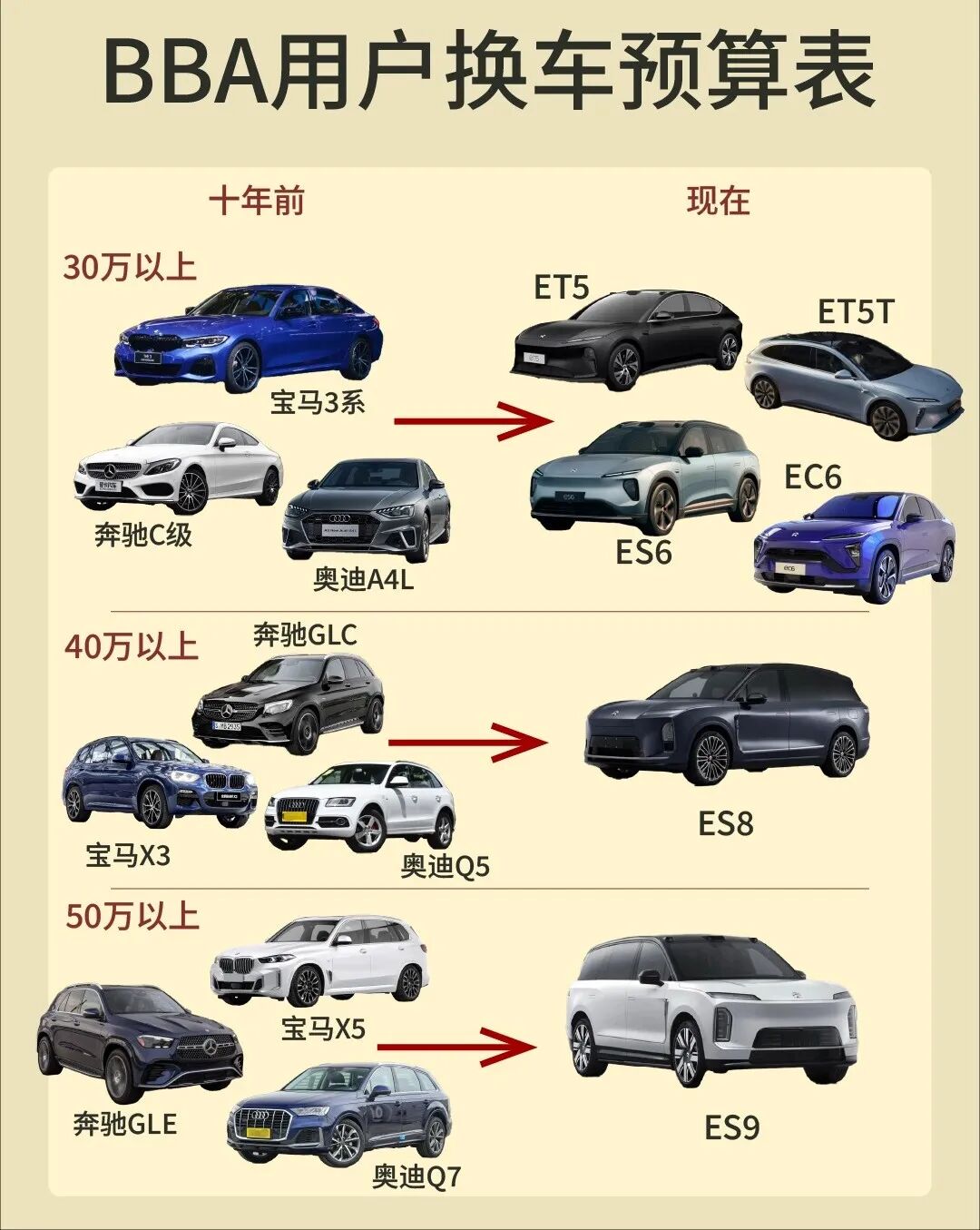
Image source: Weibo
Decoding ‘China’s No.1 Luxury Brand’: Multiple Benchmarks Apply
While Q3 sales mark a milestone, “China’s top luxury brand” lacks a singular definition. NIO led local luxury sales in Q3, but competitors remain strong annually. In 2025, Hongmeng Intelligent Mobility (HIM) sold ~589,100 units, Li Auto 406,300, and NIO 326,000—placing NIO third by scale. Some netizens set loftier goals: “The ultimate target is surpassing the combined BBA volume.” Market expectations for NIO now transcend immediate achievements. In the RMB 1 million+ segment, the NIO ET9 outsold the BMW 7 Series and Audi A8L with 835 insured units, cracking open the ultra-luxury EV market.
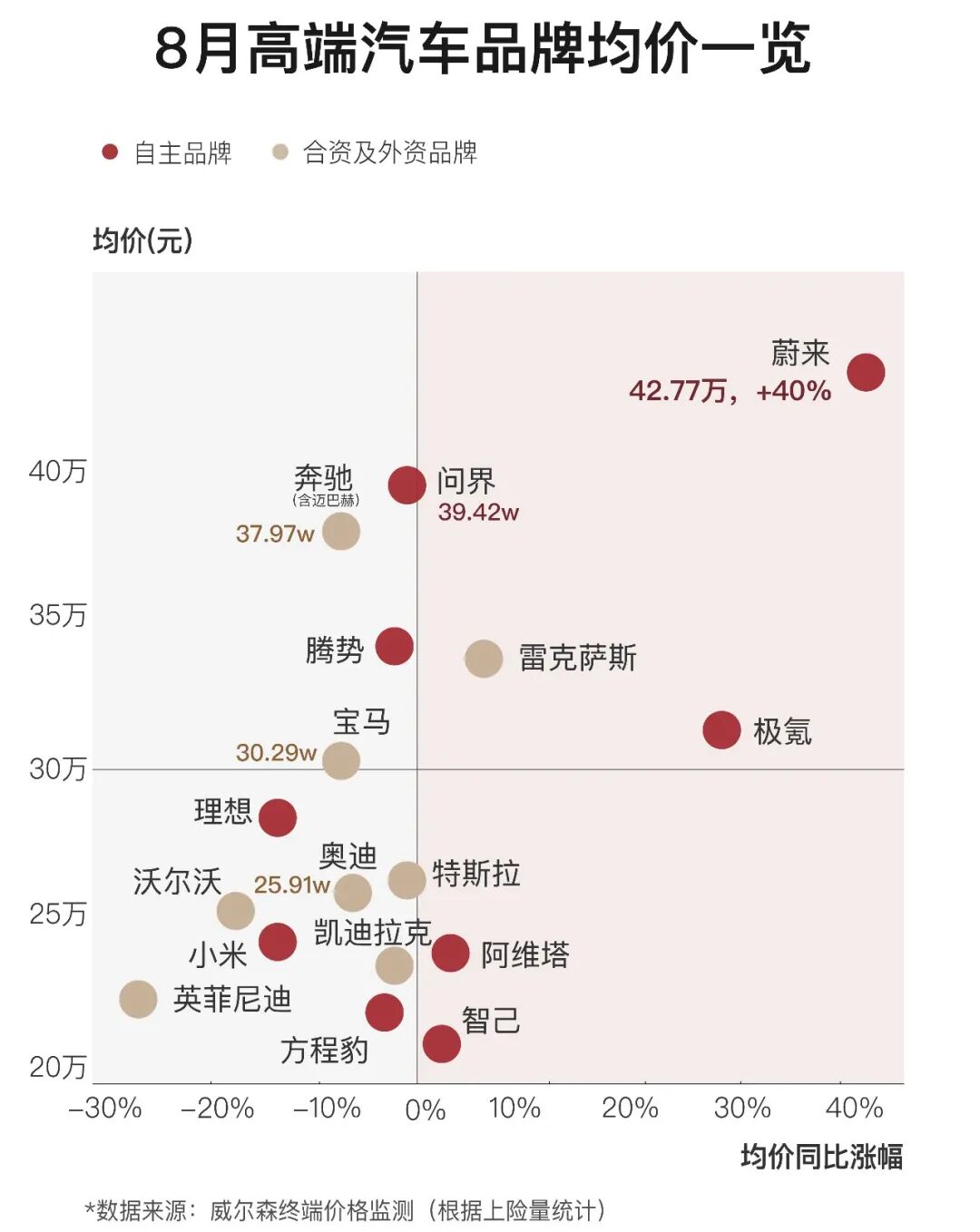
Image source: Weibo
In brand positioning, pricing power, and experience, NIO holds distinct advantages: Jeran Road’s ranking groups NIO with BBA as “luxury brands,” while Li Auto and Xiaomi fall under “premium brands.” J.D. Power named NIO No.1 in both luxury and domestic new energy purchasing experiences. Its RMB 400,000+ ASP reflects rare domestic luxury pricing power.
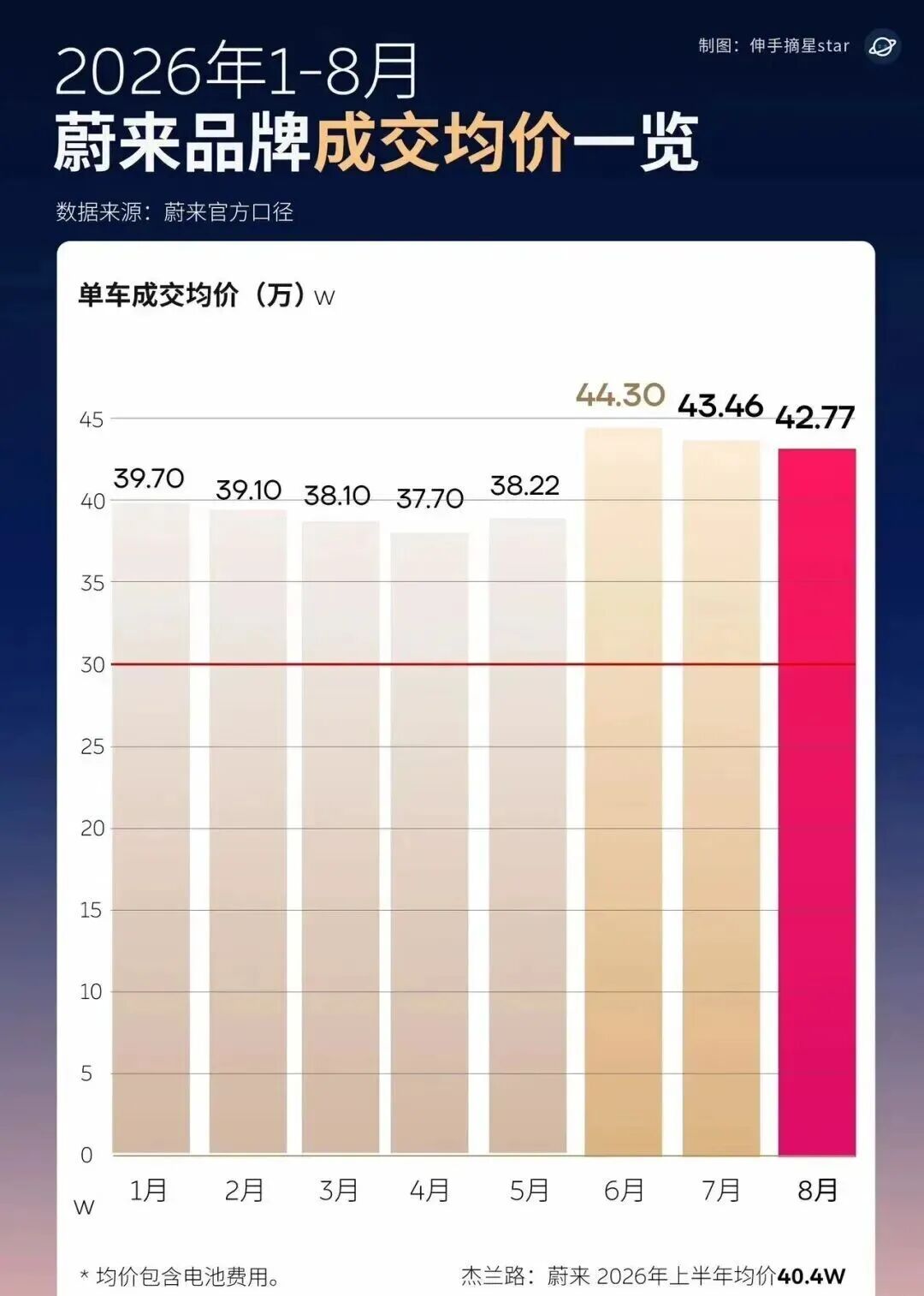
Image source: Jeran Road
However, rational voices persist: “Sales comparisons are meaningless—profitability matters most” and “Compare profits or German market sales.” Sales volume is just the first hurdle; profitability and overseas expansion remain daunting challenges. One netizen quipped: “Does NIO have a flying car like Tesla?” underscoring soaring expectations for domestic premium brands. To clarify: NIO outperformed BBA in quarterly sales but trails HIM annually. Yet by luxury positioning, user reputation, and per-unit pricing, NIO firmly occupies China’s top luxury tier. What Li Bin once dismissed as bragging now challenges deep-seated perceptions—can domestic automakers truly rival BBA head-on? Fans rally: “NIO, aim for 50,000 monthly sales next year!”
The EV-ICE Shift Pressures BBA’s Luxury Dominance
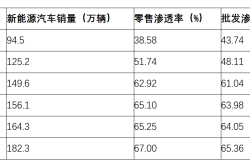
Qin Lihong attributes this to the EV-ICE substitution trend. CPCA data is stark: luxury ICE vehicle retail sales plummeted 41% in September, while pure ICE vehicles dropped 49%. NEV penetration hit 67%, with pure EVs accounting for 47.3% of passenger vehicle sales—both records. BBA’s struggles and NEV market gains are two sides of the same coin.
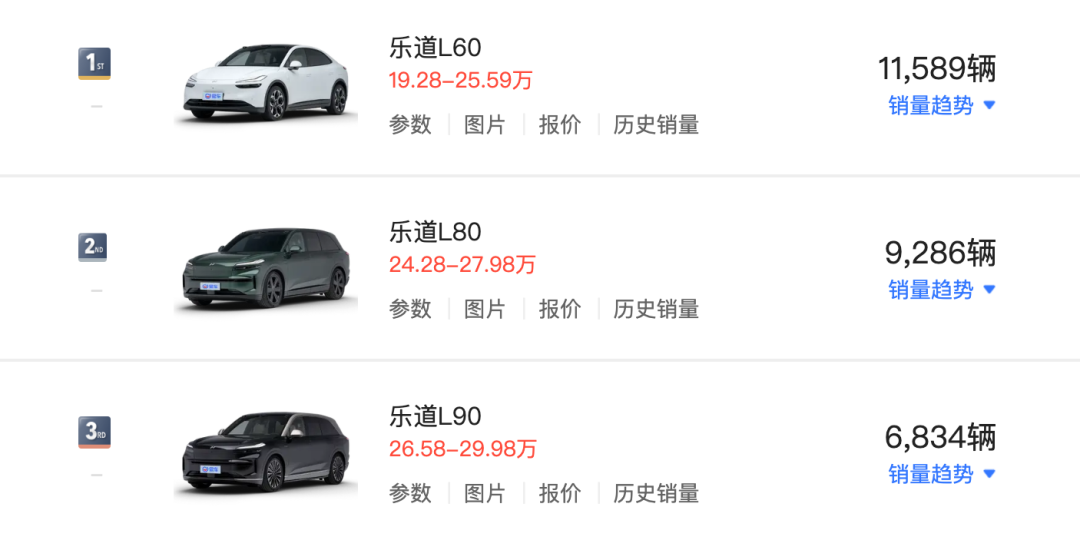
Image source: Autohome
For decades, the BMW 5 Series, Audi A6, and Mercedes-Benz E-Class (56E) defined Chinese luxury: engines, chassis, transmissions, plus brand prestige, mature dealership networks, and century-old heritage made BBA the default choice for premium consumers. Early domestic automakers focused on affordable segments, leaving the high-end race nearly vacant. Changing consumer perceptions seemed insurmountable—until electrification and intelligence disrupted the old playbook. Smart cockpits, autonomous driving, charging infrastructure, services, and user operations became new scoring criteria, rewriting luxury definitions.
BBA wasn’t blind to the tide but pivoted too slowly. They replaced Greater China CEOs early in the year, prioritizing electrification, yet failed to deliver competitive pure EVs. Many models resorted to price cuts, eroding their luxury appeal. Shrinking ICE sales and sluggish EV counterattacks amplified pressure.
Beyond Price Cuts: Systemic Capabilities as the Moat
NIO’s breakthrough stems not from marketing hype or endless discounts but from decade-long systemic capabilities. As one netizen succinctly put it: “This success didn’t happen overnight—it’s the result of years of building battery swap stations and self-developed technologies, finally forming an unstoppable force for Chinese luxury.”
The most visible barrier is the battery swap network: as of October 16, NIO operates 9,640 charging/swapping stations (4,182 swap stations, 31,480 charging piles), with 1,073 highway swap stations connecting over 550 cities, totaling 120 million+ swaps. This addresses the top anxiety for premium EV buyers—a commitment few rivals match. Underlying technologies like SkyOS self-research, NIO Smart Driving chip iterations, 900V high-voltage systems, and steer-by-wire represent years of tackling tough challenges with no immediate returns.
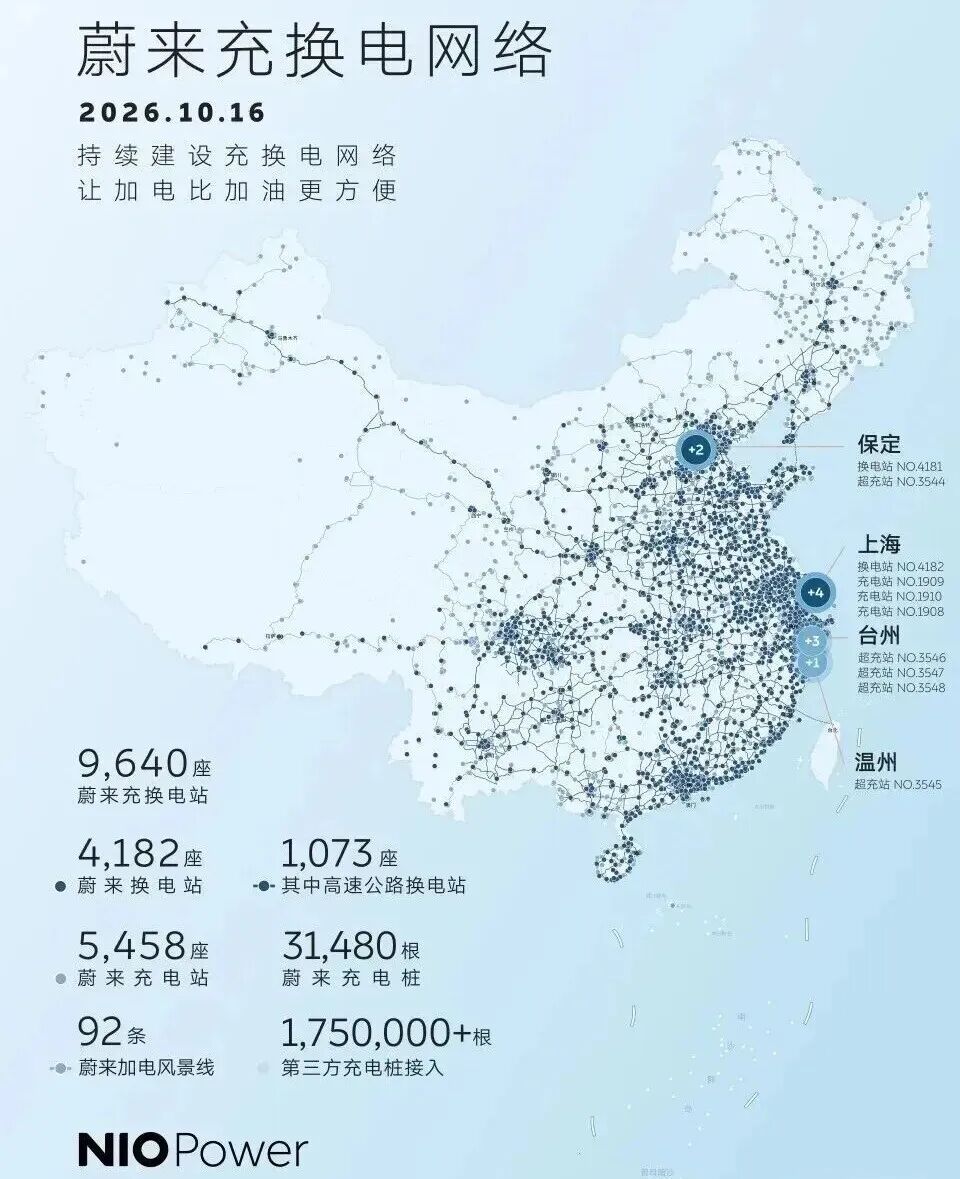
Image source: NIO
While specs can be matched, brand trust built over time is irreplaceable. Jeran Road reports NIO’s Net Promoter Score (NPS) at 81.9—top among 65 brands and the only one exceeding 80. Many ES8 owners previously drove BBA or even Porsches, validating Li Bin’s claim that “BBA’s next car is NIO” through real switchover orders.
Yet clarity remains essential: One quarter’s sales lead doesn’t equate to overwhelming dominance. BBA’s century-old heritage, global scale, complete product lines, and after-sales networks won’t erode quickly. This breakthrough marks a milestone for domestic high-end EVs in the local market, not an endpoint. Traditionally, luxury brands required centuries to establish—NIO, since its arduous 2018 ES8 launch and multiple near-death experiences, proves an alternative path exists.
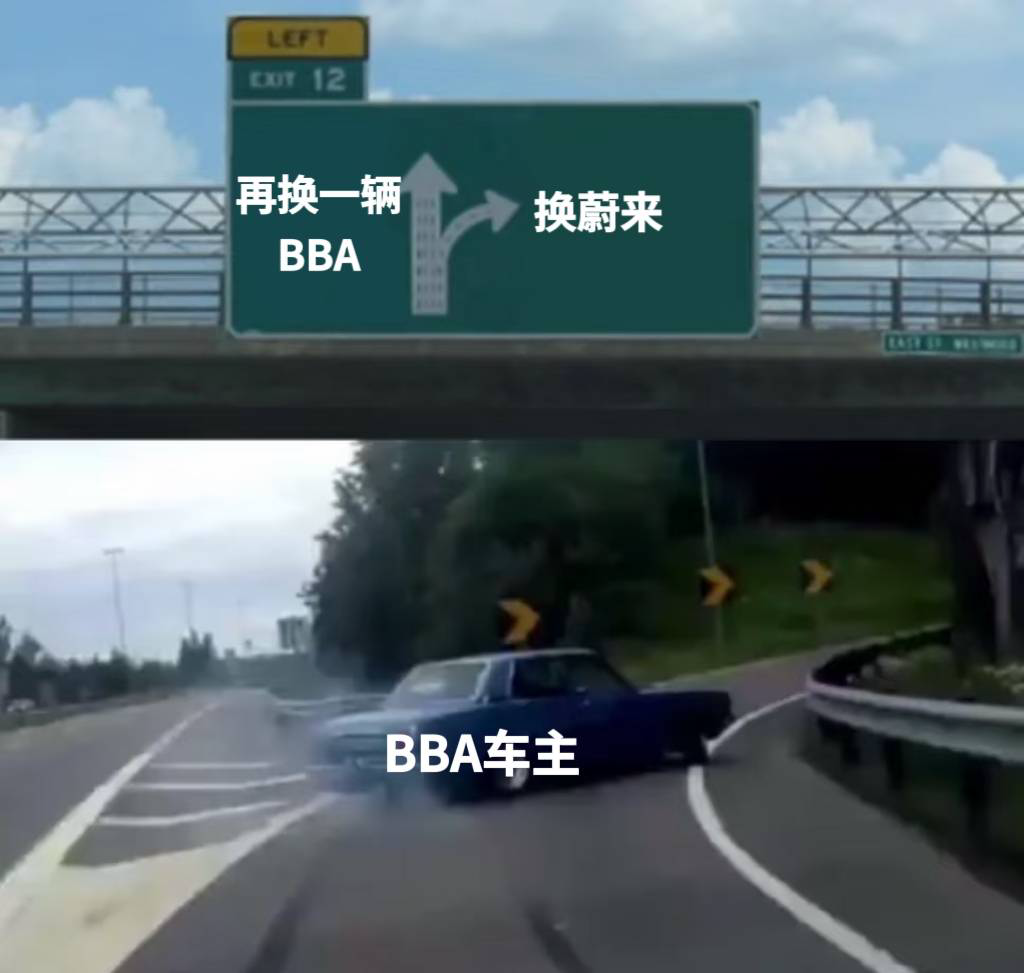
Image source: Xiaohongshu
Building a premium brand brooks no shortcuts: swap stations must be built one by one, code written line by line, technologies iterated generation by generation. In today’s saturated market, competing solely on specs and cost-effectiveness narrows the path—technology answers why to buy now, while brand answers why to commit long-term. While BBA defined luxury in the ICE era, Chinese brands now help shape new electric-age rules. Conquering cities and quarters one by one, Li Bin’s once-mocked vision materializes. The era of Chinese high-end automotive brands has arrived.
Endnote Discussion: When evaluating luxury brands, do you prioritize sales scale or brand premium (pricing power) and services?
Disclaimer: This article represents industrial commentary only and does not constitute investment advice. All corporate data and regulatory events cited are from public sources and for reference only. Official announcements shall prevail. Image sources: Internet (copyright holders may contact for removal).
-
![]()
Reviving Classic Designs: European Automakers' Nostalgic Gambit Amidst Chinese Competition
-
![]()
"Little Blue Light" Steps Out of the "Lockdown Room"!
-
![]()
Struggling in the Domestic Market? The Future Lies in Global Expansion—The 'Second Half' of China's New Energy Vehicle Industry
-
How Solid Is the Turning Point for Commercial Spaceflight?
-
![]()
Labor Pains! Li Auto Slashes 3,970 Jobs, Reports Massive Annual Loss of 4 Billion Yuan
-
![]()
Li Bin’s Bold Claim Becomes Reality: NIO Crowned China’s ‘No.1 Luxury Brand’!
-
![]()
Reimagining New Retail: A World of Boundless Possibilities
-
![]()
Ant Group Sets Sights on AI Financial Agent; Entropy Simple Technology Secures Series C Financing