Labor Pains! Li Auto Slashes 3,970 Jobs, Reports Massive Annual Loss of 4 Billion Yuan
 10/21 2026
 381
The shakeout in the new energy vehicle sector has transcended mere price wars; the axe has now fallen on internal operations, with companies streamlining their organizations and scrutinizing workforce efficiency.
A recent semi-annual report has laid bare Li Auto's current predicament. As of June 30, 2026, Li Auto employed 27,048 people, a net decrease of 3,970 from 31,018 on June 30, 2025, marking a year-on-year decline of approximately 12.8%.
On one hand, thousands of employees have been let go; on the other, the financial figures are even more striking. In the first half of 2026, revenue reached 48.65 billion yuan, a year-on-year decrease of 13.4%. Net profit swung from a surplus of 1.744 billion yuan in the same period last year to a net loss of 3.981 billion yuan, nearing the 4 billion yuan mark. Once a benchmark among new forces for being the first to achieve profitability, thanks to its extended-range technology, Li Auto is now grappling with cyclical labor pains. News of this has sparked divergent opinions online. Some bluntly stated, "I don't see what's good about Li Auto. I don't understand why so many people like it." Conversely, some car owners shared a different perspective: "The overall test drive experience was quite good, especially for family users. Most people didn't initially favor it, but they ended up giving it a try. Now, there are more large SUV extended-range products on the market; previously, Li Auto was basically the only option."
In response to the workforce changes, Li Auto's official stance was measured: "This personnel adjustment is a normal optimization based on our current operating status and industry competition, not the large-scale, disorderly layoffs rumored online." However, this explanation has raised skepticism among many netizens: "Li Auto itself said it wouldn't lay off employees." A closer look at the financial report data reveals that this adjustment was not a one-size-fits-all approach; decisions on where to cut back and where to maintain investment were clearly defined.
Staff Reductions with Precision: Sales and Production Slash, R&D Holds Firm
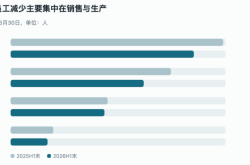
Among the net reduction of 3,970 employees, the sales department saw a net decrease of 1,780, while the production department decreased by 1,654. These two sectors combined saw a reduction of 3,434 people, accounting for 86.5% of the total staff reduction. R&D only saw a slight reduction of 186 people, maintaining a stable foundation.
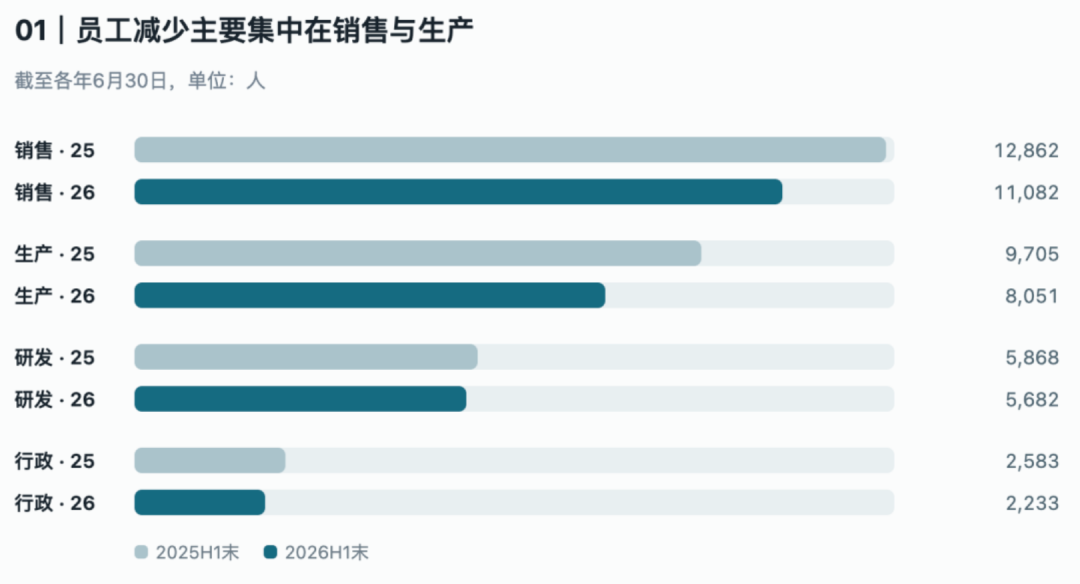 Image Source: Zhinengkeji
In simple terms, low-output sales and production line support roles were prioritized for cuts, while R&D remains a firmly defended foundation for Li Auto.
The sales end was the core of this adjustment. Li Auto adopts a direct sales model, with stores, sales consultants, and delivery teams all counted as employees of the listed company, differing from the statistical approach of automakers relying on dealerships. The number of stores contracted from 548 at the end of 2025 to 495, with low-efficiency stores closed and resources concentrated in core business districts.
Two sets of comparisons are quite telling: In the first half of 2025, 203,900 vehicles were delivered with 12,862 sales personnel; in the first half of 2026, 193,500 vehicles were delivered, a slight decline in sales, with the sales team compressed to 11,082. The slight decline in sales was accompanied by a faster contraction of the sales team, essentially forcing the channel to improve human efficiency. This also corroborates the observations of many netizens: "Li Auto's sales have been declining; sales aren't looking ideal."
The reduction in production personnel closely followed the rhythm of product refreshes. Old models were cleared out with promotions, while the ramp-up period for new models was long, leading to fluctuations in capacity utilization and concurrent streamlining of redundant support roles.
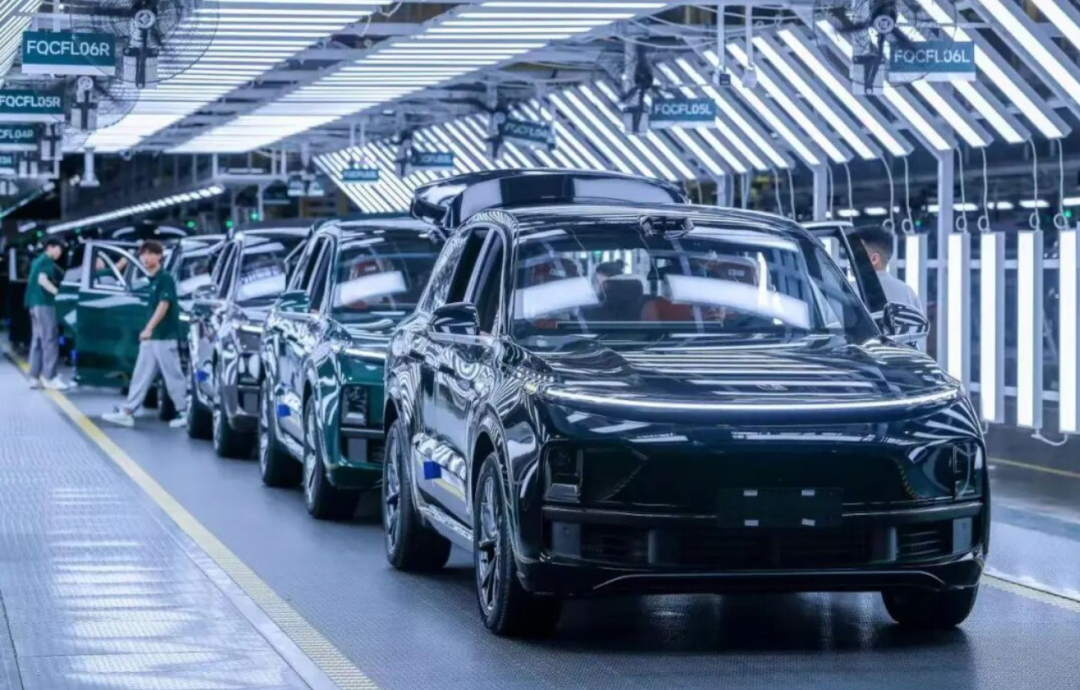 Image Source: Sina Tech
The strategy for the R&D line was completely different. In the first half of the year, Li Auto continued to advance its organizational flattening reforms: Some product definition teams were merged into the R&D system to shorten decision-making chains; the base large model and embodied intelligence teams continued to expand; component clusters were transferred to the manufacturing department, eliminating intermediate redundant links. The streamlining focused on non-core support roles, with no reduction in investment in core areas such as self-developed chips and base large models. R&D expenses in the first half of the year were 5.498 billion yuan, a slight year-on-year increase of 3.3%.
Industry estimation methods (non-official) show that among this round of personnel changes, 30%-40% were due to normal employee turnover, 20%-30% from internal transfers and department mergers, and the remaining 30%-40% were layoffs of low-efficiency redundant roles. Priority was given to internal absorption and natural attrition, with layoffs being the last resort.
Li Auto's ESG report also highlights a unique detail: For four consecutive years, the number of labor dispatch and part-time employees has been zero. All employees listed in the financial reports are full-time personnel, with no off-balance-sheet labor. Reviewing the workforce growth curve, employee numbers peaked at 32,248 in 2024 and contracted for the first time in 2025, with a net decrease of 1,520. The adjustment logic was already established at that time: Stores and blue-collar roles were no longer recruited, while highly educated talents with master's degrees or above continued to be brought in. Low-salary roles gradually exited, while high-salary technical talents were continuously supplemented, completing a transformation of the workforce structure.
The Truth Behind the 4 Billion Loss: Model Refresh Missteps, Gross Profit Halved
The optimization of personnel costs stems from pressure on profits. The once impressive profit curve of Li Auto has declined at an alarming rate: Net profit was 11.809 billion yuan in 2023, fell to 1.139 billion yuan in 2024, and directly turned into a loss of nearly 4 billion yuan in the first half of 2026. Gross profit plummeted by 59.2% to 4.644 billion yuan, with the overall gross margin declining from 20.3% to 9.5% and the vehicle gross margin only 7.8%.
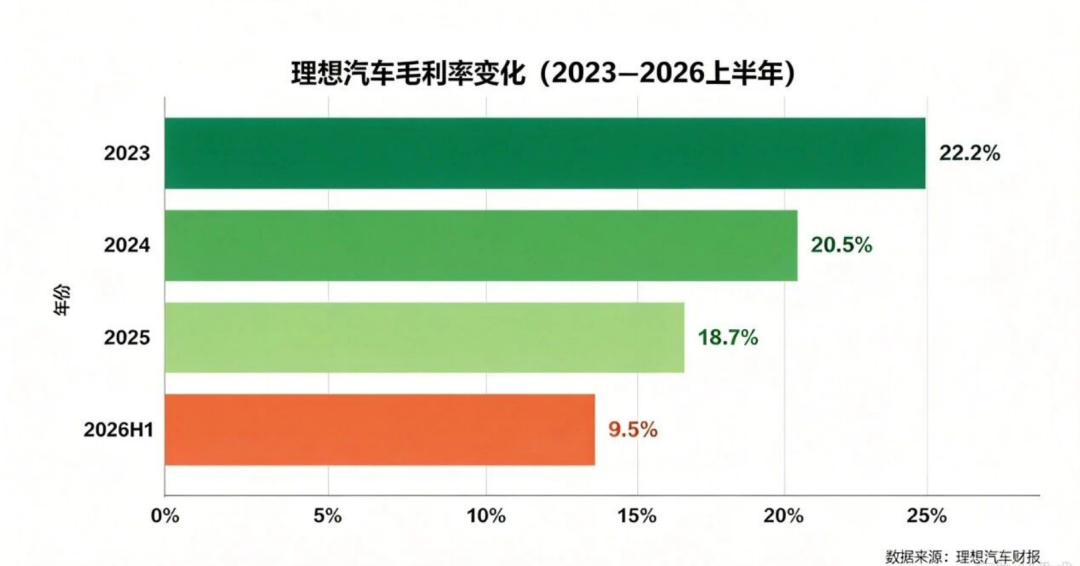
The core cause of the losses was the phased labor pains brought about by concentrated model refreshes. The all-new L9 in May, all-new L8 in June, and new-generation L6 in July were launched in quick succession. Old models were cleared out with price reductions, pulling down the average vehicle price, while the delivery ramp-up for new models was slow, with profits not yet released. Coupled with rising prices for batteries and storage chips, Li Auto's models, with their high degree of intelligence, used larger quantities of chips and storage components, resulting in a more pronounced cost impact compared to peers.
Online evaluations of Li Auto continue to be polarized. Loyal supporters stated, "I personally quite like Li Auto. Every car has its pros and cons. Which entrepreneur hasn't made money by walking on the edge? I think Li Auto is very authentic, and its quality is much better than other brands. All the wealthy people around me drive Li Autos; few drive BYD, Tesla, or other miscellaneous brands." Negative voices were equally direct: "I don't like the boss, so I don't like the car either!!" Neutral and optimistic views suggest, "Li Auto is actually not bad. Among these domestic manufacturers, I think Li Auto and NIO will develop very well in the future."
Li Xiang clearly stated during the earnings call that the cost pressure from rising component prices would not be passed on to consumers. The response plan is twofold: Short-term reliance on refined operations to reduce costs; long-term reliance on full-stack self-research and self-built supply chains to create structural cost reduction capabilities.
Amidst the losses, there are also signals of marginal improvement. The second quarter showed a rebound compared to the first: Revenue rose by 11.7% quarter-on-quarter, the gross margin recovered from 7.9% in the first quarter to 11%, operating cash flow turned positive, and the net loss narrowed by 25.1% quarter-on-quarter. The company holds 87.5 billion yuan in cash reserves and has launched a 1 billion USD share repurchase plan. As of August 26, it had already spent 632 million USD repurchasing shares. However, confidence in the capital market has been slow to recover; after the announcement of the repurchase, Hong Kong stocks have cumulatively fallen by more than 25%, with the market value falling below 100 billion HKD.
Li Auto is pinning its hopes for a turnaround on new products: The new-generation MEGA and i9 are gradually being launched, and the refreshed L series is gradually increasing in volume. Management judges that as the proportion of orders for high-gross-margin versions increases, the gross margin will continue to recover, with the goal of breaking into the top three in domestic passenger vehicle sales above 200,000 yuan. Overseas layout is also advancing simultaneously, with the Middle East and Central Asia markets being the first to be targeted, focusing on L series extended-range models, adhering to a high-end positioning, and gradually building localized sales, delivery, and after-sales systems.
Salary Breakdown: Total Spending Down, but Per Capita Costs Up?
Many are most concerned about whether Li Auto's employee salaries have shrunk after the large-scale optimization.
In the first half of 2026, total employee salary expenditures were 6 billion yuan, compared to 6.7 billion yuan in the same period last year, seemingly a reduction of 700 million yuan. However, there are counterintuitive details hidden here: The 6 billion yuan includes 375 million yuan in share-based payment expenses, compared to 739 million yuan in the same period last year. Equity incentives have been halved, contributing to more than half of the salary reduction. Excluding equity, cash wages, social insurance, and benefits totaled 5.625 billion yuan.
Based on the average number of employees for the period: In the first half of the year, the group's average monthly salary and benefit cost per employee was approximately 34,600 yuan (including equity, enterprise social insurance and housing provident fund contributions, and bonuses and benefits); excluding share-based payments, the average monthly cost was approximately 32,400 yuan. Compared to the same period last year, the average semi-annual labor cost per employee actually increased slightly by 3.3%.
The underlying logic is strongly related to the workforce structure: Most of the outflows were lower-salary store sales and frontline production personnel; those retained and continuously recruited were high-salary R&D and technical personnel, with changes in the workforce structure driving up the average cost.
Based on conservative estimates from social insurance and housing provident fund contribution data, assuming social insurance and housing provident fund contributions account for 35% of the salary base, the average enterprise labor cost per Li Auto employee in 2025 was approximately 245,000 yuan. This represents the total cost borne by the company and does not equal employees' take-home pay. The value of equity incentives has also continued to decline, peaking in 2022 and nearly halving by 2025.
The impact of changes in executive salaries is even stronger: In 2024, the total salaries of all directors and executives were 720 million yuan, falling to 64 million yuan in 2025, a 91% decrease. The reductions were primarily performance-based bonuses and restricted stock units, with fixed salaries and benefits remaining largely unchanged. Li Xiang himself confirmed equity value of 636 million yuan on paper in 2024, but equity amortization dropped to zero in 2025, with total annual compensation amounting to 2.93 million yuan. The rule is clear: If performance targets are not met, floating incentives are cut first, with executives and the boss bearing the pressure first.
Horizontal Comparison of Four New Forces: Completely Different Staffing Approaches
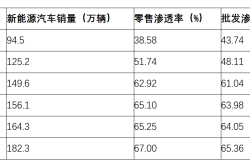
Comparing Li Auto, XPeng, and Leapmotor on the same scale, the four companies have taken completely different staffing strategies. As of June 30, 2026: Leapmotor had 31,388 employees, a significant year-on-year increase of 44.9%; Li Auto had 27,048 employees, contracting its workforce; XPeng had 20,632 employees, a slight increase of 3.8%; NIO has not disclosed its mid-year data but remains the largest in terms of workforce size among the four.
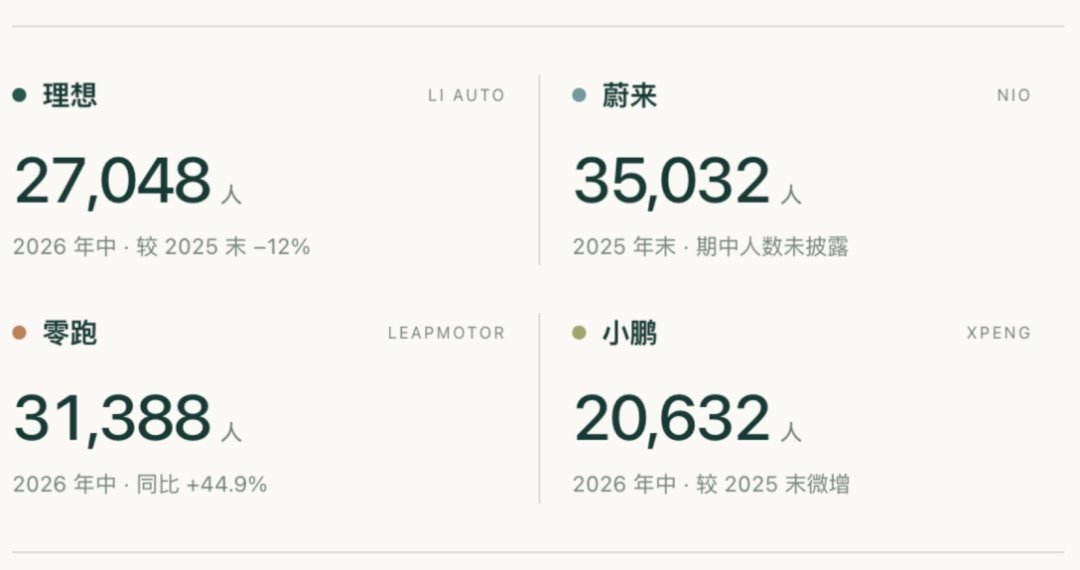 Image Source: Zhinengkeji
Whether to expand or contract is a direct reflection of strategic choices: Leapmotor focuses on cost-effectiveness and volume, continuously recruiting for its manufacturing team; XPeng heavily invests in technology, with R&D personnel accounting for as high as 42.3%; Li Auto voluntarily trims its sales and production lines while firmly defending R&D; NIO has long focused its human resources on user services and sales systems.
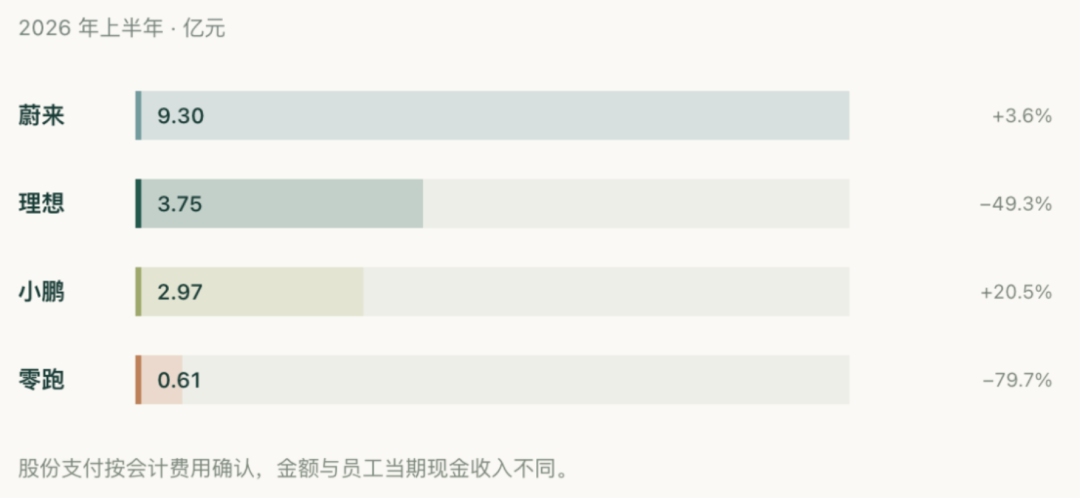 Image Source: Zhinengkeji
The styles of equity incentives also diverge significantly: NIO relies on stocks to retain talent, with share-based payments of 930 million yuan in the first half of the year; Li Auto's equity incentives have contracted sharply; XPeng has increased its equity incentives against the trend; Leapmotor's compensation is primarily in cash, with share-based payments nearly zero. The labor cost gaps are significant, with Li Auto's average semi-annual labor cost per employee nearing 208,000 yuan, while Leapmotor's is approximately 125,000 yuan, nearly double the difference.
There are no definitive advantages or disadvantages; it simply boils down to making different strategic choices. The direct sales model inherently entails substantial labor costs for sales, while a strategy focused on low prices and high sales volumes inevitably demands a larger manufacturing workforce. To maintain a competitive edge in technology over the long haul, it is crucial to stabilize the R&D team.
In Conclusion
Li Auto's current organizational restructuring is not an isolated incident. The entire new energy vehicle industry has long since moved beyond the phase of frenzied talent recruitment and rapid workforce growth that characterized previous years. Now, the industry's performance evaluation criteria have uniformly shifted towards prioritizing human efficiency.
-
![]()
Caught Between Policies and Competition: Is Ascend the Future for Chinese Models?
-
![]()
Reviving Classic Designs: European Automakers' Nostalgic Gambit Amidst Chinese Competition
-
![]()
"Little Blue Light" Steps Out of the "Lockdown Room"!
-
![]()
Struggling in the Domestic Market? The Future Lies in Global Expansion—The 'Second Half' of China's New Energy Vehicle Industry
-
How Solid Is the Turning Point for Commercial Spaceflight?
-
![]()
Labor Pains! Li Auto Slashes 3,970 Jobs, Reports Massive Annual Loss of 4 Billion Yuan
-
![]()
Li Bin’s Bold Claim Becomes Reality: NIO Crowned China’s ‘No.1 Luxury Brand’!
-
![]()
Reimagining New Retail: A World of Boundless Possibilities