Struggling in the Domestic Market? The Future Lies in Global Expansion—The 'Second Half' of China's New Energy Vehicle Industry
 10/21 2026
 499
By 2026, China's new energy vehicle (NEV) industry will have reached a pivotal historical turning point. On one hand, it will have celebrated a 'moment of glory,' with NEV penetration surpassing 50% and monthly sales accounting for over 60% of total vehicle sales for three consecutive months. On the other hand, the industry will have faced a harsh reality: profit margins will have fallen below 5%, over 170 models will have slashed prices, and some automakers will have been 'losing money on every vehicle sold.' As the domestic market transitions from a 'blue ocean of growth' to a 'red ocean of stagnation,' more automakers are turning their gaze overseas—where NEV penetration remains below 20%, offering vast untapped potential.
01 Penetration Exceeds 50%, but 'High Volume, Low Profit': The 'Glory' and 'Concerns' of NEVs
Let's delve into the latest data. According to the China Association of Automobile Manufacturers (CAAM), in September 2026, China's NEV production and sales will have reached 1.814 million and 1.823 million units, respectively, up 12.2% and 13.6% year-on-year. Monthly NEV sales will have accounted for over 60% of total vehicle sales for three consecutive months, hitting a record 61.6% in September. In the first three quarters, NEV production and sales will have stood at 12.483 million and 12.472 million units, up 11% and 11.1% year-on-year, with cumulative sales accounting for 53.6% of total vehicle sales (Source: CAAM, October 12, 2026).
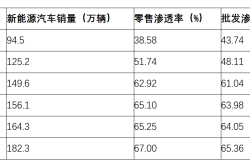
Monthly data from the Wind database reveals a steady rise in NEV penetration in 2026, with retail penetration soaring from 38.58% in January to 67.0% in September, a historic high (Source: Wind Financial Terminal, China Passenger Car Association (CPCA)).
Table: Domestic NEV Sales and Penetration Rate
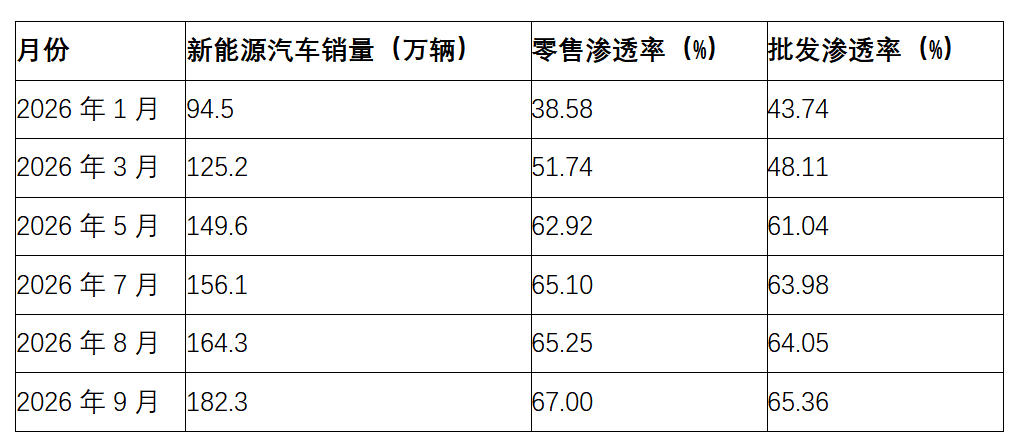
Source: Wind Financial Terminal, CPCA
In terms of automaker sales and market structure, the domestic NEV competitive landscape has become highly consolidated, characterized by 'one dominant player, multiple strong contenders, and the strong getting stronger.'
BYD leads with an absolute scale advantage, having sold 1.4483 million retail units from January to August 2026, capturing a 21.7% market share and ranking first (Source: CAAM, CCID Consulting). Geely Auto has risen rapidly with brands like Galaxy and Zeekr, selling 794,400 retail units (11.9% share) to rank second. Changan Auto has climbed to third with 439,400 units (6.6% share). Notably, Leapmotor has broken through with extreme cost-effectiveness, ranking fourth in retail sales from January to August, up 43.9% year-on-year. Tesla China has fallen to sixth with about a 5% share. NIO (+57.8%) and Leapmotor (+43.9%) have been the fastest-growing major players, while Li Auto, Changan, Tesla, Geely, and BYD have seen year-on-year declines in retail sales, reflecting both 'the strong getting stronger' and 'shifts in market share.'
Industry concentration continues to rise. The global CR5 for NEVs exceeds 50%, while China's CR8 exceeds 80%, with over a dozen small and medium-sized brands exiting the market. Experts believe only leading firms with scale, technology, and channel advantages can expand their shares in standardized competition, while SMEs face significant survival pressure without differentiation.
Beneath the surface of robust sales, automaker profitability has diverged sharply. In 2025, Seres led with a 26.9% gross margin, followed by XPeng (18.9%), Leapmotor (14.5%), and NIO (13.6%), while Li Auto and BYD saw margins decline. Leapmotor and VOYAH turned profitable for the first time in 2025, becoming industry bright spots. According to the '2025 Auto Industry Profit Analysis' by Cui Dongshu, CPCA Secretary-General (January 27, 2026), the auto industry generated RMB 11.1796 trillion in revenue (+7.1% YoY) and RMB 461 billion in profit (+0.6% YoY) in 2025, with a profit margin of just ~4.1%, below the 5.9% average for downstream industrial enterprises. From January to November 2025, 173 models cut prices, trapping some firms in a 'lose money on every sale' cycle.
By 2026, profit divergence persisted. BYD topped profits with RMB 12.334 billion, its gross margin rising slightly to 18.85%, with core business profit exceeding the previous year after excluding exchange losses. Geely's core net profit hit RMB 9.68 billion, up 46% YoY. However, 2025's 'profit star' Seres swung to a RMB 2.192 billion loss in H1 2026, with margins falling to 23.30% from 26.9%. Li Auto also turned unprofitable, losing RMB 3.994 billion, with margins nearly halving to 9.55%. Among new forces, Leapmotor remained the sole consistently profitable player with RMB 208 million in net profit for three consecutive half-years. NIO narrowed losses to RMB 860 million (-92.7%), achieving adjusted net profitability, while XPeng still lost RMB 3.121 billion. Overall, the auto industry's profit margin fell to 3.8% in H1 2026, a decade low, with average net margins in vehicle manufacturing at just 1.5%, indicating price wars no longer drive total growth, and the 'high volume, low profit' dilemma is spreading industry-wide.
Recognizing how 'involution' erodes industrial health, regulators have taken frequent actions since 2025. In February 2026, the State Administration for Market Regulation (SAMR) issued the 'Compliance Guidelines for Pricing Behavior in the Auto Industry.' On March 17, the Ministry of Industry and Information Technology (MIIT), National Development and Reform Commission (NDRC), and SAMR jointly held a symposium with NEV firms, vowing to 'resolutely resist disorderly price wars.' On March 30, SAMR announced NEVs as a key industry for comprehensive crackdowns on 'involutionary competition.' Policy focus shifted from 'supporting scale expansion' to 'regulating high-quality development.'
02 Moving Beyond 'Price-for-Volume': Upgrading Value, Optimizing Costs
To understand the NEV industry's path forward, one must grasp its business model essence. For nearly a decade, Chinese NEVs followed a 'scale-for-market' path—using subsidies and price wars to rapidly expand sales and market share. However, this model's fatal flaw is that scale does not equal profit, and sales do not equal value.
Data shows NEVs are capital-intensive, requiring heavy R&D investment and scale effects. The consensus is that firms need annual sales exceeding 100,000 units to break even and over 1 million units to gain bargaining power in the supply chain. In 2025, BYD led with 4.602 million sales but saw net profit fall 18.82% YoY to RMB 33.761 billion. Among 'NIO, XPeng, Li Auto,' Li Auto's net profit plummeted 85.84% YoY, while NIO and XPeng remained unprofitable despite revenue growth.
This suggests relying solely on domestic 'price-for-volume' tactics has reached its limits. True business model upgrades depend not on 'how expensive you sell' but on building a sustainable profit system—a dual path of distinct yet viable strategies.
One path is 'upward' value upgrading. Premiumization doesn't mean simple price hikes but building genuine value barriers through technology, branding, and services. BYD achieved technological democratization with its 'Divine Eye' intelligent driving and fifth-generation DM hybrid, targeting the RMB 1 million+ market with brands like Yangwang and Fangchengbao. Huawei's HarmonyOS Intelligent Driving entered the RMB 300,000–1 million luxury market with 'ecosystem + intelligent driving.' Li Auto differentiated through 'family scenarios + range extenders,' while NIO leveraged 'battery swapping + service systems.' Their commonality is using irreplaceable technology or ecosystems to support premiums, not just high pricing.
The other path is 'downward' extreme cost-effectiveness. Leapmotor provides a textbook example—topping new force sales with 597,000 units in 2025 and RMB 540 million in net profit, becoming the second annual profitable new force after Li Auto. Its secret lies in 'full-domain self-research + cost-based pricing': over 65% self-researched core components, 88% parts commonality, and >40% cumulative cost reductions in 18 months, making 'high quality no longer synonymous with high prices.' Leapmotor CEO Zhu Jiangming positions it as the 'Uniqlo of cars,' achieving sustainable 'low-margin, high-volume' profits in the RMB 100,000–200,000 mainstream market.
Thus, whether 'upgrading value' or 'optimizing costs,' the essence is escaping reliance on single-dimensional price wars and building unique moats.
Additionally, most domestic automakers are pursuing a broader path: going global. Overseas markets lack prolonged domestic price wars, with higher per-unit profits, offering a second growth curve for automakers to escape involution and achieve 'volume and profit growth.'
03 The World's Most Complete Industrial Chain: The Foundation for Going Global
China's NEVs dominate global competition thanks to the world's most complete and resilient industrial chain, spanning three tiers:
Upstream: Key mineral resources (lithium, cobalt, nickel) and four core materials (cathode, anode, electrolyte, separator). Leaders include Tianqi Lithium, Ganfeng Lithium, Hunan Yutong (LFP cathode), Enjie (separator), Tianci Materials (electrolyte), and BTR (anode). In 2025, China accounted for >65% of global lithium battery shipments, with CATL leading at ~37% global market share, forming a 'one superpower, multiple strong players' landscape.
Midstream: Core links like power batteries, electric drives, electronic controls, and vehicle manufacturing. In power batteries, CATL and BYD form a duopoly, with CALB, Gotion High-Tech, and EVE Energy in the second tier. In electric drives/controls, BYD and Tesla's self-supply camps coexist with third-party players like Inovance and United Electronics, with CR5 at 59.8%.
Downstream: Vehicle manufacturing and aftermarket services. In 2025, domestic NEV sales hit 16.49 million units, with vehicle manufacturing a ~RMB 3.5–4 trillion 'lead sector.' The aftermarket (insurance, maintenance, charging, recycling) reached ~RMB 2.3 trillion, becoming a new growth pole.
This 'lithium mine-materials-batteries-vehicles-aftermarket' chain underpins China's NEV globalization—Chinese automakers enjoy 20–30% lower manufacturing costs than Europe, an irreplicable 'chain advantage.'
04 Going Global: From 'Product Exports' to 'Ecosystem-Driven Globalization'
If domestically it's a 'zero-sum game,' overseas markets represent 'blue oceans of growth.'
From the demand side, global NEV penetration remains low. In 2025, it stood at ~16% outside China, including ~24% in Europe, ~9% in Southeast Asia, and just 3–4% in Latin America. The International Energy Agency predicts 23 million global NEV sales in 2026, nearly 30% of total new vehicle sales. Europe faces carbon emission constraints, Southeast Asia enters a high-growth phase (10%→30% penetration), and Latin America opens space with differentiated hybrids—offering vast overseas potential.
From the supply side, Chinese automakers hold five core advantages: rapid product iteration, complete tech routes (BEV/PHEV/REEV), high supply chain vertical integration, leading smart cockpits/EE architectures, and strong cost control. Chinese automakers enjoy 20–30% lower manufacturing costs than Europe, with overseas NEVs priced ~RMB 30,000 higher than equivalent ICE vehicles, leaving ample profit margins.
Data shows globalization is surging. In H1 2026, China exported 4.006 million NEVs, up 130% YoY, with September exports hitting 571,000 units (+160% YoY), accounting for over 50% of total vehicle exports for four consecutive months (Source: CAAM, October 12, 2026).
Table: NEV Export Data
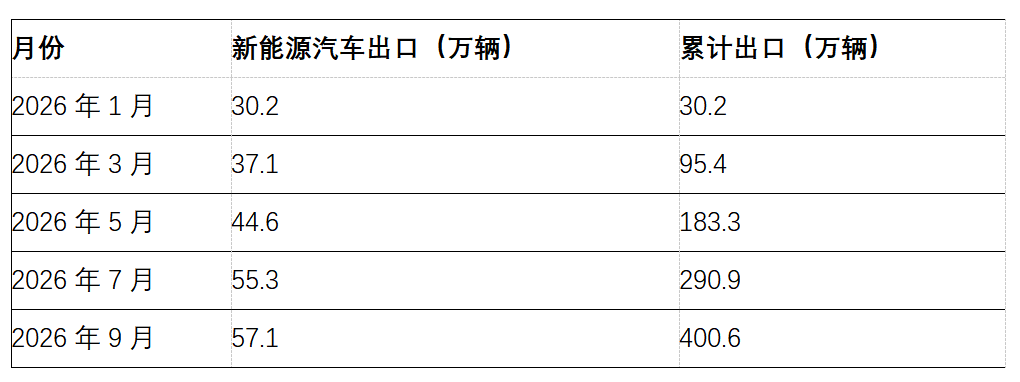
Source: Wind Financial Terminal, CAAM
More importantly, the globalization model is upgrading—from 'product exports' to 'ecosystem-driven globalization.' BYD's Thai and Brazilian plants are operational, with Hungarian and Indonesian bases underway, planning nearly 1 million units of overseas capacity. Geely's overseas sales hit 470,000 units in H1 2026 (+158% YoY), forming a JV with Ford in Spain. Leapmotor partnered with Stellantis to establish Leapmotor International, rapidly entering Europe via an asset-light model. Vehicle exports are driving full-chain spillover in batteries, electric drives, parts, logistics, and finance.
05 Who Will Win? Prospects and Beneficiaries in the 'Second Half'
Looking ahead, China's '15th Five-Year Plan' targets 70% NEV penetration in passenger vehicles and 40% in commercial vehicles by 2030, with large-scale commercialization of L3/L4 autonomous driving. Breakthroughs will accelerate in all-solid-state batteries, intelligent driving, and automotive-grade chips, shifting the industry from 'Electrification 1.0' to 'Intelligentization 2.0' and 'Decarbonization 3.0.'
In this process, the following firms are poised to benefit significantly:
Vehicle makers: Leading automakers with mature product matrices, overseas capacity, and channel foundations will lead. BYD aims for 1.6 million overseas sales in 2026, targeting 50% overseas sales long-term, with BEV+PHEV dual routes, vertical integration, and global capacity. Geely Auto, leveraging its global brand portfolio and local partnerships, raised NEV overseas sales to 51%. Leapmotor, bound tightly with Stellantis via an asset-light model, ranked first in Italy's BEV market for six consecutive months in H1 2026. Traditional export leaders like Chery, Great Wall, and SAIC are also accelerating NEV transitions.
Supply chain: Battery, electric drive, and parts firms expanding overseas alongside automakers will share the spoils. CATL is deploying RMB 100+ billion in capacity in Europe and Southeast Asia, with overseas revenue at 35%. Electricization suppliers like Inovance and Sanhua Intelligent Controls are going global, while intelligentization suppliers like Neusoft Group follow OEMs overseas, covering major international automakers.
Aftermarket: Battery recycling and intelligent driving services offer vast potential. With the battery retirement wave, the domestic battery recycling market is expected to exceed RMB 100 billion by 2030, with firms like Ganfeng Lithium accelerating 'urban mining' layouts.
Undoubtedly, the path to globalization is fraught with challenges. The EU's anti-subsidy taxes, the US's steep tariffs, along with localization policies in Brazil and Thailand, all pose significant hurdles to pure export strategies. As industry experts have observed, "Companies that rely solely on exports will continue to encounter persistent constraints from tariffs and trade frictions. Those equipped with overseas production capabilities and brand advantages will ultimately prevail." The transition from "product exports" to "ecosystem-driven globalization," and from "selling products" to "exporting technology, standards, and brands," represents the definitive trajectory for Chinese New Energy Vehicles (NEVs) to navigate through economic cycles and achieve global success.
The "involution" within the domestic market is not the final destination; rather, it serves as a catalyst propelling industrial upgrading. Once the dust settles from the price war, what truly counts are technological prowess, brand strength, and globalization capabilities. China's NEVs have already demonstrated their mettle domestically, and the next chapter of their story will unfold in the vast overseas market. Going global is not merely an option; it is an imperative that must be addressed.
- END -
-
Is the Turning Point Here for AI Companies' Financing? Even Big Players Now Face 10% Interest Rates
-
![]()
Will the 2026 Auto Market See New Champions Emerge?
-
![]()
Caught Between Policies and Competition: Is Ascend the Future for Chinese Models?
-
![]()
Reviving Classic Designs: European Automakers' Nostalgic Gambit Amidst Chinese Competition
-
![]()
"Little Blue Light" Steps Out of the "Lockdown Room"!
-
![]()
Struggling in the Domestic Market? The Future Lies in Global Expansion—The 'Second Half' of China's New Energy Vehicle Industry
-
How Solid Is the Turning Point for Commercial Spaceflight?
-
![]()
Labor Pains! Li Auto Slashes 3,970 Jobs, Reports Massive Annual Loss of 4 Billion Yuan