Caught Between Policies and Competition: Is Ascend the Future for Chinese Models?
 10/21 2026
 444
Last Friday, DeepSeek 4.1 was updated. Although it was a minor version update, the actual performance improvement was significant. Combined with the same-day news of DS's plan to use Ascend for next-gen pre-training and the impact of the U.S. Department of Homeland Security's ban, DS's recent events have had a considerable impact on the industry and its supply chain.
Key Conclusions:
1. How does the model itself perform?
V4.1-Flash-1017 is not a story of 'domestic Transcend (surpassing) Opus' but rather a reinforcement of cost leadership + specialized programming Agent capabilities. Its most direct impact is on domestic Flash models in the same tier, as well as overseas lightweight models (Haiku 5.5, GPT-6 Luna).
2. Domestic computing power substitution?
Citing sources, The Information reported that DS plans to use Ascend for pre-training cutting-edge models by the end of the year. The challenge lies not in single-card performance but in communication and stability at the scale of ten thousand cards.
DeepSeek itself calls this 'the biggest gamble.' If successful, China's cutting-edge training could truly decouple from NVIDIA. However, realization is expected only after 2027, with full delivery and overall results not visible until 2028.
3. Impact of Sino-U.S. policy clash?
The primary impact is on the intermediary channel of 'third-party cloud hosting + licensing revenue sharing.' DeepSeek relies on its proprietary API and MIT open-source model, requiring it to maintain cutting-edge leadership to preserve its scarcity valuation premium. Ascend's ability to support DeepSeek's next-gen model pre-training development is crucial.
Peers who previously bet on AWS distribution and large models with over 2 trillion parameters face greater valuation pressure due to policies.
Detailed Analysis Below
I. DeepSeek Initiates a New Round of Sino-U.S. Confrontation in 'Cost-Effectiveness' Base Models
1. V4.1 Flash-1017: Minor Version Update, Major Performance Boost
(1) V4.1-Flash Underlying Architecture:
It is a 552 billion-parameter Mixture of Experts (MoE) model, but only a small portion of 'experts' are 'awakened' at a time: about 8 billion parameters are activated when reading input, and about 16 billion when writing output.
Additionally, by compressing 'memory' (KV Cache) to about 890 bytes per token, reading an entire code repository won't overwhelm the GPU memory. Thus, it is inherently suitable for programming Agent scenarios that 'read more and write less.'
V4.1-Flash debuted on September 10 and was updated to version 1017 on October 17. Although just a minor update to the same model generation, the actual capability improvements are substantial, while the key cache pricing remains unchanged—a true 'more for the same price.'
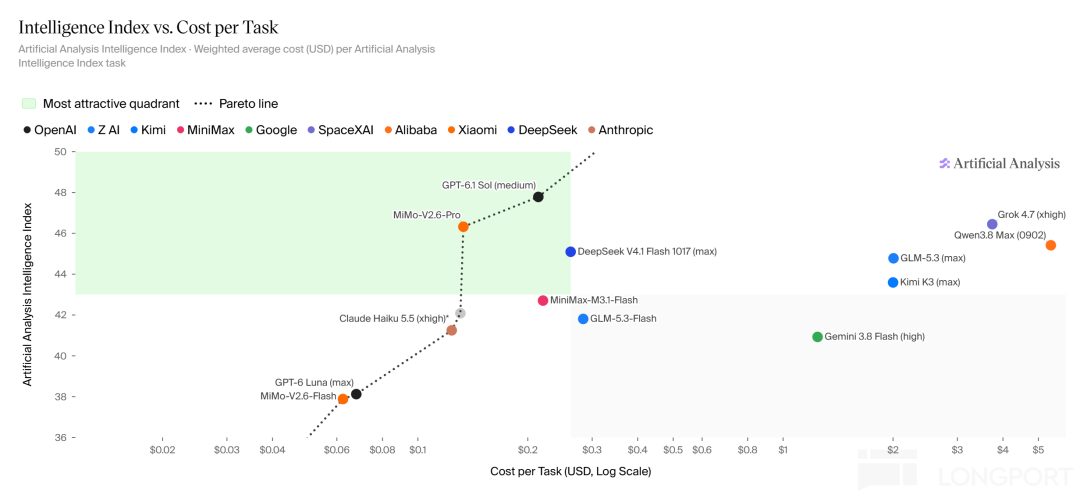
From benchmark scores and real-world testing, V4.1 Flash-1017 has returned to the Pareto optimal range (green area in the chart below). Taking the Max version as an example, in the single-task cost range of $0.2-$0.3, DS is highly competitive.
Compared to similarly positioned peer models, the Max version's overall cost-effectiveness slightly surpasses that of Claude Haiku 5.5's Max version.
(2) Path to Comprehensive Performance Improvement
In terms of specific capabilities, the 1017 version retains the underlying architecture (Causal encoder-decoder with MoE) from the September 10 debut, relying on targeted capability optimizations to enhance performance.
This architecture inherently reduces computational load during the Attention phase and compresses KV cache resource consumption. Combined with inference-side engineering optimizations, it improves cache hit rates (nearly 100%), allowing a large volume of traffic to utilize low-cost cache channels.
The ultimate realization path can be summarized as follows:
1) Reduce the model's free rein, focusing more on user-specified requirements. Simultaneously, reduce parameter, formatting, and other errors to improve the stability of returned structures;
2) Enable the model to remember key information and stay on track in multi-turn dialogues without getting lost in long contexts, compressing KV Cache.
3) Produce shorter outputs with fewer steps: Reduce instances of the model generating irrelevant content, retries, or long analyses. High cache hit rates and low-cost token channels ultimately make Agent task completion cheaper (single-task cost drops from ¥3.3 to ¥1.3).
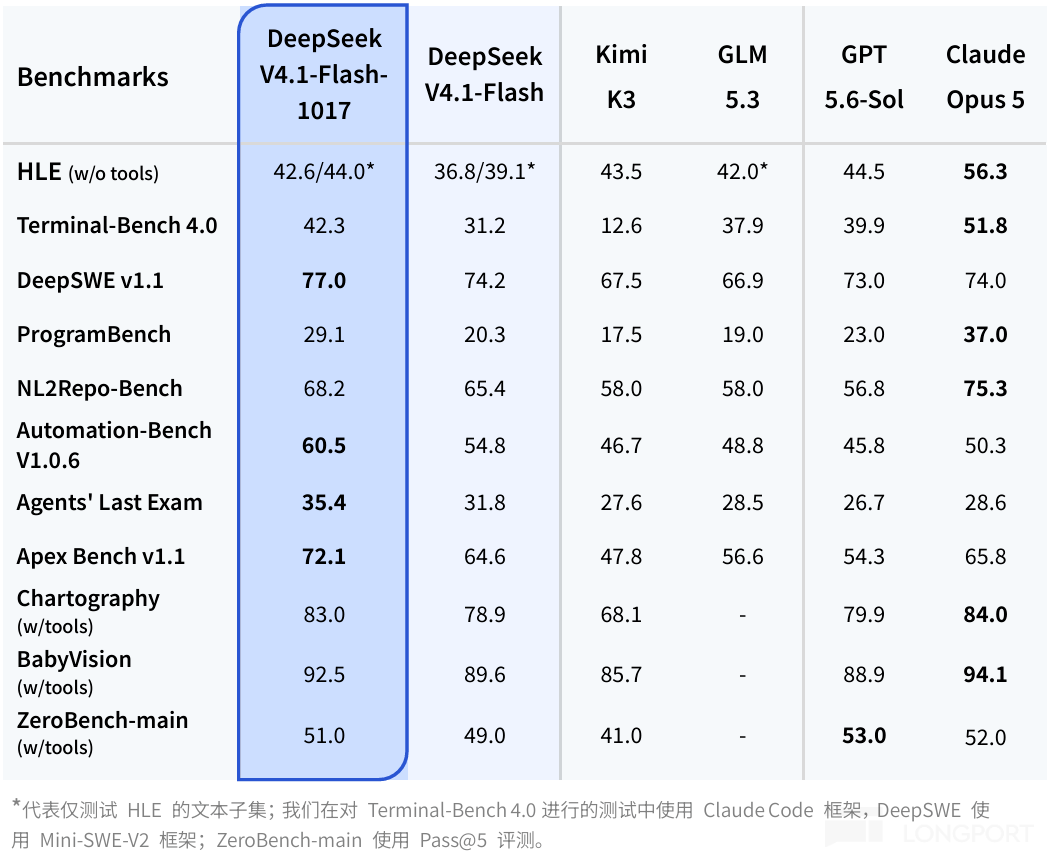
4) Focus on optimizing software engineering/terminal/automation tasks, enabling targeted improvements in DeepSeek's Coding Agent capabilities (DeepSWE improves from 74.2% → 77.0%).
5) Adapt to specific ecosystem platforms: As previously mentioned by Dolphin Brain, not all large models are fully compatible with specific Harnesses. The best scenario is when the large model and Harness belong to the same company, allowing the post-training process to leverage full trajectory data for consistent optimization.
This V4.1 update specifically optimizes compatibility with Harness platforms such as DeepSeek Harness, CodeBuddy, WorkBuddy, and Claude Code.
(3) Optimal Application Scenarios—Coding (lightweight development), Agent automation (high-frequency repetitive tasks), and multimodal vision (3D model design)
In terms of practicality, the 1017 version shows significant improvements in visual programming (2D modeling, web page generation), 3D design capabilities, and 3D task processing for game development due to breakthroughs in Coding and image understanding capabilities.
However, in general reasoning, HLE (Human Last Exam) scores do not show significant improvement. This indicates that the improvements are targeted: resources are concentrated on programming, Agent, and visual tool tasks, with no leap in general and foundational reasoning.
The official tagline is 'wishful programming'—requiring fewer prompts to build complete project engineering, relying on longer thought chains to handle complex Coding tasks (but with fast decoding speeds, so task duration remains short).
Overall, V4.1-Flash-1017 is better suited for lightweight, entry-level Coding scenarios, with some capabilities comparable to GPT-6 Extra and Luna. However, it is not suitable for high-quality official document writing, in-depth literary creation, or tasks requiring high factual accuracy with low hallucination rates—for these, flagship models perform better.
(4) New Commercial Touchpoints—Search API Now Charges
Open self-developed Search/Fetch interfaces at ¥5 per thousand successful requests. Services called through server-side tools via DeepSeek Harness, Claude Code, and Codex remain temporarily free, with per-request charging starting November 1.
2. Sino-U.S. Pursuit of Cost-Effective Base Models
In September-October, overseas markets intensively released high-cost-effectiveness products, with some lightweight models even outpricing most Chinese large models. This validates Dolphin Brain's earnings report analysis that, with sufficient computing power reserves, overseas top-tier model companies are now distilling low-cost models to compete with Chinese cost-effective models, thereby reducing the survival space for Chinese models.
On October 8, when reviewing Haiku 5.5, Dolphin Brain noted that North American models had, for the first time, surpassed most similarly performing Chinese models in cost-effectiveness at the lightweight tier.
This DS V4.1 Flash update does not further reduce listed prices but compresses actual Agent scenario task costs more through optimized cache hit rates—in Agent scenarios, the same context is repeatedly called, with most tokens utilizing cache channels.
DeepSeek's off-peak cache hit price is ¥0.02 per million tokens, while overseas vendors mostly do not disclose actual hit rates. Thus, even with similar listed prices, real bills can differ by an order of magnitude.
From K3's breakthrough catch-up in mid-year, the pace of meaningful iterations by Chinese large models seemed to slow over the next 2-3 months. Some industry insiders attribute this to the implementation of anti-distillation measures like hidden thought chains, which slowed down the catch-up speed of Chinese large models, extending the 3-month generational gap created by K3 back to 6-12 months.
However, this generational gap refers only to the pre-training phase. According to Zhipu AI, Chinese large models now increasingly rely on post-training for performance improvements. This phase demands higher data quality (with contextual environment and real feedback) rather than sheer data volume. With the rising adoption of productivity scenarios like AI Coding, high-quality user trajectory data available for post-training is also increasing.
Nevertheless, as overseas cutting-edge models scale pre-training parameters to the 5-10 trillion range, Chinese large models still have room for improvement in the pre-training phase. Most currently released Chinese large models have total parameters below 1 trillion, with more models under development targeting 3 trillion or more parameters.
In the Sino-U.S. large model competition, we view the DS 1017 version as the starting point for a new round of Chinese counterattacks in the 'cost-effectiveness' race (not the most cutting-edge model). According to industry research, several Chinese large models are set for major version updates in October-November. Besides yesterday's Minimax M3.1 release, GLM 5.5, Kimi K3.1, Qwen 4.0, and HY-4 Pro will be rolled out over the next 1-2 months.
II. Is Domestic Computing Power Substitution Imminent? Communication Stability at Ten Thousand-Card Scale Remains Key
Yesterday, The Information reported that DeepSeek is collaborating with Huawei to design future AI chips, planning to use Ascend 950DT for pre-training as early as the end of 2026. For DeepSeek, this is 'a major gamble.'
This also confirms previous rumors of capacity building: In September, Bloomberg reported DeepSeek's plan to build a gigawatt-scale data center in Ulanqab, procuring at least 160,000 950DT chips (approximately $2.56 billion). However, the initial claim was that 950DT would mainly be used for inference, with training still relying on NVIDIA, and delivery taking at least 18 months.
The discrepancy in statements suggests that while using Ascend for year-end pre-training is the planned direction, actual implementation, large-scale deployment, and effectiveness evaluation will only be determined next year.
1. What Level Is the 950DT?
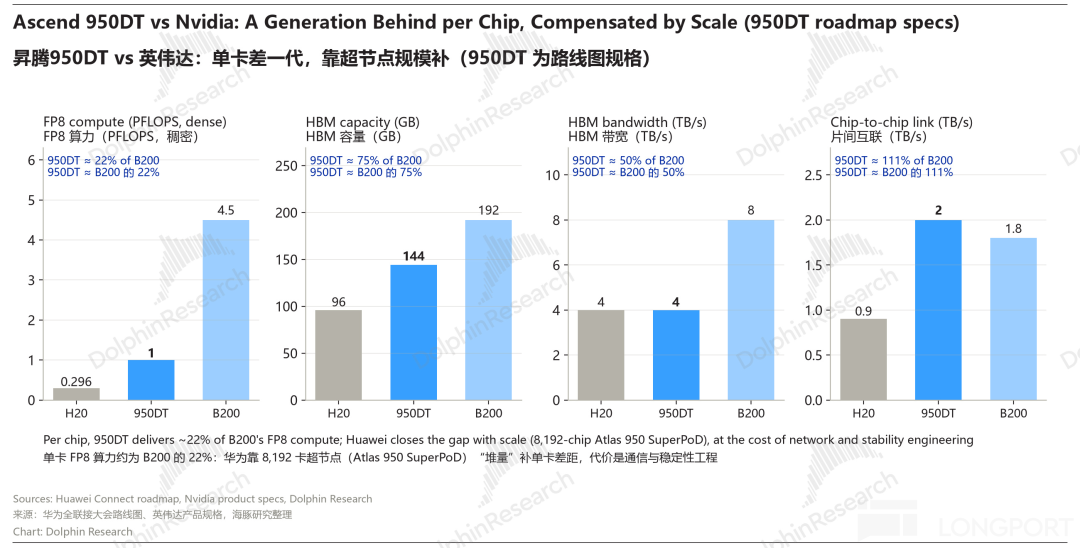
According to Huawei's roadmap specifications: FP8 computing power of 1 PFLOPS, FP4 of 2 PFLOPS, 144GB self-developed HBM (HiZQ 2.0), 4TB/s memory bandwidth, and 2TB/s inter-chip interconnect, placing it between H20 and B200.
Single-card: FP8 computing power is only about 22% of B200's, with half the memory bandwidth. Interconnect: The 2TB/s inter-chip interconnect bandwidth slightly exceeds B200's 1.8TB/s. Thus, Huawei's approach is to trade interconnect for scale—the Atlas 950 super node officially confirms 1024 cards (1 EFLOPS FP8, 256TB globally unified memory addressing including CPU system memory, 3-microsecond latency), with a roadmap target of 8192 cards fully interconnected.
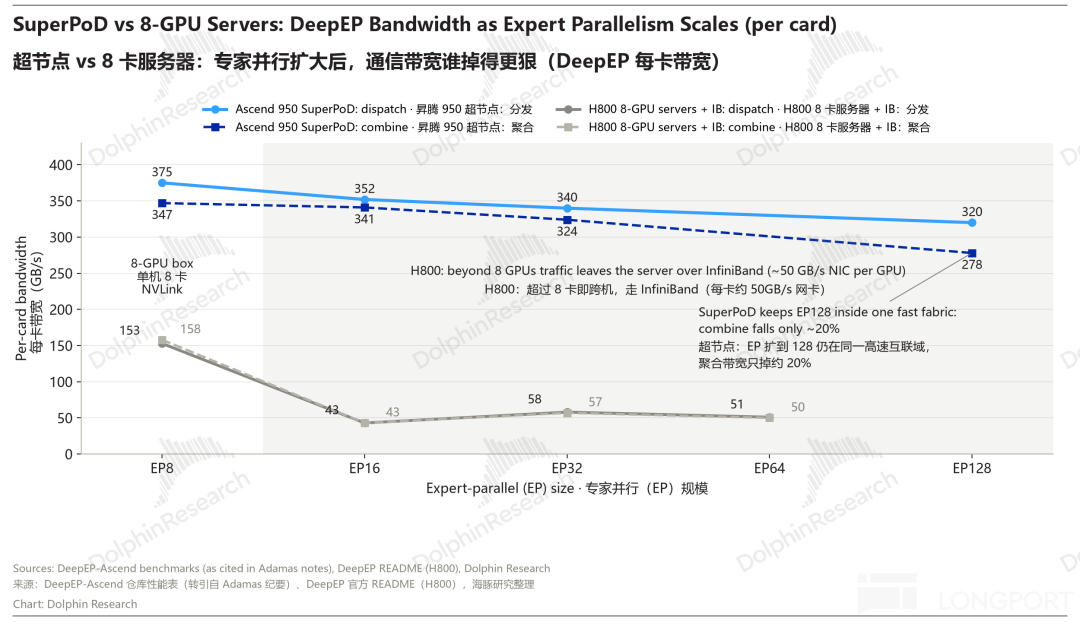
However, when training trillion-parameter MoE models, actual efficiency is determined by communication throughput under large-scale expert parallelism. When the number of expert parallels increases from 8 to 128, about 20% of throughput is lost when aggregating results from different expert tasks. In other words, the more cards connected, the weaker the effective communication capacity per card.
Nevertheless, within the super node, bandwidth during expert task dispatching and result combining approaches that of NVLink in H100/H200 nodes.
2. Technical Challenge: Stability of Ten Thousand-Card Interconnect
(1) Communication Wall: Bandwidth Degradation Under Large Expert Parallelism (EP)
For pre-training trillion-parameter MoE models, tokens must be routed between cards and nodes, running EP32 or higher.
Publicized claims: On September 30, DeepSeek open-sourced the Ascend version of DeepEP, with measured dispatch at 375GB/s, 'close to hardware limits.' However, this data is from an EP8 tier and PoC firmware version, with commercial versions likely lower. Actual degradation: Expanding from EP8 to EP128, dispatch drops by about 15%, and combine drops from 347GB/s to 278GB/s (about 20%). Officially attributed to local reduction overhead during combining and remote memory access competing with computation for HBM.
In other words, publicized figures represent optimal tiers, but actual engineering must budget for degraded numbers.
(2) Stability Wall: More Cards, More Frequent Failures
According to institutional research, Huawei claims a 300-hour MTBF (mean time between failures) for thousand-card clusters, '25% better than industry leaders.'
However, failure rates generally scale linearly with card count. For a 16,000-card cluster, this implies an average failure every 19 hours (300*1000/16000), creating a massive workload for checkpoint resumption, fault isolation, and rapid recovery. NVIDIA's ten thousand-card clusters face similar issues, but CUDA's ecosystem has accumulated fault-tolerant toolchains over the years, which Ascend still needs to develop.
(3) Efficiency Wall: There is no public data available on computing power utilization (MFU). The Huawei CANN community has disclosed a reference practice for a pre-training system for trillion-parameter MoE models: actual training validation was conducted on 950 super nodes using V4-Flash (approximately 284 billion parameters), followed by partitioning analysis for the 550B and 1.6T scales, and discussions on extrapolation to 10 trillion parameters.
However, the actual validated scale is far smaller than a trillion parameters, and details such as the number of cards used for each scale and the MFU values have not been disclosed.
Comparable data: The Pangu 718B MoE achieved an MFU of approximately 41% on the Ascend A2 cluster with 10,000 cards.
(4) Supply Wall: HBM and production capacity. The rotating chairman of Huawei stated, 'We will supply as much as we can produce,' with bottlenecks in domestic manufacturing processes, storage, and optical modules. The 950DT super node is currently undergoing testing, with mass production expected by the end of this year or early next year (full delivery will take 18 months).
Production capacity utilization: According to research, the annual production of 950DT is in the tens of thousands of units, with DS's 16,000 units accounting for approximately 40%. Cost: Industry estimates suggest that significant HBM price increases have led to 'bidirectional price hikes and reduced HBM configurations' for domestic cards, potentially further widening the performance gap per card.
3. Impact on the Sino-US Computing Power Landscape
(1) Impact on China: This is a crucial step for domestic computing power to transition from 'sufficient for inference' to 'viable for training.'
Current status: Currently, pre-training for China's leading large models still relies on overseas cards. For example, Kimi conducts approximately 70% of its cutting-edge pre-training on rented GB200/GB300 cards overseas, with the remaining 30% primarily using domestic NVIDIA cards; domestic cards are mainly used for post-training. Significance: If DeepSeek can train cutting-edge models on Ascend, the domestic reliance on NVIDIA for cutting-edge training will shift from 'mandatory' to 'optional.' Software stack: DeepSeek has ported and open-sourced DeepGEMM, FlashMLA, DeepEP, and TileLang from GPU platforms to Ascend, reducing the cost of migrating from the CUDA ecosystem to Ascend. Spillover effects under production capacity constraints: Locking in orders from top clients will further strain Ascend's limited production capacity, making it more difficult for second-tier model vendors and cloud providers to obtain cards for inference. Inference demand may spill over to other domestic chips (e.g., Cambrian, MetaX, Biren).
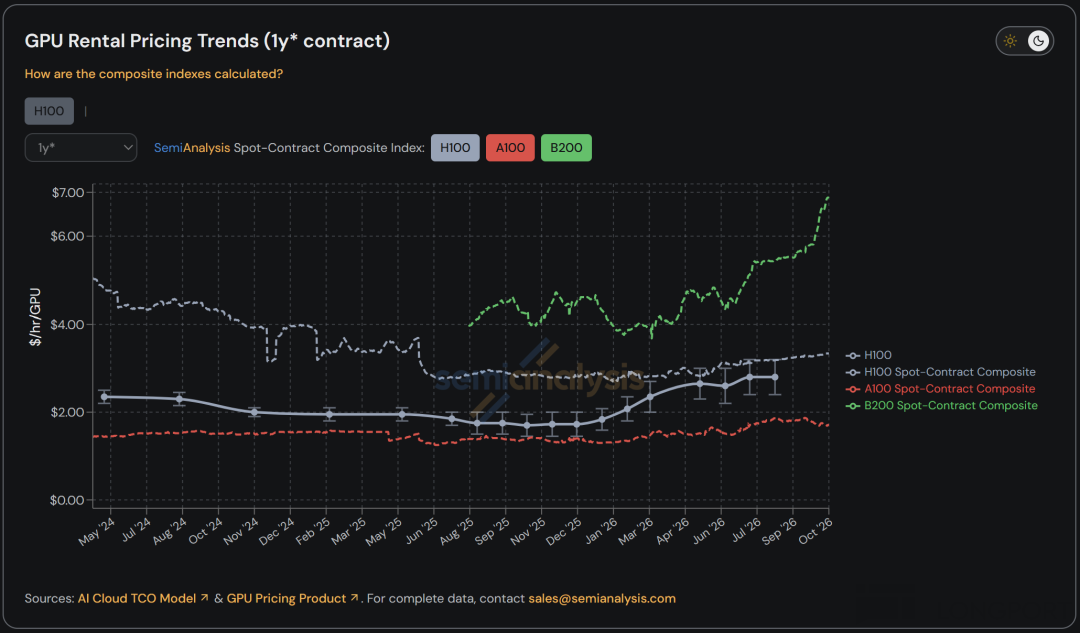
(2) Impact on overseas computing power: Minimal short-term impact. NVIDIA's share of China's high-end training card market has already been suppressed by regulations to a very low level, and this expectation has largely been priced in. US cutting-edge laboratories are still moving towards 5–10 trillion parameters, with demand for high-end computing power still exceeding supply—as shown in the SemiAnalysis tracking data below, B200 rental prices have increased by nearly 15% in the past week.
However, from a medium- to long-term perspective, DeepSeek has consistently reduced the computing power per token through sparse activation and KV compression. If it further demonstrates that 'sufficient' domestic computing power can train cutting-edge models, the marginal effectiveness of the US strategy of using computing power blockades to gain a time advantage will continue to decline.
III. Two Policies: The primary impact is on 'third-party cloud hosting + licensing revenue sharing.'
1. United States: DHS Ban
The DHS Exclusion and Removal Order No. 2026-01 (issued on July 24 and published in the Federal Register on October 20) requires:
Scope: Federal civilian agencies to cease procurement and removal of DeepSeek products, as well as 'third-party products and services developed based on DeepSeek'; national security systems with separate authorizations are excluded. Exceptions: Agencies may apply in writing within 60 days. List: Kimi and QianWen are named as 'objects of concern' but are not included in the ban.
The direct revenue impact is nearly zero, as DeepSeek has no US government clients. The real impact lies in the 'third-party products' clause: US SaaS vendors selling to the federal government will now dare not embed DeepSeek in their products. This will also lead US enterprise clients (especially those with government business) to avoid DeepSeek.
Similar measures have been taken by New York, Tennessee, Virginia, and other states. It is worth monitoring whether this logic will extend from government procurement to the commercial sector.
2. China: Technology Export Catalog (Draft for Comments)
Solicitation of comments: 23 AI technologies are proposed for addition, with comments sought until November 15. Provisional registration: Takes effect on the day of announcement, covering scenarios such as transfer of rights and overseas licensing. Controlled objects: Core technologies for large models (weights, key checkpoints, source code, architecture, training and inference acceleration technologies) are listed as restricted exports; large models trained with national core data are prohibited. Thresholds: The parameter threshold is 2 trillion, with additional training computing power thresholds of approximately 10 FLOPs and a capability threshold of 'top 10 globally' (the original text in the annex is subject to the final version).
The boundaries set by the MOFCOM spokesperson are clear:
Not considered technology exports: API calls, App/web interactions, SaaS, and lightweight end-side deployments. Subject to export controls: Deploying restricted models on overseas third-party clouds; relatively controllable scenarios such as deployment on overseas self-owned clouds may proceed with automatic licensing. Not subject to management: Technologies already in the public domain through open-source or published papers.
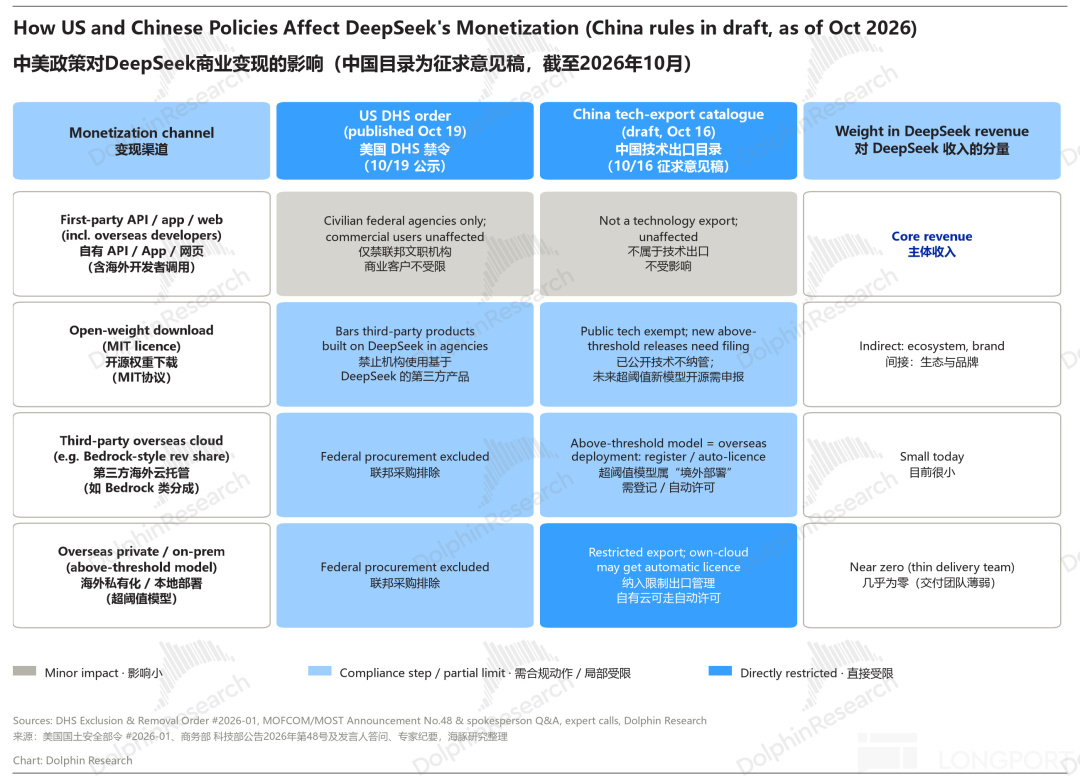
3. Impact on Business Models: Primarily Restricts 'Licensing Revenue Sharing'
Overlaying the two policies on the same table reveals that they affect the same channel: deploying weights on overseas third-party clouds for revenue sharing.
China side: Deploying models exceeding the thresholds on overseas third-party clouds is considered 'overseas deployment' and requires reporting. US side: The government and affiliated enterprises set procurement thresholds for 'products developed based on Chinese models.'
This channel is precisely the main path for Kimi and its peers to go global. Kimi's commercialization strategy involves 'reducing self-built APIs, distributing through cloud marketplaces like AWS, and having partners provide compliance endorsements,' with K3 already launched on AWS and Oracle. Simultaneously, it modified its open-source license to require revenue sharing from users with annual revenues exceeding $20 million. K3 has 2.8 trillion parameters, exceeding the 2 trillion threshold and directly covered by the catalog.
DeepSeek has minimal existing impact but faces compressed future growth space:
Revenue sources: Mainly from self-owned APIs. Revenue for the first seven months was approximately RMB 475 million, with an annualized run rate of approximately $1 billion as officially disclosed. Another MIT license does not charge royalties, with open-source itself serving as a customer acquisition tool. Parameter scale: The current mainstay V4.1-Flash has only 552 billion parameters in its backbone, and V4-Pro has 1.6 trillion, both below the 2 trillion threshold.
Thus, the direct impact of the two policies on DeepSeek's existing revenue is nearly zero. The three medium- to long-term issues it truly faces are:
Next-generation model open-sourcing requires reporting: If the next flagship model triggers thresholds in training computing power or 'top 10 globally,' open-sourcing will require prior reporting. While not a complete ban, this increases friction and cannot prevent further regulatory tightening, ultimately affecting openness in collaboration with overseas clients. At the national level, the weights of cutting-edge large models are being treated as strategic assets.
Discounted customer acquisition value of open-source: The US ban targets 'products developed based on DeepSeek.' No matter how large the open-source download volume is, it cannot win over medium- to large-sized clients in the US government and enterprises. Overseas revenue can only come from price-sensitive developers and SMEs, overlapping with the audience targeted by price reductions from Haiku 5.5 and GPT-6 Luna.
Business model continues to shift towards 'toolification': The fee-based Search/Fetch, launched on November 1, along with Harness, adds a per-use touchpoint beyond tokens. This path does not involve exporting weights and is not covered by the two policies, representing DeepSeek's safest growth direction.
Dolphin Research's View: The market tends to interpret the 'US ban + China's export controls' as a double blow to the global expansion of domestic open-source models. We believe that while expectation suppression is inevitable, the specific impacts exhibit structural differences:
(1) Areas of concentrated negative impact: Third-party cloud hosting, licensing revenue sharing, and overseas privatized deployments. Although the performance contribution from overseas cloud hosting revenue sharing is still low (Kimi and Zhipu have just started cooperating with Amazon Bedrock), it affects the valuation narrative for this segment—high-growth expectations are pinned on 'global ARR.'
(2) Less affected models: Self-owned API global expansion and open-source for customer acquisition. Most models under leading tech companies also primarily acquire customers through their own ecosystem products, so the impact is minimal.
Among independent labs, DeepSeek also primarily monetizes through self-owned APIs, with Minimax directly affected to a lesser extent, as its overseas ARR mainly comes from C-end applications and APIs. However, Minimax itself is significantly impacted by the 'price war' in base models.
(3) DeepSeek's current primary constraint: Not policies, but computing power.
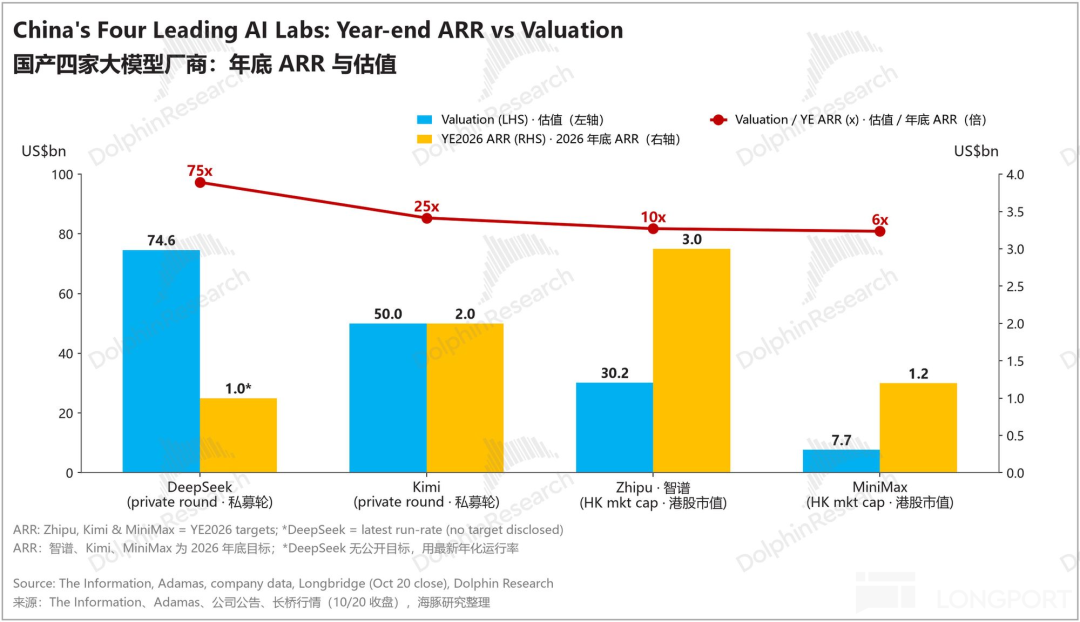
Whether the next-generation model can be trained on Ascend will determine whether it can upgrade from 'the king of cost-effectiveness in a specific price band' to 'a competitor for the upper limits of cutting-edge intelligence' and whether the narrative of a RMB 500 billion ($~75 billion) valuation can hold.
Based on Liang Wenfeng's oral disclosure of approximately RMB 6.7 billion in ARR ($1 billion), this corresponds to a price-to-sales ratio of approximately 75x.
Compared to its peers, especially the two already listed on the secondary market, DS and Kimi command a significant premium (a 'scarcity premium' for their ability to continuously iterate and develop cutting-edge models). In other words, the valuation is almost entirely supported by the option value of the next-generation model's upward potential.
Conversely, however, Dolphin Research believes that as the absolute leader, Anthropic's valuation shows a downward trend, and overall sentiment towards large models' valuations will also decrease. Coupled with intense competition + regulatory constraints, the premiums for DS and Kimi may also be forced to narrow.
- END -
// Reprint Authorization
This article is an original work by Dolphin Research. Reprinting is permitted only with authorization.
// Disclaimer and General Disclosure
This report is for general comprehensive data purposes only, intended for general reading and data reference by users of Dolphin Research and its affiliated institutions. It does not consider the specific investment objectives, investment product preferences, risk tolerance, financial situation, or special needs of any person receiving this report. Investors must consult with independent professional advisors before making investment decisions based on this report. Any person making investment decisions using or referring to the content or information in this report does so at their own risk. Dolphin Research shall not be liable for any direct or indirect responsibilities or losses that may arise from using the data in this report. The information and data in this report are based on publicly available sources and are for reference purposes only. Dolphin Research strives to ensure but does not guarantee the reliability, accuracy, and completeness of the information and data.
The information or views mentioned in this report shall not, under any jurisdiction, be considered or construed as an offer to sell securities or an invitation to buy or sell securities, nor shall they constitute recommendations, inquiries, or endorsements of relevant securities or related financial instruments. The information, tools, and data in this report are not intended for or proposed for distribution to jurisdictions where distribution, publication, provision, or use of such information, tools, and data contradicts applicable laws or regulations or leads to Dolphin Research and/or its subsidiaries or affiliated companies being subject to registration or licensing requirements in such jurisdictions, or to citizens or residents of such jurisdictions.
This report merely reflects the personal views, insights, and analytical methods of the relevant creators and does not represent the stance of Dolphin Research and/or its affiliated institutions.
This report is produced by Dolphin Research, with copyright owned solely by Dolphin Research. No institution or individual may, without prior written consent from Dolphin Research, (i) make, copy, reproduce, duplicate, forward, or distribute in any form any copies or reproductions, and/or (ii) directly or indirectly redistribute or transfer to other unauthorized persons. Dolphin Research reserves all relevant rights.
-
Is the Turning Point Here for AI Companies' Financing? Even Big Players Now Face 10% Interest Rates
-
![]()
Will the 2026 Auto Market See New Champions Emerge?
-
![]()
Caught Between Policies and Competition: Is Ascend the Future for Chinese Models?
-
![]()
Reviving Classic Designs: European Automakers' Nostalgic Gambit Amidst Chinese Competition
-
![]()
"Little Blue Light" Steps Out of the "Lockdown Room"!
-
![]()
Struggling in the Domestic Market? The Future Lies in Global Expansion—The 'Second Half' of China's New Energy Vehicle Industry
-
How Solid Is the Turning Point for Commercial Spaceflight?
-
![]()
Labor Pains! Li Auto Slashes 3,970 Jobs, Reports Massive Annual Loss of 4 Billion Yuan