A Century-First: Audi Unveils Dual-Brand Strategy, with Chinese Tech Pioneering Its Future
 10/28 2026
 376
Chinese automotive technology has now become the cornerstone of innovation for Audi, a brand with a storied century-long legacy.
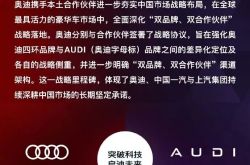
On October 26, Audi China made a landmark announcement: 'From dust to dust, from earth to earth.' The iconic Four Rings emblem of Audi will now be exclusively associated with the FAW Group, while the new AUDI (featuring the Audi letter logo) will be under the purview of the SAIC Group. Notably, SAIC-Audi will retain the right to sell Four Rings products until the end of 2027, marking the resolution of a nearly decade-long dispute over brand usage rights.
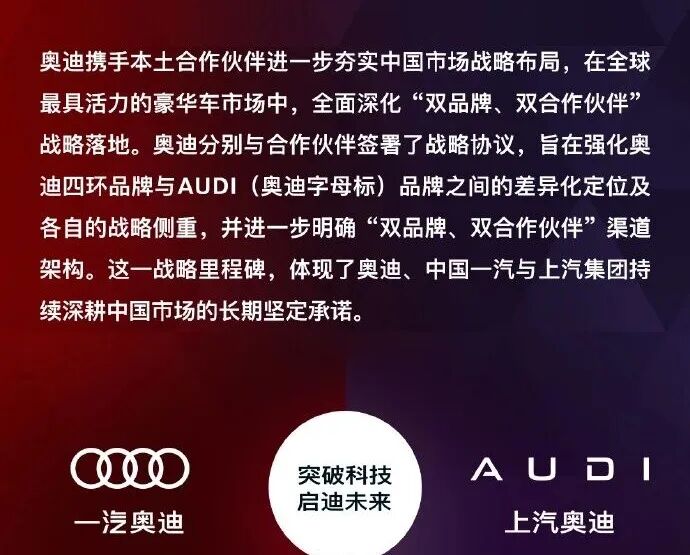
Audi China further elaborated that the China FAW Group is set to solidify the market dominance of the Audi Four Rings brand across both intelligent luxury new energy and traditional fuel vehicle sectors. This will be achieved through a comprehensive intelligent luxury product lineup, ensuring the sustained market strength of this design and technology-driven luxury brand, deeply entrenched in the Chinese market. Meanwhile, SAIC-Audi will concentrate on the AUDI (Audi letter logo) brand, with a laser focus on the new energy market, launching next-generation intelligent connected vehicles tailored to Chinese consumer preferences.
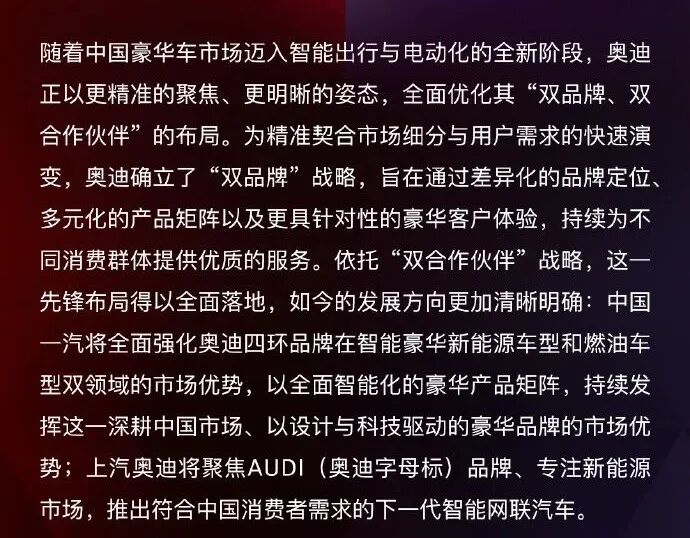
This announcement carries multiple implications: Audi will adopt a dual-brand strategy in China, featuring the Four Rings logo and the AUDI logo. This marks a historic first for Audi, as it embraces a 'dual-brand' approach in response to the unique dynamics of the Chinese market and its partnerships. Such a move is unprecedented in Audi's 100-year brand history.
The second implication is that FAW-Audi will retain the exclusive right to use the authentic Audi Four Rings logo, with its business scope encompassing both traditional fuel vehicles and new energy vehicles. This means consumers will continue to have access to new energy vehicles bearing the Four Rings logo in the future.
The third implication is that SAIC-Audi will introduce the new AUDI logo, with its traditional fuel vehicle business slated to phase out by the end of 2027, after which it will exclusively focus on new energy vehicles.
Public records indicate that the Four Rings models currently sold by SAIC-Audi include the A7L, A5L Sportback, Q6, and Q5 e-tron. Among these, the A7L, A5L Sportback, and SAIC Volkswagen's Phideon share a flexible production line. The Q5 e-tron is co-produced with SAIC Volkswagen's ID. series in the MEB park, while the Q6 is co-produced with the Teramont at SAIC Volkswagen's Ningbo plant. Following the discontinuation of these four models, the relevant production lines will remain operational for SAIC Volkswagen's vehicles, ensuring no integration of production assets between FAW-Audi and SAIC-Audi. This signifies SAIC-Audi's complete separation from Audi's traditional automotive business, with a future focus on developing the AUDI letter logo.
As early as 2024, Wang Xiaoqiu, Chairman of SAIC Group, outlined the SAIC-Audi project's vision: Audi excels in defining premium vehicle products, whole-vehicle R&D, and engineering technology, while SAIC Group leads the industry in intelligent electric innovation technology. This suggests that SAIC-Audi's development model will diverge significantly from previous joint venture automotive businesses.
Historically, Chinese shareholders in joint ventures have primarily relied on foreign partners for vehicle definition, technology R&D, and product development. Consequently, even with a 50% stake, Chinese partners often lacked substantive core decision-making power.
With the gradual liberalization of China's automotive industry policies and the advent of wholly foreign-owned factories, more and more former joint venture foreign partners have sought to increase their equity stakes. For instance, BMW in BMW Brilliance and Volkswagen in Volkswagen Anhui both hold a 75% stake. Coupled with foreign partners' absolute control over technology and products, the control of joint ventures has increasingly shifted away from Chinese shareholders. However, SAIC-Audi does not conform to this trend.
From Wang Xiaoqiu's perspective, SAIC will play a pivotal role in the intelligent and electric transformation of SAIC-Audi. In the current global automotive landscape, intelligence and electrification are already core mainstream technologies. This positions SAIC-Audi and FAW-Audi as products of two distinct eras, with one representing the future and the other the past.
Over half a century ago, in November 1978, Zhou Zijian, the Minister of China's Ministry of Machine Building, visited Volkswagen's Wolfsburg plant unannounced, seeking an opportunity to meet with Volkswagen's leadership. This visit paved the way for the subsequent cooperation between SAIC Group and Volkswagen.
Now, with SAIC-Audi shifting its focus entirely to the new business of the AUDI letter logo, it signals a paradigm shift in the balance of Sino-foreign automotive industry joint ventures and cooperation. A new era has dawned.
-
![]()
Anthropic Also Eyes Cloud Provider Partnerships
-
![]()
Can the ZON 09, Priced from 169,900 Yuan, Strike a Balance Among Model 3, Xiaomi SU7, and Itself?
-
![]()
What's Ailing XPENG?
-
![]()
From Recommendation to Mandatory: The Countdown Begins for C-V2X's 'Birth Certificate'
-
![]()
The Auto Market Price War: A Call for an Immediate Halt
-
![]()
A Century-First: Audi Unveils Dual-Brand Strategy, with Chinese Tech Pioneering Its Future
-
![]()
Chery Sets Sights on North American Market
-
![]()
A Staggering 4 Billion 'Deficit' Looms Large: Haima Automobile Faces Severe Challenges in Q3