Tariffs Doubled, Yet Chinese Cars Sell Even Better in Mexico
 11/11 2026
 519
Produced by I Xiaohai fallsea
Written by I Hu Buzhi
01
At a BYD dealership in Mexico City, salesman David Gonzalez has just seen off a group of customers who came to look at cars. The most prominent spot in the showroom holds a Seagull, priced at around $21,000—about $2,000 cheaper than comparable competitors. The question customers ask most often is not about range, but whether the price will rise again once the tariff takes effect.
Outside such stores, Chinese cars with Mexican license plates drive out one after another. On January 1, 2026, Mexico raised the import tariff on light vehicles from non-free-trade partner countries from 20% to 50%, the maximum rate for passenger cars.
A total of 1,463 categories of goods were subject to tiered tariff increases, with household passenger cars pushed to the heaviest tier. Before the policy took effect, many judged that Chinese cars would this time be shut out. Half a year later, the numbers moved in the opposite direction.
02
According to statistics from Mexico's automotive dealers association, in the first half of 2026 Chinese brands sold more than 137,000 vehicles in Mexico, up nearly 30% year on year, with their share of total new-car sales rising to about 17%.
El Economista, citing more detailed figures from Mexico's National Institute of Statistics and Geography, reported that in the first four months of 2026, the share of Mexico-made Chinese cars in local sales rose 3.9 percentage points year on year, reaching about 23%.
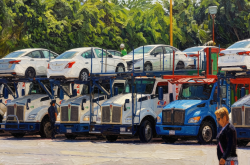
On the export side, volumes are also rising. Data from the China Passenger Car Association show that in 2025 China exported 625,000 vehicles to Mexico, surpassing Russia for the first time and making Mexico the largest destination for China's passenger car exports, including 199,000 new energy vehicles, up 140.8% year on year.
The market share of Chinese brands in Mexico rose from less than 1% in 2020 to about 19%. BYD is the steepest segment of this curve. It only brought passenger cars into Mexico in early 2023; in 2024 its sales nearly doubled, capturing about 70% of the local pure electric plus plug-in hybrid market.
In the full year of 2025, BYD exported 130,451 complete vehicles to Mexico, including 54,511 pure electric and 75,940 plug-in hybrid, and Mexico surpassed Brazil for the first time to become its largest overseas export destination.
Yet during the same period, it had not a single complete-vehicle plant in Mexico. With 130,000 complete vehicles pouring in, there was not even a shadow of a factory. The faster sales grew, the more glaring this gap became. The business of selling cars is thriving in Mexico.
03
Building a factory has never been a commercial decision; it is a political one. Once it reaches this stage, the rhythm is thrown into disarray. After entering the market in March 2023, BYD inspected three sites in Mexico, with the northern region near the United States the most promising, and originally planned to employ tens of thousands of workers.
But before the 2024 U.S. election, site selection stopped. In July 2025, Bloomberg reported that BYD had shelved plans to build a large factory in Mexico.
On July 1 of that year, BYD Executive Vice President Li Ke said in an interview in Brazil that geopolitics has a huge impact on the auto industry, that everyone is re-examining overseas strategies, and that they hope to make decisions after the situation becomes clear.
Mexican President Sheinbaum had also said in March that BYD had not yet submitted a formal investment proposal to Mexico. On one side is a 70% share of the segment; on the other is a factory still unresolved.
04
This contrast gained a new footnote in February 2026. Nissan and Mercedes-Benz have a joint venture factory in Aguascalientes called COMPAS, completed in 2017 with an investment of about $1 billion and annual capacity of 230,000 vehicles, mainly producing the Mercedes GLB and Infiniti QX50. Affected by the U.S. 25% tariff on vehicles made in Mexico, the factory officially closed on May 31, 2026.
Before closing, it attracted bidding interest from nine companies. In the end BYD, Geely, GAC and Vietnam's VinFast made the final list. Chery and Great Wall also expressed interest but did not reach the end. Buying an existing factory saves the cycle of building from scratch and the trouble of fermenting matters with the local government all over again. But this deal is likewise stuck in the same place.
The Mexican government cannot stop the sale of a privately owned factory, but according to people familiar with the matter, officials from the Ministry of Economy privately urged local governments to suspend approval of Chinese automakers' investments until trade negotiations with the United States are completed.
As of November 2026, the final winner of the COMPAS factory bid has still not been announced. An existing factory has been fought over as a hot commodity. A new factory, however, has yet to be grounded.
05
On October 13, 2026, the Mexican government extended another ladder that seemed to reach out to Chinese automakers. A decree published in the official gazette that day cut the import tariff on knockdown and completely knocked-down kits used for complete vehicle assembly from 10% to zero, valid for five years and effective October 14.
Against the backdrop of complete-vehicle tariffs pushed to 50%, bringing parts in and assembling them locally into complete vehicles is equivalent to jumping from the 50% tax tier to zero, a gap of fifty percentage points. The ladder was extended, and three days later it was pulled away.
The Ministry of Economy then clarified that this exemption is not universal and applies only to manufacturers that already have production facilities in Mexico and meet conditions such as bonded warehouse licenses, per-vehicle declaration of vehicle identification numbers, and traceable sources of parts.
Reuters inferred from industry data that about 11 light vehicle manufacturers meet the conditions: Audi, BMW, Ford, General Motors, Honda, Kia, Mazda, Nissan, Stellantis, Toyota and Volkswagen—all German, American, Japanese or South Korean, with not a single Chinese brand.
The Ministry of Economy put it more bluntly: enterprises without local production facilities and that do not create local added value are not within scope. The exemption order was extended, but the list was never published.
06
Put these three things together, and Mexico's calculations become clear. In 2025, parts for complete vehicle assembly imported by Mexico accounted for only 0.01% of its total automotive imports. This figure shows that the October exemption order was not aimed at expanding duty-free imports at all.
It uses five years of zero tariffs as bait to force multinational automakers already locally present to move overseas production lines into Mexico, while raising the proportion of local parts. What Mexico wants is capacity and jobs, not ports for knocked-down kits.
So a doubling of tariffs failing to stop Chinese cars, and an exemption order shutting Chinese automakers out, are two squares on the same abacus. In the selling-cars square, Mexico welcomes you. Cars need to enter stores, build channels, hire local sales staff, and give consumers cheaper options.
With tariffs raised to 50%, cars still sell, relying on cost-effectiveness and dealer networks. Selling a Chinese car in Mexico does not take cheese off anyone's plate; it only gives local consumers one more affordable choice.
In the factory-building square, Mexico hesitates. Land, tax incentives and permits—these three things in Mexico are all held by people worried about angering the United States. Ministry of Economy officials privately urged local governments to suspend approval of Chinese automakers' investments, on the grounds that the trade agreement with the United States must first be concluded.
The exemption order draws the threshold at existing production facilities, which is tantamount to telling newcomers plainly: if you want zero tariffs, first actually move production capacity here. But the step of actually moving production capacity here is the very step Washington is most sensitive about. It wants to give it to you, but dares not.
07
This explains something that looks contradictory. Chinese automakers can sell cars in Mexico, but find it very hard to stand up production capacity. Selling cars follows market access. Tariffs are clearly priced costs added at the customs entry stage; consumers calculate the overall cost-effectiveness of the complete vehicle, not the customs tariff schedule.
A BYD salesman in Mexico City told Bloomberg that the company concentrated promotions at year-end before the tariff took effect, absorbed costs itself after implementation, and retail prices rose by at most about 15,000 pesos, equivalent to more than $8,000.
Of the 50% tax, only a small portion is actually passed on to car prices. Building a factory follows another set of rules. For a factory to stand on someone else's land, what is tested is not how precisely you calculate costs, but how much of what you have is recognized by the other side as local value, and whether the other side is willing to loosen its grip for you.
Mexico cannot stop the sale of privately owned factories, but drags out whatever it can. It exempts parts from tariffs on one hand, while locking exemption eligibility to existing capacity on the other, using rules to weld shut the shortcut of bringing in knocked-down kits and shipping out complete vehicles. Sales can keep rising in a year when tariffs double, but when a factory lands is not determined by sales; it is determined by political risk.
Chinese automakers can calculate costs clearly, but cannot calculate what Washington's next list will say. 08 For companies going global, Mexico's data over the past half year are an unavoidable reference. The threshold of market access can be crossed through products and prices. The threshold of supply chain access cannot be crossed.
The former tests competitiveness; the latter tests how much of what you have is recognized by the other side as originating there, and under how much pressure the other side still dares to let you land.
Tariffs can change the landed price, but cannot change the cost-effectiveness of a car calculated on configuration, fuel consumption and after-sales accounts. But whether production capacity lands does not depend on how strong you are; it depends on whether others loosen their grip. The former is up to you; the latter requires others to nod.
Mexico is not rejecting Chinese capital; it is attaching a formal condition to Chinese capital. That condition is currently still stuck in Washington's hands.
What Chinese automakers are traveling in North America is a deliberately narrowed road: complete vehicle exports are blocked by tariffs, circumvention is blocked by rules of origin, and local factory construction is blocked by national security reviews. No matter how loudly the abacus of selling cars clicks, it cannot reach the factory-building square.
-
![]()
For the First Time in Audi's History, the "Engineering Sign-Off" Pen Is in Chinese Hands
-
![]()
The Worst Thing About Selling Cars Isn't Being Criticized—It's Being Completely Ignored
-
To My Surprise, Xiaomi Saw the World's Largest Phone Price Hike in 2026
-
![]()
How Are the New Forces Faring as the Auto Market Loses Its "Golden" Touch?
-
![]()
Tariffs Doubled, Yet Chinese Cars Sell Even Better in Mexico
-
![]()
Cars That Sell Well Will All Be Replaced by Cheaper Alternatives Eventually
-
![]()
The 'Golden September and Silver October' Phenomenon Has All but Vanished: The Auto Market Enters an Era of Pure Survival
-
![]()
Tesla Sold Just 8,817 Vehicles in October—But the Factory Didn't Build a Single One Fewer