How Are the New Forces Faring as the Auto Market Loses Its "Golden" Touch?
 11/11 2026
 381
Introduction | Lead
The 2026 "Golden September and Silver October" failed to deliver the usual peak-season narrative. The overall auto market remained under pressure, and structural divergence widened further. Within the new forces camp, it was likewise a tale of two worlds: Leapmotor, XPeng, and Zeekr kept pushing higher, identified the logic for incremental growth, and bucked the downward trend, while some brands saw October deliveries shrink sharply and entered a period of deep adjustment.
Produced by | He Yan Yue Che Studio
Written by | Cai Yan
Edited by | He Zi
2,621 words in total
4 minutes to read
"Golden September is not golden, and Silver October is not silver" is the most brutal portrayal of the overall auto market in September–October 2026. On November 9, the China Passenger Car Association released the latest market production and sales data: in October 2026, retail sales in the national passenger vehicle market were 1.643 million units, down 27.1% year-on-year; from January to October, cumulative passenger vehicle retail sales were 14.978 million units, down 22.3% year-on-year. Even during the traditional peak sales season of "Golden September and Silver October," the overall auto market still shrank by more than 25%.
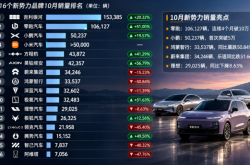
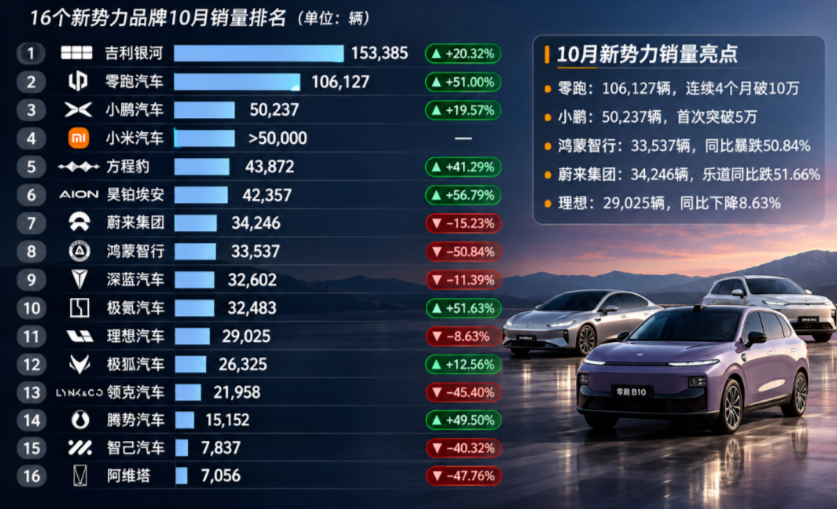
Judging from the October sales announced by new force automakers, the "Silver October" auto market did not see widespread gains as in previous years, but was instead concentrated in the continued surge of leading automakers. Looking only at monthly sales, the new forces present a clear three-tier structure: Geely Galaxy and Leapmotor are in a league of their own; XPeng and Xiaomi form the second tier at the 50,000-unit level; and the rest are at the 40,000-unit range and below. However, it should be emphasized that in today's downward market, sales are only one part, and the brand value brought by average transaction price is even more important.
Within Expectations
As a brand that has long dominated the top of the new forces, Leapmotor continued to surge 51% year-on-year in October, with cost-effectiveness and its overseas strategy still driving growth. On one hand, Leapmotor benefits from the cost control brought by full-domain in-house research and development, and has extremely strong dominance in the 100,000 to 200,000 yuan range with ultra-high cost-effectiveness. On the other hand, it has gradually established a viable overseas model with Stellantis. In the first nine months of this year, Leapmotor's cumulative exports exceeded 150,000 vehicles. In the first half of the year, Leapmotor's market share in Italy's pure electric market had already exceeded 25%. Therefore, it can be predicted that as the domestic market becomes increasingly competitive, the rapidly growing overseas market will be a topic Leapmotor must face in its next stage.
Beyond Expectations
XPeng delivered 50,200 vehicles in October, up 19.57% year-on-year and 21.77% month-on-month, setting a new monthly historical high. XPeng's leap across the 50,000-unit sales threshold also relied on "technology deployment downward + overseas growth." As for technology deployment, it mainly targets frequent new launches of MONA models, especially the MONA L05, which, while fully balancing "large space + high cost-effectiveness + XPeng's excellent intelligent driving," provides XPeng with ample order sources. Industry forecasts that the MONA L05 will help XPeng challenge monthly sales of 60,000 vehicles in the future are not aggressive.
Looking at XPeng's overseas sales reveals the momentum even more clearly. In October, XPeng delivered 13,300 vehicles overseas, a year-on-year surge of 166%, accounting for about 26.5% of total deliveries. In other words, "for every five vehicles XPeng sells, one is delivered to an overseas market." This level of overseas sales is arguably in a league of its own among NIO, XPeng, Li Auto, and Leapmotor. In addition, XPeng was one of only two brands invited during the Paris Motor Show to participate in public-road experience of high-level intelligent assisted driving, and XPeng's intelligent driving label is extending from the domestic market to the global market.
Exceeding the Target
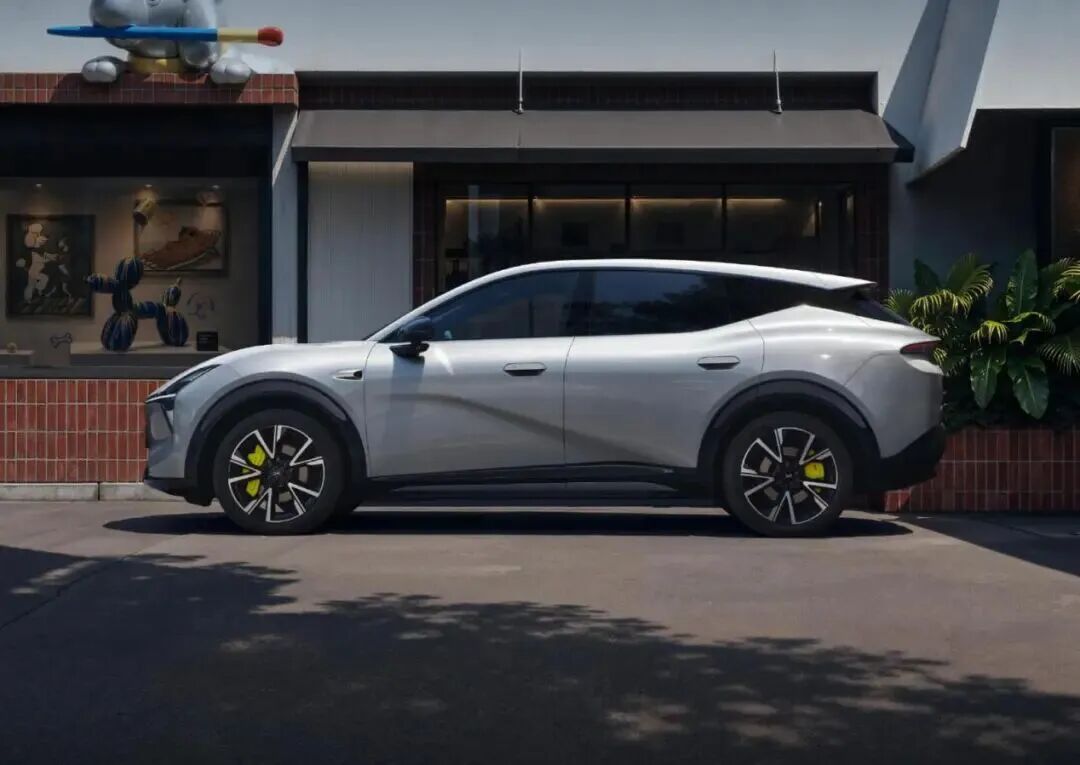
Zeekr can be said to be the most eye-catching new force brand in October, delivering 32,400 vehicles, up 51.6% year-on-year, with cumulative deliveries from January to October reaching 320,800 vehicles, up 94.4% year-on-year. More importantly, Zeekr has exceeded its 2026 sales target with a completion rate of 107%. It should be noted that according to industry practice, achieving more than 80% of the full-year target in the first 10 months is already quite outstanding.
Digging into Zeekr's growth logic, it can be said to have grasped the most rare brand characteristic in the current stock-market involution environment, underpinned by "building high value and high trust through system capability." To put it plainly, Zeekr's growth logic lies in "high-end brand system perception + technical system foundation + customer operations system maintenance."
First, regarding high-end brand system perception, since Zeekr successfully merged into the greater Geely group in 2025, it has no longer wavered between "moving up" and "moving down," but has been determined to make high-end flagship products. Therefore, looking through Zeekr's product system, it is not hard to find that the average selling price per vehicle is close to 310,000 yuan, and as of October this year, Zeekr's average transaction price per vehicle was 370,000 yuan. While others compete on price, Zeekr has been patient and competes on value in the 300,000 yuan range.
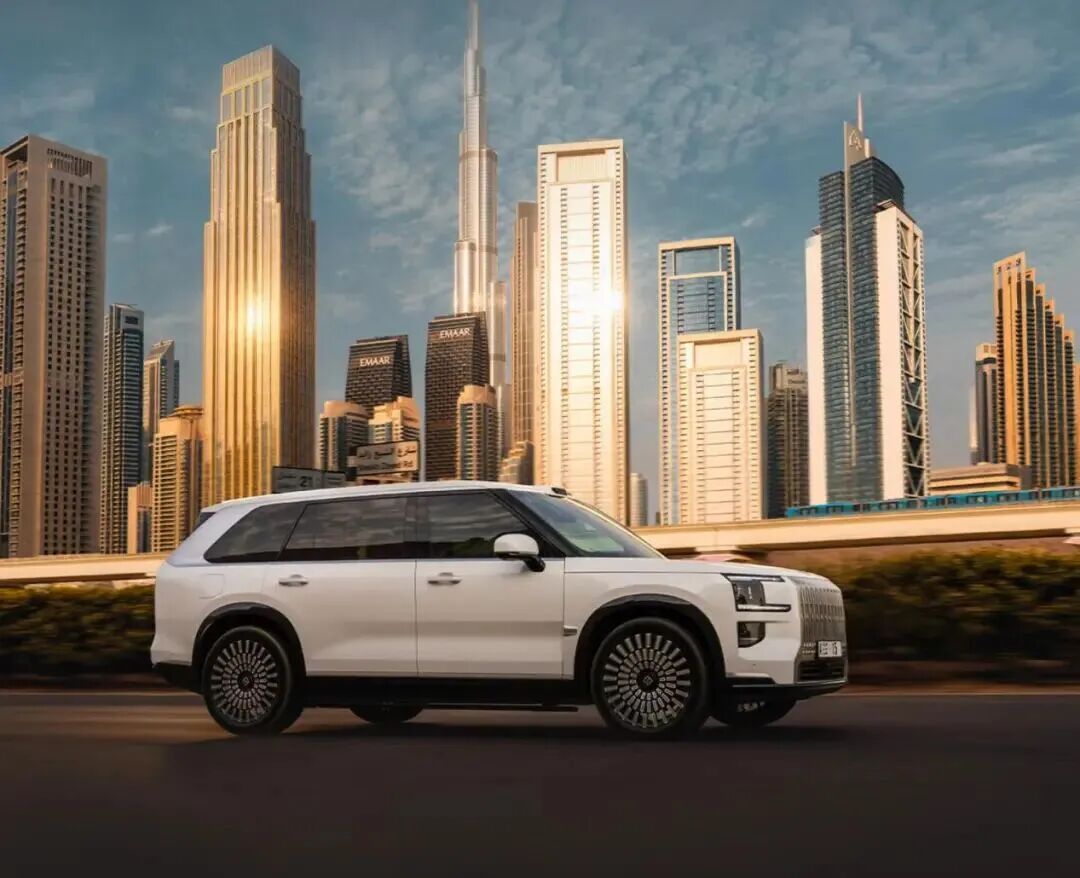
Second is the technical system foundation. The large-scale reuse of the SEA architecture has allowed Zeekr to keep high-end costs under control. When Lynk & Co, Polestar, Smart, and Volvo are all using the same architecture parent body, Zeekr has not only successfully escaped the scale limitations brought by a single brand, but also enjoyed the cost advantages brought by group-based systemization. This is the fundamental reason Zeekr can maintain high value.
The third is user operations, which is precisely the market strategy Zeekr re-emphasized after stumbling in the past. From once being criticized for a chaotic price system due to "three facelifts in one year," to now the Zeekr 9X ranking first in NPS among all models above 500,000 yuan, the key lies in actions such as "advance notice of model facelifts, advance disclosure of information, and returning the voice to customers." These are also the attributes currently most scarce among AITO, Li Auto, NIO, and XPeng.
Deep Adjustment
Harmony Intelligent Mobility was the camp with the most contrasting sales among the leading new forces in October, delivering 33,500 vehicles, a year-on-year plunge of 50.84%. More importantly, as of October, Harmony Intelligent Mobility had posted year-on-year declines for five consecutive months and month-on-month declines for four consecutive months. Among them, AITO, as the main sales support for Harmony Intelligent Mobility, saw October sales consistent with the overall trend of Harmony Intelligent Mobility, falling 54.69% year-on-year.
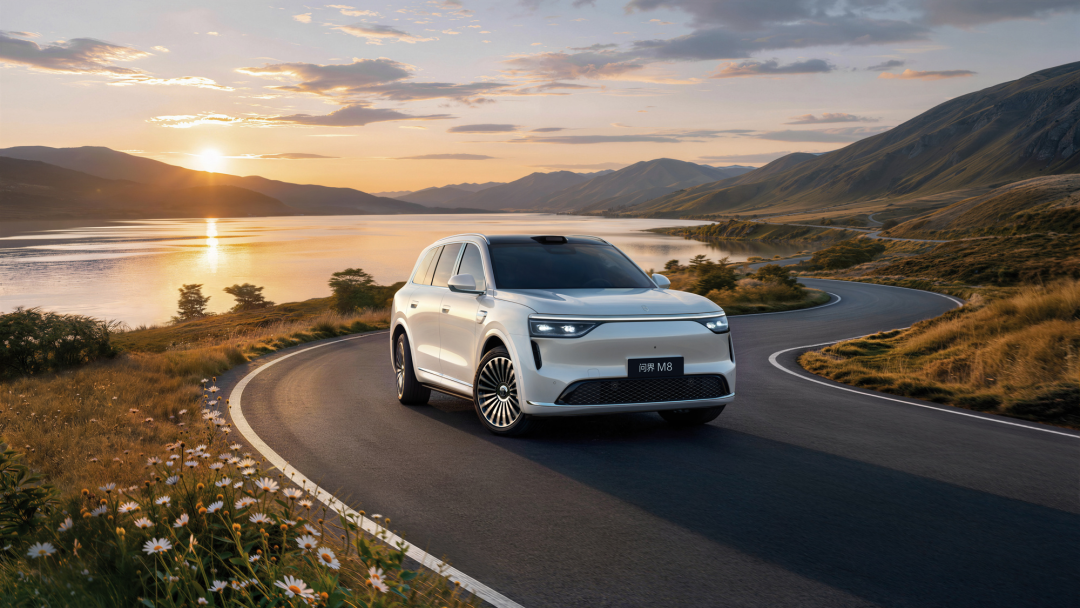
However, as long as one breaks down Harmony Intelligent Mobility's product system, it is not hard to find that although Harmony Intelligent Mobility's October sales fell behind, its prices stood firm. First, regarding the reasons affecting sales, from the perspective of AITO's product market strategy and life cycle, the product cadence of the M7/M8 throughout 2026 was indeed in a transitional stage. First, the addition of the 896-line lidar version in March 2026 did further strengthen intelligent driving capability at the product level, but for consumers, a major facelift every six months was indeed somewhat frequent. Combined with news in the third quarter that the M7/M8 would continue to receive facelifts, with new cars to be designed for the L3 architecture, consumers' wait-and-see sentiment became one of the key reasons for the sales decline.
As for changes in the cooperation model, that was another factor in the sales decline. On September 15, AITO announced that Seres would lead product definition, brand marketing, and channel retail, with Huawei only providing empowerment, and dealer contract entities also switched to Seres. However, half a month later, on October 1, Huawei and Seres signed a new five-year contract agreement, confirming that they would continue to upgrade the business in an "exclusive and dedicated" manner, and AITO would remain sold through Huawei channels.
October, as the first full month after AITO's new model was implemented, saw channel authorization, store display, and sales scripts all in the process of adjustment, compounded by changes in statistical calibers, which directly affected terminal sales. In addition, within the Huawei system, with the emergence of brands under the "Jing" name, consumers faced a lower threshold for purchasing "Huawei intelligent technology," so market sales inevitably had another portion diverted. On one side were Harmony's "World" brands, and on the other were Qiankun's "Jing" brands; disputes over brand systems and price systems had already spread to the consumer end.
At present, Harmony Intelligent Mobility has not lost its footing because of five consecutive months of sales decline, but is gradually advancing "new exploration of cooperation models."
On October 12, AITO officially announced that it would enter the European market in 2027, which means that within the Harmony Intelligent Mobility system, AITO has stronger market strategic capability. On November 5, Harmony Intelligent Mobility's official Weibo released a teaser for the new AITO M8, saying that the new car was gradually arriving at AITO authorized centers nationwide, which means Harmony Intelligent Mobility is further clarifying the brand ownership of AITO. This new car, set to launch on November 13, should bring a new round of attention.
As for the manifestation of value, a deeper look at the other side of the October new force sales rankings actually makes it easy to find that even though Harmony Intelligent Mobility's sales are far below before, its average transaction price across the lineup exceeds 400,000 yuan, and the M9 has sold more than 10,000 units for four consecutive months. There is no doubt that this remains a top-level performance among new force brands. By comparison, Zeekr, which also sold just over 30,000 vehicles in October, had an average transaction price of 370,000 yuan across its lineup, still some distance from Harmony Intelligent Mobility.
In an overall declining auto market, price and value are more important than the gold content of sales. Simply put, even if Harmony Intelligent Mobility endures short-term sales fluctuations, it has not lost its grasp of long-term trends.
Commentary
As the end of 2026 approaches, the new forces have gradually found and identified their brand growth logic. Although this year's situation is already largely clear, 2027 will bring many variables and unknowns. The new forces must not only fight to close out this year, but also prepare for next year. In the future, overseas market momentum may continue, and in addition, L3 may become the hottest track.
(This article is original to "He Yan Yue Che" and may not be reproduced without authorization.)
-
![]()
For the First Time in Audi's History, the "Engineering Sign-Off" Pen Is in Chinese Hands
-
![]()
The Worst Thing About Selling Cars Isn't Being Criticized—It's Being Completely Ignored
-
To My Surprise, Xiaomi Saw the World's Largest Phone Price Hike in 2026
-
![]()
How Are the New Forces Faring as the Auto Market Loses Its "Golden" Touch?
-
![]()
Tariffs Doubled, Yet Chinese Cars Sell Even Better in Mexico
-
![]()
Cars That Sell Well Will All Be Replaced by Cheaper Alternatives Eventually
-
![]()
The 'Golden September and Silver October' Phenomenon Has All but Vanished: The Auto Market Enters an Era of Pure Survival
-
![]()
Tesla Sold Just 8,817 Vehicles in October—But the Factory Didn't Build a Single One Fewer