Land Rover Loses First Round: Dutch Court Rules BYD Raid Was a "Fishing Expedition," Ti7 Copying Allegations Still Unresolved | Mingjing Pro
 11/13 2026
 460
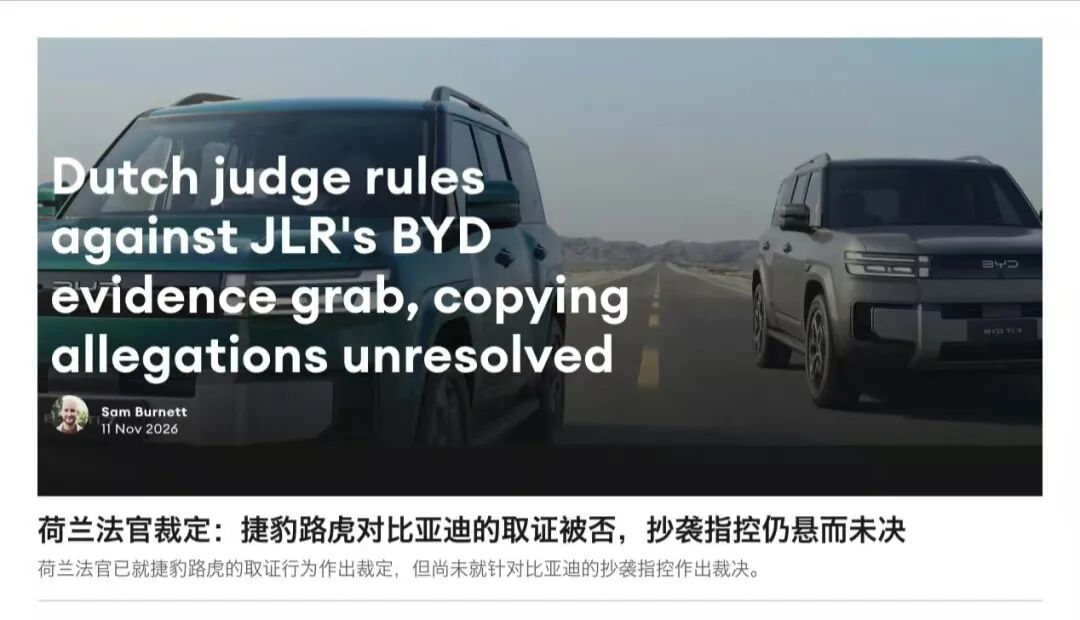
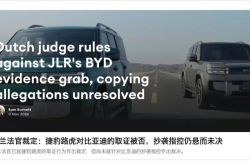
In the first round of the legal battle over allegations that BYD's Ti7 (sold overseas as the "Ti7") copied the Defender, Jaguar Land Rover has come out on the losing end.
According to a November 11 report by the Dutch national news agency, the Hague court in the Netherlands issued a procedural ruling on the intellectual property dispute between Jaguar Land Rover and BYD. The court ruled that evidence seized by an enforcement team representing Jaguar Land Rover during a previous raid on BYD's European headquarters was unrelated to the plagiarism allegations, and revoked the earlier seizure of BYD-related documents and data as evidence.
Jaguar Land Rover had accused the Ti7 of copying the Defender's styling and filed a lawsuit at the Hague court. Beyond the styling allegations, Jaguar Land Rover also suspected that BYD had dismantled a Land Rover Defender, reverse-engineered certain technologies, and may have used the results in developing the Ti7. On that basis, Jaguar Land Rover additionally filed a copyright infringement lawsuit at the Rotterdam court.
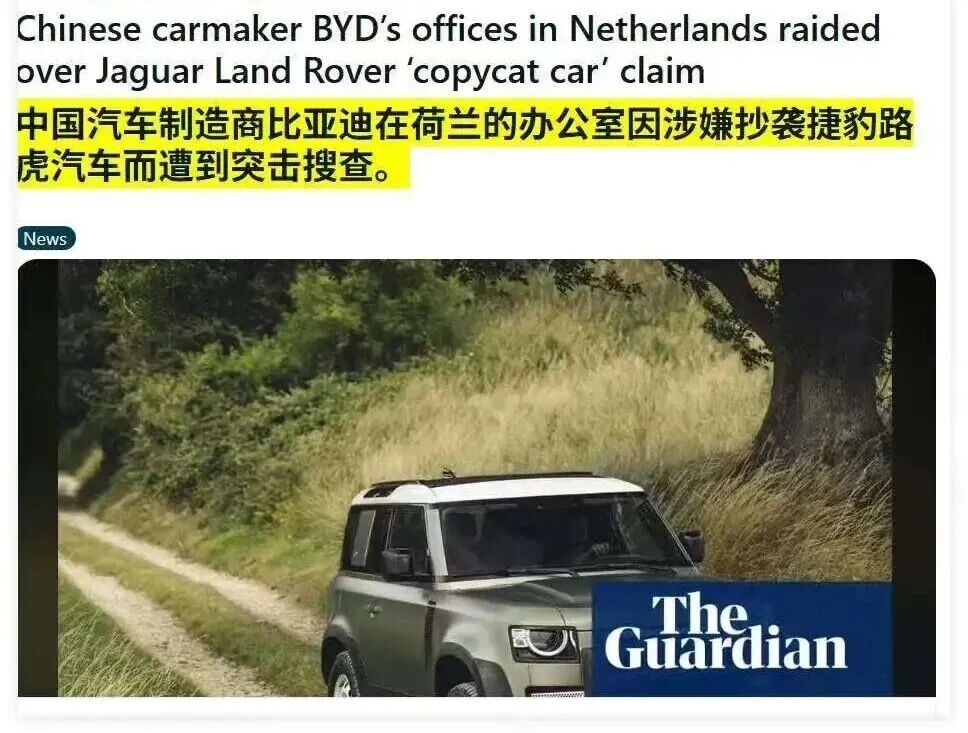
In August this year, with court authorization, enforcement officers representing Jaguar Land Rover conducted a surprise evidence-gathering operation at BYD's two offices in Schiedam and Hoofddorp in the Netherlands, seizing relevant digital materials. BYD's legal team characterized the search as a "fishing expedition," arguing that the scope of the seized documents was too broad and the targets were unclear, and filed an objection.
Earlier, in October this year, lawyers for both Jaguar Land Rover and BYD appeared at the Hague court. The core dispute centered on how the seized digital records should be used and which of them could serve as valid evidence in subsequent litigation. BYD's challenge remained that the search scope was too broad, while Jaguar Land Rover accused BYD of attempting to obstruct the evidence seizure process. In addition, Jaguar Land Rover had requested that BYD pay a fine of 500,000 euros, alleging that it failed to comply with the original seizure order. BYD argued that because Jaguar Land Rover's seizure was excessive, BYD should not bear these fines.
At this hearing, the presiding judge of the Dutch proceedings, Hugo van Heemstra, listened to BYD's arguments and held that Jaguar Land Rover's seizure of documents and archives from its Dutch offices constituted a "fishing expedition" beyond the scope of the plagiarism allegations.
Details disclosed at the hearing showed that court bailiffs copied electronic materials from the systems at BYD's Dutch offices and made physical copies of paper materials on the office premises. These materials included details of the Ti7's launch plan, technical data, sensitive financial information related to the vehicle, and all materials related to the Land Rover Defender in BYD's computer systems.
According to the ruling, Jaguar Land Rover must destroy the evidence taken from BYD's offices within 24 hours or return it to BYD, and must prevent the data from falling into the hands of any party other than BYD. Failure to comply within the deadline will result in a fine of 50,000 euros per hour.
At the same time, the judge also rejected Jaguar Land Rover's request for evidence preservation, pointing out that because the Ti7 has not yet been launched in the EU, Jaguar Land Rover could not prove that it had suffered harm due to the vehicle, and ordered Jaguar Land Rover to pay BYD 25,376.57 euros in litigation costs.
However, this ruling is only a procedural ruling concerning Jaguar Land Rover's seizure of BYD materials and does not address whether the Ti7 copied the Land Rover Defender.
In response to the court's latest ruling, BYD stated that in overseas intellectual property protection, the scope of evidence collection needs to match the product market and the burden of proof, and the scope of retrieval cannot be arbitrarily expanded. BYD also emphasized that it insists on forward development and, while complying with intellectual property laws and regulations of various countries, will also safeguard the brand's legitimate rights and interests.
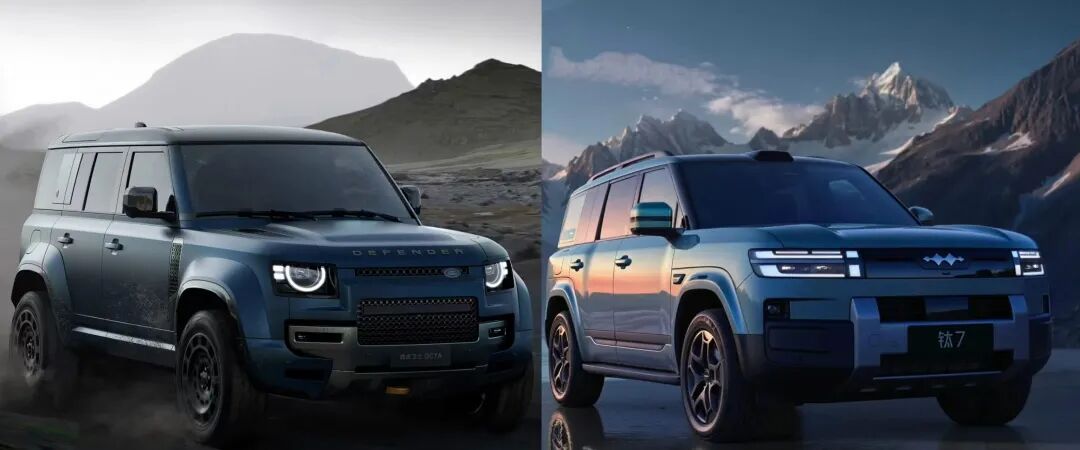
The matter arose on the eve of the Ti7's official entry into the European market. According to plan, the Ti7 will be launched in the UK in January next year. The Ti7 has already opened for ordering in the European market, with a starting price of 47,995 pounds (about 430,000 yuan). By comparison, the seven-seat Land Rover Defender 110 has a starting price in the UK of 68,465 pounds (about 610,000 yuan)—a difference of more than 20,000 pounds, or about 180,000 yuan.
The Defender is Jaguar Land Rover's best-selling vehicle and an important contributor to the company's profits. Although the Defender has a luxury brand heritage and hardcore off-road capability, the Ti7 offers a better smart cockpit and new energy powertrain, and coupled with pricing 20,000 pounds cheaper than the Defender, it may still divert some Defender consumers.
Foreign media analysis suggests that Jaguar Land Rover's lawsuit accusing the Ti7 of copying the Defender may be intended to prevent the Ti7 from entering the European market. However, based on the current progress, although Jaguar Land Rover has initiated relevant proceedings at the Hague and Rotterdam courts respectively, subsequent court hearings are still pending, and the case is expected to be unable to be fully concluded before the Ti7's UK launch in January next year. Especially considering the difficulty of obtaining evidence for Jaguar Land Rover's "reverse engineering" allegations against BYD, this case will not reach a result quickly.
-
![]()
Can Honda Thrive Without Leaning on China?
-
![]()
After Orders Exceed 10,000, It Suffers a Fierce Paid Poster Attack: Whose Turf Did the Second-Generation Blue Mountain Step On? | Mingjing Pro
-
![]()
Land Rover Loses First Round: Dutch Court Rules BYD Raid Was a "Fishing Expedition," Ti7 Copying Allegations Still Unresolved | Mingjing Pro
-
![]()
In October, AITO Sold 21,115 Units: Between the M6 and M9, Who Is Driving the Brand's Sales?
-
![]()
Changan Automobile's Domestic Terminal Sales Hit 104,000 in October: Qiyuan Begins to Drive Volume, Deepal at 20,000, Avatr at 2,858
-
![]()
Who in France Is Buying Chinese Cars?
-
Africa's Phone King Transsion, Pushed to a Transformation Crossroads by Memory Price Hikes
-
Apple Emerges as the Biggest Winner of Double 11, Crushing All Domestic Phone Brands, with Xiaomi Taking Second Place