Xiaomi Auto Sold 100,000 Vehicles in Q3 but Lost 3.4 Billion Yuan — What Went Wrong?
 11/26 2026
 344
Xiaomi Auto has released its financial report for the third quarter of 2026, reporting deliveries of 100,975 new vehicles. Yet the operating loss for its innovative business segment — which includes new energy vehicles and AI — reached 3.4 billion yuan. What exactly happened?
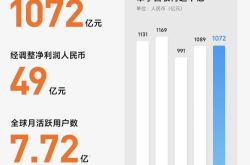
On November 24, Xiaomi Group released its third-quarter financial report. Revenue for the quarter came in at 107.24 billion yuan, down 5.2% year on year; net profit was 3.876 billion yuan, down 68.42% year on year; adjusted net profit was 4.884 billion yuan, down 56.8%; gross profit was 21.615 billion yuan, down 16.7%, with a gross margin of 20.2%. R&D spending for the quarter was 9.2 billion yuan, up 2% year on year, while R&D expenses for the first three quarters totaled 27.4 billion yuan, up 16.5%.
The innovative business segment — new energy vehicles and AI — which draws the most attention from the automotive industry, generated revenue of 23.884 billion yuan in Q3, down 17.7% year on year. Of that, new energy vehicle revenue accounted for 22.7 billion yuan, with the remaining 1.2 billion yuan coming from related businesses including AI. The segment posted a gross margin of 19.2% for the quarter and an operating loss of 3.4 billion yuan. That brought the cumulative loss for Xiaomi Group's innovative businesses, including new energy vehicles and AI, to 9.1 billion yuan for the first three quarters. In the same period last year, the total loss was just 100 million yuan — a clear sign that losses in this segment are widening.
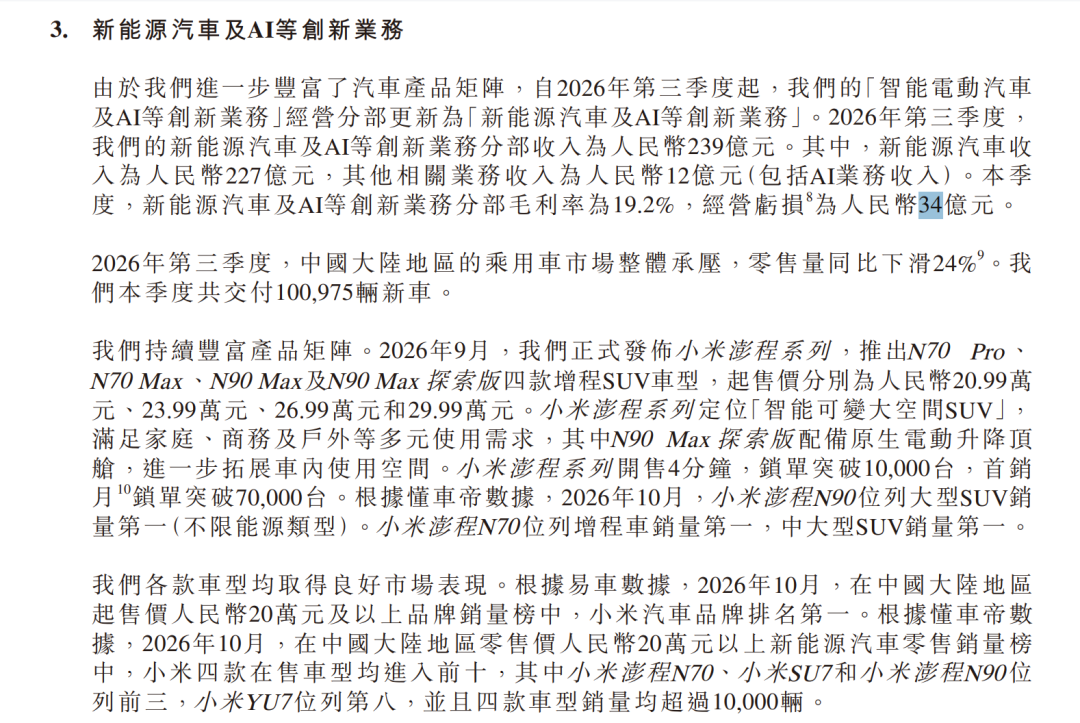
Xiaomi noted in its financial report that in the third quarter of 2026, the passenger vehicle market in mainland China came under broad pressure, with retail sales falling 24% year on year. Is that the main reason behind the losses in Xiaomi's new energy vehicle business?
Looking at deliveries, Xiaomi Auto delivered 100,975 new vehicles in Q3 this year, compared with 108,796 in the same period last year — a year-on-year decline of 7.2%. Against an industry-wide drop of 24%, a decline of just 7.2% suggests Xiaomi Auto is actually outperforming the broader market.
Looking at the average selling price per vehicle: Xiaomi Auto's vehicle revenue in Q3 this year was 22.7 billion yuan, implying an average selling price of 224,800 yuan per vehicle. In the same period last year, vehicle revenue was 28.3 billion yuan, with an average selling price of 260,100 yuan. For the full year of 2025, Xiaomi Auto's vehicle business revenue was 103.3 billion yuan, with an average selling price of about 251,200 yuan per vehicle. In the first three quarters of this year, vehicle business revenue was 65.6 billion yuan, with an average selling price of 229,400 yuan. These figures show that Xiaomi Auto's average selling price in 2026 has fallen by more than 20,000 yuan compared with the previous year — meaning its entire price range is shifting downward, which may not be good news for Xiaomi.
To further boost sales, Xiaomi launched two extended-range vehicles in September this year: the Xiaomi Pengcheng N90 and the Xiaomi Pengcheng N70. Official figures show that within four minutes of going on sale, the Pengcheng series received more than 10,000 locked orders, and locked orders exceeded 70,000 in its first sales month. According to Dongchedi data, in October 2026 the Xiaomi Pengcheng N90 ranked first in sales among large SUVs regardless of powertrain type, while the Xiaomi Pengcheng N70 ranked first among extended-range vehicles and first among mid-to-large SUVs.
Xiaomi Auto stated: "All of our models have achieved good market performance." According to Yiche data, in October 2026 Xiaomi Auto ranked first in sales among brands with a starting price of 200,000 yuan and above in mainland China. According to Dongchedi data, in October 2026, among new energy vehicles retailing for more than 200,000 yuan in mainland China, all four Xiaomi models on sale entered the top ten — the Xiaomi Pengcheng N70, Xiaomi SU7, and Xiaomi Pengcheng N90 took the top three spots, with the Xiaomi YU7 in eighth place — and all four models sold more than 10,000 units.
All four models are performing exceptionally well in the market, yet overall losses are widening — which may be Xiaomi's biggest concern.
According to the latest forecast from the China Passenger Car Association, domestic passenger vehicle retail sales in 2026 are expected to reach 18.5 million units, compared with 23.74 million in 2025 — a drop of 5.24 million units in a single year. That volume is back to 2014–2015 levels: in 2014, domestic passenger vehicle retail sales were about 17.75 million units, growing to 19.63 million in 2015.
In the extended-range vehicle market specifically, 2026 saw extended-range models as the only one of the three new energy categories — extended-range, pure electric, and plug-in hybrid — to decline. Meanwhile, just one month after the launch of the Xiaomi Pengcheng N70 and N90, SAIC Volkswagen's second extended-range vehicle, the ID. ERA 8X, officially went on sale. It has a longer wheelbase than the Xiaomi N70 but a smaller turning radius than the Pengcheng N70, and comes standard across the lineup with an 800-volt high-voltage architecture, with the top trim featuring Momenta R7 advanced intelligent driving. The Xiaomi Pengcheng N70 and N90, by contrast, use a 400-volt architecture across the lineup and are equipped with Xiaomi's self-developed intelligent driving system. On hardware, the two Xiaomi Pengcheng vehicles show a fairly obvious gap compared with SAIC Volkswagen's two extended-range models, the ID. ERA 9X and 8X. On price, the 9X is relatively more expensive, while the starting price of the 8X is even a few thousand yuan cheaper than the N70. That means if the Xiaomi Pengcheng series wants to perform well in 2027, it will have to contend with pressure from SAIC Volkswagen's two models. Moreover, looking at the overall market trend, the extended-range vehicle market will face severe pressure in 2027. As new models from Xiaomi Auto, whether the Pengcheng N70 and N90 can sustain market momentum is highly uncertain.
Looking at deliveries across the entire third quarter, Xiaomi had four models on sale, yet total deliveries were lower than last year's two models. Excluding the two extended-range vehicles, this means sales of the two hit models, the Xiaomi SU7 and YU7, are already on a downward trend. That is partly because both models have been on the market for some time and their novelty is fading. What's more, this trend is almost impossible to reverse — the only lever is price cuts, but cutting prices too aggressively would deepen losses.
For Xiaomi's automotive business, therefore, how to operate with greater precision in 2027 may prove to be critically important.
-
Apple Is Very Proud: I Sold 710,000 Fewer Phones, Yet Revenue Increased by 55 Billion!
-
Does Xiaomi Need to Go All In?
-
![]()
Xiaomi, Seeking a "New Rhythm"
-
![]()
Only 3 Years Left Before China's Auto Export Boom Ends?
-
![]()
Two Central SOEs Swap Equity Stakes
-
![]()
Aston Martin Appoints New Asia-Pacific Head as Volume Cuts Aim to Protect Pricing
-
![]()
BYD Set to Acquire French Factory, Macron Announces Publicly
-
![]()
Those Who Need a Personal Agent Most Are Middle-Aged People Starting to Become Forgetful