Lens Revenue Rockets 42%! What’s Behind Artini Optical’s HK$13.38 Million Loss?
 09/16 2026
 563
563
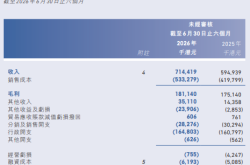
Artini Optical recently published its interim report, revealing a 20% year-on-year surge in consolidated revenue, reaching HK$714.4 million. Despite this growth, the company still reported a net loss attributable to its owners, narrowing to around HK$13.381 million, translating to a loss per share of HK 3.46 cents.
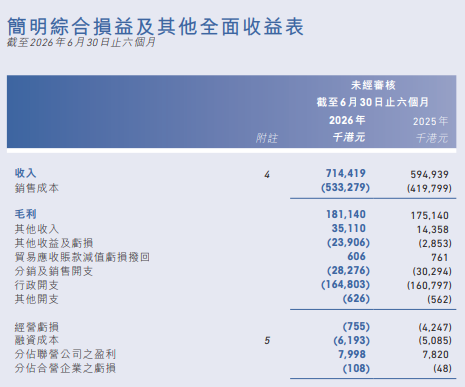
At first glance, the company seems to be incurring losses. However, a deeper dive into its business structure and recent capital maneuvers unveils that this seasoned eyewear manufacturer is at a pivotal moment of capacity expansion and business transformation. The signs of improvement in its operational fundamentals are arguably more significant than the reported profits or losses on paper.
In terms of segment performance, Artini Optical’s growth is propelled by three key business lines. The Original Design Manufacturing (ODM) segment accounted for 65% of the consolidated revenue, with customer sales climbing 23% year-on-year to HK$465.7 million. This increase is primarily attributed to a surge in orders from overseas customers, with Vietnamese production facilities securing additional orders.
The lens segment delivered the most remarkable performance, with revenue soaring 42% from HK$71.5 million in the same period last year to HK$101.7 million. This leap is credited to the Group’s further investment and capacity expansion in lens production facilities in China and Malaysia in 2025. The distribution segment experienced moderate revenue growth of 2%, reaching HK$147 million, with the German brand STEPPER continuing to be the most sought-after brand in this category.
It’s worth noting that roughly 98% of the lens segment’s revenue currently stems from the Asian market. The Group has plans to gradually extend this business to other regions. This geographical concentration underpins the current growth trajectory but also suggests potential for further expansion if the product and channel capabilities that have proven successful in Asia can be replicated elsewhere.
Meanwhile, the global lens industry is shifting towards high-quality, branded products. According to a Frost & Sullivan research report, consumer upgrades are transforming lenses from a mere tool for vision correction into a medium for fashion expression and health management. The penetration rate of functional products, such as blue light protection and progressive lenses, is on a continuous rise.
Despite the growth in revenue and gross profit, Artini Optical has yet to achieve profitability, mainly due to two non-operational factors. The report explicitly points out that losses were exacerbated by escalating local production costs stemming from RMB appreciation and a HK$5.2 million fair value loss on investment properties.
Since 2026, the strengthening RMB has exerted widespread pressure on export-oriented manufacturers. For exporters, costs denominated in RMB, such as raw materials, labor, and manufacturing expenses, are relatively inflexible. Meanwhile, the reduced foreign currency revenue upon conversion squeezes profit margins. It's important to note that some of the exchange rate impacts arise from period-end revaluation on the balance sheet date, representing book losses rather than actual cash outflows. Nonetheless, these still influence the current reported profits or losses.
During the reporting period, operating cash flow shifted from a net outflow of HK$3.1 million in the same period last year to a net inflow of HK$86 million. Capital expenditures decreased to HK$17.9 million, the debt-to-equity ratio dropped from 63% to 58%, and inventory turnover days shortened from 113 to 88 days. The significant improvement in cash flow provides financial flexibility for subsequent capacity investments and business expansion, indicating substantial progress in working capital management.
In the short term, RMB exchange rate fluctuations and investment property valuations remain key variables influencing Artini Optical’s pace of profit recovery. However, for a manufacturing enterprise in its investment phase, robust revenue growth and positive operating cash flow may be more indicative of the direction of its operational fundamentals than the reported profits or losses themselves.
During the transition period of the optical industry from traditional manufacturing to precision optoelectronics, Artini Optical’s capacity布局 (layout) and financial enhancements have secured a time window for transformation. Whether it can capitalize on opportunities in industrial chain (supply chain) restructuring driven by emerging demands such as AI eyewear hinges on its subsequent technological investments and customer acquisition efforts.
-
![]()
Industry-Academia Synergy! Hongshi Intelligent Partners with Tsinghua University to Overcome Key Hurdles in MicroLED Optics
-
![]()
Chengfeng Technology Shines at CIOE 2026: Bolstering the ‘Chinese Core’ of AI Optical Interconnection with Cutting-Edge Nanoscale Optical Inspection
-
![]()
Lens Revenue Rockets 42%! What’s Behind Artini Optical’s HK$13.38 Million Loss?
-
![]()
Can Seres Reclaim AITO’s Leadership? Will the ¥1.7 Billion Loss Be Reversed?
-
![]()
3 Billion Yuan: Can Neta Cars Stage a Remarkable Comeback?
-
Huawei and Seres 'Part Ways'? Seres Takes the Lead in Five Key Areas, Huawei Steps into a Supportive Role
-
![]()
Snatching Half-Yuan Electricity at Midnight, Complaining About Service Fees by Day: Who Exactly is Profiting from New Energy Charging Stations?
-
![]()
Restructuring of FAW and GAC: Not Just Merging North and South Toyota with 20 Billion Yuan