Global Automotive Lighting Industry Shake-up: Chinese Carmakers Dive into Lighting, Hyundai Mobis Exits
 10/14 2026
 374
374
The automotive lighting sector is in the midst of a significant transformation.
◎ Hyundai Mobis offloads its lighting division to France's OPmobility for $443 million.
◎ Chinese firm Xingyu rises to global top 10, while BYD, Leapmotor, and Great Wall Motors bring lighting production in-house.
So, what does the future hold for the automotive lighting industry? Does the $443 million deal signal the decline of traditional automotive lighting?
Part 1
China Dominates Complete Lighting Systems, Yet Mobis Exits
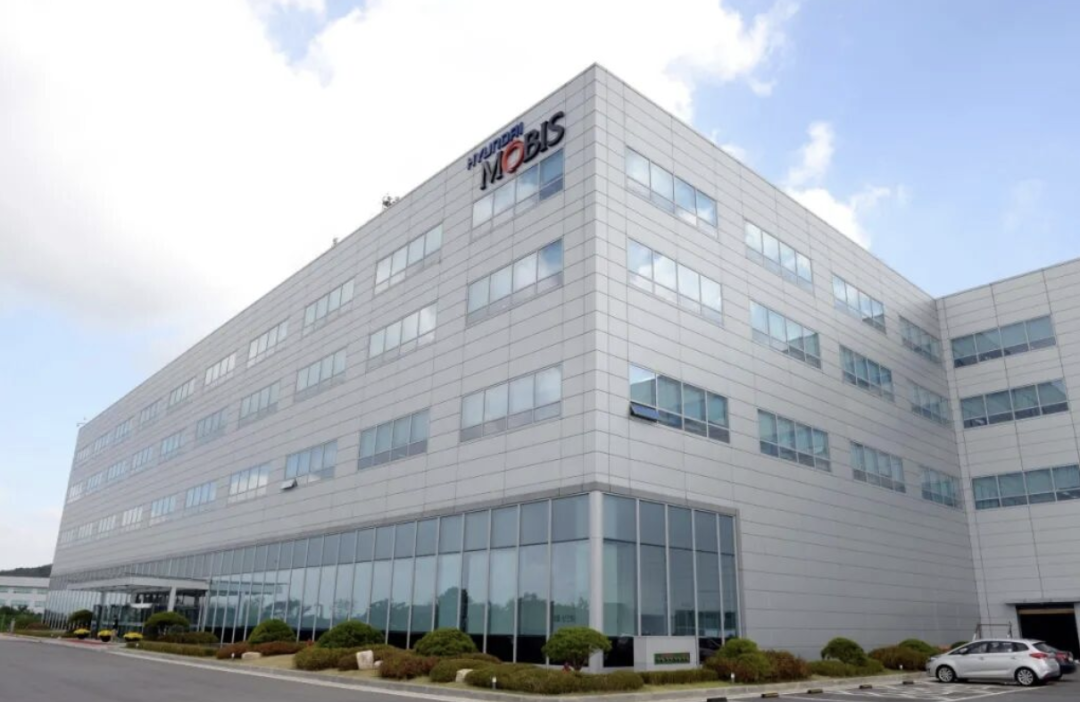
OPmobility acquires Hyundai Mobis' lighting business for approximately $443 million. The acquired unit generated roughly €1.6 billion in revenue in 2025, with a positive operating margin. However, its total enterprise value stands at just about €390 million, or 0.24 times the previous year's revenue.
Despite its global presence, OEM customer base, and mature R&D capabilities, this traditional automotive lighting business commands a surprisingly modest valuation.
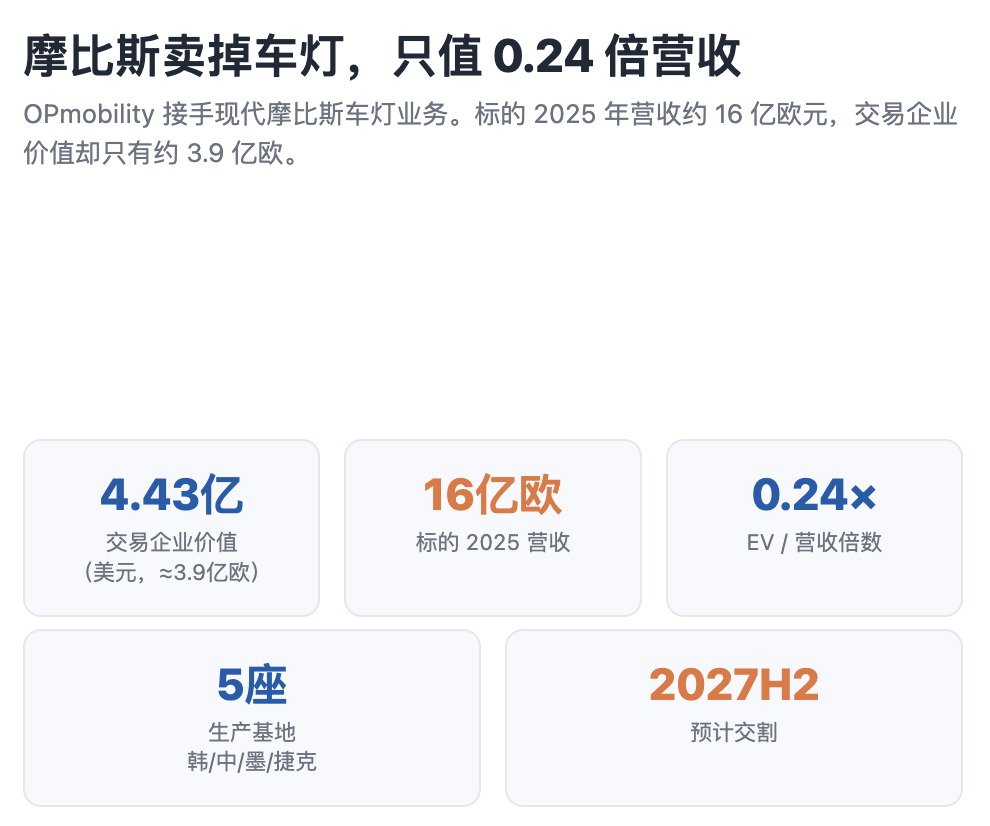
While the revenue multiple may suggest a bargain, full disclosure on EBITDA, capital expenditures, and debt is still pending. As lighting evolves from a simple illumination tool to an intelligent electronic system, the valuation logic for traditional lighting manufacturers is shifting.
OPmobility aims to deepen ties with Hyundai and Kia by integrating lighting and exterior modules. Meanwhile, Mobis divests to free up capital for electrification and automotive electronics investments.
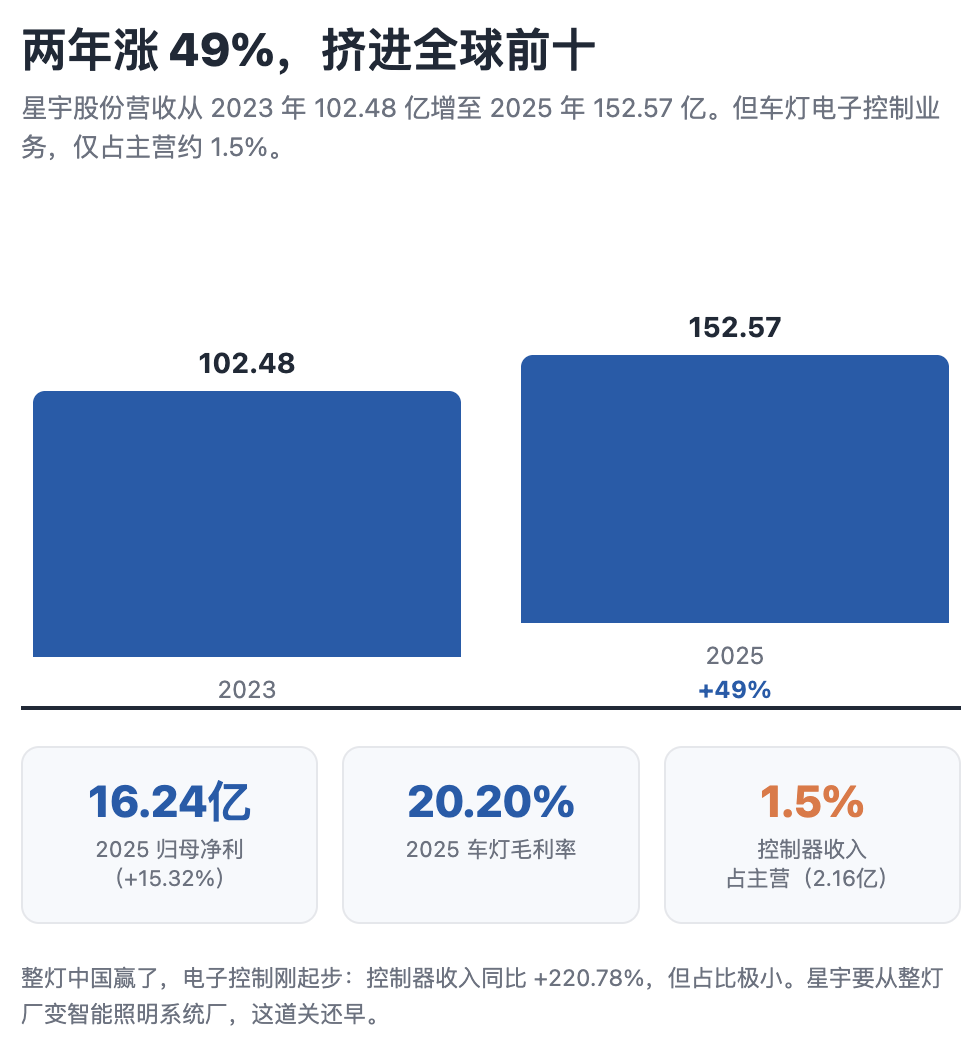
Xingyu has already established itself as a top 10 global automotive lighting supplier. In 2025, its revenue reached ¥15.257 billion, up 15.12% year-on-year, with net profit attributable to shareholders at ¥1.624 billion, up 15.32% year-on-year. From ¥10.248 billion in 2023 to ¥15.257 billion in 2025, cumulative two-year growth approached 49%.
Its client roster includes Volkswagen, Mercedes-Benz, BMW, Toyota, as well as Chery, Geely, NIO, Li Auto, XPeng, and Seres—without over-reliance on any single automaker.
More notably, automakers are increasingly involved directly.
◎ BYD's Fudi Vision focuses on lighting R&D and manufacturing, having developed over 50 models and 600 lighting variants since its 2020 inception.
◎ Leapmotor's Huzhou mega-factory handles batteries, electric drives, domain controllers, and lighting, with in-house R&D and manufacturing accounting for 65% of vehicle costs—lighting being a clearly defined in-house category.
◎ Great Wall Motors deploys complete lighting systems, optical modules, and electronic controls through Mand Electronic. China's automotive lighting landscape is expanding, from specialized suppliers to automakers' internal systems.
Part 2
Core Components Remain Foreign-Dominated; Domestic Substitution is the Next Challenge
Core Components Still Foreign-Dominated; Xingyu's Controllers Account for Just 1.5%
Viewing lighting as an electronic system reveals stark contrasts.
Xingyu's 2025 automotive lighting revenue reached approximately ¥14.362 billion, with controller revenue at just ¥216 million—up 220.78% year-on-year but accounting for only about 1.5% of main business revenue. While Xingyu promotes DLP, MicroLED, and lighting controllers, its revenue remains dominated by complete lighting systems.
Though lights are made in China, the MCUs running control logic and driver ICs are mostly imported.
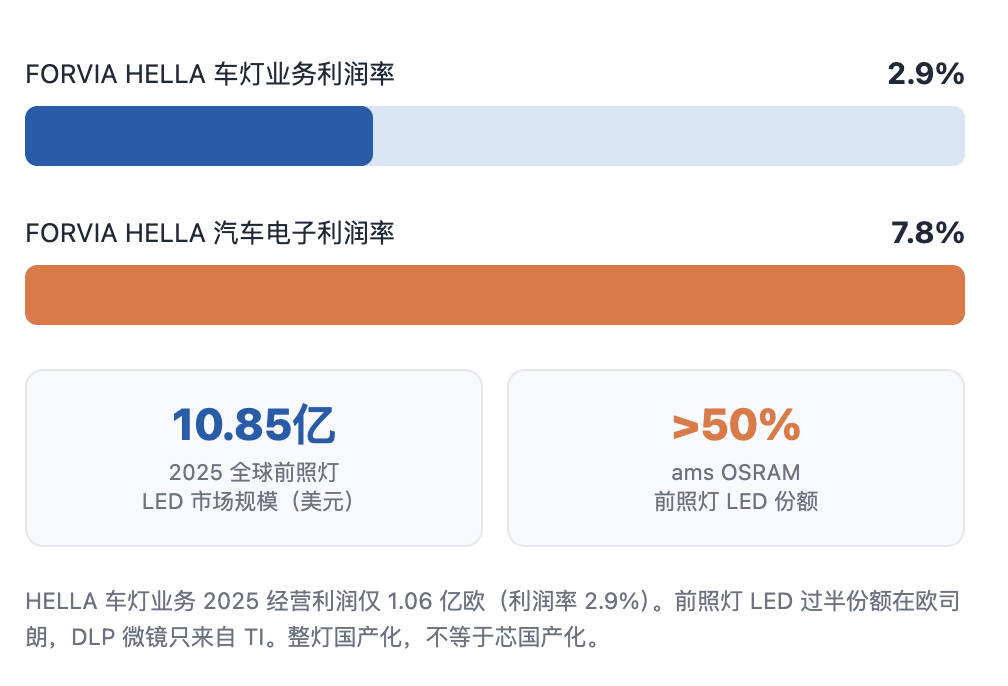
The light source market is even more concentrated. According to TrendForce's 2026 research, the 2025 global headlight LED market reached $1.085 billion, with ams OSRAM holding over 50% share.
This means that no matter how many complete lighting systems manufacturers produce, the most valuable optical chips still go to Osram.
NIO ET9's headlights exemplify this. While Marelli handles system integration, the critical pixel light source uses ams OSRAM's EVIYOS HD25 with over 25,000 independent pixels.
Chinese lighting manufacturers can build the housings, but high-end light sources and drivers remain constrained by upstream international suppliers.
ADB, MicroLED, DLP: Technology Tiers Determine Profit Distribution
Intelligent automotive lighting comprises five tiers:
◎ Basic illumination: LED sources and lenses, now widely adopted.
◎ Adaptive illumination: Matrix ADB with automatic dimming to reduce glare, penetrating more price segments.
◎ High-resolution illumination: HD-ADB and MicroLED, gradually expanding in high-end mass production.
◎ Digital projection: DLP and pixel projection, already in mass production but with high costs.
◎ Interactive illumination: MiniLED, OLED, and ISD light language, developing rapidly but constrained by regulations.
Two technological routes warrant comparison:
◎ ams OSRAM's EVIYOS HD25 uses 25,600 independently controlled pixels for light shaping.
◎ Texas Instruments' DLP5531-Q1 employs over 1.3 million addressable micromirrors for high-resolution road projection.
Pixel count alone doesn't determine overall lighting performance—light efficiency, heat dissipation, and driving methods vary significantly. However, one fact remains clear: these core components come from Osram and TI, not Chinese lighting manufacturers.
True competitive barriers lie in ADB's glare suppression, high-resolution beam control, and long-term reliability—not merely stacking LEDs.
One dataset illustrates operational pressures on lighting manufacturers. FORVIA HELLA's 2025 lighting sales reached €3.7 billion, down 8.3% year-on-year, with operating profit at €106 million—just a 2.9% margin. That same year, its automotive electronics operating margin stood at 7.8%. Higher-tech lighting doesn't necessarily yield greater profits for lighting manufacturers.
Lighting manufacturers bear precision injection molding, optical development, electronic assembly, tooling, testing, and factory depreciation costs. Meanwhile, upstream key light source and chip companies sell relatively standardized components to multiple lighting manufacturers.
This necessitates viewing two distinct markets separately:
◎ Complete lighting systems: Large scale but heavily influenced by project development, manufacturing, customer bargaining power, and capital expenditures.
◎ Light sources, driver chips, and electronic controls: Smaller scale but with high technical concentration in some products.
Opportunities in China's automotive lighting industry also fall into two categories:
◎ Xingyu and Hasco Vision expanding global share in complete lighting systems.
◎ Domestic light sources, optical components, driver chips, and lighting controllers entering high-end supply chains.
The automotive lighting industry's most fascinating aspect lies in its dual nature as both a traditional component and modern automotive electronics:
◎ One end involves molds, injection molding, coating, assembly, and project delivery.
◎ The other end comprises semiconductor light sources, software, electronic controls, and high-resolution optics.
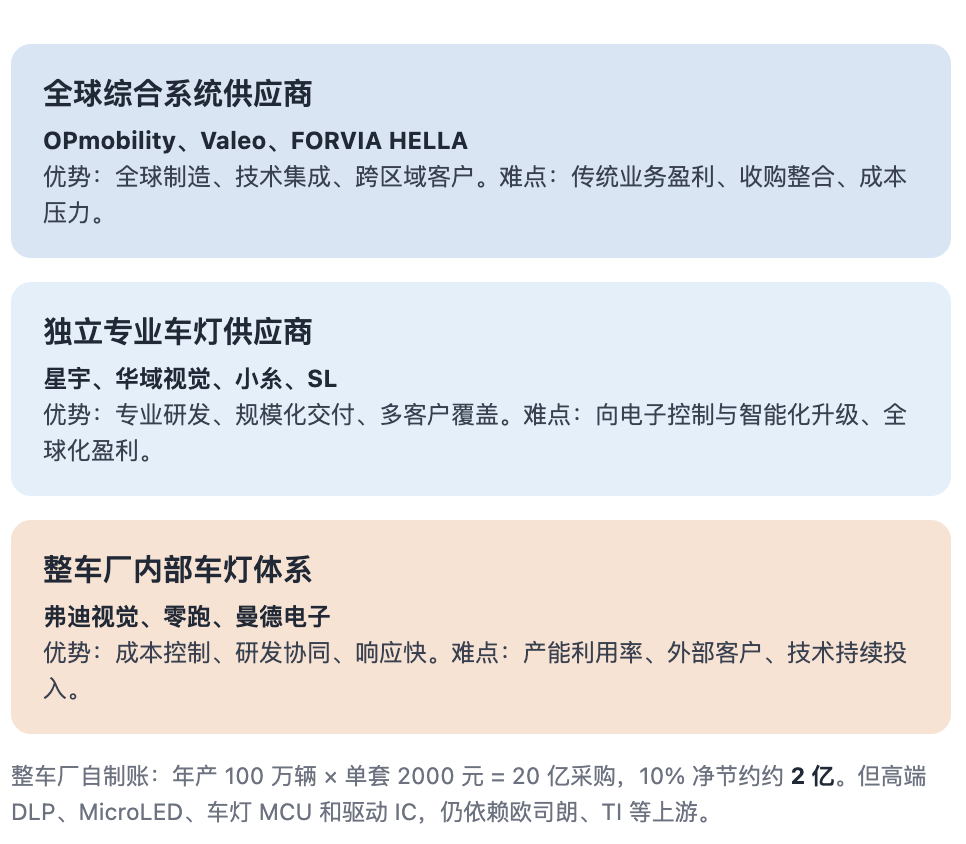
Hyundai Mobis divesting its lighting business, OPmobility continuing acquisitions, Xingyu capturing overseas clients, and BYD/Leapmotor increasing in-house production may seem contradictory but actually represent different corporate choices regarding industrial division of labor and cost structures.
For Chinese suppliers, localization of complete lighting systems has reached the global top 10. The next challenge is localizing critical components:
◎ Xingyu and Hasco Vision's domestic and international project revenue and gross margins will reveal whether globalization truly generates profits.
◎ Fudi Vision, Leapmotor, and Mand's complete lighting capacity versus external supply ratios will show how much independent Tier 1 market share automakers' in-house production captures.
◎ Actual installation rates of ADB, HD-ADB, DLP, and MicroLED will indicate whether technological upgrades translate to market growth.
◎ Most critically, whether domestic light sources, automotive lighting MCUs, and driver ICs secure high-end project design wins will mark the true watershed from complete lighting localization to critical component localization.
Conclusion: The Lights Are Made in China
Opportunities remain in the automotive lighting industry, but different types of companies must be evaluated separately. Traditional lighting manufacturers face inventory competition and structural upgrades. Xingyu and Hasco Vision have opened internationalization windows. BYD and Leapmotor's in-house production will continue as part of vertical integration. Meanwhile, semiconductor and optical component companies face new opportunities from intelligent lighting upgrades.
-
![]()
How 79-Year-Old Lao Gan Ma Founder Tao Huabi Leveraged AI to Achieve 5.4 Billion Yuan in Revenue
-
![]()
Breaking News! Doubao Faces a Collective 'Ban' from Tencent, Alibaba, and Others for Attempting Mobile Phone Manipulation
-
![]()
How Robust Are China’s New Energy Vehicles? A Look at Eight Months of Global Market Sales
-
Competition in Ecosystems: AI’s Next Frontier
-
![]()
The cost per vehicle is 73,000 yuan higher in Europe than in China; European markets can't stop Chinese cars by any means
-
![]()
Why Has Renault, Which Doesn't Sell Cars in China, Become the Biggest Winner in Europe?
-
![]()
ZTE: First-Half Net Profit Plummets Over 40%, Computing Business Grapples with Low-Margin Challenge
-
![]()
OPPO Could Be Manus's First Domestic Partner?