Industry | Memory Prices Surge 171%, AI Snaps Up Production Capacity, Smartphones and PCs Become 'Sacrificial Victims'
 12/26 2025
 723
723
Preface:
As storage transitions from a [secondary accessory] in consumer electronics to [core infrastructure] in the AI era, a realignment of global supply chains is inevitable.
Behind this storm lies the AI industry's voracious appetite for storage capacity, with impacts lasting through 2028 and rewriting the rules of the consumer electronics market.
Image Source | Network
Collective Pressure from Local Assemblers to Global Giants
[8GB-3200MHz DDR4 memory modules with Hynix/Samsung particles averaged 70 yuan/stick before September but surged to 350 yuan by mid-December, a 280% increase.]
Secondhand disassembled memory and overseas-refurbished [e-waste] storage products followed suit, eliminating even the buffer space of the cost-effective used market.
Consumer-grade price hikes are just the tip of the iceberg. Global tech giants have begun raising prices.
Dell led with a 10%-30% price increase for commercial PCs starting December 17. Pro series laptops with 32GB memory rose by $130-$230, while 128GB top-tier models jumped $520-$765.
Lenovo, HP, Acer, and ASUS followed suit. Lenovo's CFO stated [price hikes are inevitable by 2026], while HP revealed plans to adjust prices after mid-2026 inventory depletion, possibly introducing lower-spec models.
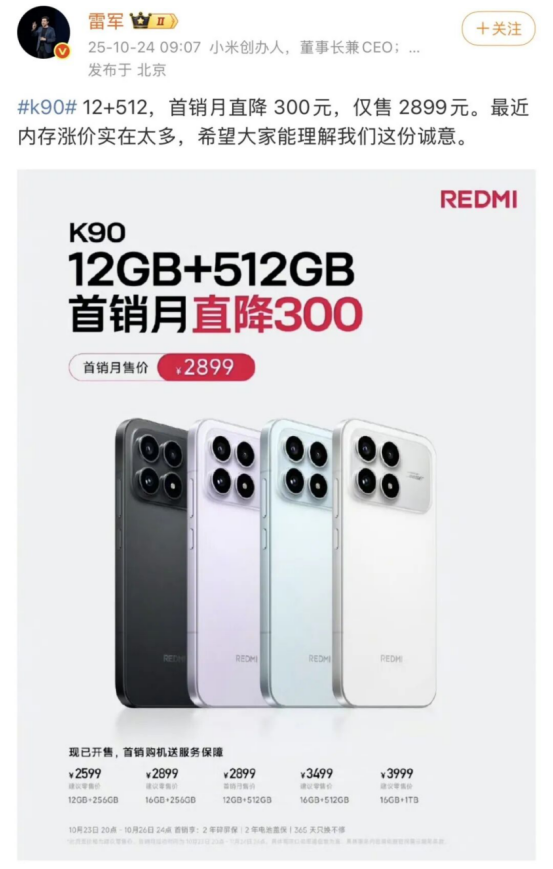
Smartphone makers face direct pressure. The Redmi K90 series launched at 3,199 yuan for the 12GB+512GB version, widening the price gap from the previous K80 series' 400 yuan to 600 yuan.
This is just the beginning. The vivo X300 series and OPPO Find X9 series saw 100-300 yuan increases, while Samsung's Galaxy S26 series is expected to start above 6,000 yuan, nearly 20% higher than the S25.
The price surge spread faster than expected. Previously, terminal manufacturers could buffer chip price hikes for 3-6 months via inventory. However, this time, the magnitude and speed of memory chip price increases left Xiaomi, OPPO, vivo, and other top smartphone makers with inventories below two months, and some with DRAM stocks under three weeks, unable to absorb cost pressures.
Research firm TrendForce downgraded its 2026 global smartphone and laptop shipment forecasts from slight growth to annual declines of 2% and 2.4%, respectively.
Tight consumer electronics memory supplies and high prices will drive negative growth in smartphones and laptops by 2026. Mid-range products face the greatest impact, forcing manufacturers to accelerate premium transitions while low-end models risk [producing more, losing more] scenarios.
The Core Logic Behind Memory Price Hikes
This global storage storm stems not from traditional industry cycles but from structural capacity shifts driven by the AI boom.
As tech giants like OpenAI, Google, and Microsoft launch an [AI arms race], memory chips have evolved from consumer electronics components into strategic AI infrastructure materials.
While AI servers require high-bandwidth memory (HBM) similar in function to consumer DDR4, their production processes and performance requirements differ entirely.
HBM's high margins, exceeding three times those of standard DDR4, have become a magnet for manufacturers' capacity shifts.
A single AI server demands eight times more DRAM and three times more NAND than a standard server, while producing equivalent HBM capacity consumes over three times the wafer volume of standard DRAM.
Faced with such demand and profitability, the world's top three storage giants—Samsung, SK Hynix, and Micron—have collectively pivoted.
SK Hynix, the first to mass-produce fifth-generation HBM, nearly monopolizes NVIDIA's orders, with 2025 and 2026 capacities fully booked. Samsung's HBM products have entered NVIDIA's H100 supply chain.
To secure HBM production, these giants have reconfigured their lines, directly squeezing consumer-grade memory chip capacity by 20% and creating supply gaps.
While HBM's capacity grab represents [incremental extrude (incremental compression)], DDR memory's generational shift and discontinuation have driven [stock shrink (stock contraction)].
Under AI-induced capacity pressures, storage giants have chosen to [abandon low for high].
In early 2025, Samsung, SK Hynix, and Micron announced a focus on higher-margin DDR5, planning to halt DDR4 production by the end of 2025.
Domestic giant Changxin Memory followed suit, planning to fully discontinue DDR4 supplies by the first half of 2026.
This decision has made DDR4 the fastest-rising category, with prices for some industrial DDR4 models surging to 5-6 times their early-year levels.
Meanwhile, DDR5 prices have not been spared. Despite being a new generation, AI servers' strong DDR5 demand led the top three to allocate 70% of their capacity to HBM and DDR5, tightening DDR5 supplies.
Third-party data shows DDR5 particle prices surging over 90% monthly, with Q4 2025 contract prices up 75% year-on-year. Even manufacturers planning to switch to DDR5 face [five-to-six-month backlogs].
A rare phenomenon in this storage cycle is that memory manufacturers have become among the few able to wield pricing power against NVIDIA.
In November 2025, SK Hynix gained the upper hand in sixth-generation HBM supply negotiations with NVIDIA, securing a price increase exceeding 50%.
This pricing power reversal has solidified the [seller's market] dynamic.
The top three storage giants control over 90% of the global DRAM market, forming an [OPEC-like] oligopoly whose capacity adjustments can shake global markets.
AI giants' [strategic necessity] for storage and low price sensitivity empower manufacturers to keep raising prices.
Critically, storage manufacturers show little willingness to expand production. After the 2023 downturn, which saw Samsung hit a 14-year profit low, giants remain cautious about overcapacity risks if AI demand falters.
SK Hynix internal documents reveal new DRAM factories require years to reach full operation, with new capacity not arriving until 2028, implying years of supply tightness.
AI Industry's Reconfiguration of Consumer Electronics Supply Chains
The essence of this storage storm is the AI industry's reconfiguration of traditional consumer electronics supply chains. Over the next few years, the global memory market will exhibit a [two-tier] dynamic.
AI server memory demand continues to explode, with DRAM needs rising 21% and NAND Flash demand surging over 70% by 2026.
Faced with AI's high-profit allure, the top three storage giants—Samsung, SK Hynix, and Micron—have uniformly adjusted their strategies.
Micron directly terminated its nearly 30-year-old consumer brand Crucial to focus entirely on data center Customer requirements (customer demands).
Samsung redirected over 80% of its advanced capacity to HBM and other premium products.
This strategic shift has directly contracted consumer-grade memory production. The AI industry's massive capacity absorption has led major suppliers to abandon [fragmented, low-volume] markets that primarily served consumer electronics.
Industry data shows DDR4 memory prices surging over 200% in six months, with server-grade DDR4 rising 30%-70% in one month.
UBS predicts DRAM shortages will persist through Q1 2027, with NAND shortages extending to Q3 2026.
During this period, memory chips will enter a [super cycle], with the global storage market potentially reaching $300 billion by 2027.
As Samsung, SK Hynix, and Micron pivot to AI-related products, a rare window has opened for domestic storage manufacturers.
Data shows domestic storage chips typically cost 15%-20% less than imported equivalents in 2025. A smartphone with a 500-yuan storage module could save 75-100 yuan by using domestic chips.
Changxin Memory launched China's first domestic DDR5 product in November 2025, boasting speeds up to 8,000Mbps.
A month earlier, the company released LPDDR5X for low-power scenarios like smartphones and laptops.
Luo Xiaodong, head of Changxin's marketing center, emphasized China's need for stable domestic DRAM production to reduce reliance on overseas suppliers.
Currently, domestic storage companies are at a critical stage of capacity expansion and technological breakthroughs.
SMIC's NOR Flash, NAND Flash, and other specialty storage products have seen sufficient orders due to this spillover effect.
GigaDevice plans to mass-produce its self-developed LPDDR4X series in 2026 and has initiated R&D for small-capacity LPDDR5X products.
Additionally, domestic manufacturers are expanding into servers and IoT. Demingli's enterprise-grade SSDs customized for Alibaba Cloud's [Panju Server] mark a successful entry into top cloud providers' supply chains.
However, domestic storage still faces shortcomings. In high-performance storage media like HBM and high-speed interface technologies, a generational gap remains compared to Samsung and SK Hynix.
In the medium to long term, only by achieving breakthroughs in HBM and other core technologies can domestic storage truly break through.
Epilogue
In Samsung and SK Hynix factories, machines roar day and night, but the production lines now flow with high-bandwidth memory for AI servers rather than memory modules for ordinary PCs.
Market laws are ruthless: when a single customer can lock in 40% of global supply, resource allocation becomes swift and intense.
There has never been a public policy debate weighing whether accelerating AI development justifies rising consumer computing costs.
The 2026 consumer electronics market will inevitably face turbulence, with price hikes, specification reductions, and product mix adjustments becoming the norm.
Partial Source References: Dianchang: 'Behind Memory Price Hikes: AI Storage is [Devouring] Smartphones and PCs', China Entrepreneur: 'Crazy Memory Prices, Hyped into [Gold Bars]', Nanfeng Window: 'Memory Sticks Rising Faster Than Gold', Financial Associated Press: 'Global [Memory Shortage] Intensifies'
-
![]()
Even a Titan Like Musk Has Faced Setbacks in Fulfilling Promises
-
![]()
AI Office: The End of the Racing Era, Context Becomes the Key to Success
-
![]()
Domestic Vehicle Chassis Revolution ②: The Steering Wheel Remains, But Mechanical Connections in the Steering System Are Decreasing
-
![]()
Exploring MiniMax Design: Can Video Editing Be as Simple as Speaking?
-
![]()
Why Can SenseTime Achieve Profitability While CloudWalk Still Faces Challenges, Despite Both Adopting Large Models?
-
![]()
Domestic Car Chassis Revolution Part 3: Suspension Systems Transform Vehicle Posture, from Vibration Absorption to Active Force
-
![]()
Hainan is Going on a Crazy Satellite-Building Spree
-
![]()
Optics Determines Success in the XR Era: Wafer Production Reaches Millions, Industry Giants Join the Fray!