DeepSeek V4 Is on the Brink, Sparking a Prosperity Surge
 01/13 2026
 479
479
“Chip” Original — NO.77
A fresh wave of growth is poised to take off. The current game plan is straightforward: prioritize implementation over models, and efficiency over mere technology.
Produced by I Chip Trend IC
ID: I xinchaoIC
Image: I unsplash
Just as the wind rises from the tips of green reeds and waves form from tiny ripples, so too do technological revolutions begin with subtle shifts.
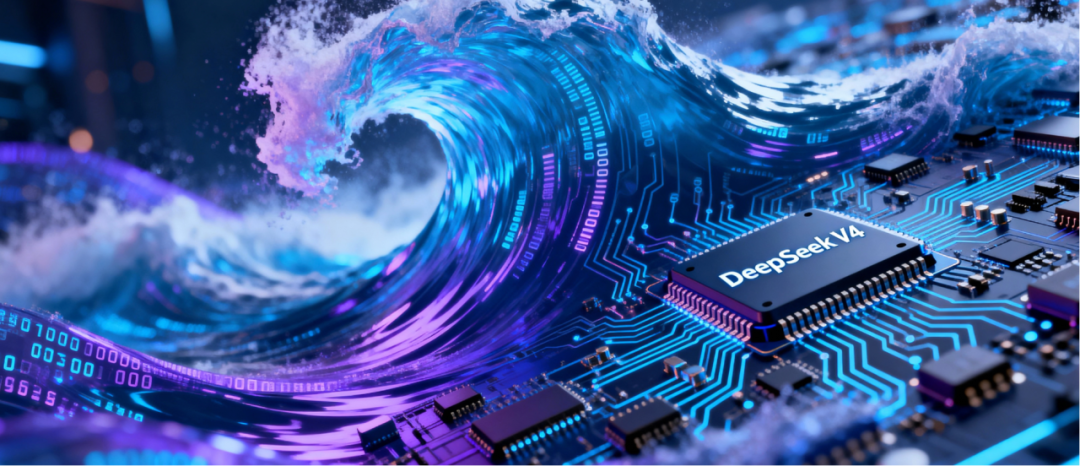
Recently, whispers about the impending launch of DeepSeek V4 have been circulating persistently in both tech and industrial circles. Unlike past large-scale model upgrades, the buzz in the market doesn't revolve around “doubling parameters” but rather centers on deeper system-level integration and efficiency enhancements.
For the average user, this might just be another tech headline. For investors, it opens a new window of opportunity. But for companies in the AI, chip, and hardware sectors, it signals the dawn of a new era filled with opportunities and challenges.
Whoever can harness this wave of change may secure a spot on the main track for the next decade; those who falter will be left behind.
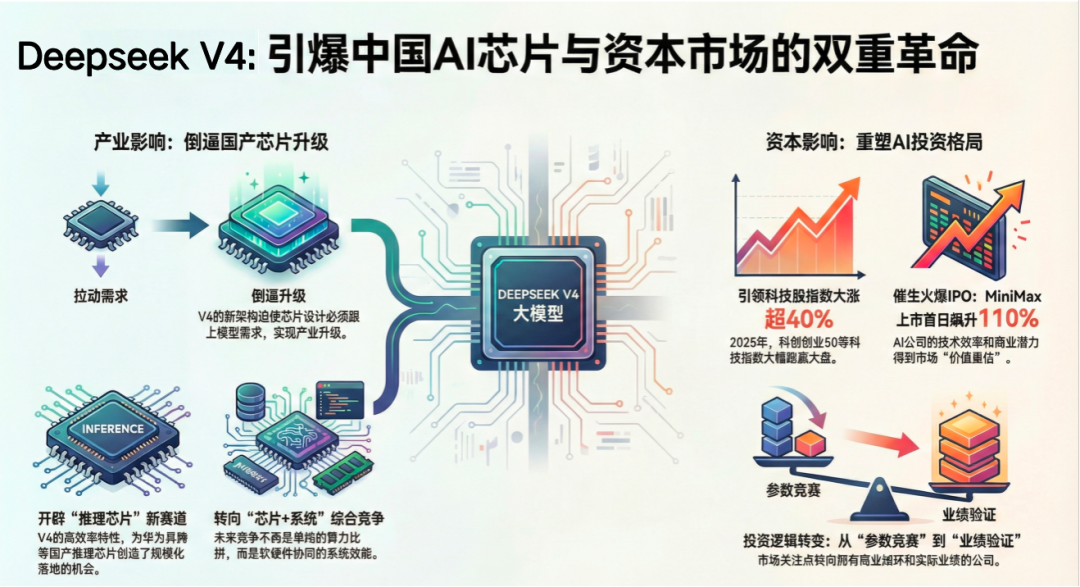
DeepSeek V4 Launch: Who Will Rise? Who Will Face the Ultimate Test?
Over the past year, the global AI industry has been singularly focused on one theme: computing power.
Those who can acquire more H100s edge closer to the next generation of large models; those who can construct a 10,000-card cluster stand atop the industry food chain. This narrative holds true in the United States and has been globally reinforced. However, it has encountered a practical stumbling block in China.
DeepSeek, dubbed the “price destroyer,” was initially revered in the tech community not for its parameter scale but for its ability to “maximize system efficiency” with limited computing power.
DeepSeek-MoE (Mixture of Experts) isn't just an engineering marvel; it's a highly pragmatic survival strategy. When neither single-card computing power nor cluster scale offers an advantage, redefining “cost-effectiveness” through architecture, scheduling, and algorithmic efficiency becomes imperative. In essence, DeepSeek's competitiveness lies not in being the “strongest” but the “most efficient.” It's this extreme efficiency that has unveiled true system-level capabilities.
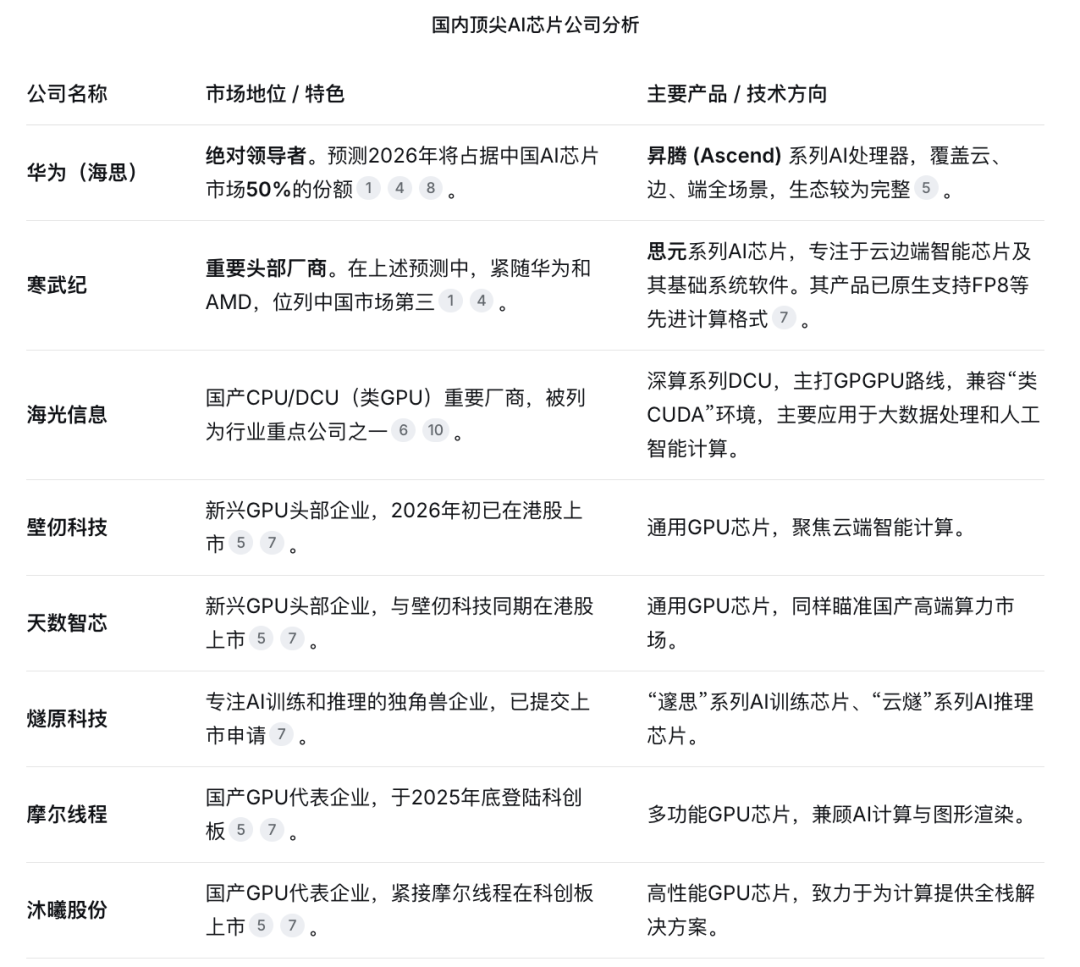
Around DeepSeek V4, the market's most commonly misused claim is that it's “good for domestic AI chips.” While there's some truth to this—with the release around the Spring Festival potentially reigniting enthusiasm for AI chips in the capital markets—the harsh reality is often overlooked.
Over the past two years, the procurement logic for domestic AI chips has seen a significant amount of “buying for the sake of buying.” Compliance requirements, strategic statements, and demonstrative significance have driven domestic cards into data centers. But the reality is stark: sales volume doesn't equate to usability, and inventory doesn't equate to productivity. Many chips, once purchased, face ecosystem incompatibility or can only support simple demos, far from real-world production.
When a model with dominant capabilities starts defining operator implementations, communication libraries, and scheduling mechanisms, it essentially sets hardware standards. The future logic will shift: instead of models adapting to chips, chips must perfectly support models.
“Can it run DeepSeek V4?” will, for the first time, drag domestic chips from conceptual narratives back to cold, hard performance metrics. This isn't a one-sided boon but a fierce battle where software forces hardware to mature, and many companies will be swiftly eliminated.
Only those capable of delivering will stay in the game;
Those who can't, even with orders, will be marginalized.
Domestic computing power is transitioning from a “all flowers bloom together” greenhouse to a “survival of the fittest” arena.
2026
A New Wave of Hardware Growth Is About to Begin
If you view DeepSeek V4 solely as a model upgrade, it might seem unremarkable. But when you step back, it serves as an industrial signal, indicating that the hardware ecosystem is about to enter its next phase.
Why might 2026 become the “hardware boom” year?
Because DeepSeek V4 fills in the missing link in the logical chain: the lightweighting of high-performance models becomes the catalyst for an “edge revolution.” Several long-accumulating variables are now converging at the same point.
The first logic: the transformation of AI's form.
Over the past two years, AI's main battleground has been in the cloud. Users “utilize models” rather than “own computing power,” with terminal devices requiring only internet connectivity. Performance improvements have been more of a bonus.
But starting in 2025, this dynamic is shifting. Model capabilities are beginning to spill over to the edge, with privacy, latency, and power consumption gradually transitioning from technical parameters to real needs. Devices are no longer just entry points; they must possess computing, storage, and sensing capabilities to fulfill their roles as “intelligent agents.”
The efficient model path represented by DeepSeek V4 makes edge deployment feasible for the first time. Once AI no longer relies entirely on the cloud, hardware can't remain stagnant. It's not that hardware wants to upgrade; it's that AI forces hardware to upgrade. When devices can no longer run the latest models, device replacement shifts from an “option” to a “necessity.”
The second logic: the maturity threshold of computing power structures.
This round of AI competition has long since moved beyond merely stacking GPUs. Computing power is shifting from general-purpose to heterogeneous computing, from single-chip performance to system-level collaboration, and from “computing fast” to “computing efficiently.” This necessitates simultaneous updates across the entire hardware chain: high-bandwidth memory, advanced packaging, optical interconnects, power management, cooling, and materials.
In 2023–2024, these technologies were still being validated;
in 2025, they gradually matured;
by 2026, they will enter a window for scalable deployment.
At this juncture, the true scarcity isn't the technology itself but who can adopt it first and who can implement system-level solutions first. What DeepSeek V4 represents isn't continuous scaling up but truly running models smoothly under given conditions. This path aligns perfectly with changes in computing power structures.
The third logic: the suppressed device replacement cycle.
Post-pandemic, the global consumer electronics industry has experienced a prolonged period of destocking. Manufacturers have been cautious, products conservative, and users have delayed decisions. But demand hasn't vanished; it's merely accumulated.
Almost every hardware cycle begins with a generational leap in experience, not just parameter upgrades. When AI brings clear new scenarios, coupled with enterprise-side device renewal needs, the pent-up demand from previous years will be unleashed en masse. 2026 is almost certain to be the year of fulfillment.
Meanwhile, user-side dynamics are also evolving: hardware once again has a clear, compelling narrative. Over the past decade, upgrade reasons have been limited to “thinner, faster, more power-efficient,” with rare generational leaps and insufficient motivation to replace devices. AI redefines boundaries, allowing users to perceive that “this generation is truly different.”
Thus, 2026 matters not because it's destined to explode but because, at that point, model capabilities, computing power structures, industrial cycles, and user experiences will all align in the same direction for the first time.
When Technology Becomes Affordable: The Real Winners Are Never Peers
The greatest “danger” for Chinese companies lies in their ability to swiftly engineer and scale technologies, deploying them across all niche scenarios once technical barriers are lowered.
If DeepSeek V4's engineering and programming capabilities truly approach or even surpass those of Claude 3.5 Sonnet or GPT-4o, the first barriers to fall will be those in application and software development.
SaaS, internal systems, and customized development will no longer heavily rely on large teams of junior engineers. Capabilities will be absorbed by models, and efficiency will be amplified by systems. The timeline for Chinese software products from conception to deployment will shrink further—exactly the rhythm Chinese companies are most adept at.
The manufacturing sector will face particularly direct impacts.
Past industrial digitalization efforts have largely addressed record-keeping and process issues, but the systems were rigid, expensive, and costly to adjust. With the emergence of models like DeepSeek V4 that enhance engineering understanding, industrial systems can now be “generated on demand and adapted quickly” for the first time. Business personnel can use natural language to call up data, analyze anomalies, and participate in decision-making, with systems becoming integral to the decision-making process rather than just tools.
This also means that industrial software companies will face true differentiation. Future competition will no longer revolve around who sells systems but who can embed models into real production processes. Those still stuck in one-time delivery, heavy customization, and slow iteration logic may be swiftly replaced by model-driven new paradigms.
More importantly, AI adoption in China may proceed faster and more aggressively than many anticipate. Projects that once required million-dollar budgets may now be compressed to tens of thousands or even thousands of dollars. This will significantly boost AI penetration in second- and third-tier cities and among small and medium-sized enterprises, well above the global average.
Chinese companies will leverage AI—this “high technology”—to systematically drive down costs across all traditional businesses once again.
Epilogue
A Decade of Prosperity Awaits
Looking back at internet history, this path isn't unfamiliar. Many technologies weren't pioneered in China, but China pushed them to extremes through its complex and real-world application scenarios.
If DeepSeek V4 represents engineering wisdom forced by reality, then China's vast industrial and commercial landscape serves as the best accelerator for this wisdom. Today, we're defining a new track in an extremely pragmatic and uniquely “Chinese” way—“low computing power thresholds, high engineering efficiency, full-scenario adoption.” This path may not be elegant, even muddy, but it often leaves the deepest footprints.
For entrepreneurs and investors, the current strategy is clear:
Don't bet on models; bet on implementation. Don't bet on technology; bet on efficiency.
The storm is approaching—please fasten your seatbelts.
Disclaimer:
1. The content of this article is original to Chip Trend IC. The views and opinions expressed are for reference only and do not constitute investment advice. All information cited is from publicly available market sources, and we make no guarantees regarding its accuracy or completeness.
2. This article may not be reproduced, copied, published, or quoted without permission. For reprints, please contact us.
-
![]()
Registered Capital Slashed to 372 Million Yuan! Yutong Optical Finalizes Industrial and Commercial Change Registration
-
![]()
Zhuque-3 Successfully Lands, and 'Time Traveler' Secures Another ¥100 Million in Funding: China's Commercial Space Industry Experiences a 'Dynamic August'
-
![]()
Autohome Faces a Shrinking Window of Opportunity
-
![]()
Even a Titan Like Musk Has Faced Setbacks in Fulfilling Promises
-
![]()
AI Office: The End of the Racing Era, Context Becomes the Key to Success
-
![]()
Domestic Vehicle Chassis Revolution ②: The Steering Wheel Remains, But Mechanical Connections in the Steering System Are Decreasing
-
![]()
Exploring MiniMax Design: Can Video Editing Be as Simple as Speaking?
-
![]()
Why Can SenseTime Achieve Profitability While CloudWalk Still Faces Challenges, Despite Both Adopting Large Models?