Apple Makes a Bold Move! Collaborates with Google Gemini to Overhaul Siri, Posing a Threat to Domestic Phone AI Dominance?
 01/14 2026
 634
634
Apple Shows Humility, Siri Gets a Makeover
As the saying goes, life is full of unexpected twists.
Just yesterday, on January 12, 2026, a groundbreaking event occurred in the tech realm: Apple and Google, two longstanding adversaries locked in a fierce battle in Silicon Valley for over a decade, officially declared their 'alliance.'
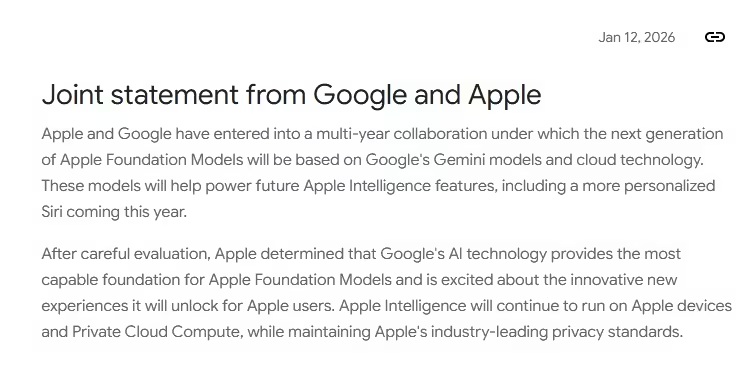
(Image Source: X)
Honestly, my initial reaction upon seeing this news was, 'Is this some kind of April Fools' joke that's a year too early? The timing seems a bit off for such a prank!'
But after verifying the sources multiple times, I realized this was indeed happening.
According to the joint statement issued by Apple and Google, the two companies will collaborate to drive the next generation of 'Apple-branded AI.' Apple's upcoming foundational AI model will be built on Google's Gemini and its cloud technology, supporting various Apple Intelligence features, including a new, personalized Siri.
Wow, considering that when Steve Jobs was still at the helm, he vowed to wage a 'thermonuclear war' to annihilate Android, and now Apple, to stay competitive, has extended a hand of friendship to Google.
Judging by the reactions of many Apple enthusiasts, they seem somewhat disheartened by this decision. However, there are also many who believe it makes perfect sense. After all, users have endured Siri's 'artificial stupidity' for far too long. If Siri can truly acquire a high-IQ brain, regardless of whether it's Apple-branded or Google-branded, as long as it performs well, that's all that counts.
So, I spent an entire night delving into announcements and technical documents from overseas to unravel the complexities behind this move.
Siri Lagging Behind: Why Has Apple's In-House AI Development Stalled?
'Apple Intelligence is a flop!'
Believe it or not, for the past two or three years, this has been the prevailing sentiment among most foreigners when discussing Apple's AI capabilities online.
Of course, you'll also encounter various other descriptions, such as 'useless' or 'pathetic,' but the core argument remains unchanged.
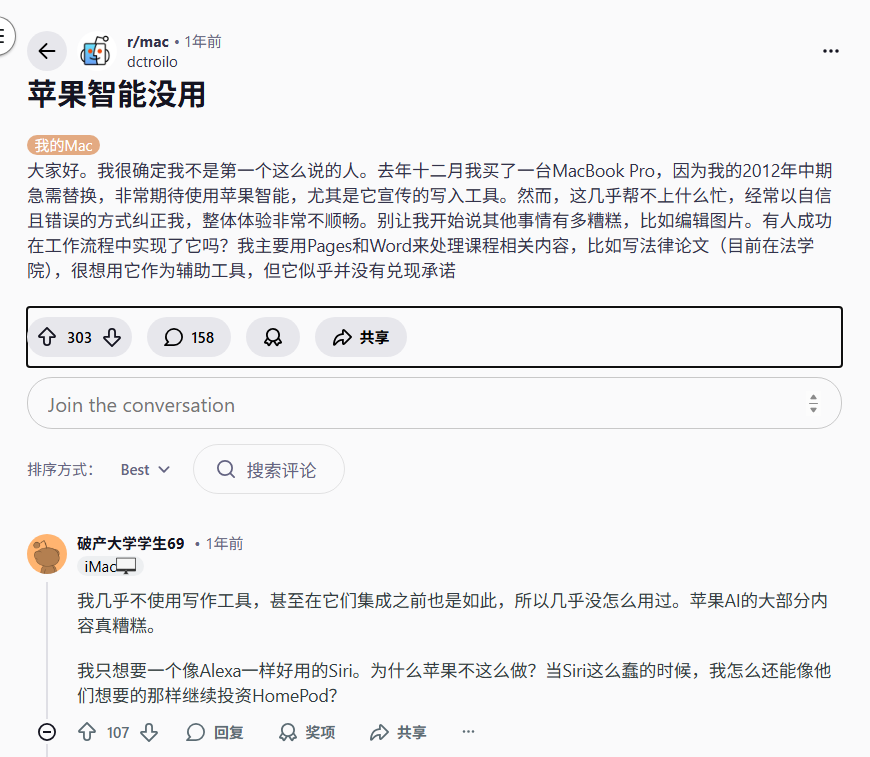
(Image Source: Reddit)
From what I've observed, foreign users' dissatisfaction with Siri primarily stems from its poor accuracy, limited functionality, and disappointing AIGC (Artificial Intelligence Generated Content) experience. Posts like the one above are rampant on international forums like Reddit, easily garnering over 300 upvotes, indicating just how many foreign users share these sentiments.
Compared to its stagnant capabilities, Apple's inconsistency may be an even more pressing issue.
As early as WWDC 2024, Apple unveiled a new version of Siri powered by Apple Intelligence, boasting enhanced contextual understanding, screen awareness, cross-app operations, and more. The press release for the China-specific iPhone model released that same year even stated that China-specific support would be launched in April 2025.
Let me check the date now... January 2026.
Behind this prolonged delay lies Apple's crisis in large model technology.
I'd argue that one contributing factor to the crisis is Apple's 'obsession with cleanliness'—its excessive focus on privacy and on-device operation.
But the problem is, for large models to be intelligent, they require massive computational power, relying on thousands of GPUs in the cloud. Apple's insistence on cramming large models into smartphones results in models that are too small and not intelligent enough. Attempting to build its own cloud infrastructure from scratch is too late of a start, with insufficient computational reserves compared to Google and Microsoft.
Of course, an even more critical issue is the brain drain.
In recent years, Apple's AI executives and core engineers have been lured away by OpenAI, Google, and Meta in waves, with large numbers departing simultaneously. Even executives who have just been promoted to team leaders may find themselves in Meta's offices the next day.
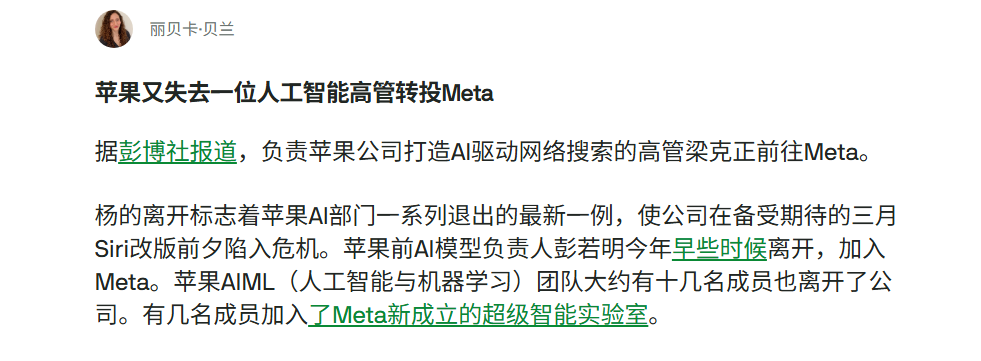
(Image Source: Bloomberg)
This has also led to the sluggish progress of Apple's internal self-developed model—the project codenamed 'Ajax.'
As 2026 approaches, rival smartphones can already assist you in writing weekly reports, removing passersby from photos, taking meeting minutes, and some, like the aggressive Doubao mobile assistant, can even perform hands-free operations. If the iPhone can only comprehend 'Hey Siri, play music,' its high-end image will truly crumble.
So, Cook's only option is: if you can't beat them, join them.
Rather than stubbornly persisting with in-house development and ending up with a half-baked product ridiculed across the internet, it's better to humble yourself and partner with the strongest player, hoping for some surprises.
Why Gemini? What Are Apple's Considerations in Choosing Google?
So, the question arises: with so many powerful AI models on the market, and Apple having previously flirted with OpenAI, why did it ultimately choose Google?
Well, as stated in the joint announcement, this was a carefully evaluated decision, weighing the pros and cons.
First, it's important to clarify that while OpenAI is technologically strong, it's just a model builder, heavily reliant on Microsoft for infrastructure. Choosing it would, to some extent, place Apple's lifeline in Microsoft's hands, which is clearly not something Apple desires. Google, on the other hand, is a well-rounded player.
(Image Source: Google)
As an established giant in the AI field, Google's Gemini model boasts massive parameter counts and comprehensive capabilities, excelling in images, text, and videos. The latest Gemini 3 features the most outstanding multimodal understanding capabilities, naturally able to comprehend images, videos, and code, making it a perfect match for iPhone's desired screen awareness.
In comparison, other models may require an additional visual model, resulting in lower efficiency.
Furthermore, unlike pure AI players like OpenAI or Claude, Google has unparalleled experience in the mobile space.
Don't forget, Google has its own Android system and Pixel phones, with the Pixel 9 series even featuring Gemini as the default assistant. They know exactly how to integrate large models into smartphones and how to ensure a seamless AI experience with limited battery and memory.
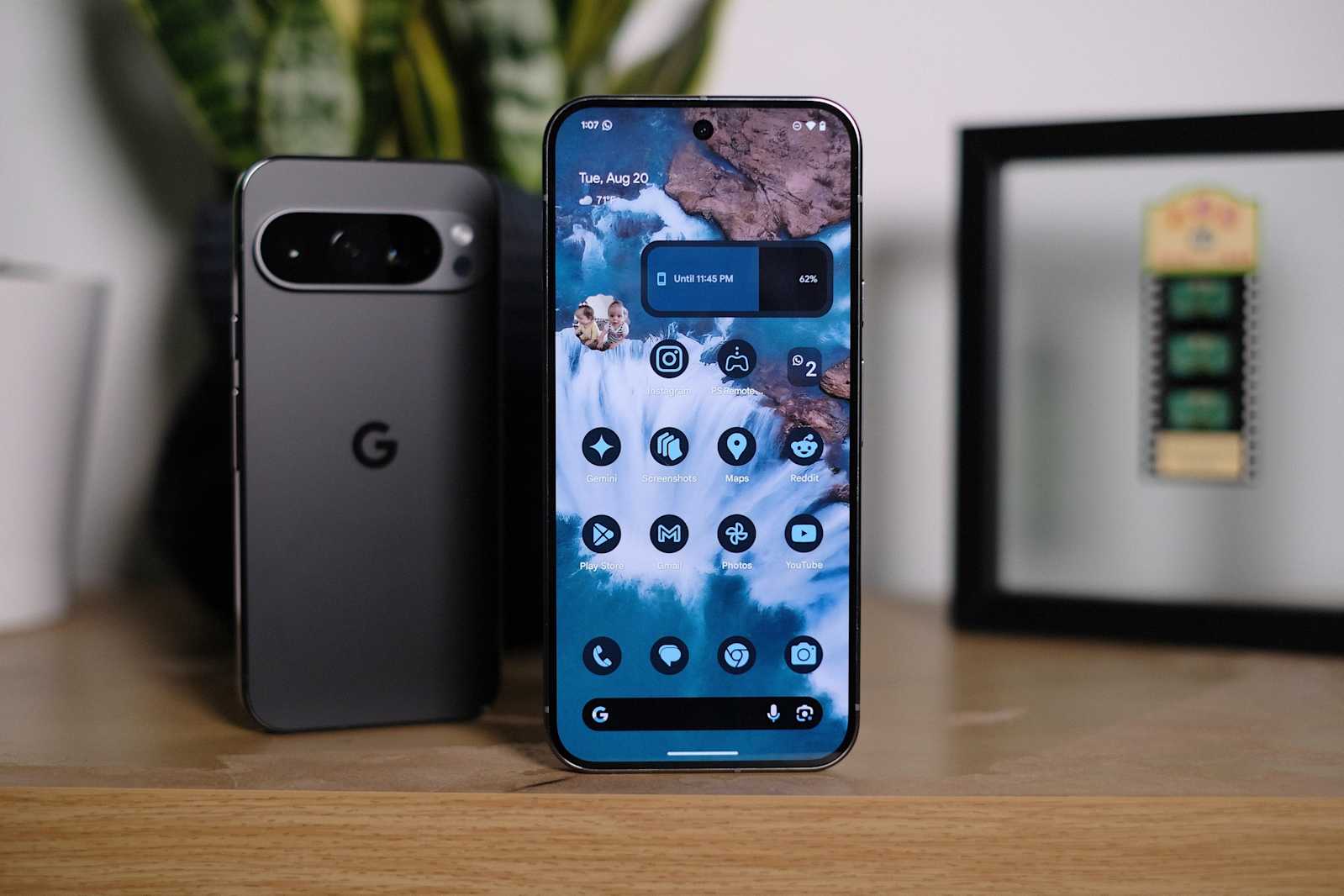
(Image Source: Engadget)
For example, Gemini Nano is specifically designed for smartphones, providing a ready-made foundation for Apple to enhance its self-developed model capabilities.
Of course, Google's willingness to compromise is crucial.
According to details uncovered, Apple has deployed Google's Gemini model on its self-built 'private cloud computing' servers. This means Apple can leverage Google's technology while maintaining its reputation as a privacy-first company.
Considering the capabilities for such private deployments, Google is currently one of the few companies capable of meeting Apple's scale demands.
For Google, this is a dream come true.
With over 2 billion active Apple devices worldwide, if they can all access Gemini, Google would directly control the largest AI gateway in the mobile internet era.
So, this collaboration between the two companies, while unexpected, is actually quite logical.
Domestic Manufacturers Feel the Heat: AI Leadership Faces Challenge from Apple
Honestly, this move has sent shockwaves through the domestic smartphone industry, comparable to a depth charge.
You see, in recent years, domestic smartphone manufacturers have somewhat looked down on Apple in terms of AI. After all, in the Chinese context, our highly capable Xiao Bu and Xiao Ai are indeed much smarter than Siri's 'artificial stupidity.'
But now, things have changed.
Apple's move to 'borrow a chicken to lay eggs' has directly brought in the globally strongest Gemini.
Now, the question arises: if the iPhone's Siri suddenly becomes capable of understanding complex instructions while maintaining Apple's unwavering privacy protection, can domestic smartphones still stand by their 'AI is far ahead' selling point?

(Image Source: Apple)
For domestic smartphone manufacturers, the pressure is instantly immense.
However, for domestic AI companies like ByteDance's Doubao and Alibaba's Tongyi Qianwen, this presents a golden opportunity to rise.
Last December, ByteDance launched the Doubao AI Phone M513, which featured an embedded Doubao mobile assistant showcasing a forward-thinking concept and next-generation experience. With just voice commands, users could instruct the phone to perform complex operations, such as multi-app background automation and cross-platform automatic price comparison and purchasing, leaving smartphone manufacturers in awe.
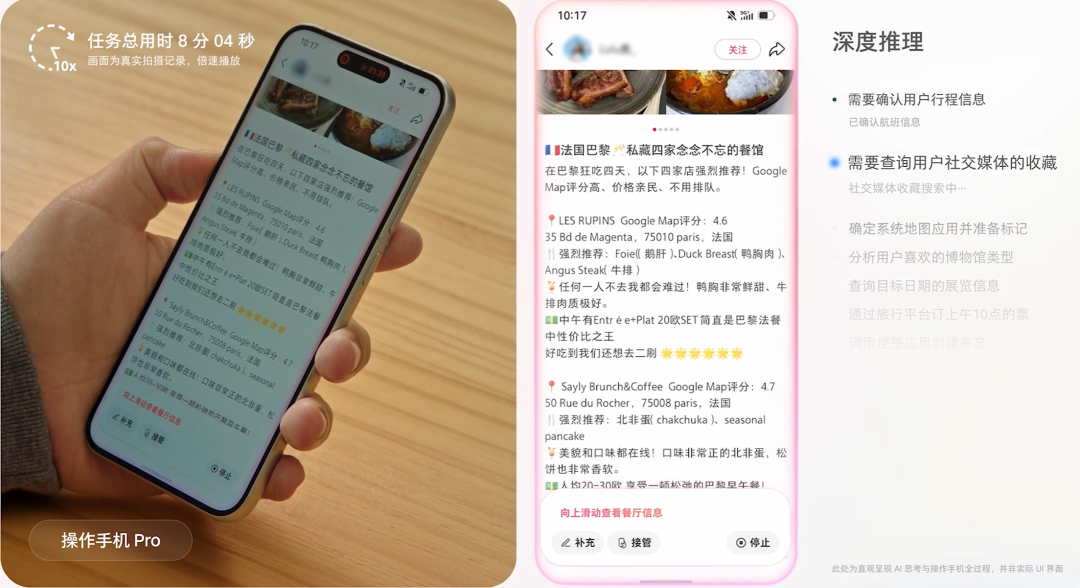
(Image Source: Doubao)
However, as long as the Doubao mobile assistant remains a 'third-party application,' it will always exist in the gray area of Android's permission system, leading to its ban by various social media apps, financial tools, and even games.
Mutual attacks among internet companies and the detachment of smartphone manufacturers have left domestic AI companies once seeing no light at the end of the tunnel.
But now, Apple is here.
It's foreseeable that under the pressure brought by Apple, hardware manufacturers like Vivo, Lenovo, and Transsion will likely accelerate their exploration of collaborations with ByteDance or Alibaba, pre-installing higher-level AI assistants on their devices to rival the upcoming AI experience on the iPhone.
This is also the first time Doubao or Qianwen have a chance to gain system-level permissions on smartphones, evolving from mere chatbots into true mobile assistants.
Perhaps by 2026, when we talk about smartphones again, we won't be asking, 'How many megapixels does your phone's camera have?' but instead, 'Can your phone help me get those tedious tasks done?'
If so, the world would be a much better place.

Apple Google Siri Gemini
Source: Lei Technology
Images in this article are from: 123RF Licensed Image Library
-
![]()
Registered Capital Slashed to 372 Million Yuan! Yutong Optical Finalizes Industrial and Commercial Change Registration
-
![]()
Zhuque-3 Successfully Lands, and 'Time Traveler' Secures Another ¥100 Million in Funding: China's Commercial Space Industry Experiences a 'Dynamic August'
-
![]()
Autohome Faces a Shrinking Window of Opportunity
-
![]()
Even a Titan Like Musk Has Faced Setbacks in Fulfilling Promises
-
![]()
AI Office: The End of the Racing Era, Context Becomes the Key to Success
-
![]()
Domestic Vehicle Chassis Revolution ②: The Steering Wheel Remains, But Mechanical Connections in the Steering System Are Decreasing
-
![]()
Exploring MiniMax Design: Can Video Editing Be as Simple as Speaking?
-
![]()
Why Can SenseTime Achieve Profitability While CloudWalk Still Faces Challenges, Despite Both Adopting Large Models?