The Crimes and Consequences Faced by Robots
 01/16 2026
 663
663

In 2025, no tech sector has witnessed such dramatic fluctuations as embodied AI.
On one hand, the sector holds immense promise. Hailed as the 'inaugural year of mass production' for humanoid robots, leading companies have announced their foray into large-scale manufacturing. Tesla declared the mass production of thousands of Optimus units, while firms like UBTECH, Unitree Robotics, and ZhiYuan Robotics have achieved deliveries in the thousands. Humanoid robots steal the limelight at AI expos, with robot marathons and combat competitions emerging endlessly. The dance performance of Unitree's robots at Wang Leehom's concert left Americans in awe.
Yet, paradoxically, robots appear to be underperforming in the same year. From 2024 to 2025, over ten robotics companies have filed for bankruptcy. Some prominent firms announced closures due to financing difficulties. Neither in the B2B nor B2C sectors have humanoid robots achieved significant sales volumes. The capital market has shown little patience for the prevalent high valuations and low revenues of robotics companies.
What accounts for this stark contrast amidst the robots' twirling and leaping? The answer may lie in the fact that most people today are reluctant to acknowledge the inescapable original flaw of robots.

Following ChatGPT's ignition of the large model craze, the field of robotics, or embodied AI, correspondingly heated up. Both within the tech industry and the public eye, there seems to be a belief that embodied AI and AI are closely intertwined. In recent years, we've witnessed some AI technological breakthroughs that seem applicable to the robotics domain. For instance, multimodal large models akin to GPT-4o are employed to aid robots in semantic understanding and autonomous task planning. Emerging AI technology routes, represented by world models, also consider robots as potential future application scenarios.
However, let's pause, close our eyes, take a deep breath, and engage in introspective reflection. Delve deep into the corridors of our memory—who exactly told us that AI is related to robots? Was it a research paper? A specific piece of software or hardware technology? Or did the media suddenly introduce a term called embodied AI, leading us to naturally equate robots with AI by drawing connections from robotic scenes in sci-fi movies?
In truth, 'embodied AI' is merely a more appealing rebranding of the traditional robotics framework, using religious concepts. No exclusive technological breakthroughs specific to humanoid robots have been achieved in recent years.

From another perspective, large models enhance various hardware equally. They indeed aid robots, just as they assist smartphones, computers, glasses, toys, and rice cookers. Logically, the development potential of embodied AI is on par with that of 'smart bricks'.
Since the rise of machine learning, decades of AI exploration have not been tailored to the humanoid robot as a hardware platform. AI, as software, does not require a body; it's merely that robotics enthusiasts leverage the influence of sci-fi culture to make the public perceive an inevitable connection between the two.
This conceptual misalignment has burdened the current robotics boom with an original flaw: the lack of any exclusive technological breakthroughs. To conceal this flaw, we witness tactics akin to 'The Emperor's New Clothes.' Robot company leaders and investors enjoy discussing theology, the universe, humanity, dreams, and youthful bonds, yet avoid addressing technical issues like robots handling cross-scenario data or executing vague instructions. On the other hand, the capabilities of robots marketed by manufacturers seem increasingly diverse—dancing, running, boxing—all within reach. However, these abilities primarily stem from mechanical design and refinement, executing actions based on preset instructions. Long before large models, robot running and combat competitions were already common recreational activities among university students and amateur scientists, merely now elevated to a seemingly more legitimate stage with capital and policy support.
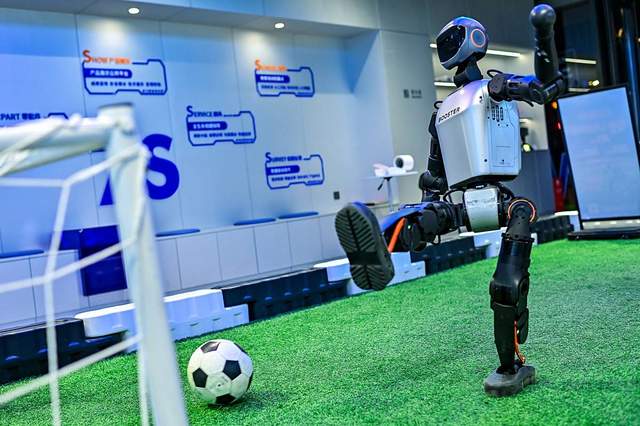
These robotics projects largely adhere to the decades-old template established by Boston Dynamics, making it hard to believe they can escape Boston Dynamics' fate.
It's not that mechanical upgrades are useless, but their utility is no different from AGV carts or welding robotic arms in factories. In terms of robotic 'intelligence,' they remain at the level of robotic vacuum cleaners.
Look, the emperor is devoid of attire.
Look again, the robot lacks a brain.

Many robotics practitioners and believers might retort: 'We never claimed robots are AI or can think like humans.' Perhaps they didn't, but the public has genuinely come to believe otherwise.
During the 2025 WAIC World Artificial Intelligence Conference, we witnessed a remarkable scene: in previous years, AI expos were dominated by tech professionals. This year, however, three distinct groups coexisted. The first comprised tech enthusiasts—supply chain enterprises, developers, and media reporters. The second consisted of parents bringing their children. The third... were credit card promoters.
How did the credit card promoters end up here?
Speaking of parents, I've inquired with many about why they brought their children. The reality is, few aim for their children to develop AI or intelligent agents. Most parents consistently answered: to see robots. The atmosphere on social media and at tech expos has led them to firmly believe that robots equal AI. The saturation of humanoid robot promotions has convinced them that they'll soon purchase a humanoid robot capable of household chores, grocery shopping, cooking, and childcare.
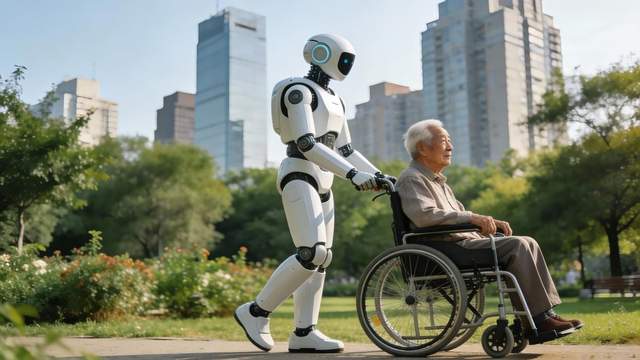
Building on this, the elderly envision relying on robots for elderly care; mothers hope robots can babysit; some unscrupulous bosses dream of entirely robotic companies. If we randomly interview ten people on the street about what they most desire from AI, eight or nine will say: a robot to do my housework.
These eager expectations are all founded on a false causal link between robots and AI technology, deliberately guided by entrepreneurs and investors. When people realize this imagination is merely a dream, and that household robots capable of handling complex environments with elderly, children, and pets are nowhere near realization, the harm will be immeasurable.
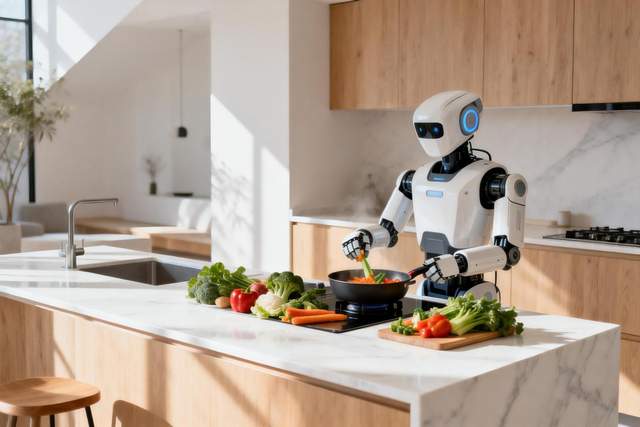
More dishearteningly, when the robot fantasy shatters, the public will inevitably direct their anger towards the term 'AI.' They'll feel deceived by artificial intelligence, unaware they were merely hoodwinked by a handful of robotics companies riding the AI hype.
People will perceive AI as a massive bubble and scam, even if large models have accomplished ten thousand tasks by then.
The original flaw of robots lacking intelligence will ultimately trigger a domino effect of consequences. It will radiate outward from robot investors and entrepreneurs, eventually engulfing the entire AI and intelligent industry. As we revel in this robotic Dionysian frenzy, can we truly accept the hangover after the feast ends?

The robot narrative will persist for a while. For instance, there's ample room for progress in mechanical technologies like dynamic adaptation and complex terrain movement. Additionally, the robot supply chain can continuously optimize; with the establishment of a domesticated supply chain, we should witness a rapid reduction in costs and prices for humanoid robots, which currently cost tens of thousands of dollars.
These factors will spark several waves of enthusiasm. Yet, at some point, this story will quietly conclude with decisive finality. As the joke goes, many dream of a robot to care for them in old age, but now, buying a robot lets you pre-experience caring for your future self.
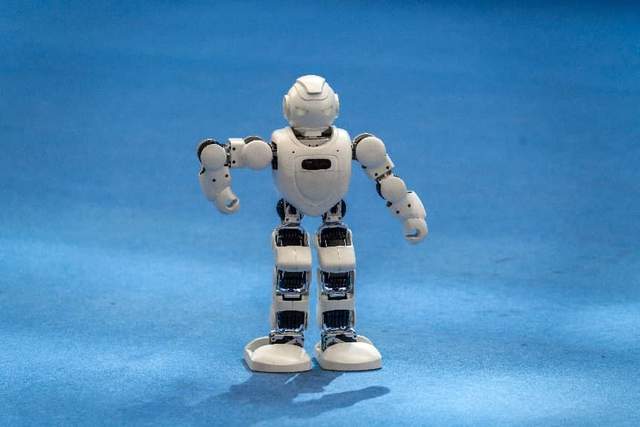
When people realize this isn't a joke and cannot be changed, the story ends.
Robotics is a potentially vast industry, but manufacturers must collaborate with capital, market users, and adjust expectations of its value. It's like contemplating 3D printing a figurine, but there's no need to aspire to 3D print a mansion. Humanoid robots have the potential to become productivity tools in certain industrial scenarios and toys for a few geeks. However, within the foreseeable future, they won't transform into the 'cyber slaves' of our dreams.
Sleep well, human friends—dreams offer everything. But most robotics companies, you better wake up.

-
![]()
Registered Capital Slashed to 372 Million Yuan! Yutong Optical Finalizes Industrial and Commercial Change Registration
-
![]()
Zhuque-3 Successfully Lands, and 'Time Traveler' Secures Another ¥100 Million in Funding: China's Commercial Space Industry Experiences a 'Dynamic August'
-
![]()
Autohome Faces a Shrinking Window of Opportunity
-
![]()
Even a Titan Like Musk Has Faced Setbacks in Fulfilling Promises
-
![]()
AI Office: The End of the Racing Era, Context Becomes the Key to Success
-
![]()
Domestic Vehicle Chassis Revolution ②: The Steering Wheel Remains, But Mechanical Connections in the Steering System Are Decreasing
-
![]()
Exploring MiniMax Design: Can Video Editing Be as Simple as Speaking?
-
![]()
Why Can SenseTime Achieve Profitability While CloudWalk Still Faces Challenges, Despite Both Adopting Large Models?