The AI Short Drama Boom: Who Will Be Out of Work First?
 03/03 2026
 721
721
Technology becomes productive only when it serves "thrill efficiency."
Author | Wang Tiemei
Editor | Gu Nian
Half a month after Seedance 2.0 took the internet by storm, Zhengzhou, known as the "Vertical Studio" of the short drama industry, began to feel the shift.
In previous years, the Spring Festival season was the busiest time for short drama companies. This year, however, many teams have chosen to hit pause.
"We've been in the short drama business for two years, but at this point, we have to pivot or fall behind," said Zhang Miao. Shortly after the Spring Festival, her company laid off nearly half of its staff, paused all live-action short drama projects, and shifted toward AI-simulated human content.
The platform's signals are clear. According to Douyin Group's recent policies, AI-simulated human short dramas are now a priority support (support) area. Hongguo categorizes simulated human scripts into four tiers—S+, S, A+, and A—offering guaranteed payments of RMB 80,000, RMB 60,000, RMB 40,000, and RMB 20,000 respectively, along with a permanent 20% revenue share.
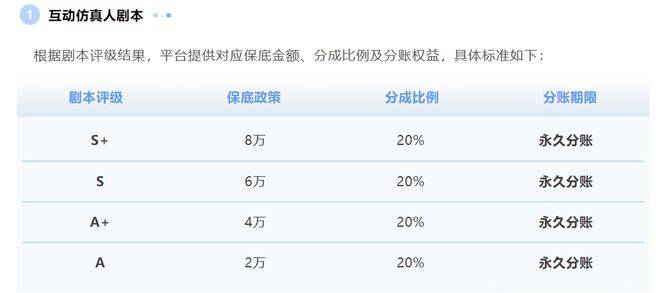
This means an S+ tier work can cover most production costs through guaranteed income alone, with higher viewership translating to greater revenue. Compared to ordinary live-action short dramas, this represents a "safety-net incentive."
According to *Short Drama Dark Horse*, ByteDance has internally designated simulated human animated dramas as one of its core entertainment development priorities for the next three years. With capital, policy support, and traffic entry points all aligned, the shift has become a rational choice.
However, audiences on social media criticize the unrealistic visuals, strange characters, and stiff movements, with the "uncanny valley effect" becoming a frequent complaint. Under this evaluation system (evaluation system), it seems controversy (controversy) will only subside when technology advances to near-perfect realism. But industry insiders believe this judgment is misguided.
The success of AI short dramas does not hinge on whether they "resemble real humans." The core competitive metrics for short dramas have never been visual realism but thrill density and reversal efficiency.
AI transforms production efficiency, not aesthetic sophistication. Traditional live-action short dramas often cost thousands of yuan per minute. Under the AI-simulated human model, costs drop to RMB 1,000 or even lower per minute, with production cycles shrinking from months to weeks.
In this structure, the real pressure falls not on actors but on organizational roles in traditional production chains: producers, assistant directors, on-site coordinators, etc. The past competition revolved around assembling a crew quickly; now, it's about identifying thrill formulas faster.
The Focus Isn't on Realism
In early 2026, *Zhanxiantai Live-Action AI Edition* burst onto the scene, amassing 100 million views in six days and topping multiple short drama charts. According to Xiong Binghui, CEO of platform provider Kemeng Intelligence, the 12-person team produced the work in 30 days with RMB 100,000 in computing costs.
"This means the production cost was just a quarter of traditional live-action short dramas," Zhang Miao summarized.
In terms of efficiency, Xiong revealed that the 81-episode *Zhanxiantai* averaged 40 shots per episode. The team combined AI and manual labor to complete all storyboarding in 30 days, a process that would take months traditionally. Meanwhile, AI rapidly generated complex actions like sword flight and magical duels, avoiding the safety risks and limitations of live-action filming.
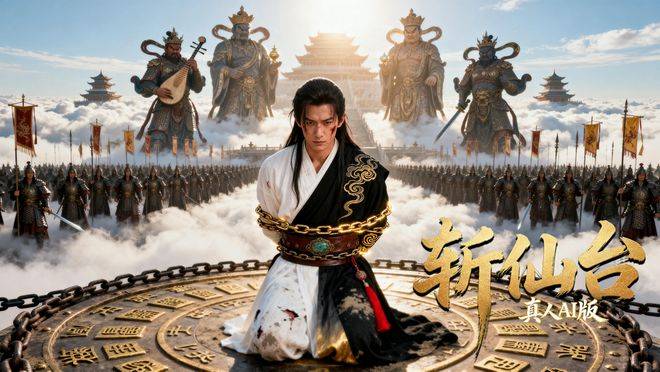
Despite significant cost and efficiency advantages—and becoming a dark horse in the short drama scene—the work's visuals fell short of indistinguishable realism from live-action dramas.
It suffered from typical AI live-action short drama flaws like choppy visuals and stiff performances. However, common live-action complaints like "mismatched lip-syncing," "unfocused gazes," and "stiff movements" rarely appeared in the show's bullet comments.
Zhang Miao told *Shixiang* that the industry's anxieties might be misplaced from the start. "Audiences for simulated human short dramas aren't seeking live-action replacements. These dramas have their own audience. Viewers who leave due to lack of realism weren't our target anyway."
User demographics reveal that short drama audiences remain predominantly middle-aged and elderly, with viewers aged 41–50 accounting for nearly 30%. Third- and fourth-tier cities are key markets. For these audiences, plot progression speed, reversal density, and emotional stimulation often matter more than visual precision.
In other words, the core competition in short dramas remains "thrill efficiency," not visual precision.
Technological upgrades haven't changed this. Models like Seedance 2.0 have boosted generation capabilities, but the current commercial logic of AI live-action short dramas hinges on affordability, not realism.
Current industry estimates suggest a commercially viable AI live-action short drama on platforms like Hongguo can cost as low as RMB 1,000 or even RMB 100 per minute. A 100-minute production might total just tens of thousands of yuan. A live-action drama of the same scale would typically cost three to four times as much.
The saved budget isn't poured into "more realistic" visuals but redirected toward traffic acquisition and advertising.
Hyper-realistic visuals remain the domain of advertising and film industries, where production standards cost hundreds of thousands of yuan per minute. Such standards don't apply to the short drama market, characterized by rapid updates and intense emotional stimulation.
Xuebao Studio, a leading player in the sector, learned this lesson firsthand.
They produced two dramas simultaneously: *Regretting the Moon Behind the Red Gates*, which spent one to two months refining visual realism and character details, and *The Fat Concubine*, a novel-themed work with inferior production quality. Upon release, *Regretting the Moon* underperformed due to its unoriginal script.
Xuebao subsequently established a principle: technology must serve content, and teams are prohibited from showing off technical prowess. "AI-simulated human dramas need short drama DNA—reversals and thrills—but must incorporate AI's unique traits to qualify as genuine AI short dramas, not traditional live-action ones," Xuebao summarized.
*Zhanxiantai Live-Action AI Edition* followed this approach. Its script originated from a proven AI dynamic animation version, representing a validated IP. Better AI models didn't create new demand but reduced live-action adaptation costs.
Thus, the explosion of AI live-action short dramas may owe more to production structure changes than technological progress. At least in this early stage, realism isn't the focus of a hit work.
Animated Explanation Dramas or Live-Action Short Dramas?
After AI-simulated human technology entered the short drama industry, the first sector to explode wasn't "live-action replacements" but animated explanation dramas.
While AI dynamic animations cost around RMB 1,000 per minute, AI explanation dramas could reach just dozens of yuan per minute. Some producers told *Shixiang* that using in-house workflows and tools, costs could drop to RMB 20 per minute.
Extremely low costs and high production efficiency attracted hordes of producers. Currently, a single distributor can release over 1,000 AI live-action explanation dramas daily.
Giant Engine data shows Manhua Drama (animated dramas) platform supply has surpassed 100,000 titles, dominated by low-cost emoji-based and explanation-style works. Over the past two months, AI live-action explanation dramas have increasingly dominated the charts. A leading animated drama producer revealed that of Douyin's RMB 30 million daily spending on animated dramas, at least RMB 20 million goes to AI live-action explanation dramas.
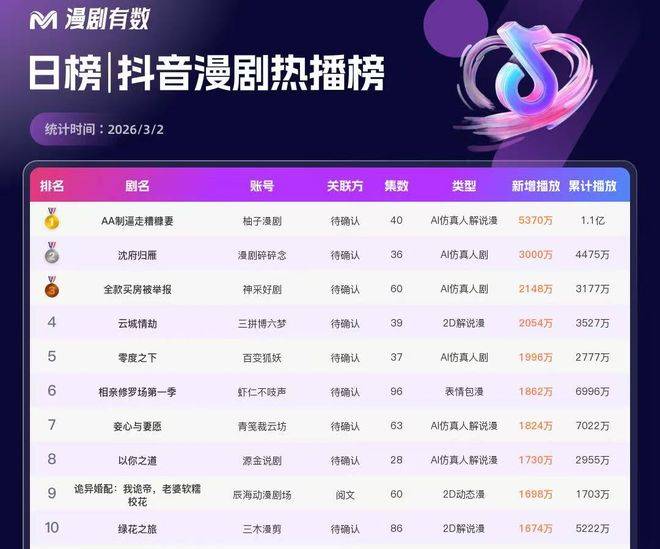
Amid this explosion, a standout hit often leaves thousands of other works as also-rans. Explanation dramas resemble audiobooks—rewarding in the short term but hard to break through long-term.
In late January 2026, Douyin Group's Short Drama Copyright Center upgraded its script cooperation mechanism, categorizing simulated human drama scripts into S+, S, A+, and A tiers with maximum guaranteed payments of RMB 80,000 and a permanent 20% revenue share. Meanwhile, coefficients for dynamic explanation dramas dropped to 5x, and static explanation dramas remained at 1x.
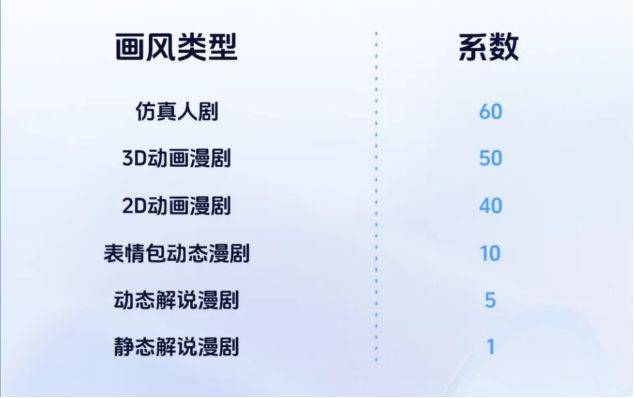
These adjustments signal that platforms refuse to pay for "low-quality, high-volume" content and want to focus resources on genuinely valuable short dramas. This means AI-simulated human technology must shift from "low-cost, high-volume" explanation dramas to bona fide short drama production.
For example, a few months ago (a few months ago), leading AI animated drama companies like Jiangyou Animation and Youhe Culture planned to go all-in on premium AI animated dramas. Now, just as they consider diving into AI live-action short drama explanations, they must weigh the implications of platform policy changes. "The industry is still in a chaotic development phase, so we're taking it one step at a time," Zhang Miao said.
A founder of an animated drama company argued that "most animated drama companies chose this track (sector) because AI could only handle animations initially. Once it can do simulated humans, 80–90% of teams will switch." The logic is that, by analogy with live-action short dramas, the AI-simulated human drama market will dwarf the current animated drama market.
Technology hasn't altered commercial logic but has determined early dividend (dividend) content forms. Explanation dramas were first mass-produced because early AI video generation resembled "PPT animations"—visually striking frame-by-frame but lacking cinematic language. Creators had to generate vast amounts of material through "card-drawing" methods and manually curate and splice it together.
From explanation dramas to animated dramas to simulated human short dramas, the core challenge has always been generating usable content.
When Juhe Intelligence produced its early AI drama *Strange Tales of Xing'anling*, character and scene consistency stood at just 60–70%. By *Strange Tales of Xing'anling 2* in late 2025, this metric rose to 80–90%, with today's most advanced models achieving 98% consistency.
Market estimates suggest Seedance 2.0, the most representative video generation model, now boasts 90% usability. Previously, AI video generation averaged just 20% usability, meaning only 1 minute of every 5 minutes of generated material made it into the final cut.
Changes Happening Before Actor Replacement
Technological progress is also reshaping workforce structures in short drama production.
Before the Spring Festival, Zhang Miao heard of many short drama companies planning to pivot. "Normally, everyone rushes to produce dramas for the Spring Festival traffic bonus. This year, the buzz is all about layoffs and reassignments."
"The first roles to go were traditional producers. All positions related to live-action filming were reassessed," another short drama insider told *Shixiang*. Producers have lost nearly all their advantages in the AI era.
Traditional crews needed producers to coordinate actor schedules, location rentals, extras, equipment transport—a complex workflow where producers were the linchpin. Now, AI crews of just a few people can handle everything from script to final cut, drastically reducing the need for human coordination.
"We've discussed this with platforms, which have explicitly demanded significant reductions in film production costs," Zhang Miao said. This suggests such downsizing isn't temporary—producers are just the beginning.
Directors face similar scrutiny. "Now, directors must either adapt to AI dramas or leave the industry," he said. However, AI drama success is far harder for traditional filmmakers, as creators must use prompts to "direct" soulful performances without live actors. "This stage will weed out many traditional live-action directors."
Traditional content production followed fixed workflows, but AI tools now let creators generate content from a laptop. With strong enough ideas, audiences will pay.
Film and TV companies don't generate ideas—individuals do. "We don't want layoffs either," Zhang Miao said. "But if individuals can earn more using AI tools independently, why stay with a company? For film and TV firms, this is a serious, practical issue."
In contrast, behind-the-scenes workers face intense competition, while short drama actors face replacement later.
Currently, AI has only tightened actors' ties to platforms and agencies. Some actors revealed, "The best scripts are pre-assigned to company-signed talent. Even new signees get priority for good scripts." Meanwhile, AI itself requires actor footage, IPs, and other materials.
Just two days after Seedance 2.0's release, the Motion Picture Association of America—representing Warner Bros., Netflix, Disney, and four other studios—issued a statement alleging massive copyright infringement risks. Meanwhile, Tim, founder of tech influencer "Film Storm," publicly questioned infringement issues in his review video.
ByteDance quickly responded, with platform operators in the Jimeng creator community announcing a temporary ban on using real human footage as reference material and emphasizing "respect as the boundary of creativity."
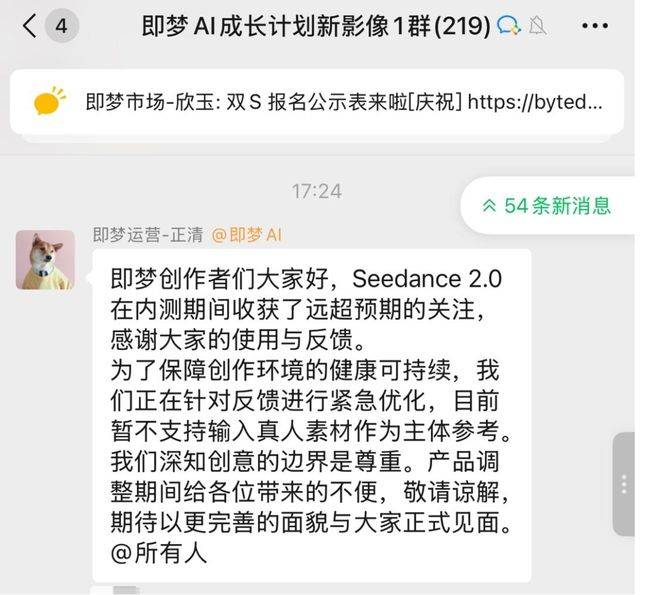
Li Liang, Vice President of Douyin Group, stated that Seedance 2.0 requires real-person authentication for digital avatars and temporarily bans generating real human faces or IP images, including Disney or *Boonie Bears* characters. "The team's top priority lately has been maintaining and strengthening anti-infringement strategies," he said.
With legal boundaries still unclear, some practitioners ask: If unauthorized use of an artist's name, image, or voice carries clear risks, can AI technology legally boost productivity when used responsibly with full consent from rights holders?
One industry insider speculated, "The future's top stars might be those who most successfully license their digital avatars." If so, actors' value won't disappear but transform into scalable intellectual property.
(Names in this article are pseudonyms.)
-
![]()
Doubao Work Unveiled! Domestic AI Leaders Fully Commit to the 'Work' Sector
-
![]()
Who’s Sounding the Alarm on ‘Rushed Vehicles’?
-
![]()
Over 5.3 Billion Yuan in Losses Over Three and a Half Years! Can Yonyou Reverse Its Fortunes Through Streamlining and AI Transformation?
-
![]()
Baidu AI Adopts Free Model: A Strategic Maneuver in Traffic and Monetization
-
![]()
Silicon-Based OLED Pioneer Unveils Financial Results: H1 Shipments Outpace Entire 2025 Volume
-
![]()
AI's First "Lost Summer"
-
![]()
Zeiss Makes Another €2.2 Million Bet: Will Eye Tracking Be the Next Big Thing in the Smart Glasses Industry?
-
![]()
RUNTO Ranking | Global Top TV ODM Factories' Shipment Figures for July 2026