NetEase, Lagging in AI Adoption, Faces Imminent Challenge from ByteDance
 01/16 2026
 638
638
Recalling the market value and stock price fluctuations of China's internet behemoths over the past year, the overall landscape remains relatively stable. Yet, subtle shifts in strategic directions and performance disparities have reshaped the competitive dynamics.
For instance, Alibaba has emerged as the "dark horse" of growth among the top-tier players, boasting a 77% year-on-year surge, which not only outpaces Tencent's 45% but also narrows the gap between the two tech giants. Meanwhile, Baidu's stock price has soared, propelling its market capitalization to $45.5 billion and elevating its industry ranking to eighth place, up one notch from the previous year.
Delving into the success stories of these high-performing giants, a common growth catalyst emerges: AI. Alibaba has seamlessly integrated AI into its e-commerce operations, enhancing operational efficiency. Kuaishou has leveraged Kling AI to bolster its market presence. Not to be overlooked, Baidu's revaluation is directly attributed to its formidable AI capabilities.
However, there is a notable exception: NetEase. In 2025, NetEase's stock price witnessed a remarkable 62% surge, placing it second only to Alibaba, with an $88.9 billion market cap quietly catapulting it back into the top five.
Initially, Ding Lei took the helm personally, returning to the "front lines" of NetEase and initiating a series of bold reforms. These changes spurred intuitive performance growth last year, with promising financial results seemingly heralding a resurgence for NetEase.
The crux of the issue lies in the fact that as AI becomes the central battleground in internet competition, NetEase's absence places it at a significant disadvantage. Other giants now wield AI technology like "swords," potentially striking NetEase unexpectedly at any moment.
For instance, ByteDance has already positioned itself as a formidable contender in front of NetEase.
Spark Music: The First to "Target" NetEase Cloud Music?
In the long-established online music market, Spark Music's meteoric rise is akin to a thunderclap in calm waters, sending shockwaves throughout the industry. Its scale now rivals that of NetEase Cloud Music.
According to QuestMobile data, as of September 2025, Spark Music's monthly active users (MAUs) reached 120 million, marking a year-on-year increase exceeding 90%, and quietly climbing to fourth place in the industry. NetEase Cloud Music leads with 147 million MAUs, but the gap is narrowing. Moreover, while Spark Music's user base is growing "aggressively," NetEase Cloud Music's MAUs are declining. In 2021, during its Hong Kong stock listing, NetEase Cloud Music reported 185 million MAUs for its online music service in the first half of the year.
In other words, with one trending upward and the other downward, Spark Music could easily surpass NetEase Cloud Music in user data.

Spark Music's ascent disrupts the traditional copyright-centric approach of music platforms. Leveraging free "ace cards" and backed by Douyin's ecosystem and traffic, it rapidly amassed a massive user base. More critically, relying on short videos and ByteDance's powerful algorithms, it is reshaping user listening habits from "active song searches" to "passive algorithm recommendations."
This model taps into user groups previously outside the purview of traditional music platforms. Amid stagnant growth in the overall online music market, these users represent significant untapped potential.

Of course, copyright is not NetEase Cloud Music's core barrier; its competitive edge lies in music-based social interactions built on emotional resonance and music review culture, fostering user loyalty far above industry averages. Thus, while Spark Music's user base is growing rapidly, it struggles to poach NetEase Cloud Music's loyal users.
However, a new variable is emerging: AI music.
In October 2025, an AI singer named "Datouzhen" (Big Head Pin) suddenly went viral on Douyin. His covers of "July 7th Sunny Day" and "Tears Sea" dominated BGM charts, with his high-pitched, emotionally charged style perfectly aligning with short video aesthetics. Within three months, 1.1 million fans flocked to his Spark Music page. Beyond Douyin, the global music scene is witnessing an "AI invasion," with AI singers' tracks appearing on Spotify, Billboard, and other charts.
Whether AI music can overcome cognitive biases and gain widespread user acceptance remains uncertain. However, once a mature AI music industry chain forms, Spark Music's library will expand significantly, providing a crucial foundation for attracting more users. Critically, this also partially offsets its copyright deficiencies.
Looking ahead, if AI music's influence grows in the "duel" with human music, Spark Music, with AI music as its competitive edge, will pose the greatest threat to both Tencent Music and NetEase Cloud Music. After all, the current music scene, especially Chinese music, has seen its heyday fade, with mainstream platforms relying on classic old songs.
Can NetEase Still Capitalize on AI Education?
From aspiring to transform education through technology to embracing traffic and advertising, NetEase Youdao has undergone a commercial transformation in recent years. Now, as education becomes a core AI application scenario, Youdao has a new narrative: a learning and advertising AI application service provider.
In AI education, Youdao enhances capabilities through continuous iteration of its Ziyue large model while entering high-frequency learning scenarios like Q&A through AI hardware.

This aligns with the path chosen by education giants like Yuanfudao and Zuoyebang. However, in the AI education race, besides traditional education giants, internet giants are accelerating AI's integration into educational scenarios to complete their ecosystems, with ByteDance leading the charge. In terms of downloads, ByteDance's products dominate: its international product Gauth has 6.75 million downloads, while its domestic product Doubao Aixue has 4.81 million, both with over 100% month-on-month growth.
Internet giants leverage traffic to rapidly scale user bases, but traditional education giants, with years of user accumulation, brand recognition, and teaching research capabilities, enjoy stronger user loyalty. Thus, they outperform internet giants in user engagement, their core strength in AI education.
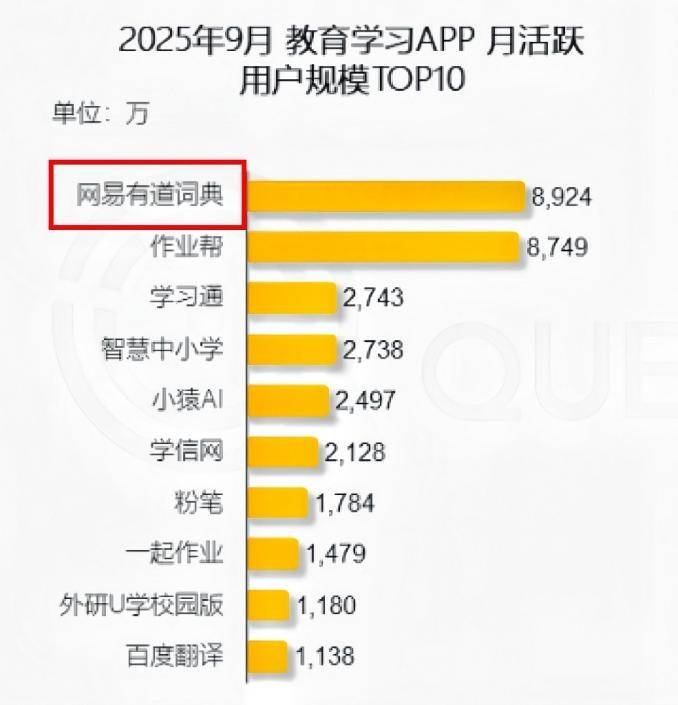
Take NetEase Youdao as an example: according to QuestMobile data, in September 2025, Youdao Dictionary had 89.24 million monthly active users, the highest among educational apps.
The strategic divergence between traditional education giants and internet giants seems to allow parallel development in AI education. However, theoretically, AI's evolution could directly undermine advantages in content and user loyalty, creating a "dimensional reduction attack." Currently, internet giants hold the technological high ground and an "ecosystem card," enabling AI applications to penetrate various niches, match users with services, and become "super entrances."
Such a comprehensive "player" poses significant threats to vertical educational products.
Doubao is already testing these waters. Recently, many users noticed that Doubao added multiple ByteDance services, including Spark Music and Doubao Aixue, to its chat interface. While this appears to inject traffic and users into ByteDance's new products, it fundamentally previews an Agent ecosystem for future leaps.
By integrating Spark Music and Doubao Aixue, users can access them without leaving the Doubao chat, meaning users could listen to music, search for answers, or find AI tutors without downloading separate apps if they form habits.
Of course, such a "super entrance" threatens more than just traditional education giants.
NetEase Urgently Needs to Find Its "Place" in the AI Era
As nearly all internet giants invest heavily to secure entry points in the AI era, NetEase's silence stands out.
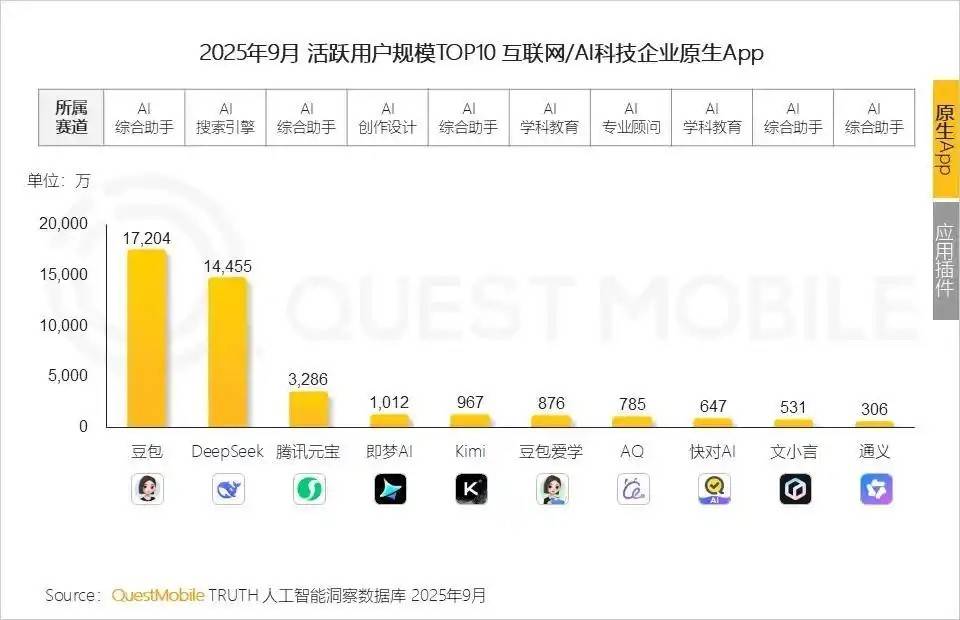
In early 2024, Ding Lei's statements indicated NetEase's strong emphasis on AIGC applications in gaming, music, and other scenes. However, by the second half of the year, NetEase's AI strategy abruptly shifted, with previously increased R&D investment contracting again. From a product perspective, NetEase's offerings lack prominence among AI-native applications. According to QuestMobile data, none of NetEase's products appeared in the top 10 AI-native apps by monthly active users in September this year.
In China's internet landscape, NetEase has always carved out a unique niche. During the mobile internet era, it focused on gaming as its core business, quietly thriving among top internet companies. Simultaneously, it excelled in creating distinctive products rooted in nostalgia, becoming an unignorable force in internet competition.
While NetEase stayed away from the internet's core battlegrounds, it developed its survival logic outside major conflicts.
However, in the AI era, NetEase's delayed AI strategy has left it behind other giants. Now, ByteDance and others leverage AI to extend their reach across sectors, unleashing strong growth potential. If NetEase Cloud Music and Youdao are marginalized, it would essentially cripple NetEase, reducing it to a mere gaming company.
While a pure gaming company holds commercial value, without a compelling narrative, it lacks market imagination. Currently, AI is the core engine revaluing companies.

In the AI era, another potential shift is that the mobile internet's "product-centric" competition logic may evolve into "technology-centric," which bodes ill for NetEase, currently absent from the AI race.
On one hand, application-layer innovation depends on and is constrained by underlying technological advancements, which may be controlled by tech giants. On the other hand, if AI super entrances emerge, directly fulfilling complex user needs, opportunities for other companies to grow and disrupt niches will diminish.
NetEase's refusal to chase trends reflects its stubbornness in staying true to itself amid capital noise. However, AI is not a trend but a tidal wave. Currently, while other internet companies leverage AI to reinvigorate core businesses, NetEase's three non-gaming subsidiaries have weakened.
This is a dangerous signal.
Dao Zong You Li, formerly known as Waidao Dao, is a new media outlet covering the internet and tech sectors. This is an original article; any reproduction without retaining the author's information is strictly prohibited.
-
![]()
Registered Capital Slashed to 372 Million Yuan! Yutong Optical Finalizes Industrial and Commercial Change Registration
-
![]()
Zhuque-3 Successfully Lands, and 'Time Traveler' Secures Another ¥100 Million in Funding: China's Commercial Space Industry Experiences a 'Dynamic August'
-
![]()
Autohome Faces a Shrinking Window of Opportunity
-
![]()
Even a Titan Like Musk Has Faced Setbacks in Fulfilling Promises
-
![]()
AI Office: The End of the Racing Era, Context Becomes the Key to Success
-
![]()
Domestic Vehicle Chassis Revolution ②: The Steering Wheel Remains, But Mechanical Connections in the Steering System Are Decreasing
-
![]()
Exploring MiniMax Design: Can Video Editing Be as Simple as Speaking?
-
![]()
Why Can SenseTime Achieve Profitability While CloudWalk Still Faces Challenges, Despite Both Adopting Large Models?