The Spring Festival: Beyond Red Envelopes—It’s the AI Platforms’ First “Back-to-School Exam”
 02/05 2026
 525
525
Baker Street Detective

AI Platforms Take Proactive Measures
On February 2, 2026, the Qianwen App rolled out its “Spring Festival Hospitality Plan,” exclusively sponsoring four major Spring Festival Gala events on Dragon TV, Zhejiang TV, Jiangsu TV, and Henan TV. Acting as an “AI performer,” it leveraged AI-generated videos, AI image recognition, AI Q&A, and other technologies to deliver creative and engaging gala programs. With a total investment of approximately 3 billion yuan, Qianwen became the latest AI platform to join the competition, following in the footsteps of Tencent, ByteDance, and Baidu.
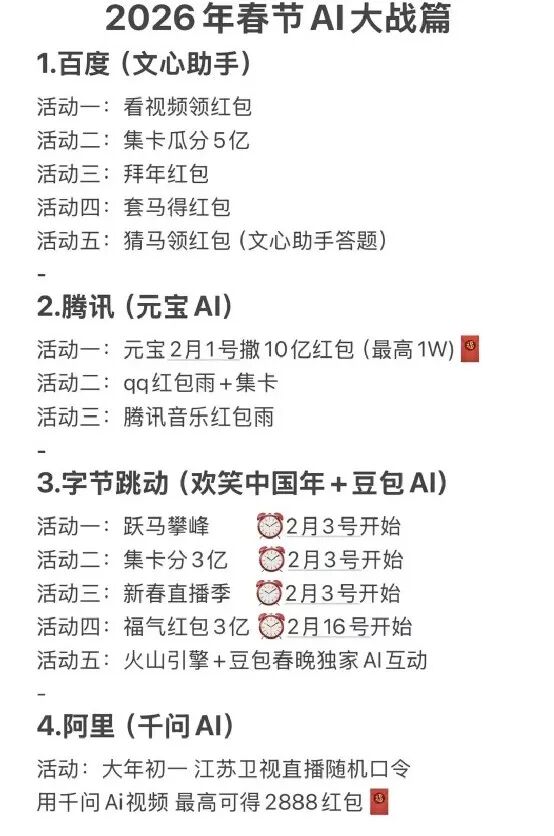
Image Source: Internet
Tencent’s “Yuanbao” capitalized on WeChat’s social virality, investing 1 billion yuan in red envelopes to recreate the historic success of WeChat’s red envelope feature. Baidu invested 500 million yuan in its Wenxin Assistant and tied it to the Beijing TV Spring Festival Gala, extending the event period to solidify its market position. ByteDance, while not disclosing the exact amount, made “Doubao” the exclusive AI cloud partner for CCTV’s Spring Festival Gala, directly securing top-tier traffic access. Alibaba’s Qianwen, on the other hand, focused on e-commerce and local life services, using 3 billion yuan in cash to attempt a latecomer’s advantage.
A horizontal comparison of the four AI platforms reveals that they are not developing identical “AI products.” Instead, they are competing for different “key positions” within their respective strongest ecosystems.
Tencent Yuanbao’s core strength lies not in the model capability itself but in collaboration and relational chains. It integrates with WeChat and enterprise tool systems, prioritizing the question of “how people use AI together.” It functions more like an intelligent connector amid a crowd of users.
Baidu Wenxin revolves around search and knowledge systems, emphasizing authoritative information, tool utilization, and serious scenarios. Its goal is to become the most trustworthy and suitable intelligent assistant for work and professional decision-making.
ByteDance’s Doubao follows a content efficiency route, deeply integrating with short videos, creation, and recommendation algorithms. Its core value lies in transforming AI into an accelerator for the content industry rather than a new tool that requires learning.
Alibaba’s Qianwen clearly targets industrial and transactional scenarios, spanning e-commerce, local life services, and enterprise services. It emphasizes “intelligent agents that directly drive conversions,” essentially using AI to reconstruct business processes.
While all four platforms appear to be creating general-purpose assistants, they are actually positioning themselves at different entry points: one occupies relational chains, one occupies knowledge authority, one occupies content production, and one occupies commercial closures. This determines that their future success will not depend solely on model parameters but on the depth of their ecosystems.
On the surface, the upcoming Spring Festival sees the four AI platforms taking different paths, but their goals are surprisingly aligned: during the critical window of AI application explosion, they aim to seize the super entry point for the next-generation internet using the familiar tactic of “burning money to capture the market.”
Tencent Yuanbao leads the way by humbling itself and directly integrating into real-life scenarios.
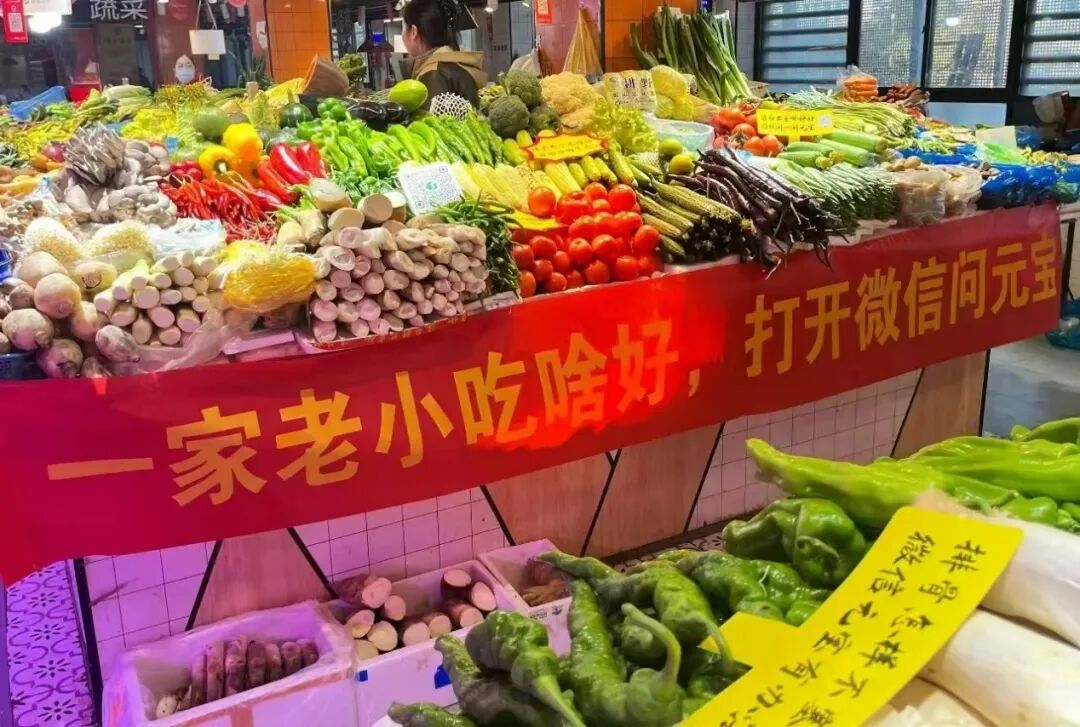
Image Source: Internet
It is no exaggeration to say that the 2026 Spring Festival will be the most intense trial ground for Chinese AI platforms.
Here, users will not pay for “advancedness” but will vote with their convenience. What can be stuffed into red envelopes is not necessarily the entry point; what can be integrated into wet markets, daily eating and drinking, and other mundane aspects is the true infrastructure. Looking back at this red envelope battle, you will notice a sober yet harsh reality:
Some AIs are using money to buy downloads; others are doing the same.
I believe you, being clever, have already realized—this is just like the food delivery wars back in the day!
The same subsidy logic, the same traffic frenzy, the same “seize the entry point first, then talk about monetization.” The only difference is that back then, they fought over “which meal you would eat today,” whereas now, they fight over who you will open first every day in the future.
The AI red envelope battle during the Spring Festival is not essentially about giving away money but about seizing the default entry point for the life operating system. Whoever can repeatedly appear in high-frequency, essential, and low-decision-cost scenarios will qualify as the “next-generation WeChat,” “next-generation browser,” or “next-generation food delivery app collective.”
This is why the real danger does not lie in who gives away the most red envelopes but in who is the first to humble themselves and enter real life.
While some AIs are still indulging in Spring Festival Gala exposure, model parameters, and technical narratives, Yuanbao focuses on why users should use AI and, more importantly, how to use it frequently.
This step closely resembles the moment when food delivery platforms expanded from white-collar office buildings to mom-and-pop shops and roadside stalls. That was not expansion but occupation of the “first layer” of users’ lives. Once you habitually use it for the smallest, most trivial, and least thought-intensive decisions, path dependency becomes irreversible.
Thus, the ultimate outcome of this AI war will not be determined by “who is the smartest” but by who is the most like air—something users grow accustomed to and cannot live without.
Red envelopes will stop, subsidies will withdraw, and events will end. However, if, after the Spring Festival, users still subconsciously open it when buying groceries, placing orders, choosing what to eat, or making decisions—then it has won not just one Spring Festival but the user stickiness that defines the mobile internet era.
When users subconsciously open that AI platform whether they are buying groceries, cooking, placing orders, or choosing what to eat, it will not just pass but directly secure admission to the “Double First-Class” in the AI “back-to-school exam” held during the Spring Festival.
The lead image was generated by AI.
© THE END
All materials are sourced from official public information.
This article does not constitute any investment advice.
This article is original to Baker Street Detective and may not be reproduced without permission.
-
Several Judgments on the Development Trends of AI Data Centers
-
![]()
Tough Times Are Here: The Auto Industry Is Mired in Immense Pain
-
![]()
Honda Finds Itself 'With No Alternative' but to Battle On for Another Ten Years
-
![]()
Is the 'Chili Fish Head' Car, Once a Hit Among Noble Ladies, on Its Way Out?
-
![]()
DJI Osmo 360 II Review: Impeccable Hardware, Yet Software Still Lags Behind
-
![]()
The 'Dichotomy' in Alibaba's AI Ledger
-
Reinventing the 'Old Guard' with AI: A $12 Billion Venture in Just a Year
-
![]()
Alibaba's Q2 Profit Plummets by 32.6 Billion Yuan, with 67.7 Billion Yuan Earmarked for Capital Expenditures