No 'Mid-Game Battle' for Tech Giants: The Last Boarding Pass for Cloud, Chip, and Model
 02/05 2026
 719
719

Produced by | Bullet Finance
Art Editor | Qianqian
Reviewed by | Songwen
As the Spring Festival approaches, the red envelope battles among internet giants are once again making headlines. Baidu is giving away 500 million, Tencent Yuanbao is splashing out 1 billion, and Alibaba Qianwen is investing 3 billion...
However, the surface-level frenzy of "money-throwing" cannot conceal the undercurrents below, as an "infrastructure war" for the AI landscape over the next decade is quietly unfolding.
(Image / Shetuwang, based on VRF protocol)
In late January, with Alibaba's T-Head quietly launching its self-developed AI chip "Zhenwu 810E," Alibaba completed the full-stack puzzle of AI infrastructure.
Thus, the global AI landscape has officially formed a GBA full-stack club of Google, Baidu, and Alibaba. Alibaba's entry once again confirms the consensus among tech giants: full-stack capabilities are the lifeline for staying in the game. The AI competition has completely bid farewell to single-point breakthroughs and has entered a full-stack system competition of "cloud, chip, model, and ecosystem."
1. The Emergence of the GBA Big Three in the AI Era
The ticket to the AI era is no longer simply "going to the cloud" but "cloud-intelligence integration."
Over the past decade, most enterprises have completed the basic move of "going to the cloud," but they soon realized that "going to the cloud" is just a means, not an end. The real goal is to form productivity through digitalization and intelligence. This market demand forces cloud service providers to transition from "selling resources" to "selling intelligence."
Baidu Cloud, sensing this trend, made a forward-looking strategic adjustment as early as 2015, rebranding from Baidu Cloud to Baidu Intelligent Cloud. This was not just a name change but a reconstruction of the underlying logic: the competitive focus shifted from the price and stability of computing power to the full-stack collaborative efficiency of "bottom-layer chips + middle-layer cloud services + top-layer large models."
In this chain, chips determine the upper limit of computing power, large models determine the lower limit of intelligence, and cloud services are the neural network running throughout. All three are indispensable.
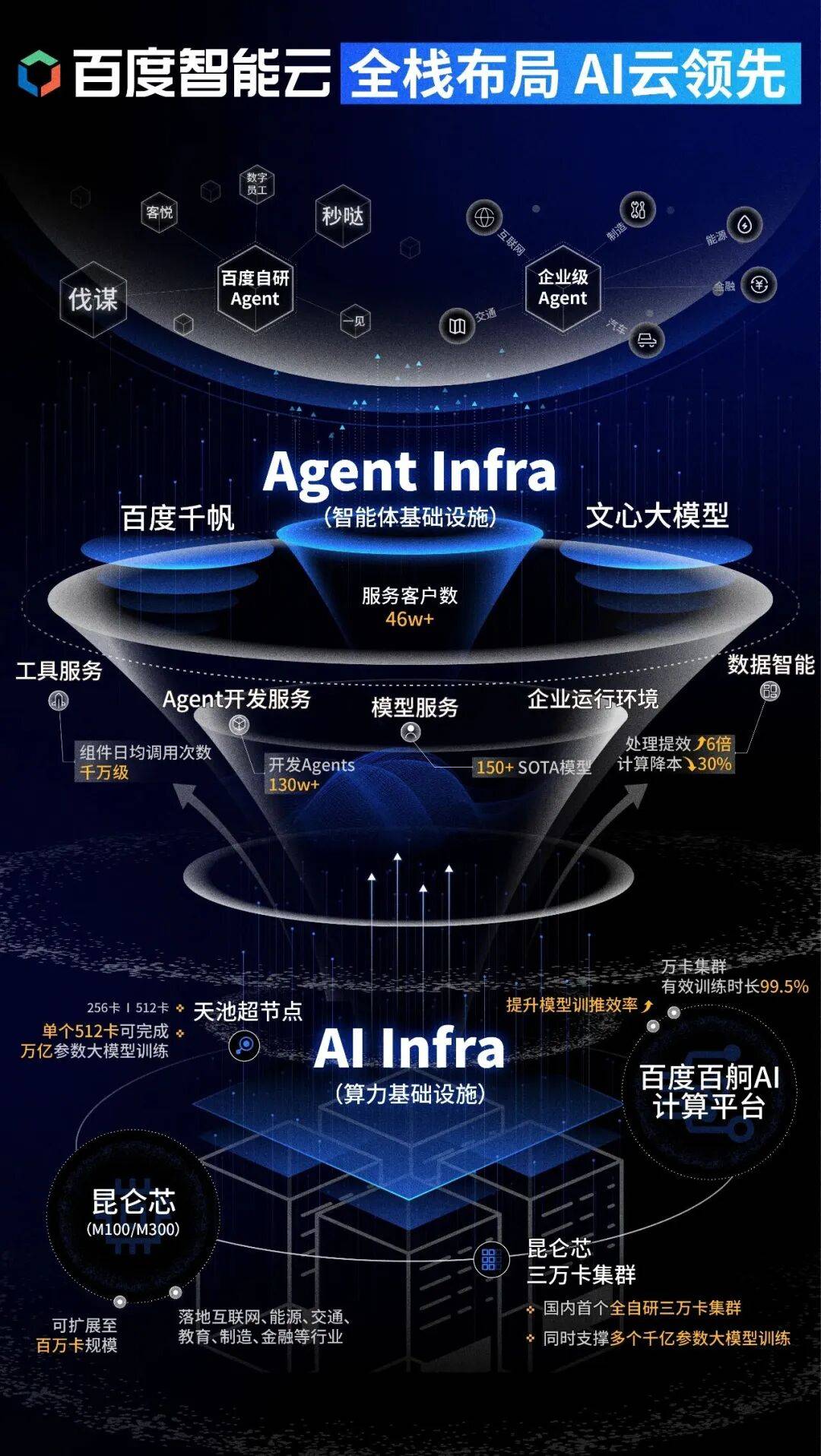
Over the past decade, only Google and Baidu have been able to complete moves in this highly challenging full-stack game globally.
Google, in addition to cloud services, owns self-developed products such as TPU chips and the Gemini large model.
Correspondingly, Baidu has its self-developed Kunlun chip at the chip layer, which has undergone multiple iterations since its release in 2018. At the same time, Baidu has also launched the Baige AI computing platform, which fully unleashes the potential of the chips, making good chips even better. At the model layer, Baidu's Wenxin large model has been iterated to version 5.0 since its release in 2019. Baidu's Qianfan platform provides enterprises with a complete toolchain for model-to-Agent development.
Now, with Alibaba completing the last piece of the puzzle in cloud, chip, and model, the "GBA" (Google, Baidu, Alibaba) tripartite standoff in the AI era has officially taken shape. This marks that the future cloud market will be a "high-end game" for full-stack players.
2. Reaping the Rewards from a Decade Ago
The full-stack self-research of GBA is not about doing everything in-house but about achieving ultimate cost-effectiveness. In the second half of AI commercialization, the winner will be the one who can reduce costs and increase efficiency.
The advantage of Baidu Intelligent Cloud lies in that it does not just sell cloud services but sells "end-to-end software-hardware collaboration." This full-link optimization from chips to models has brought tangible returns: for example, relying on the Baige platform, the single-card throughput performance of the third-generation Kunlun chip's 30,000-card cluster is 90% higher than mainstream solutions, and the inference speed of large-scale, high-concurrency models has increased by over 40%.
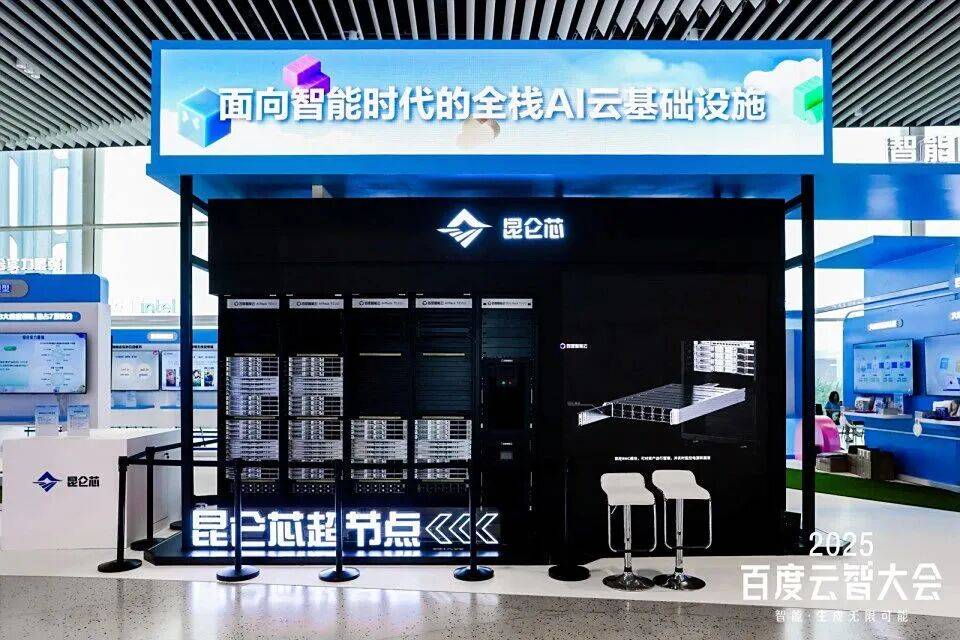
This technological dividend has directly translated into customer productivity. Take China Merchants Bank as an example; based on the Kunlun chip P800, it can complete the full training of a 100-billion-parameter large model with just 32 servers, achieving industry-leading multimodal inference performance. In the field of embodied AI, Baidu has helped the Beijing Humanoid Robot Innovation Center double its R&D efficiency.
Market recognition is the only standard for testing technology. Data shows that in 2025, the cumulative number of large model-related bid wins by mainstream Chinese cloud providers reached 341, with Baidu Intelligent Cloud becoming the cloud provider with the most bid wins and the highest bid amount for two consecutive years. Following closely are Volcano Engine and Alibaba Cloud.
Not only are the numbers and scale large, but the quality is also extremely high. Public data shows that Baidu Intelligent Cloud has served 65% of central state-owned enterprises, all systemically important banks, and over 800 financial institutions, as well as the top 10 mobile phone manufacturers and the top 15 car brands in the Chinese market, maintaining the highest penetration rate in the field of embodied AI.
These clients include financial institutions and central state-owned enterprises with extremely high data security requirements, as well as tech companies with strong innovation vitality at the forefront of innovation. Their collective choice of Baidu proves that in complex scenarios with "high thresholds, high security, and high concurrency," Baidu Intelligent Cloud is currently the best solution.
3. From Traffic in the Mobile Internet Era to Foundations in the AI Era
Returning to the Spring Festival red envelope battle at the beginning, while C-side traffic competition is important, the decisive battlefield in the AI era has already shifted from "traffic" to "foundations." In the mobile internet era, those who owned traffic ruled the world; in the AI era, only those who own infrastructure have a future.
At the beginning of 2026, the dense (intensive) listings of multiple domestic AI startups are an inevitable result of the maturity of China's AI infrastructure, especially the full-stack self-research capabilities of tech giants. Without giants like Baidu and Alibaba, who have the strategic determination and patience to persist in bottom-layer technologies such as chips, cloud, and large models, China's AI ecosystem might still be constrained by others.
For Baidu, the seeds of full-stack capabilities sown a decade ago have now grown into a towering tree that protects the industry, earning market and customer recognition.
But Baidu's ambition does not stop there. While consolidating the solid foundation of "chips, cloud, and models," Baidu is accelerating its full-speed advance toward "intelligent agents," a new application frontier. In the AI arena, not following trends but defining trends and directions—this is how a tech giant should behave.
*The featured image in the article is from Shetuwang, based on the VRF protocol.
-
![]()
Li Shufu's Lesson in 'Abstract' Thinking: With Speed Dividends Peaking, What Will Drive China's Auto Industry Through the Next Two Decades?
-
![]()
World’s Pioneering! Automated Production Line for Million-Scale Volume Holographic Waveguides Launched in Tianjin
-
![]()
Cars Can't Be Made with the 'Quick Buck' Mentality: Li Shufu's Candid yet Impactful Remarks
-
![]()
Can You Snag a Complete Trio of Digital Gadgets for 10,000 Yuan? AI Recommendation Showdown: How Trustworthy Are Doubao, DS, Qianwen, Kimi, and Yuanbao?
-
![]()
DingTalk Undergoes Leadership Overhaul Amid Alibaba’s AI Strategy Unveiling
-
![]()
Revealing the Myth of the '10 Billion Subsidy': Pinduoduo Faces Heightened Scrutiny with Its '100 Billion Initiative'
-
![]()
Yousu's '70,000-Character Long Essay' Resonates with Alibaba Executives' 'Cultural Awareness'
-
Analysis | SpaceX is about to land on Nasdaq. Where is the breakthrough point for China's commercial aerospace?