The Other Side of the Spring Festival AI Battle Report: Big Companies Fight for Prestige, Small Companies Profit from Substance
 03/02 2026
 421
421


While giants spent heavily, 4.5 billion RMB, to compete for traffic access points, small companies silently profited handsomely. The winners of this Spring Festival AI battle may not be on the leaderboards. 
Original Tech Insights AI New Tech Team
The Spring Festival that just passed brought a familiar scent of bloodshed to China's internet. This time, however, it wasn't ride-hailing apps or food delivery platforms throwing money around, but AI large models representing new quality productive forces.
With 4.5 billion RMB in red envelopes flying around, big companies went all-in to contend for (compete for) the title of 'national AI.' If you opened your phone during the holiday, you'd find the App Store charts resembling a palace intrigue drama of shifting alliances: ByteDance's Doubao dominated for 15 days, Alibaba's Qianwen for 8 days, while Tencent's Yuanbao and Alibaba's other offering, Afu, claimed the top spot for 5 and 3 days respectively. On the surface, AI has conquered Chinese netizens' digital world at unprecedented speed.
Yet the world's fascination often lies in its hidden B-side.
Today, let's deeply analyze this Spring Festival AI battle to see who gained prestige and who earned substance after the 4.5 billion RMB frenzy.
01
The Battle for Prestige: The Illusion of Top-Tier Traffic Bought with 4.5 Billion
The internet has memory, and big companies' executives know this well. In 2014, WeChat ambushed Alipay's Pearl Harbor with mere hundreds of millions in red envelopes, achieving a Normandy landing for mobile payments. A decade later, big companies attempt to replicate this miracle in the AI era.
But this time, the cost is 4.5 billion RMB. Combined with the latest App Store chart data, we can clearly see the tactical differences and strategic cards of each giant.
First is ByteDance's 'brute force aesthetics.' Doubao's 15-day chart domination proves ByteDance's strategy of aggressive user acquisition through massive spending remains unbeatable in the consumer market. ByteDance's logic is simple and crude: as long as my exposure is dense enough, as long as I stuff Doubao links into every crack of the Spring Festival Gala, Douyin, and Toutiao, users will eventually click. They don't care about single-click conversion rates; they care about absolute mindshare domination. 
Next are Alibaba's 'transaction bundling' and Tencent's 'social virality.' Qianwen and Afu combined dominated for 11 days, Yuanbao for 5 days. Alibaba spent 3 billion RMB to 'treat the nation to milk tea,' directly bundling AI capabilities with lifestyle services and e-commerce transactions. Ordering takeout or movie tickets with one sentence, Alibaba aims to create immediate commercial loops. Meanwhile, Tencent's Yuanbao fully leveraged WeChat's social ecosystem, with over 1 billion 'inflation cards' Crazy forwarding (going viral) in family groups. Through trusted social endorsements, they forced Yuanbao into the top tier. 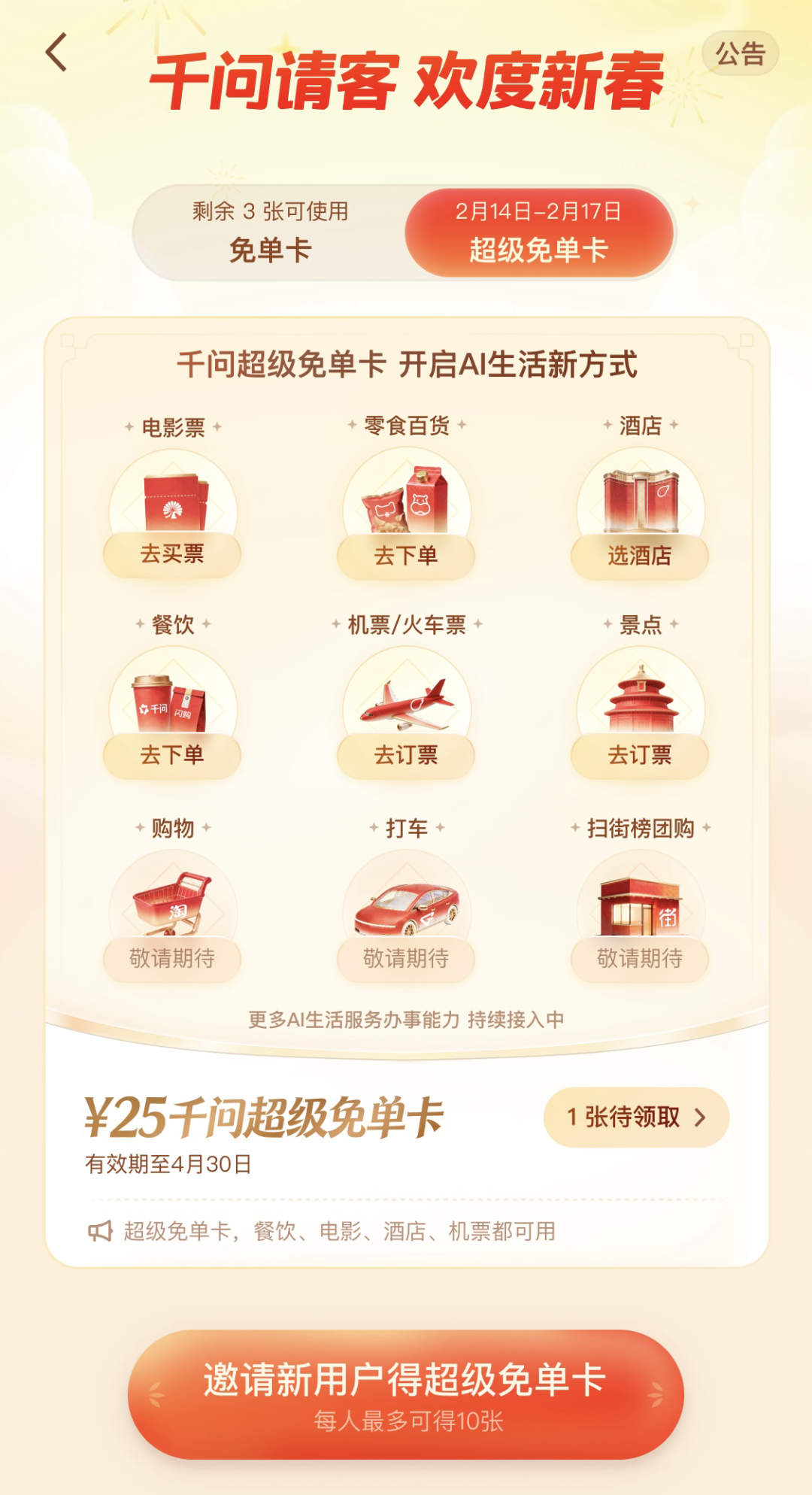
We must not overlook Baidu's moves in this chaos. Compared to others' aggressive advances, Baidu spent 500 million RMB in cash red envelopes this Spring Festival but adopted a more calculating strategy. Baidu didn't try to build a new standalone super-app but instead used an 'invisible embedding' model. Baidu's logic: don't force users to change habits, but provide AI-powered value-added experiences along their existing intent paths. This not only activated Baidu's massive existing user base but also executed a brilliant defensive counterattack, stabilizing its stronghold amid AI's potential disruption of traditional search. 
Summarizing the big companies' 'battle for prestige,' the core logic boils down to two words: land grabbing.
Do big companies really care about the current 20-30 RMB monthly AI membership fees? Not at all. What they want is the super entry point for the next decade. Among 8.1 billion global population, over 80% have never truly used AI. Whoever can get hundreds of millions of Chinese users in lower-tier cities and rural areas to use AI for the first time this Spring Festival will secure tickets to the new world.
Thus, these 4.5 billion RMB in red envelopes are merely entry stakes. Big companies aren't just burning money but also billions of free tokens. This follows typical old mobile internet thinking: first subsidize to acquire users, boost DAU, then cultivate habits, and finally monetize through ads or ecosystems.
This creates an illusion of top-tier traffic. The prestige of ranking first exists, but will users open that AI app again after claiming red envelopes? This remains a Schrödinger's mystery with a huge question mark.
02
The Battle for Substance: The Computing Power Deflation Behind Sold-Out Services
While big companies worried about DAU during the Spring Festival Gala and aggressively drove traffic to various apps, the other end of the AI industry witnessed an extremely surreal spectacle.
Startup models like Kimi, Zhipu AI, and MiniMax didn't appear on the Spring Festival Gala or distribute billion-RMB red envelopes, yet they first achieved closed-loop AI commercialization during the holiday, experiencing true meteoric success. This represents an extremely rare computing power squeeze in Chinese software history.
Consider Kimi: shocking industry data reveals Kimi's revenue over the past 20 days exceeded its original 2025 annual forecast. Why? Because Kimi addressed the absolute rigidity need: long-text parsing and strong logical reasoning. During the holiday, whether financial workers rushing reports, researchers quickly reading massive papers, or programmers coding on New Year's Eve, they had no time for small red envelopes. They willingly paid for Kimi's premium tier to avoid queues and maintain intelligence. 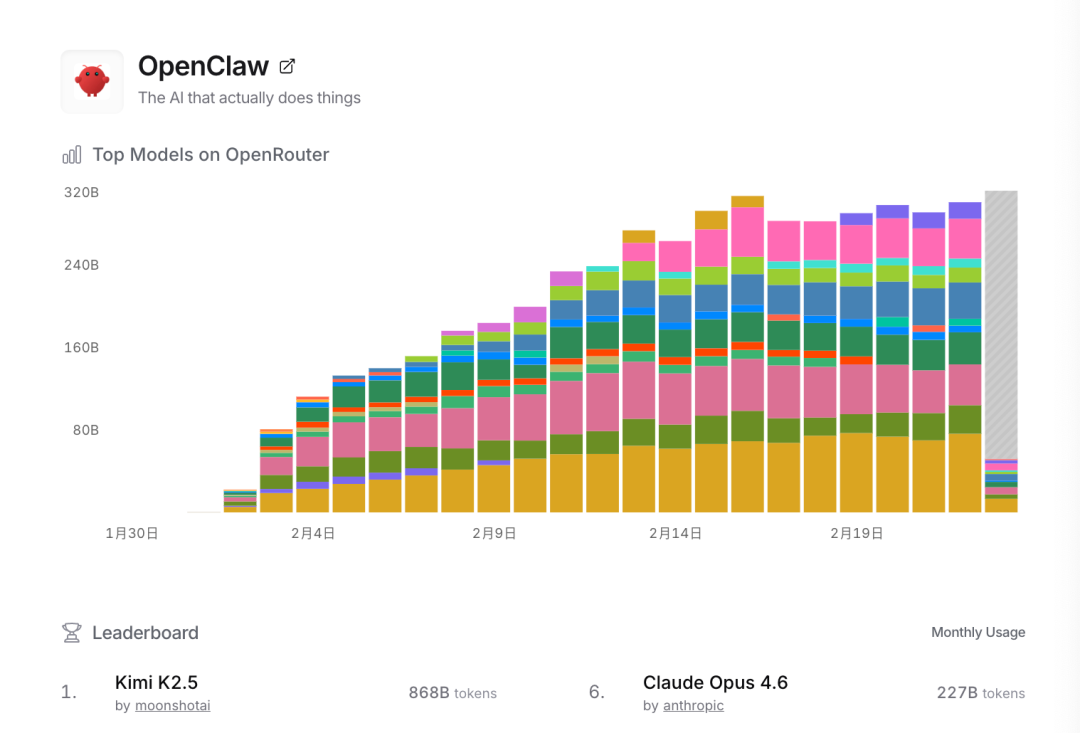
Source/Kimi K2.5 ranked first in model calls on OpenClaw's leaderboard
Now look at GLM-5: Zhipu's new model demonstrated extreme competitiveness during the holiday, with its highest-tier paid membership actually selling out. Yes, you heard correctly—a virtual software service sold out. This essentially means user demand instantly overwhelmed Zhipu's backend GPU computing capacity. When concurrent paid user requests exceeded cluster throughput, officials had to halt sales to protect existing users' experience. This shows users weren't just trying but heavily using the service.
Then there's MiniMax: beyond consumer products, MiniMax demonstrated terrifying dominance in the developer ecosystem, topping global model aggregation platform OpenRouter's call volume leaderboard for a week. This means not just Chinese but global developers are aggressively calling MiniMax's APIs with real money to build their applications.

More frighteningly, OpenClaw has opened a new world. With Agent technology maturing, large models are no longer simple Q&A systems. When you give AI a complex instruction, it autonomously plans, multi-step reasons, and even self-corrects in the backend. This Agentic workflow causes token consumption to grow exponentially. Previously, users consumed hundreds of tokens per question; now, AI might consume tens of thousands or even hundreds of thousands of tokens in the backend to solve a complex problem.
This creates the current small companies' prosperity dilemma. All model vendors frantically sought additional computing cards during the holiday, purchasing or leasing computing power everywhere.
This is no longer a marketing issue of not finding users but a supply-side crisis of having money but no computing power. In this battle for substance, small companies proved one thing: as long as your model is smart enough and truly solves productivity problems, users desperately want to pay you. Against computing power deflation, whoever has the highest-quality model holds the new era's money printer.
03
The Cold Truth: 0.3% Adoption vs. 99.7% Wilderness
However, whether it's big companies' 4.5 billion RMB traffic frenzy or small companies' server-selling profit myths, viewing this globally reveals an extremely cold undercurrent.
Basic data pours ice water on all AI practitioners' heads: among 8.1 billion global population, over 80% have never truly used AI; only 0.3% are willing to pay for AI.
What does this mean? It means the billion-RMB red envelope battles, trending topics, and computing power shortages we saw during the holiday essentially just repeatedly washed the extremely narrow existing market.
Who are these 0.3%? They're geeks, programmers, writers, financial analysts—the first to benefit from AI. They use large models as external brains for coding, making PPTs, analyzing financial reports. They contribute most of Kimi and GLM's revenue.
What about the remaining 99.7%? They might have claimed Baidu's 500 million RMB red envelopes, clicked Qianwen for Alibaba's free milk tea, or opened Tencent Yuanbao's inflation cards in family groups. But after work resumed on the eighth day of the lunar new year, that app silently remained in their phone's corner, never reopened. For an ordinary security guard, wet market auntie, or assembly line worker, they still don't know what AI can actually do for them beyond writing a simple poem.
This reveals the core strategic divergence between big and small companies.
Big companies bet on the 99.7% wilderness. Their logic is infrastructure: they know ordinary people won't pay for AI now, so they heavily subsidize to lower barriers. Their goal is making AI as fundamental as utilities. As long as you stay in their ecosystem, as long as Baidu can still precisely recommend content, Alibaba facilitate transactions, and Tencent control social connections, big companies will find countless ways to monetize these 99.7% free users.
Small companies bet on the 0.3% existing market and try to expand it to 1% or even 5%. Startups lack big companies' bottomless funds for free games. They must pursue high-margin, high-repurchase SaaS or MaaS models. They bet that as human society becomes more complex, more knowledge workers will be forced into this 0.3% elite group. Small companies don't sell software but intellectual premium and productivity leverage.
The world changes as AI capabilities evolve exponentially daily; yet the world remains unchanged as most people remain trapped in traditional physical reality and daily necessities, not truly entering the AGI river. 
Source/AI-generated
The 2025 Spring Festival might just be AI's prelude; but this 2026 Spring Festival is definitely an accelerator for AI's full-scale adoption and a brutal differentiator for the industry.
When holidays end and red envelopes are cashed out, the traffic tide will recede. This battle without smoke actually has no absolute winners.
Big companies spent 4.5 billion RMB to gain 'prestige' and tickets to the future, but now face retaining users who came for red envelopes from uninstalling. Small companies earned 'substance' through hardcore technology and validated business models, but face the Sword of Damocles: constantly threatened computing power shortages and high inference costs.
Giants still calculate DAU retention rates; small companies still scramble for the next batch of arriving GPU clusters. Everyone tries to 'keep playing music, keep dancing.' After all, AI's party is far from over.
But before that cold 0.3% payment rate, everyone should Soberly aware (soberly) realize: time for free lunches and traffic illusions is running out. Only tokens that truly solve human problems deserve the new era's throne.
- The end -
-
![]()
Doubao Work Unveiled! Domestic AI Leaders Fully Commit to the 'Work' Sector
-
![]()
Who’s Sounding the Alarm on ‘Rushed Vehicles’?
-
![]()
Over 5.3 Billion Yuan in Losses Over Three and a Half Years! Can Yonyou Reverse Its Fortunes Through Streamlining and AI Transformation?
-
![]()
Baidu AI Adopts Free Model: A Strategic Maneuver in Traffic and Monetization
-
![]()
Silicon-Based OLED Pioneer Unveils Financial Results: H1 Shipments Outpace Entire 2025 Volume
-
![]()
AI's First "Lost Summer"
-
![]()
Zeiss Makes Another €2.2 Million Bet: Will Eye Tracking Be the Next Big Thing in the Smart Glasses Industry?
-
![]()
RUNTO Ranking | Global Top TV ODM Factories' Shipment Figures for July 2026