Brand Competition Pattern Amidst a 211% Surge in China's Smart Glasses Sales in 2025
 03/02 2026
 531
531
As smartphone screens and interactions reach their physical limits and innovation plateaus, the industry urgently seeks next-generation mobile terminals as new entry points. Smart glasses, recognized as full-modality interactive devices 'closest to the human brain,' have emerged as a pivotal bridge connecting the physical and digital worlds in recent years, transitioning from niche adoption to mainstream acceptance in developed markets.
In the Chinese market, as we enter 2026, smart glasses, as the sole newly added category, have been included in the national subsidy scope for the first time. This move underscores the category's rapid development and the official emphasis and expectations placed on it by the Chinese government.
According to the latest data released by Runto, China's smart glasses market witnessed sales of 1.454 million units in 2025, marking a staggering 211% year-on-year surge.
Based on product form and functionality, Runto categorizes smart glasses into three types: AR glasses (with display and audio), audio glasses (without display but with audio), and camera glasses (without display but with a camera). Among these, AR and audio glasses experienced year-on-year sales growth of 83% and 135%, respectively, while camera glasses achieved a breakthrough, rising from nearly zero to 500,000 units.
Sales Trends in China's Smart Glasses Market (2023-2025)
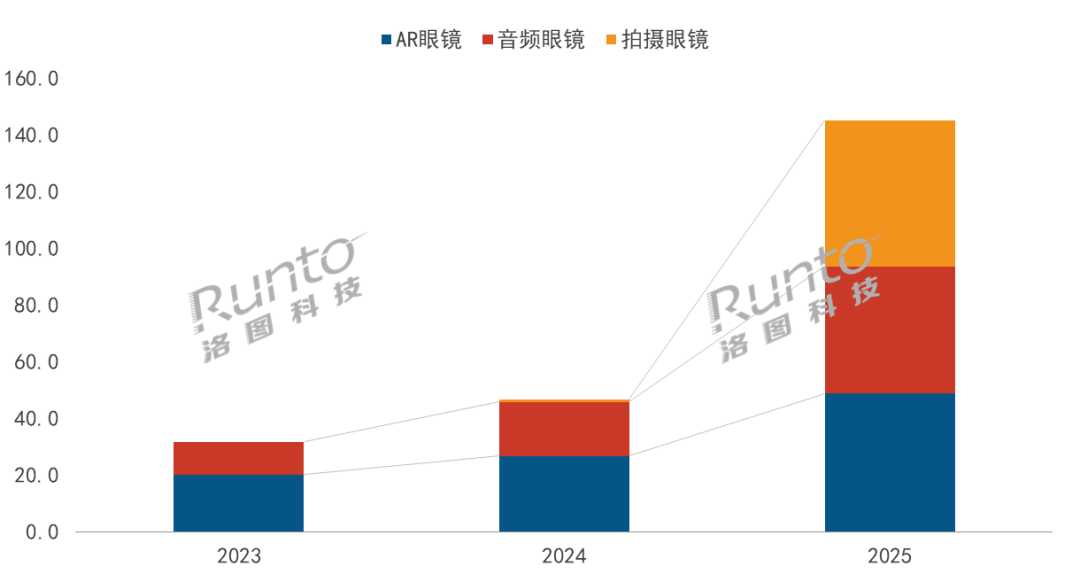
Data Source: Runto, Unit: 10,000 units
The explosive growth in market size can be attributed to breakthroughs in core technologies such as optical displays, lightweight designs, AI, and multimodal interactions, coupled with the full maturity of upstream and downstream industrial chains. The entry of tech giants and capital from various fields has accelerated market education and competition. Additionally, strong policy support and the comprehensive penetration of application scenarios, ranging from entertainment to productivity, have contributed to this surge.
Notably, brands have made breakthroughs in multiple dimensions, including technical solutions, functional forms, and market positioning, injecting new vitality into various segments and playing a pivotal role. Runto will provide a detailed analysis of the brand competition pattern in the smart glasses market through sales data.
I. AR Glasses Market: Thunderbird Innovation Leads, Second-Tier Competition Intensifies
AR glasses, with their early start driven by the XR metaverse narrative, saw China's market scale grow from 267,000 units in 2024 to 489,000 units in 2025, an 83.2% increase, nearly doubling in size.
In 2025, the Chinese market witnessed intense brand competition with a slight decline in concentration, characterized by relatively stable leading brands, intensified competition among second-tier players, and accelerated diversification in the industry.
In the online market, the primary sales channel, Runto data reveals that Thunderbird Innovation, Xreal, Rokid, and StarV Meizu ranked as the top four in sales in 2025, with a combined sales share (CR4) of 78.4%.
Brand Sales Share and Changes in China's Online AR Glasses Market (2025)
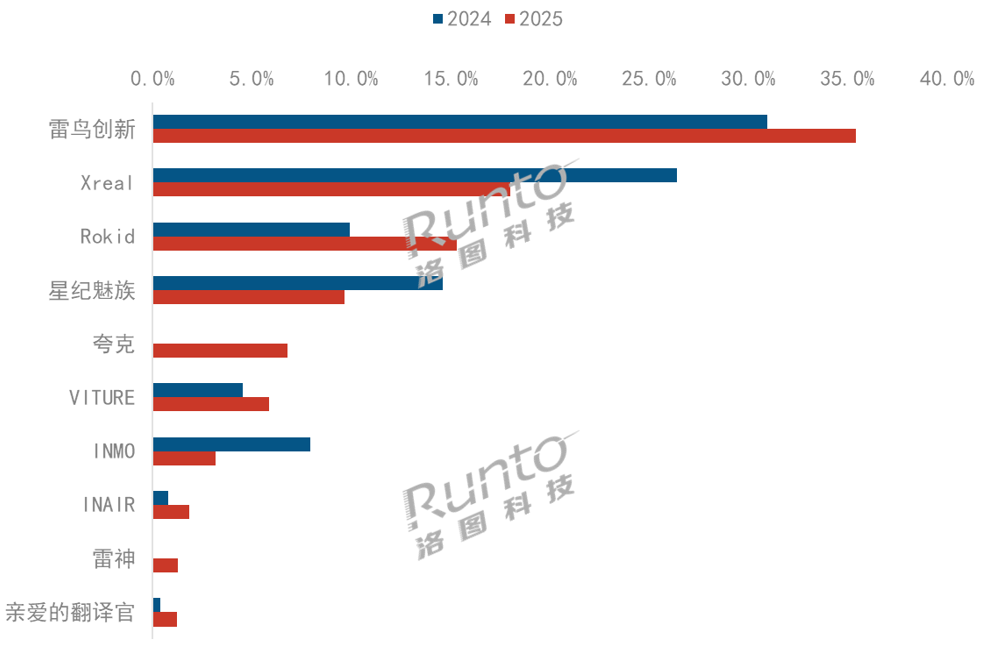
Data Source: Runto Online Data, Unit: %
Thunderbird Innovation held a 35.4% sales share, up 4.5 percentage points year-on-year, maintaining its top position in China's online full-channel market for the fourth consecutive year. In 2025, Thunderbird Innovation continued to deepen its 'AR+AI+Full-Scene' strategy, driving down consumer product prices to further consolidate its mass-market advantage while accelerating the commercialization of high-end technologies. The Thunderbird X3 Pro, unveiled at CES 2025, achieved mass production, and at CES 2026, the innovative X3 Pro Project eSIM was introduced, enabling independence from smartphones and true standalone communication capabilities. Meanwhile, leveraging deep cooperation with ecosystem partners such as B&O, SeeYA, Qualcomm, and Alibaba Cloud, Thunderbird achieved continuous breakthroughs in hardware technology, software platforms, and scenario adaptation, realizing a comprehensive upgrade from hardware iteration to ecosystem empowerment.
Xreal ranked second, with spatial computing as its core competitive edge, optimizing the accuracy of 3DoF hover functionality through self-developed chips while expanding application scenarios such as 3D imaging and spatial office work. Additionally, Xreal further strengthened ecosystem cooperation, forming deep linkages with leading brands in consumer electronics and automotive sectors, recently collaborating extensively with Google to develop Project Aura based on the Android XR platform.
Rokid emerged as the industry dark horse in 2025, with a sales share of 15.3%, up 5.4 percentage points from 2024. In 2025, Rokid focused on a 'lightweight + high cost-performance' mass-market strategy, launching multiple entry-level products suitable for daily commuting and mobile office work, significantly lowering the consumption threshold for users.
Meanwhile, second-tier brands also engaged in fierce competition, with established players like VITURE and INMO consolidating their positions through technological iterations, while new entrants such as Kuake, INAIR, and Thunderobot quickly penetrated the market with price strategies and scenario innovations.
II. Camera Glasses Market: Xiaomi and Thunderbird Lead, New Brands Break Through, White-Label Brands Hold a Place
In 2025, China's camera glasses market officially entered a phase of scaled-up growth, reaching 517,000 units.
Throughout the year, the number of brands monitored online exceeded 100, with the brand landscape not yet fully formed, characterized by dual leadership, new brand breakthroughs, and space for white-label brands.
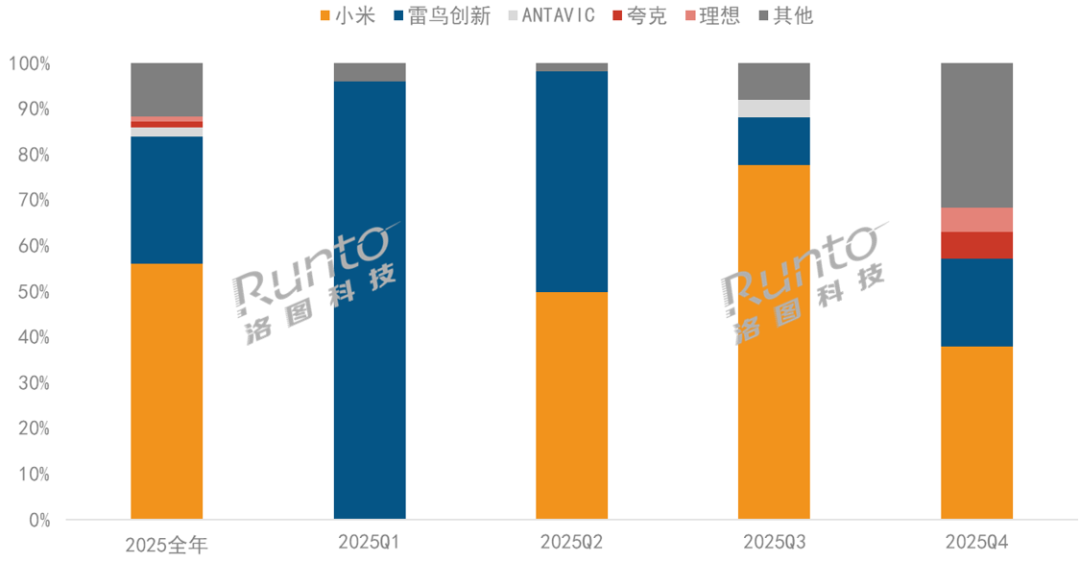
In the online market, Xiaomi and Thunderbird Innovation dominated with an absolute advantage, collectively occupying over 80% of the market share. Xiaomi ranked first, leveraging its strong brand appeal, mature consumer electronics supply chain, and channel penetration capabilities to quickly secure market positions. Thunderbird Innovation followed closely, leveraging its technological accumulation in the AR glasses field to launch products with AI visual algorithms and professional shooting capabilities, establishing an early advantage in the initial market phase and forming strong user loyalty, especially among mid-to-high-end and professional user groups.
Quarterly analysis of market dynamics: In the first quarter, the market was monopolized by Thunderbird Innovation; in the second quarter, Xiaomi's new product launches created a competitive stance against Thunderbird Innovation; by the fourth quarter, a large number of new brands entered and quickly broke through. Kuake, relying on its youth-oriented positioning and support from Alibaba's channels, achieved market penetration, while Li Auto leveraged its automotive ecosystem scenarios and user philosophy, with both brands entering the market in the fourth quarter and immediately ranking third and fourth.
Additionally, white-label and small-to-medium-sized manufacturers occupied around 10% of the online market share, primarily supported by the extremely efficient supply chain ecosystem in Huaqiangbei, while also confirming that price-sensitive consumers remain a significant segment among China's diverse user base.
Quarterly Brand Sales Share in China's Online Camera Glasses Market (2025)
Data Source: Runto Online Data, Unit: %
When combining the AR and camera glasses markets, Thunderbird Innovation held the top position with over a 30% market share, exceeding the combined share of the second and third-ranked brands.
III. Audio Glasses Market: Huawei and Xiaomi Lead with Ecosystem Advantages
In the audio glasses market, Huawei and Xiaomi have long dominated the industry with their deep-rooted mobile ecosystems.
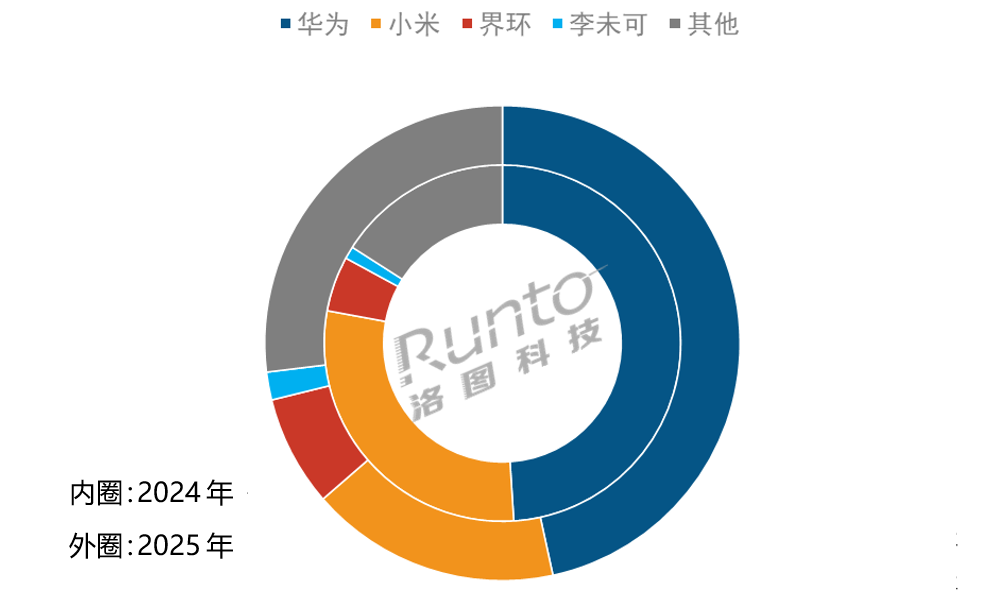
According to Runto's online data, Huawei held a 46.6% sales share in 2025, maintaining its top position and fully monopolizing the mid-to-high-end market above 1,500 yuan.
Xiaomi's sales share was 17.0%, with its core strength lying in the mass market below 1,000 yuan, attracting young user groups with cost-effective products.
Jiehuan and LeeWeKe saw their sales shares increase by 2.5 and 0.8 percentage points, respectively, compared to 2024. Unlike Huawei and Xiaomi, which rely on mobile ecosystems, Jiehuan and LeeWeKe focus on core technologies such as AI audio interactions and intelligent voice assistant optimization, enhancing experiences like call noise reduction, real-time translation, and voice command responses through lightweight AI algorithms.
Similar to the camera glasses market, the audio glasses segment also features active participation from white-label and small-to-medium-sized manufacturers. Due to the relatively simple product structure and manufacturing processes, their market penetration was faster, with a sales share as high as 30% in 2025.
Brand Sales Share and Changes in China's Online Audio Glasses Market (2025)
Data Source: Runto Online Data, Unit: %
Entering 2026, new brands will continue to enter China's smart glasses market, with products from ByteDance (Doubao), Samsung, XGIMI (MemoMind), Vidda, Huawei, Dreame, and Qianwen making their debuts. The entry of new giants will further enrich the product matrices across various segments, ultimately driving up industrial chain value and market size.
Runto predicts that China's smart glasses market will exceed 3.2 million units in 2026, a 120% year-on-year increase, with the industry's brand landscape continuing to evolve amidst more intense competition.
-
![]()
Hardware is the skeleton, AI is the soul, and data integrates the two
-
![]()
China’s AI Industry: A Unified Pivot Towards Monetization?
-
![]()
New Progress! Infineon Completes Acquisition of ams OSRAM's Non-Optical Sensor Business
-
![]()
35 Million Bet on an Optical Future! Tengjing Technology Makes a Move in AR
-
![]()
Why World Models Get Stuck on Construction Roads in Autonomous Driving Applications
-
Alibaba Initiates Cultural Transformation: Is Jack Ma Making a Strategic Comeback?
-
Tianfeng Heads to Hong Kong for IPO with RMB 3.8 Billion in Funds: Xingyu's Cross-Border Foray into Embodied AI Faces Uncertain Future
-
![]()
Mengshi Auto’s High-End Aspirations Dashed: Huawei Partnership Fails to Revive Sales, New Model’s Entry Price Dips Below 300,000 Yuan