OpenClaw's Chinese Proteges
 03/03 2026
 673
673
Author | Hao Xin
Editor | Wu Xianzhi
The global phenomenon of "shrimp farming" (a metaphor for engaging with AI models like OpenClaw) has sparked a frenzy, presenting golden opportunities for Zhipu, Yuezhian (hereinafter referred to as Yue'an), and MiniMax.
Zhipu, in collaboration with Alibaba Cloud's Wuying AgentBay, unveiled AutoGLM-OpenClaw, a cloud-based solution leveraging the OpenClaw (Lobster) framework. Yue'an introduced Kimi Claw, facilitating one-click deployment and swift utilization of OpenClaw functionalities. MiniMax, on the other hand, launched MaxClaw, a cloud-native AI assistant built atop OpenClaw.
From the initial cloud deployment of "Lobster" to seamless one-click functionality unlocking and subsequent ecosystem integration, large model companies have truly capitalized on the situation, maximizing their gains.
The silver lining is that AI companies, which previously could only nibble at the edges, are finally relishing the "lobster feast."
According to OpenRouter data, Kimi K2.5 tops the chart in OpenClaw's model invocation rankings.
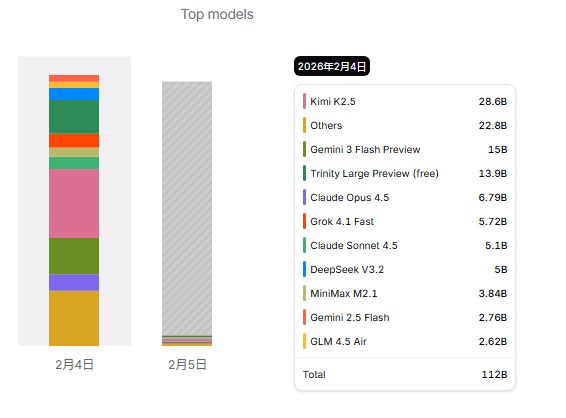
Moreover, amidst the rapid proliferation of "Lobster," Kimi's cumulative revenue over the past 20 days has eclipsed its total earnings for the entirety of 2025, fueled by a surge in global paying users and API calls. Notably, post-K2.5 release, Kimi's revenue structure flipped, with overseas revenue outpacing domestic earnings.
Peeling back the "Lobster" shell, it becomes evident that large model vendors have adeptly navigated the Spring Festival challenge: Zhipu's GLM-5, MiniMax's M2.5, and Kimi's K2.5 have bridged the capability gap with leading international counterparts. Leveraging OpenClaw, they've also secured a foothold in commercialization.
As the "Lobster" tide recedes, the pressing question for large model vendors who feasted on this opportunity is how to transform short-term gains into sustainable commercialization capabilities.
Large Model API Monetization
Currently, two primary revenue models emerge from the prospectuses of Zhipu and MiniMax.
One approach is offering MaaS (Model as a Service), standardizing model capabilities for enterprise clients. The other is a consumer-centric strategy, directly serving users through globally oriented AI-native applications.
Yue'an has consistently opted for a relatively lightweight intermediate path. On the consumer front, since its inception, Yue'an has focused solely on the Kimi application. On the enterprise side, it has de-emphasized customization, instead offering large model API invocation services to businesses and developers.
Due to its early emphasis on consumer services over enterprise solutions, Yue'an's total revenue remained relatively modest. However, after pivoting towards foundational model research last year, its revenue from model-driven API calls began to climb.
Kimi founder Yang Zhilin revealed in an internal memo that in 2025, Kimi's monthly growth in paying users, both domestically and abroad, exceeded 170%. Additionally, overseas large model API revenue quadrupled compared to the previous year's September-November period.
Yue'an aims to demonstrate a fundamental yet challenging business tenet: in the AI large model sector, superior technology and fair pricing will naturally attract users willing to pay.
While revenue growth is impressive, a complete business closed loop remained elusive until the K2.5 launch, which leveraged OpenClaw to achieve breakthroughs. For Yue'an, this meant not only savoring the "lobster meat" but also accelerating its commercialization efforts.
According to Huxiu, Yue'an has restructured its internal organization, rapidly expanding its large model API team as an independent business unit reporting directly to President Zhang Yutong.
The OpenClaw boom is not the endpoint but the starting point. This wave of growth, driven by favorable timing, has unveiled the immense potential of Yue'an's API business. Its sustainability hinges on both favorable conditions and proactive efforts. Rapidly expanding the team and elevating reporting levels are strategic moves to mitigate market uncertainties with organizational certainty.
Based on job postings on recruitment websites, Photon Planet observed that Yue'an has adopted a typical To B developer ecosystem strategy for API sales. This approach centers on technology-driven initiatives and developer ecosystem building, forming a technical sales team to understand customer business scenarios and provide tailored solutions.
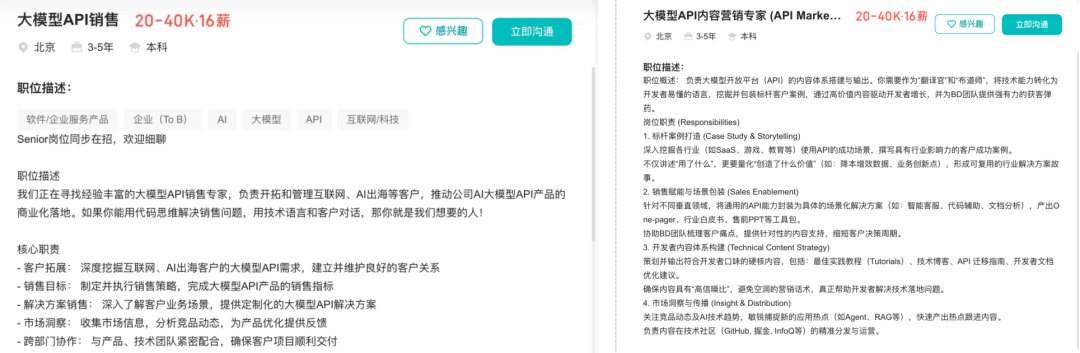
On the sales front, coding logic is employed to tackle sales challenges. Sales teams are expected to engage clients in technical jargon, acting not just as negotiators but as technical advisors. The focus is on deeply understanding customer scenarios to provide customized solutions rather than merely selling interfaces.
On the marketing front, all content and sales messaging revolve around developers, fostering technical trust. By showcasing successful client cases, Yue'an aims to establish industry influence, particularly by quantifying cost-saving and efficiency-enhancing data to demonstrate replicable success to potential clients.
At this juncture, Yue'an's understanding of API sales has evolved beyond merely tracking Token consumption. Instead, it delves into enhancing customer usage, pointing towards higher-level commercialization capabilities.
Model Startups Find Their Niche
Reflecting on the Spring Festival, two distinct battles unfolded.
One was a battle for consumer mindshare in AI applications, led by major players like Doubao, Yuanbao, Qianwen, and Wenxin. The other was a ranking elimination round for foundational models, featuring representatives like Zhipu, Yue'an, MiniMax, and Qwen.
The two battlefields have never been as clearly demarcated as they are now, with large corporations focusing on AI for consumers (AI To C) and startups targeting AI for businesses (AI To B).
Previously, the industry idolized OpenAI for epitomizing the Scaling Law—the belief that larger parameters and higher evaluation scores equated to superiority. However, as resources dwindled, Anthropic's pragmatism emerged as the true path forward. Rather than engaging in fierce competition in the consumer AI application market, selling Tokens via B2B APIs proved more sustainable.
Anthropic recently released two sets of data: since October last year, the number of paying users for its Claude chatbot has doubled, primarily driven by growth in Claude Code coding agents and the AI agent Claude Cowork.
Previously, Anthropic estimated that approximately 86% of its projected $4.5 billion in revenue for 2025 would come from model sales via APIs.
This implies that for ChatGPT, Kimi, or MiniMax, the conversation window serves merely as a showcase of model capabilities, intended to let users experience their power. The real commodity is Tokens—every user dialogue and invocation essentially represents a Token purchase.
In the previous phase, everyone aimed to create a Super APP to retain users within the conversation window. However, it has now become clear that the most straightforward business model is selling Tokens, enabling developers and businesses to integrate model capabilities into their applications and workflows, generating sustained invocation volumes.
The OpenClaw boom fundamentally reflects developers voting with their feet. For all model startups, including Yue'an, OpenClaw represents a crucial validation of value.
Previously, large model startups faced a common dilemma: the technology was cutting-edge, but paying customers were scarce. API pricing, typically based on usage volume, confined models to lightweight scenarios like Q&A and search, resulting in limited Token consumption and extremely low average selling prices. Many companies found themselves in a paradox of acclaim without profitability.
OpenClaw demonstrated that once models become executors, Token consumption surges exponentially. A complex automation task may require thousands of model invocations, transforming APIs into a continuously consumed product.
For large model startups, the key is not to pursue breadth but to identify high-frequency scenarios that sustain model consumption, thereby breaking through commercialization ceilings. The boom in AI coding tools has already validated this conclusion.
Computational power, data, and capital are the three formidable challenges weighing on startups. Given these inherent disadvantages, breaking through on the main battlefield is arduous.
OpenClaw presents a new path for leveraging ecosystems to go global. When an open-source project becomes a standard for developers worldwide, models deeply integrated with it naturally gain global traction. The model invocation rankings on OpenRouter serve as potent marketing tools.
This offers a potential revelation for the industry: AI companies need not initially attempt to create a ChatGPT-like super app for consumers. By cultivating a developer ecosystem, embracing open-source communities, and deeply aligning with popular open-source projects, they can achieve success through indirect means.
Optimistic Yet Precarious
The large model market is both optimistic and volatile.
In the second week of February, Chinese models achieved a historic milestone, surpassing U.S. models with 4.12 trillion Token invocations compared to 2.94 trillion.
From February 16 to 22, the weekly rankings revealed that four of the top five models by platform invocation volume hailed from Chinese vendors: MiniMax's M2.5, Yue'an's Kimi K2.5, Zhipu's GLM-5, and DeepSeek's V3.2. These four models collectively contributed 85.7% of the total Top 5 invocations, marking a high point for domestic large models.
Simultaneously, the market has become highly sensitive, with large model companies placed under intense scrutiny.
The stock market is the most visible barometer, capable of rapidly amplifying expectations or delivering harsh blows.
During the Spring Festival, Zhipu and MiniMax witnessed significant gains, with their market values briefly surpassing JD.com and Kuaishou. Conversely, Zhipu experienced a 22.76% single-day plunge due to computational resource constraints and service instability, dragging down the entire sector. MiniMax was also affected, with its stock price retracting by 13.35%.
In the B2B API market, service stability is non-negotiable. A single hiccup can erode the developer trust accumulated over time. The secondary market prices AI stocks based on expectations rather than current profits, amplifying any negative events that could disrupt those expectations.
The fates of the "AI Six Dragons" have never been as intertwined as they are now—they rise and fall in unison.
The gains of Zhipu and MiniMax have elevated the valuation of unlisted companies like Yue'an and Jieyue. However, they also serve as a Sword of Damocles hanging over their unlisted peers.
Any misstep by these companies could tighten financing conditions across the sector in the primary market, casting significant doubt on the valuation narratives of large models in investors' minds.
No one can definitively say whether the success of OpenClaw can be replicated.
This may be an endless pursuit. Every explosive growth phase for models is built on achieving capability parity with international leaders. Every monetization opportunity must be earned through continuous pursuit and validation.
The OpenClaw craze will eventually subside, but large model vendors must remain acutely aware: in AI, progress is mandatory—stagnation means regression. Only by proving themselves before the next wave arrives can they seize monetization opportunities again.
This represents both the dawn of commercialization and an endless trial by fire.
-
![]()
Doubao Work Unveiled! Domestic AI Leaders Fully Commit to the 'Work' Sector
-
![]()
Who’s Sounding the Alarm on ‘Rushed Vehicles’?
-
![]()
Over 5.3 Billion Yuan in Losses Over Three and a Half Years! Can Yonyou Reverse Its Fortunes Through Streamlining and AI Transformation?
-
![]()
Baidu AI Adopts Free Model: A Strategic Maneuver in Traffic and Monetization
-
![]()
Silicon-Based OLED Pioneer Unveils Financial Results: H1 Shipments Outpace Entire 2025 Volume
-
![]()
AI's First "Lost Summer"
-
![]()
Zeiss Makes Another €2.2 Million Bet: Will Eye Tracking Be the Next Big Thing in the Smart Glasses Industry?
-
![]()
RUNTO Ranking | Global Top TV ODM Factories' Shipment Figures for July 2026