Does Baidu Flout Rules by Categorizing One-Time Employee Severance as R&D Expense Growth?
 03/03 2026
 742
742
By: Guo Churu
Edited by: CC Sun Congying
In the fourth quarter of 2025, Baidu (BIDU, 09888.HK) found itself at a pivotal moment in its strategic overhaul, with a continuous effort to optimize its financial framework. Its AI business experienced explosive growth, contributing 43% to total revenue and emerging as a core pillar alongside traditional businesses to support the company's long-term development.
However, beneath this remarkable transformation, a notable detail surfaced in its financial data: R&D expenses in the fourth quarter increased by 8% compared to the previous quarter. The primary factor behind this rise was not an uptick in R&D investment but rather the inclusion of employee severance payments in R&D expense accounting.
This accounting strategy immediately caught the market's attention and sparked investor inquiries: Does Baidu's classification of employee severance payments as R&D growth contravene regulations?
Amidst Baidu's extensive Q4 layoffs, the effectiveness of this cost-cutting measure in enhancing human efficiency remains to be evaluated over time.
AI Business Challenges Traditional Operations in Strength
On February 26, 2026, Baidu officially unveiled its Q4 and full-year 2025 financial results, showcasing a pattern where the "AI business leads while traditional operations face pressure."
In Q4 2025, Baidu's traditional advertising business continued to falter, generating approximately RMB 12.3 billion in revenue. Meanwhile, Baidu's core AI-driven new business revenue reached RMB 11.3 billion, accounting for 43% of its total business revenue, with a mere RMB 1 billion gap separating the two. Despite AI-native marketing services growing by 110% year-on-year and AI high-performance computing surging by 143%, these gains were insufficient to fully offset declines in the core business, resulting in a slight 3% year-on-year drop in total annual revenue.
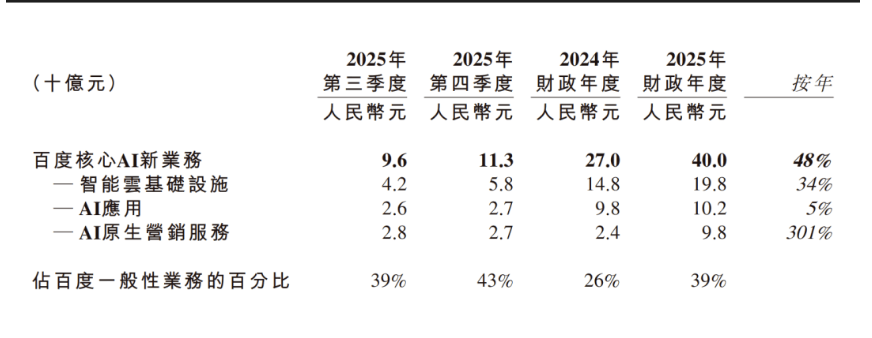
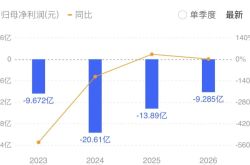
Profit margins faced even greater strain. Affected by a RMB 16.2 billion long-term asset impairment loss in Q3, the annual net profit attributable to shareholders plummeted by 76% to RMB 5.6 billion. Even excluding impairments, the Non-GAAP net profit of RMB 18.9 billion still declined by about 20% from RMB 23.8 billion in 2024, indicating that Baidu's AI investments remain in a "money-burning" phase.
Notably, Baidu has not disclosed core profitability metrics such as gross and net profit margins for its AI business, leaving uncertainty about whether AI can truly become its second growth engine.
Annually, total revenue reached RMB 129.1 billion, down slightly by 3% year-on-year.
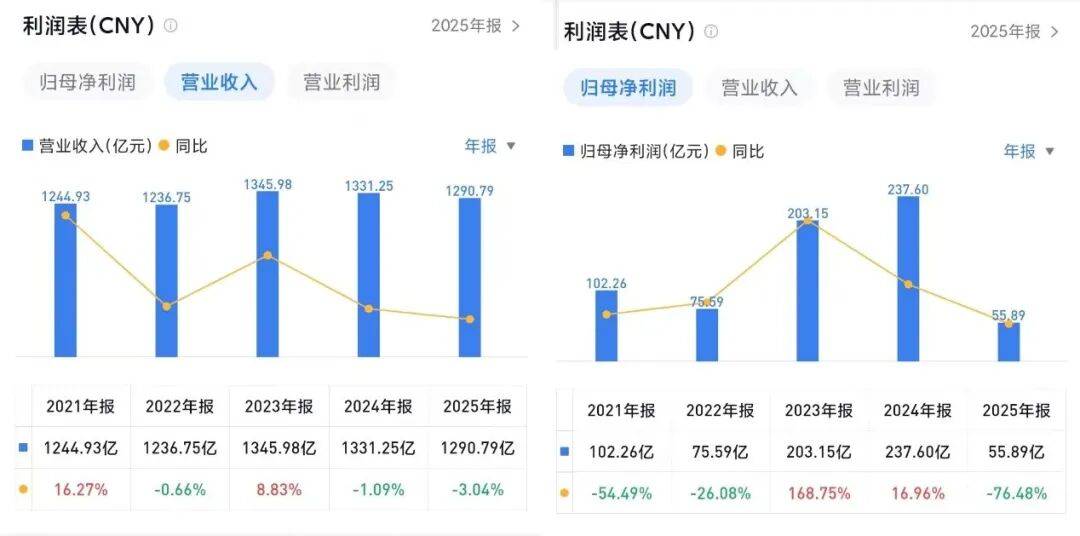
AI cloud services stood out, with full-year 2025 revenue from intelligent cloud infrastructure reaching approximately RMB 20 billion, up 34% year-on-year. Baidu leads in AI industry adoption, ranking first in market penetration for embodied AI. According to Omdia's China Embodied AI Cloud Market 1H25 report, Baidu Intelligent Cloud held a 35% market share, topping China's embodied AI cloud services market. Additionally, in the broader AI large model solutions market, IDC's report showed Baidu Intelligent Cloud leading with a 16.6% share, reflecting its accumulated To B market experience and AI industry implementation capabilities.
Furthermore, as of February 2026, Baidu's Robotaxi service, Luobo Kuaipao, had accumulated over 20 million rides across 26 global cities. In Q4, global autonomous driving rides reached 3.4 million, surging over 200% year-on-year, with weekly ride peaks exceeding 300,000. Meanwhile, its overseas expansion accelerated significantly.
Concurrently, Baidu made frequent capital moves, pushing for Kunlunxin's spin-off and Hong Kong IPO in early 2026 while launching a USD 5 billion share buyback program. Market forecasts suggest Kunlunxin's valuation likely sits at the high end of the "HKD 30-100 billion" range. This move is seen as a critical step in Baidu's asset restructuring and value reassessment, potentially breaking its "undervalued market cap" stalemate.
Accounting Controversy: Should Severance Pay Be Classified as R&D Expenses?
Behind Baidu's strong performance, abnormal Q4 R&D expense growth drew market scrutiny.
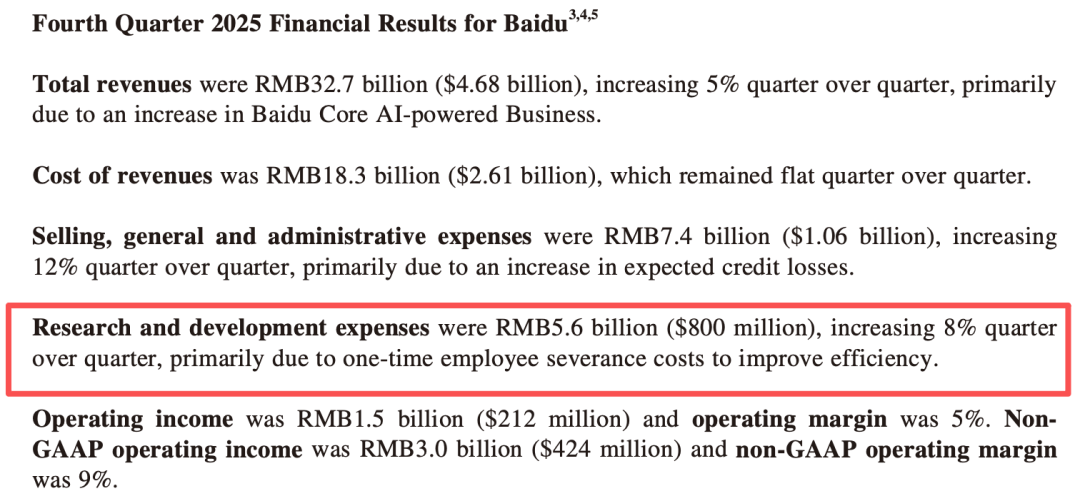
Financial reports showed Q4 R&D expenses hitting RMB 5.6 billion, up 8% compared to the previous quarter. The primary driver was not increased traditional R&D investment but one-time employee severance payments made by the company.
This accounting method—classifying layoff-related severance payments as R&D expenses—raised questions among investors and industry analysts about its rationality.
From Baidu's adherence to U.S. Generally Accepted Accounting Principles (US GAAP), this approach is largely reasonable. If all severance payments are classified as R&D expenses originating from workforce optimizations within the R&D team—rather than other business units—and aimed at optimizing R&D team structure and efficiency, directly relating to R&D activities, it aligns with US GAAP's scope for R&D expense accounting.
As long as Baidu can prove the laid-off personnel belonged to the R&D team and the layoffs aimed to enhance R&D efficiency, such expenses can be classified as R&D costs.
However, Baidu's financial reports provided no clarification on whether severance payments for non-R&D personnel were mixed into R&D expenses or if R&D expenditures were improperly capitalized. Thus, compliance with US GAAP's core principles remains unverified without more detailed information. Given this ambiguity, some investors worry this approach may inflate R&D investment figures and mislead the market.
Notably, under Chinese Accounting Standards for Business Enterprises (CAS), Baidu's classification of R&D team severance payments as R&D expenses lacks validity—a key point of market controversy. According to Accounting Standards for Business Enterprises No. 9 – Employee Benefits, severance payments (termination benefits) are compensation for terminating employment and should be accounted for as a separate category of employee benefits, following the core principle of "recognition in current profits and losses" rather than being allocated to business-specific expense accounts like R&D or production costs.
Specifically, CAS clearly distinguishes between R&D expenditures and termination benefits: On one hand, CAS requires R&D spending to differentiate between research and development phases, with research-phase costs fully expensed as R&D expenses and development-phase costs capitalized as intangible assets if criteria are met. However, this applies only to "direct expenditures from R&D activities," such as regular R&D personnel salaries, experimental materials, and outsourced R&D fees. On the other hand, severance payments for R&D teams fall under termination benefits, not direct R&D expenditures—as they represent obligations from terminating employment, not investments to advance R&D projects—and thus cannot be classified as R&D expenses.
According to practical accounting norms, termination benefits paid by enterprises, regardless of the department involved (including R&D), should be uniformly recorded under "administrative expenses" rather than department-specific expenses (e.g., R&D or sales costs). This is a key difference between CAS and US GAAP in accounting for such expenditures.
In short, while US GAAP permits classifying severance payments for R&D-related personnel as R&D expenses, CAS explicitly requires all termination benefits to be recorded as administrative expenses, independent of the employee's department. Thus, Baidu's accounting method complies with US GAAP but not CAS.
Large-Scale Layoffs: A Standard in the AI Era?
Accompanying the R&D expense controversy was Baidu's large-scale Q4 layoffs. According to financial reports and disclosures, Baidu's core business employed approximately 29,000 people by the end of 2025, down by about 3,100 from Q3 2025. This indicates 3,100 layoffs in Q4, exceeding a 10% reduction—a typical large-scale workforce optimization.
These layoffs marked Baidu's largest personnel reduction in recent years. Correspondingly, the company paid RMB 708 million in one-time severance payments. No data confirms what portion of these severance costs was allocated to R&D expenses.
Public reports reveal that since late November 2025, shortly after Baidu announced a Q3 loss, it initiated structural adjustments across multiple business lines, with layoff ratios generally ranging from 10% to 25%, and some lines seeing cuts as high as 40% to 90%. The Mobile Ecosystem Group (MEG), centered on advertising, bore the brunt, aligning with Baidu's 18% year-on-year decline in Q3 online advertising revenue.
Notably, these layoffs were not merely "age-based optimizations" targeting employees over 35; both long-tenured staff and new hires with only a few months of service were affected. This suggests the layoffs were less a calculated restructuring and more a sudden business contraction aimed at focusing on AI strategy. Positions related to AI R&D and cloud computing were largely preserved, with Baidu even establishing two new R&D departments—Basic Models and Applied Models—on November 25, 2025, reporting directly to CEO Robin Li.

Clearly, these layoffs reflect Baidu's resource reallocation to boost AI investments. In 2025, domestic tech firms intensified competition for AI traffic, with Baidu's presence noticeably weakening. While its AI business revenue grew 48% to RMB 10 billion, user scale lagged behind peers. According to Reuters, in September 2025, Wenxin Yiyan's app had 10.77 million monthly active users, compared to Doubao's 150 million and DeepSeek's 73.4 million.
QuestMobile's H2 2025 AI app report ranked Doubao, DeepSeek, and Yuanbao as the top three in weekly active users, with Mayi Afu and Qianwen in the second tier, while Baidu's Wenxiaoyan failed to make the top ten.
However, doubts remain about whether these layoffs will truly enhance human efficiency in the AI era.
In the short term, layoffs achieved cost reductions, but long-term risks include demoralized teams and potential talent drain, which could hinder R&D efficiency and AI business progress. Additionally, with traditional businesses contracting and AI still in its investment phase, Baidu may struggle to fill gaps left by personnel cuts, requiring time for team cohesion and efficiency gains.
Given that Baidu's AI business, while growing rapidly, still trails rivals in user scale, efficiently reallocating resources and boosting human efficiency through layoffs remain critical challenges for Baidu's future.
-
![]()
Doubao Work Unveiled! Domestic AI Leaders Fully Commit to the 'Work' Sector
-
![]()
Who’s Sounding the Alarm on ‘Rushed Vehicles’?
-
![]()
Over 5.3 Billion Yuan in Losses Over Three and a Half Years! Can Yonyou Reverse Its Fortunes Through Streamlining and AI Transformation?
-
![]()
Baidu AI Adopts Free Model: A Strategic Maneuver in Traffic and Monetization
-
![]()
Silicon-Based OLED Pioneer Unveils Financial Results: H1 Shipments Outpace Entire 2025 Volume
-
![]()
AI's First "Lost Summer"
-
![]()
Zeiss Makes Another €2.2 Million Bet: Will Eye Tracking Be the Next Big Thing in the Smart Glasses Industry?
-
![]()
RUNTO Ranking | Global Top TV ODM Factories' Shipment Figures for July 2026