From "Novice" to "Industry Pacesetter": The Rapid Rise of Humanoid Robots in Just a Year
 03/09 2026
 544
544
Crafted by Zhineng Technology
At the 2026 Spring Festival Gala, robots made a remarkable debut, seamlessly executing backflips, manipulating walnuts, delivering comedic skits, and dazzling audiences with song and dance routines.
Just two weeks later, during the National People's Congress, journalists eagerly sought updates on humanoid robots from the spokesperson. When "embodied AI" first surfaced in the 2025 government work report, many were puzzled, asking, "How do you even say that?"
Back then, the term was largely confined to academic circles, obscure to the general public. Today, however, the humanoid robot industry has skyrocketed in prominence, usurping the new energy vehicle sector as the new frontier of industrial innovation.
01
From "Pioneering a Year Ago" to "140 Companies Strong Today"
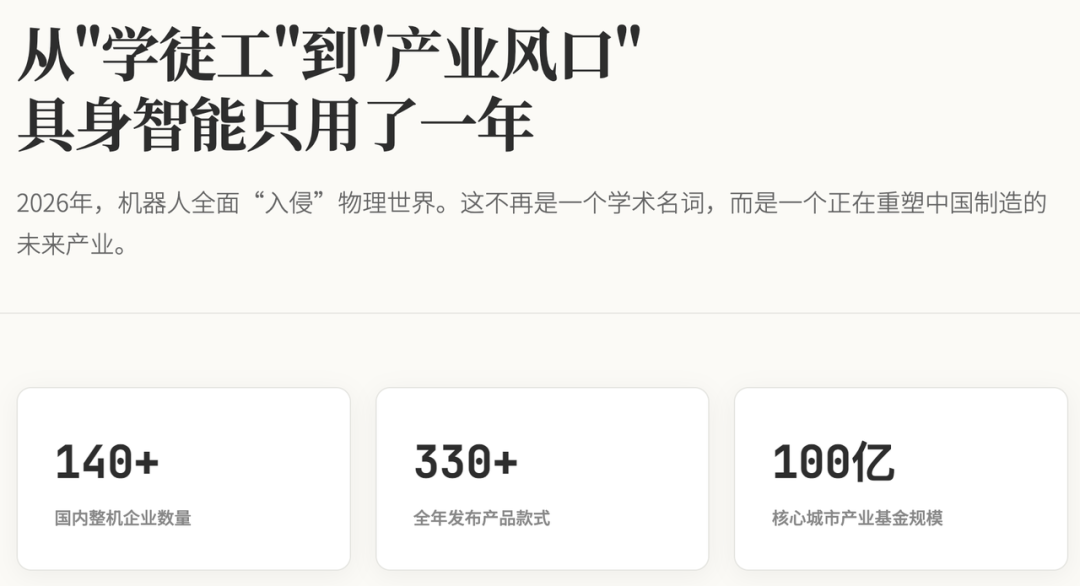
In 2025, we began to acquaint ourselves with the term "embodied AI." A year on, the industry has responded with impressive statistics:
◎ Over 140 domestic manufacturers of humanoid robots
◎ More than 330 humanoid robot products launched annually
◎ Cities like Beijing, Shanghai, and Shenzhen have established billion-dollar industrial funds, fueling genuine investment and fierce competition.
Why "Embodied AI"? Before delving into that, let's tackle another query: Where has AI been hiding all this time? Traditional AI has primarily operated in the digital sphere—crafting copy, generating images, creating videos. While useful, it ultimately served as a mere intermediary, transforming information from one format to another.
The true revolution in AI lies in its foray into the physical world. Embodied AI endows AI with a "body," enabling it to perceive, comprehend, and interact with its surroundings. CCTV News accurately defines it: "Smartphones, computers, and intelligent robots are all quintessential terminals and devices of embodied AI."
Why must China seize this moment?
◎ Firstly, from a technological standpoint. The global AI race is shifting from the digital to the physical realm. Tesla has Optimus, OpenAI has invested in Figure AI, and NVIDIA has launched GR00T—international behemoths are all doubling down. If China remains mired in the application layer, it risks once again becoming a downstream player in the industrial chain.
◎ Secondly, from an industrial perspective. As the world's largest manufacturing nation, China grapples with labor shortages and escalating costs. Embodied AI offers viable solutions—humanoid robots replacing manual labor, smart manufacturing automation upgrades, and service robot applications.
◎ Thirdly, from a competitive angle. Amid the U.S.-China tech rivalry, core technologies must be independently developed. Humanoid robots encompass chips, sensors, reducers, motion control—every link poses a challenge, yet every link also serves as a competitive barrier.
02
Policy Support Ramps Up: From "Nurturing" to "Nurturing and Expanding"
In January 2026, eight ministries, including the Ministry of Industry and Information Technology, issued the "Implementation Opinions on the Special Action for 'AI + Manufacturing.'"
On February 28, 2026, China unveiled its first comprehensive standard system covering the entire humanoid robot industrial chain—the "Humanoid Robot and Embodied AI Standard System (2026 Edition)." This system spans six major domains, including foundational commonalities, brain-inspired computing, and core components, marking just one facet of sustained policy support.
Let's zoom out and examine the timeline below. A subtle shift in phrasing reveals a continuous escalation in strategic importance.

At this year's Two Sessions, discussions surrounding humanoid robots among delegates were particularly vibrant.
◎ Lei Jun, NPC delegate and Xiaomi Group chairman, aptly described today's humanoid robots as still being "novices."
This metaphor rings true. Current humanoid robots can perform backflips and dances but are far from being practical additions to the workforce.
◎ He Xiaopeng, NPC delegate and XPeng Motors chairman, turned his focus to "edge-side local intelligence." He argued that deploying autonomous perception, decision-making, and execution capabilities locally enables higher-order intelligent humanoid robots with generalization abilities, better suited for industrial, commercial, and even household adoption.
The differing viewpoints of the two delegates reflect the industry's current state: rapid hardware advancements, while software and scenarios remain underexplored.

Performing backflips is no easy feat, but deploying robots to factories for screw-tightening tasks proves even more daunting. Industrial adoption must yield tangible results.
Capital is flowing into three key areas:
◎ Industrial manufacturing: Humanoid robots now participate in automotive assembly, quality inspection, and component placement, significantly enhancing flexible production efficiency—the most mature commercialization scenario to date.
◎ Specialized scenarios: Robot dogs and wheeled dual-arm robots now routinely handle power grid inspections, chemical handling, and disaster relief—scenarios with clear pain points willing to pay a premium for safety.
◎ Public services: Elderly care, household services, and commercial delivery robots are rapidly gaining traction. Spring Festival holiday sales surged 32.7% year-on-year—consumers are casting their votes with their wallets.
Each direction follows its own rationale: industrial manufacturing hinges on efficiency, specialized scenarios on safety, and public services on user experience. The common denominator? Customers are willing to pay.
Of course, the complexity of the physical world dwarfs that of the digital realm. Perception, decision-making, motion control, and fine motor skills—every link presents formidable challenges. Transitioning from "capable of a single task" to "competent at work" remains a long and arduous journey.
Fragmented scenarios, high customization costs, and unclear ROI—these issues cannot be resolved through technological progress alone. Customers demand results, not mere demonstrations.
Single humanoid robots can cost hundreds of thousands or even millions of yuan. Achieving consistent mass production remains elusive due to immature supply chains. Cost reduction is the universal challenge confronting all robotics companies.
When Lei Jun refers to them as "novices," he speaks not out of humility but out of honesty.

Conclusion
By 2026, embodied AI has found its way into government work reports and onto the Spring Festival Gala stage. It boasts 140 companies, 330 products, policy frameworks, capital investment, and real-world applications. Yet, it remains a "novice"—capable of backflips but not yet ready for the workforce. This is the industry's most captivating moment: the light is visible, but the journey is far from over.
-
![]()
Doubao Work Unveiled! Domestic AI Leaders Fully Commit to the 'Work' Sector
-
![]()
Who’s Sounding the Alarm on ‘Rushed Vehicles’?
-
![]()
Over 5.3 Billion Yuan in Losses Over Three and a Half Years! Can Yonyou Reverse Its Fortunes Through Streamlining and AI Transformation?
-
![]()
Baidu AI Adopts Free Model: A Strategic Maneuver in Traffic and Monetization
-
![]()
Silicon-Based OLED Pioneer Unveils Financial Results: H1 Shipments Outpace Entire 2025 Volume
-
![]()
AI's First "Lost Summer"
-
![]()
Zeiss Makes Another €2.2 Million Bet: Will Eye Tracking Be the Next Big Thing in the Smart Glasses Industry?
-
![]()
RUNTO Ranking | Global Top TV ODM Factories' Shipment Figures for July 2026