Guangzhou, a Time-Honored Commercial Powerhouse, Advances with Multi-Billion AI Investments and Workers Earning Substantial Daily Incomes
 03/09 2026
 761
761
Source | YuanMedia
Shortly after the Spring Festival marking the Year of the Horse, the well-known garment manufacturing villages of Kangle, Lujiang, and Datang in Guangzhou's Haizhu District buzzed with activity as work resumed. On the morning of March 3rd, the Kanglu New Recruitment Plaza was teeming with activity, as hundreds of factory owners, clutching sample garments marked with production details and wage information, lined up to recruit workers. Some employers even offered daily wages of 400 yuan for sewing machine operators, with skilled workers commanding 500 to 600 yuan. Workers were discerning; they carefully compared options and inquired about details, with some even bringing portable sewing machines to demonstrate their skills and negotiate wages on the spot.
Behind this vibrant recruitment scene lies not only the subtle transformation of Guangzhou's traditional garment industry but also a strong link to the city's strategic development plan of embracing AI and fostering new growth drivers. Experienced industry insiders have observed that personalized and niche market orders are gaining popularity, with subcategories like high-end pet clothing offering profit margins significantly higher than those of ordinary ready-to-wear garments. The data speaks volumes: by spring 2026, personalized and custom orders accounted for 45% of the total in garment-making villages, an 18-percentage-point increase from the previous year, with pet clothing and Hanfu accessories among the fastest-growing subcategories.
Interestingly, on March 5th, Guangzhou was thrust back into the spotlight with the release of a city ranking. The <2026 China's Top 100 Cities Index> published by urban research institution GYBrand showed Guangzhou climbing to third place nationwide, thanks to its "well-established support system for livability and business, and the commercial heritage amassed over a millennium as a trading hub."
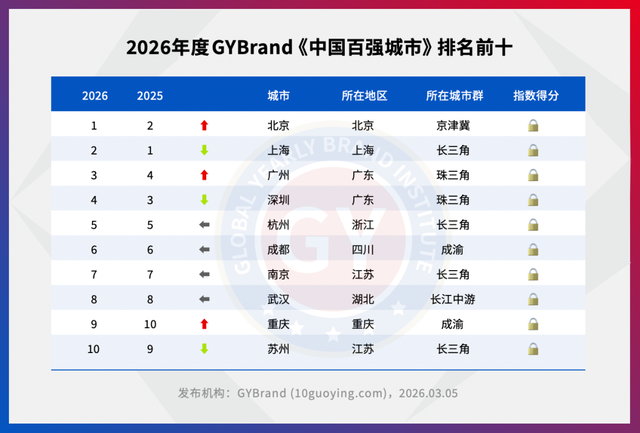
Image source: GYBrand
The lively recruitment scene in the garment-making villages and the subtle shifts in the city's ranking are intriguingly intertwined in the spring of the inaugural year of the 15th Five-Year Plan period—far from a mere coincidence. At the start of the year, Guangzhou swiftly inked 57 major projects with a total investment exceeding 130 billion yuan, with the majority of funds earmarked for emerging sectors such as artificial intelligence and robotics, fully committed to constructing a closed-loop AI ecosystem from computing power infrastructure to scenario-based applications.
On one hand, traditional industries are being revitalized through skill enhancement and market regulation; on the other, emerging industries like AI are gaining momentum through policy guidance and capital investment. Guangzhou, this ancient commercial hub, is embracing a new vitality that blends traditional strengths with innovative spirit.
01
Embedding "Predictability" into the City's Core
On the afternoon of March 5th, coinciding with the release of the <2026 China's Top 100 Cities Index>, Wang Yanshi, a deputy to the National People's Congress and director of the Guangzhou Municipal People's Congress Standing Committee, proposed a bold suggestion during the deliberation of the government work report: to study and formulate an
"Stabilizing employment, enterprises, markets, and expectations hinges on maintaining the stability and coordination of economic policies introduced by different departments," Wang stated candidly. His five recommendations—defining the scope of economic policies, standardizing their introduction procedures, establishing an expiration date system, clarifying procedures for major adjustments, and prohibiting regional "involutionary" competition—directly address a core pain point: businesses fear not market fluctuations but policy "reversals."
As a seasoned official in the people's congress system, Wang's decision to raise this issue at the National People's Congress during the inaugural year of the 15th Five-Year Plan period sends a clear signal: Guangzhou aims to deeply embed "predictability" into the fabric of its business environment.
For Guangzhou, which is undergoing profound industrial restructuring, this may be more effective than any preferential policies for attracting investment. After all, the bosses in Kanglu dare to offer daily wages of 500 to 600 yuan to recruit skilled garment workers after the Spring Festival because they are confident that business will be "viable" this year. For enterprises, nothing is more valuable than stable expectations.
In fact, over a month earlier, at the Guangdong Provincial People's Congress, Huang Kunming, the provincial party secretary, used a vivid metaphor during his deliberation with the Guangzhou delegation: manufacturing and services are like the trunk and branches of a tree—only with deep roots and a sturdy trunk can the branches flourish.
A year ago, Guangzhou unveiled a comprehensive blueprint for its "12218" modern industrial system: one overarching requirement (manufacturing as the cornerstone), two main directions (integration of manufacturing and services, digital and green transformation), 18 strategic industrial clusters, and future industries.
By the 2026 Guangzhou Municipal Government Work Report, this strategic vision had become even clearer: adhering to the overarching requirement of "industry first, manufacturing as the cornerstone," grasping the main directions of "integration of manufacturing and services" and "digital and green transformation," developing 15 strategic industrial clusters and six future industries, and strengthening eight modern service sectors.
The report also identified three key breakthrough areas for the first time: artificial intelligence, marine economy, and biomedicine, precisely pinpointing the keys to Guangzhou's development over the next decade.
02
From Multi-Billion Projects to Individual Worker Transformation
At the Guangzhou High-Quality Development Conference on February 25th, a list of signed projects drew significant attention: 57 major projects with a total agreed investment of 130.5 billion yuan.
The figures were impressive, sparking curiosity about where the funds were being allocated.
Four projects with investments exceeding 10 billion yuan stood out: a series of projects by China State Shipbuilding Corporation (10 billion yuan), the Huangpu AI Chip High-End Integrated Circuit Substrate Project (10 billion yuan), the Huangpu AI Computing High-End Printed Circuit Board Project (10 billion yuan), and a 50-billion-yuan provincial strategic emerging industry investment guidance fund.
A closer examination of the sub-sectors reveals even more: the Xiaopeng Embodied Intelligent Humanoid Robot Industrialization Project, the GAC Robot Project, the Guangzhou Zhisheng Computing Center Project... Nearly 20% of the projects are geared toward future-oriented sectors such as artificial intelligence, robotics, and embodied intelligence.
Linking these projects together reveals a clear logical chain: from computing power infrastructure (chips, substrates) to scenario-based applications (humanoid robots, computing centers) to capital leverage (industrial guidance funds), Guangzhou is fully committed to constructing a closed-loop AI ecosystem.
At the Guangzhou Development District and Huangpu District High-Quality Development Conference held on February 26th, the intelligent glasses worn by Xian Yinsong, deputy secretary of the Guangzhou Development District Party Work Committee and secretary of the Huangpu District Party Committee and district mayor, were a true reflection of Guangzhou's AI ecosystem. Weighing just 35 grams, these glasses link together over 30 manufacturers and service providers through more than 50 core components, serving as a "microcosmic sample" of the deep integration of manufacturing and services empowered by artificial intelligence.
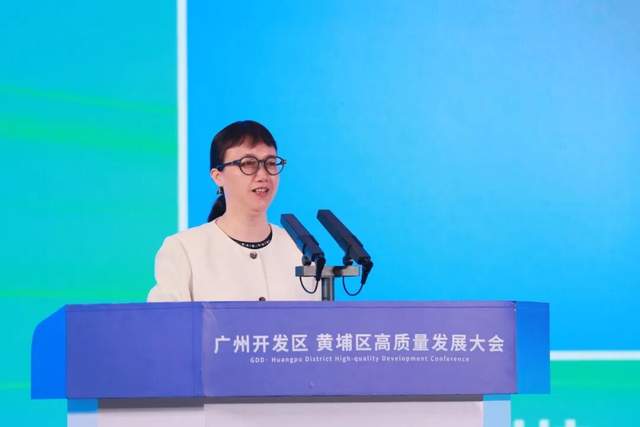
Note: Xian Yinsong, deputy secretary of the Guangzhou Development District Party Work Committee and secretary of the Huangpu District Party Committee and district mayor, wears intelligent glasses to promote Huangpu's tech products | Photo by Li Jianfeng
While 130.5 billion yuan in funding surged toward AI and robotics, a quiet revolution was unfolding in Kanglu's garment-making villages.
The former chaos of "street-side recruitment" at Lujiang Ballpark has been transformed into a standardized 4,875-square-meter gig economy market, divided into functional areas for docking and negotiation, job postings, operational services, and dispute resolution. Equipped with drinking fountains, restrooms, LED screens, and facial recognition surveillance, it has become a veritable "employment haven." According to statistics, the market has received over 15 million visits, with an average daily footfall of around 20,000 and approximately 3,000 successful flexible employment matches daily.
At a corner of the market, the "Haizhu District Shanhai Xinlian Home" service station provides one-stop services such as household registration consultations, policy interpretations for children's schooling, and residence permit processing for approximately 45,000 migrant workers. Additionally, through the Master Craftsman School and garment-making skills training workshops, Guangzhou has introduced the "Red Cotton Master Studio" led by Yang Haifeng, a national-level intangible cultural heritage representative inheritor, which has conducted 31 training sessions and trained 477 individuals.
"In the past, we made whatever the market demanded; now, we need to co-develop with brands one or two years in advance," said a textile factory owner. His company plans to participate in 11 overseas exhibitions this year, covering the Americas, Europe, and Africa. "Going global is not just about expansion; it's about showcasing the charm of Chinese manufacturing on the world stage." Other practitioners spoke more about digitalization: "I've been exploring new technologies. In the future, whoever can better connect production and demand through digitalization and intelligence will gain an edge in this traditional industry."
Here, there are no grand narratives of multi-billion-dollar projects—only individual people, specific skills, and concrete orders. But when "earning 500 to 600 yuan a day" becomes the norm, when the gig economy market transforms from street-side recruitment to an employment haven, and when a national-level intangible cultural heritage inheritor begins training garment workers, these fragmented transformations form the most solid foundation of Guangzhou's "support system for livability and business."
03
Retaining Talent with Tangible Support
If the story of the garment-making villages represents Guangzhou's "strength," then the low-altitude economy showcases the city's "edge." Chen Tengfei, a deputy to the Guangzhou Municipal People's Congress and chief designer at EHang Intelligent, proposed a targeted suggestion for a "low-altitude sandbox" pilot program—dividing regions based on different scenarios such as manned flights and emergency rescue to streamline approval processes.
The underlying issue is clear: for flying cars to "take off," technology is no longer the biggest hurdle; airspace management and approvals are the key. Chen also suggested establishing a dedicated science and technology R&D fund to provide upfront financial support for small and medium-sized enterprises hesitant to invest due to unclear industrialization demands.
The city's response was equally decisive: planning to build a comprehensive major scenario for an all-space unmanned system, setting up vertical takeoff and landing points at iconic locations like Canton Tower and Baiyun Mountain, and launching "Air View of Guangzhou" experience projects. Making the low-altitude economy tangible and accessible to the public aligns perfectly with Guangzhou's pragmatic character.
In fact, Guangzhou has already laid a solid foundation in the low-altitude economy, not only including it as a strategic pilot industry in its "12218" modern industrial system but also establishing a physical implementation mechanism with "municipal-level coordination, district-level linkage, and departmental collaboration." It has introduced a series of policy safeguards, such as the
With industry and technology comes the need for talent.
On March 6th, during the Guangdong Delegation's Open Day at the National People's Congress, Gao Song, president of Sun Yat-sen University, proposed increased funding support for doctoral students and postdocs, along with sequential funding policies to continue supporting outstanding postdocs in their third year. Behind his proposal lay concrete data: among Sun Yat-sen University's 2025 graduates, 72% chose to work in Guangdong, totaling nearly 7,000 individuals.
Meanwhile, Guangdong's ongoing "Bringing One Million Talents to Southern China" 2026 action plan will host a large-scale spring recruitment fair in Guangzhou on March 15-16, with over 1,800 enterprises and institutions expected to offer more than 70,000 positions.
The intensity of the talent competition often determines the outcome of industrial transformation—a point Guangzhou understands well.
04
A Time-Honored City Embraces New Vitality
Looking back at GYBrand's ranking, besides Guangzhou's rise to third place, the report also highlighted another change in Guangdong: after three years of implementing the "100-1000-10,000 Project," cities in eastern and western Guangdong, such as Shantou and Zhanjiang, have steadily improved in the rankings, providing a provincial-level demonstration model for addressing China's urban-rural and regional development imbalances.
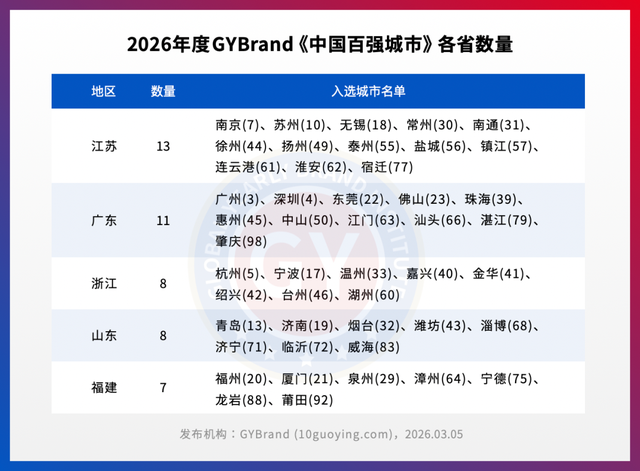
Image source: GYBrand
This offers a broader framework for comprehending Guangzhou's "third-place" standing. As the capital city of the province, Guangzhou's rise is not a standalone urban story; rather, it constitutes a crucial element of Guangdong's strategy to tackle regional disparities and revamp its developmental landscape.
From Wang Yanshi's proposal for an Economic Policy Law to the precise allocation of 130.5 billion yuan in investment, from the standardized evolution of Kanglu's gig economy market to the exploration of a "flying car sandbox" pilot program and the ongoing demand for top-tier talent, all these elements coalesce to paint a vivid picture: Guangzhou is transitioning from "policy provision" to "ecosystem construction."
Policy provision is akin to a blood transfusion; ecosystem construction resembles hematopoiesis. The shift from traditional factor support, such as offering land and capital, to the current systemic ecosystem construction that provides computing power, scenarios, and markets, signifies a profound enhancement in urban governance capabilities. The government's role is also undergoing a transformation, evolving from the traditional approach of "managing" enterprises to gradually "understanding" them, and striving to "anticipate enterprises' needs and think from their perspective."
Evidently, Guangzhou, now reclaiming its third-place position, is no longer the old city that solely relied on commerce and automobiles. With intelligent glasses serving as a microcosm of industrial integration, flying cars poised to blend into the city's skyline, and skilled garment workers earning 500 to 600 yuan a day, this millennium-old commercial hub is demonstrating its "new way of life" in the most resolute manner.
Regarding city rankings, they are merely a natural consequence of transformation. The true emphasis lies in whether Guangzhou can materialize its "12218" industrial system from concept to reality over the next five years, transition the integration of manufacturing and services from an idea into everyday life, and transform "AI empowerment across industries" from a slogan into tangible financial benefits for enterprises.
This transformative battle for the city's future has only just commenced.
Some images are sourced from the internet. Should any infringement occur, please notify us for their removal.
-
![]()
Net Profit Surges 13.65% Year-on-Year! Yutong Optics Reports RMB 1.782 Billion in H1 Revenue
-
![]()
Q2 Net Profit Slashes Losses by 80%! Has Costar Emerged from Its Darkest Hour?
-
AI Agents: The Paradigm Shift from 'Conversation' to 'Execution'
-
NVIDIA Takes Bold Strides to Lead in Both Hardware and Software Realms
-
![]()
It's Hard to Build Cars, Even Harder to Build Humans, and XPENG is Doing Both
-
![]()
Valuation Soars by $57 Billion: Three Entrepreneurs Born in the 1980s Forge an AI Unicorn Now Suddenly on the Market
-
![]()
How Can We Achieve the Goal of 100,000 Hydrogen Vehicles by 2030?
-
![]()
July Online Market for Consumer-Grade Sports Cameras: Robust Double-Digit Growth in Sales Volume and Value, Mid-Range Products Fuel Market Expansion